EARTH DAY: SPIRITUALLY UPLIFTING, INTELLECTUALLY DEBASED by Julian L. Simon

During the first great Earth Week in 1970 there was panic.

The public’s outlook for the planet was unrelievedly gloomy.

The doom saying environmentalists – of whom the dominant figure was Paul Ehrlich – raised the alarm: The oceans and the Great Lakes were dying; impending great famines would be seen on television starting in 1975; the death rate would  quickly increase due to pollution; and rising prices of increasingly-scarce raw materials would lead to a reversal in the past centuries’ progress in the standard of living.

… On average, people throughout the world  have been living longer and eating better than ever before.

Fewer people die of famine nowadays than in earlier centuries.

The real prices of food and of every other raw material are lower now than in earlier decades and centuries, indicating a trend of increased natural-resource availability rather than increased scarcity.

The major air and water pollutions in the advanced countries have been lessening rather than worsening.

Julian L. Simon

Via Julian Simon memorial site

HT: The Climate Counsel

Great Ed Glaeser quote at Café Hayek

Obama’s opportunistic record on fighting global warming

Even in the US, where nothing can be done through legislation thanks to Republican delusionists.

The 2008 Republican Party presidential nominee supported cap-and-trade. McCain had a strong legislative record; he introduced a bill with Joe Lieberman to introduce carbon trading in 2003.

McCain has been one of the most outspoken members of Congress on the issue of climate change’ and he “managed to force the first real Senate vote on actually doing something about the largest environmental peril our species has yet faced.

McCain used a Senate parliamentary manoeuvre that forced a floor vote on the climate legislation. The McCain-Lieberman bill lost 43-55.

In 2007 he reintroduced his bill, with bipartisan co-sponsorship. Obama missed the June 2008 vote on McCain’s Climate Security Bill.

In a March 2008 speech, McCain called for a “successor to the Kyoto Treaty” and a cap-and-trade system “that delivers the necessary environmental impact in an economically responsible manner.”

McCain’s climate policy includes several target dates. By 2012, McCain said U.S. emissions should return to 2005 levels. By 2050, he says, the U.S. emissions should be 60 per cent below 1990 levels.

In January 2010, the Pew Research Center asked Americans to rank the importance of twenty-one issues. Climate change came in last.

After winning the fight over health care, another issue for which polling showed weak support, Obama moved on to the safer issue of financial regulatory reform.

There were 5 Republican senators who would have voted for cap and trade in April 2010: Lindsey Graham, Susan Collins, Olympia Snowe, Scott Brown, and George LeMieux. There were 57 Democrat Senators. It takes 60 votes to break a filibuster.

President Obama could have fought harder to get the Bill the House passed through the Senate but he did not.

Blame Obama, no one else. He is supposed to make change happen. He lacked the political skills to build coalitions even within his own party to deliver.

Many others, including McCain softened or reversed positions as voter support waned as the great recession deepened.

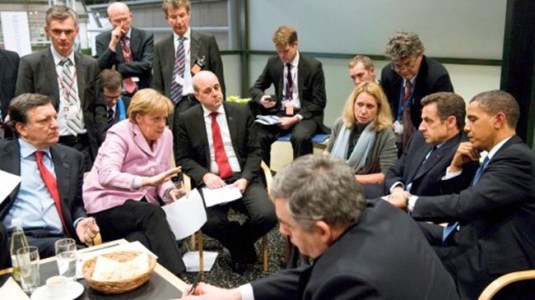
In Copenhagen’s final private negotiations, Obama, Brown, Sarko and Merkel sat down with He Yafei, the Chinese vice-minister of foreign affairs. There is a tape of this meeting at Der Spiegel. HT: The Guardian.

He Yafei was the smartest guy in the room – listen to the tape. Wen Jiabao refused to attend most of the negotiating sessions.

Given the choice of walking out and sitting down with a vice-minister, they chose humiliation. One response of Obama was:

It would be nice to negotiate with somebody who can make political decisions.

Rather than blaming vast right-wing conspiracies, using Google searches for “unemployment” and “global warming”, Kahn and Kotchen found that:

  • Recessions increase concerns about unemployment at the expense of public interest in climate change;
  • The decline in global-warming searches is larger in more Democratic leaning states; and
  • An increase in a state’s unemployment rate decreases in the probability that Americans think global warming is happening, and reduces the certainty of those who think it is.

The middle-of-the-road voters changed their priorities and their political leaders followed them.

It’s the peoples’ will, I am their leader, I must follow them. – Jim Hacker, The Greasy Pole

As Geoff Brennan has argued, CO2 reduction actions will be limited to modest unilateral reductions of a largely token character. There are many expressive voting concerns that politicians must balance to stay in office and the environment is but one of these. Once climate change policies start to actually become costly, expressive voting support for these policies will fall away, and it has.

The Household Demand for Low Carbon Public Policies

Matt Kahn at Environmental and Urban Economics: Carbon Politics and Economic Research.

Let the climate science be settled! Only the economics matter

The great tactical victory of environmentalists is keeping the debate on the science going because even if the science is right, the economic costs are small.

Let the climate science be settled. How much will global warming cost is the correct question for policy debate.

Global warming, although real, is not apt to be severe. It will lower the level of GDP by maybe 2%. The loss of one year’s income growth! Courtesy of David Friedman’s reading of the report, this is what the IPCC said this week:

With these recognized limitations, the incomplete estimates of global annual economic losses for additional temperature increases of ~2°C are between 0.2 and 2.0% of income (±1 standard deviation around the mean)

Many of the consequences of global warming will be beneficial – warmer in some places, colder in others; wetter in some places and drier in others. The sea level rises will mean local problems, not a planetary crisis.

New Zealand will have a more reliable power supply because of increased winter rainfall as well as warmer winters. Most of New Zealand’s power supply is from lakes that rely on the Spring melting of the winter snow rather than winter rainfall.

The chances of India, China and the rest of the Third World agreeing to forego or even slow their economic development to fight global warming is zero even before you consider the international collective action, verification and free rider problems.

Climate changes have a greater impact in the most under-developed countries that are yet to embrace capitalism. Agriculture provides the livelihoods of 30 per cent or more of their populations, many of whom still practice subsistence agriculture.

Yet the trend in developing countries is to be much less dependent on agriculture as a  source of employment and family incomes. If per capita income in the poor countries grows in the next forty years as rapidly as it has in the forty years just past, their vulnerability to climate change should diminish.

Adaptation and richer is safer are the only games in town for both the developed and the developing worlds.

The only case for even a token carbon tax is to avoid green tariffs in the EU and USA on exports. We may as well collect the revenue for ourselves rather than let the EU and USA pocket it.

p.s The report of the IPCC yesterday was a one-day media wonder in the country where I live. I could not find a single story today in the Dominion Post, which is the paper for the political capital for New Zealand.

The incentives to research the economics of global warming – the minimum wage edition

David Card’s research suggested that small rises in the minimum wage do not reduce employment by much.
He said that he did not do much further research in the area because people were so personally unpleasant for him:

I haven’t really done much since the mid-’90s on this topic. There are a number of reasons for that that we can go into.

I think my research is mischaracterized both by people who propose raising the minimum wage and by people who are opposed to it.

… it cost me a lot of friends. People that I had known for many years, for instance, some of the ones I met at my first job at the University of Chicago, became very angry or disappointed.

They thought that in publishing our work we were being traitors to the cause of economics as a whole.

I also thought it was a good idea to move on and let others pursue the work in this area. You don’t want to get stuck in a position where you’re essentially defending your old research.

You need a thick hide and academic tenure to do research into the minimum wage these days. There are plenty of research topics that do not cost you friends.

Richard Tol has pointed out that maybe 20 or so academic economists work on climate change on a regular basis. Many of the key survey papers are written by the same few people, including him.

The reasons were that inter-disciplinary works is looked down on in the economics profession and government agencies do not like what economic research says about the costs and benefits of global warming so they pre-emptively do not fund it.

Richard Tol quit as the lead author of an economics chapter of the most recent of the IPCC report after a dispute about research techniques. Tol had been invited to help in the drafting in a team of 70 and was also the coordinating lead author of a sub-chapter about economics.

When he dissented about the quality and alarmist nature of the economics of the IPCC reports, they smeared him so badly as a fringe figure that you wonder why they hired him in the first place.

The co-chair of the IPCC working group that produced the report, said Richard Tol was outside the mainstream scientific community and was upset because his research had not been better represented in the summary:

“When the IPCC does a report, what you get is the community’s position. Richard Tol is a wonderful scientist but he’s not at the centre of the thinking. He’s kind of out on the fringe,” Professor Field said before the report’s release.

You cannot, on the one hand, say that you have hired the best and the brightest to work on “the greatest moral, economic and social challenge of our time” and then say that a dissenting member is a fringe figure. If that was true, rather than a smear, he would never have been hired in the first instance.

Nor would Richard Tol have been asked to write a 2009 survey of the economics of climate change for the leading surveys journal in all of economics – The Journal of Economic Perspectives. This fringe figure said in that survey in 2009 that:

Only 14 estimates of the total damage cost of climate change have been published, a research effort that is in sharp contrast to the urgency of the public debate and the proposed expenditure on greenhouse gas emission reduction.

These estimates show that climate change initially improves economic welfare. However, these benefits are sunk.

Impacts would be predominantly negative later in the century.

Global average impacts would be comparable to the welfare loss of a few percent of income, but substantially higher in poor countries.

Still, the impact of climate change over a century is comparable to economic growth over a few years.

The IPCC hired Tol because their economics of global warming chapters would have lacked credibility if he had not been on the team. LBJ said that it is better to have someone inside the tent pissing out than outside pissing in.

Richard Tol even has an academic stalker:

Bob Ward, has reached a new level of trolling. He seems to have taking it on himself to write to every editor of every journal I have ever published in, complaining about imaginary errors even if I had previously explained to him that these alleged mistakes in fact reflect his misunderstanding and lack of education. Unfortunately, academic duty implies that every accusation is followed by an audit. Sometimes an error is found, although rarely by Mr Ward.

Richard Tol blogs at http://richardtol.blogspot.co.nz/

David Friedman on Bits From the Latest IPCC Report

I have not yet gotten into the full report but, judging from accounts I have seen, 2°C of additional warming is about what it suggests we can expect by 2100 if we don’t do much to prevent it. So if policies to prevent warming reduce the annual growth rate of world income from (say) 2% to 1.98%, the resulting loss will just about cancel the gain. Not a compelling argument for switching from fossil fuels to solar power.

via Ideas: Bits From the Latest IPCC Report.

wpid-friedman-david.jpg

Ideas: Dealing with Climate Change: Prevention vs Adaptation

via Dealing with Climate Change: Prevention vs Adaptation

The intriguing public choice history of the Kyoto protocol

The US Senate voted 95-0 in July 1997 that the Kyoto Protocol would not be ratified because it excluded certain developing countries, including India and China, from having to comply with new emissions standards.

Disregarding the Senate Resolution, Vice President Al Gore symbolically signed the Protocol on November 12, 1998.

ji-agreement-1024x718

Knowing that the Kyoto Protocol would not be passed without the inclusion of developing countries in some way, Clinton did not even send the Protocol to the U.S. Senate for ratification. Clinton had 801 days in office to submit it, but did not. As it was going to be rejected, it cost him nothing to sign it and he won the support of expressive voters. Bush was criticised for not doing what Clinton also failed to do.

The EU made demands that the USA would not accept so that the treaty would not include the USA. This allowed EU ministers to look good to expressive voters back home by standing staunch and not compromising.

US non-participation made participation cheaper for the EU because the USA would not be competing for carbon credits, so the price of carbon would be much less.

There was an emergency night time meeting to save the Copenhagen Summit called by Gordon Brown. He was joined by Obama, Sarkozy, Merkel and PM Hatoyama of Japan. To make a point, China sent a rather out-spoken vice foreign minister of foreign affairs. He was the smartest guy in the room.

How to negotiate a treaty on global warming

I found the best writer on global warming to be Thomas Schelling. Schelling has been involved with the global warming debate since chairing a commission on the subject for President Carter in 1980.

Schelling is an economist who specialises in strategy so he focuses on climate change as a bargaining problem. Schelling drew from his experiences with the negotiation of the Marshall Plan and NATO.

International agreements rarely work if they talk in terms of results. They work better if signatories promise to supply specific inputs – to perform specific actions now.

  • Individual NATO members did not, for example, promise to slow the Soviet invasion by 90 minutes if it happened after 1962.
  •  NATO members promised to raise and train troops, procure equipment and supplies, and immediately deploy these assets geographically. All of these actions can be observed, estimated and compared quickly. The NATO treaty was a few pages long.

The Kyoto Protocol commitments were not based on actions but on results, to be measured after more than a decade and several elections and a recession or two in between.

Climate treaties should promise to do certain actions now such as invest in R&D and develop carbon taxes that return the revenue as tax cuts. If the carbon tax revenue is fully refunded as tax cuts, less reliable countries, in particular, have an additional incentive to collect the carbon tax properly to keep their budget deficits under control.

Due deference to experts in public policy making

I caught Sir Paul Nurse’s Attack on Science on cable recently. He was exploring why people were unwilling to accept the word of science.

Sir Paul believes that people should defer to experts. He named two expert consensuses: global warming and GMOs.

In his 2012 Dimbleby Lecture Sir Paul called for a re-opening of the debate about GM crops based on scientific facts and analysis:

“We need to consider what the science has to say about risks and benefits, uncoloured by commercial interests and ideological opinion.

It is not acceptable if we deny the world’s poorest access to ways that could help their food security, if that denial is based on fashion and ill-informed opinion rather than good science.”

Many activists, without blinking an eye, will reject the science of GMOs but will hound from the temple anyone who defies another consensus they agree with.

Sir Paul interviewed James Delingpole. After they agreed that science does not proceed on the basis of consensus, Sir Paul asked Delingpole why he rejected the scientific consensus on global warming but accepted the scientific consensus on cancer.

Delingpole said he did not accept the analogy, but he was otherwise flat-footed. I suggest the following answer:

  1. Medicine proceeds on the basis of double blind trials and other small field experiments. Control and treatment groups are used before any treatment is applied widely. Medicine is not perfect as was the case with the misdiagnosis of the causes of stomach ulcers.
  1. The lag between cause and effect are short as would be the case if you rejected emergency treatment after a car accident or cancer treatment.
  1. Medicine tests the efficacy of invasive treatments, weighs side-effects and encourages adaptation and prevention.
  1. The staying power of self-interest in medicine is well-known: much higher rates of surgery when there is fee for service and much lower rates of surgery if the patient is a doctor’s wife. The efforts of the medical profession to suppress new entry to inflate their own incomes are well-known.

Ken Arrow in the early 1960s famously concluded that virtually all the special features of the medical care industry could “be explained as social adaptations to the existence of uncertainty in the incidence of disease and in the efficacy of treatment”.

  1. Physicians may not agree on the medical condition causing the symptoms the patient presents.
  2. Even if physicians agree on their diagnoses, they often do not agree on the efficacy of alternative responses — for example, surgery or medical management for lower-back pain.
  3. Third, information on diagnosis and likely consequences of treatment are asymmetrically allocated between providers and patients.
  4. The reason patients seek advice and treatment in the first place is that they expect physicians to have vastly superior knowledge about the proper diagnosis and efficacy of treatment.

Like all experts, doctors can advise you of the options open to you.

You must weigh those options in light of the costs and benefits to you and those costs and benefits are known only to you.

An old mate, who was in his thirties, had to consider back surgery that had a 10% chance of leaving him in a wheelchair for life. Experts cannot tell you what to do with those odds. After months of terrible pain and incapacity, his back slowly recovered without the surgery.

Most of the debate over global warming is explained by uncertainty about both the extent and incidence of global warming and the efficacy of prevention versus adaptation.

What global warming will cost us if we do nothing

David Friedman at Ideas delved into the best estimate of the global cost of global warming – by William Nordhaus – $4.1 trillion this century. This is $48 billion a year – 1/20th of one per cent of world income! Friedman then asked this:

Friedman’s even better argument on the social costs of global warming is that the costs of unlikely but catastrophic risks are included in the social cost arithmetic to make the problem serious. Without including them, global warming up to about a 2-degree warming provides a net benefit.

My Photo

Friedman shows great insight when he goes on to say that there is “no similar attempt to take account of low probability, high cost consequences of preventing global warming”.

That low probability, high cost consequence, which will occur sooner or later, is the next ice age. The next ice age could include a drop in sea levels of three hundred feet and half a mile of ice over the top of London and Chicago. That would bring a new meaning to climate change refugees. We are in a relatively warm period – an interglacial – in an ice age that started two million years ago.

Friedman asked whether “It is at least possible that global warming is all that is preventing the interglacial from ending”.

The great tactical victory of environmentalists is keeping the debate on the science going because even if the science is right, the economic costs are small.

How much will global warming cost is the correct question for policy debate. Let the science be settled!

Economists have no more expertise to judge the science of global warming than they do in judging the science behind the inevitability of super volcanoes going off again such as the one just north of me. The Yellow stone national park super volcano is 50,000 years overdue, by the way.

Economists can comment on the likely consequences, intended and unintended, of different choices and the constraints that different national and international institutional frameworks place on what policy choices might be made.

The chances of India, China and the rest of the Third World agreeing to forego or even slow their economic development to fight global warming is zero even before you consider the international collective action, verification and free rider problems. Adaptation and ‘richer is safer’ are the only game in town whichever way the climate goes!

Next Newer Entries

Thoughts from the North

Celebrating humanity's flourishing through the spread of capitalism and the rule of law

Fardels Bear

A History of the Alt-Right

Vincent Geloso

Econ Prof at George Mason University, Economic Historian, Québécois

Bassett, Brash & Hide

Celebrating humanity's flourishing through the spread of capitalism and the rule of law

Truth on the Market

Scholarly commentary on law, economics, and more

The Undercover Historian

Beatrice Cherrier's blog

Matua Kahurangi

Celebrating humanity's flourishing through the spread of capitalism and the rule of law

Temple of Sociology

Celebrating humanity's flourishing through the spread of capitalism and the rule of law

Velvet Glove, Iron Fist

Celebrating humanity's flourishing through the spread of capitalism and the rule of law

Why Evolution Is True

Why Evolution is True is a blog written by Jerry Coyne, centered on evolution and biology but also dealing with diverse topics like politics, culture, and cats.

NoTricksZone

Celebrating humanity's flourishing through the spread of capitalism and the rule of law

Homepaddock

A rural perspective with a blue tint by Ele Ludemann

Kiwiblog

DPF's Kiwiblog - Fomenting Happy Mischief since 2003

The Dangerous Economist

Celebrating humanity's flourishing through the spread of capitalism and the rule of law

Watts Up With That?

The world's most viewed site on global warming and climate change

The Logical Place

Tim Harding's writings on rationality, informal logic and skepticism

Doc's Books

A window into Doc Freiberger's library

The Risk-Monger

Let's examine hard decisions!

Uneasy Money

Commentary on monetary policy in the spirit of R. G. Hawtrey

Barrie Saunders

Thoughts on public policy and the media

Liberty Scott

Celebrating humanity's flourishing through the spread of capitalism and the rule of law

Point of Order

Politics and the economy

James Bowden's Blog

A blog (primarily) on Canadian and Commonwealth political history and institutions

Science Matters

Reading between the lines, and underneath the hype.

Peter Winsley

Economics, and such stuff as dreams are made on

A Venerable Puzzle

"The British constitution has always been puzzling, and always will be." --Queen Elizabeth II

The Antiplanner

Celebrating humanity's flourishing through the spread of capitalism and the rule of law

Bet On It

Celebrating humanity's flourishing through the spread of capitalism and the rule of law

History of Sorts

WORLD WAR II, MUSIC, HISTORY, HOLOCAUST

Roger Pielke Jr.

Undisciplined scholar, recovering academic

Offsetting Behaviour

Celebrating humanity's flourishing through the spread of capitalism and the rule of law

JONATHAN TURLEY

Res ipsa loquitur - The thing itself speaks

Conversable Economist

In Hume’s spirit, I will attempt to serve as an ambassador from my world of economics, and help in “finding topics of conversation fit for the entertainment of rational creatures.”

The Victorian Commons

Researching the House of Commons, 1832-1868

The History of Parliament

Articles and research from the History of Parliament Trust

Books & Boots

Reflections on books and art

Legal History Miscellany

Posts on the History of Law, Crime, and Justice

Sex, Drugs and Economics

Celebrating humanity's flourishing through the spread of capitalism and the rule of law

European Royal History

Exploring the Monarchs of Europe

Tallbloke's Talkshop

Cutting edge science you can dice with

Marginal REVOLUTION

Small Steps Toward A Much Better World

NOT A LOT OF PEOPLE KNOW THAT

“We do not believe any group of men adequate enough or wise enough to operate without scrutiny or without criticism. We know that the only way to avoid error is to detect it, that the only way to detect it is to be free to inquire. We know that in secrecy error undetected will flourish and subvert”. - J Robert Oppenheimer.

STOP THESE THINGS

The truth about the great wind power fraud - we're not here to debate the wind industry, we're here to destroy it.

Lindsay Mitchell

Celebrating humanity's flourishing through the spread of capitalism and the rule of law

Alt-M

Celebrating humanity's flourishing through the spread of capitalism and the rule of law