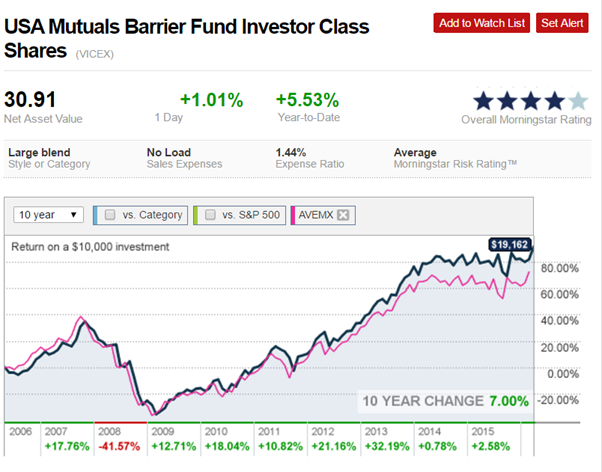
Virtue is not its own reward if you invest in the Ave Maria Catholic Values Fund which is AVEMX in the head-to-head comparison with the Barriers Fund, formerly the Vice Fund. The Ave Maria Catholic Values Fund return since inception was 5.63% as compared to the 9.95% return of the Barrier Fund.
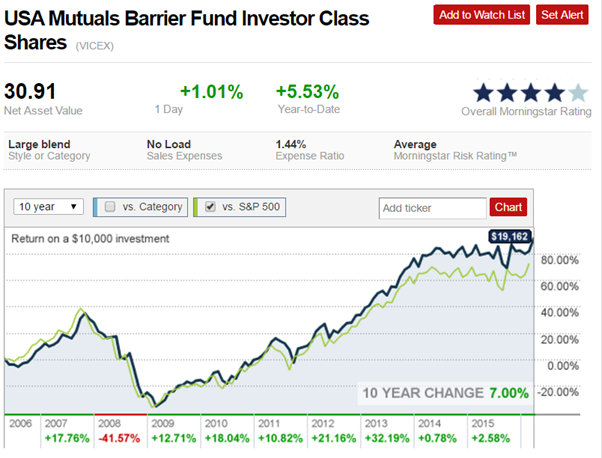
The S&P index grew by 8 .34% since the inception of the then Vice Fund, now the Barrier Fund. Such is the price of risking of going to hell if you lose Pascal’s wager by investing in tobacco, alcoholic beverage, gaming and defence/aerospace industries.
All of the equity investments (which include common stocks, preferred stocks and securities convertible into common stock) and at least 80% of the net assets of the Ave Maria Catholic Values Fund is invested in companies meeting its religious criteria as the fund manager explains
Morally Responsible Investing (MRI) is a subset of socially responsible investing, which often screens out companies engaged in environmental issues, tobacco products, alcohol, nuclear power, defense, oil and “unfair” labor practices. MRI is different in that it screens out companies engaged in activities that are not pro-life or pro-family…
All investments are screened to eliminate any company engaged in abortion, pornography, embryonic stem cell research, or those that make corporate contributions to Planned Parenthood
Traditional ethical funds use negative screens (to eliminate arms manufacturers and other frowned upon activities) and positive screens (to favour businesses with a good record on corporate social responsibility or that are involved in low-carbon industries etc).
The Vice Fund has outperformed the S&P 500 since 2004 as shown by the green line. This mutual fund invests invest in sinful stocks as its managers describe it:
Designed with the goal of delivering better risk-adjusted returns than the S&P 500 Index. It invests primarily in stocks in the tobacco, alcohol, gaming and defence industries. Vice Funds believes these industries tend to thrive regardless of the economy as a whole.
The Vice Fund is now known as the Barrier Fund because it extended out of sinful stocks into industries with high barriers to entry. Minimum Investment is $2,000.
The Barrier Fund primarily invests in the following industries: Aerospace/Defense, Gaming, Tobacco and Alcoholic Beverages. These four industries were chosen because they demonstrate one or more of these compelling and distinctive investment characteristics:
Natural barriers to new competition
Steady demand regardless of economic condition
Global Marketplace – not limited to the U.S. economy
Potentially high profit margins
Ability to generate excess cash flow and pay and increase dividends
The Barrier Fund believes numerous investment opportunities in these industries which have been largely overlooked by other funds.
The Fund has high management fees of 2%. Americans can buy Vanguard’s or Fidelity’s index funds and pay only 0.1% in expenses.
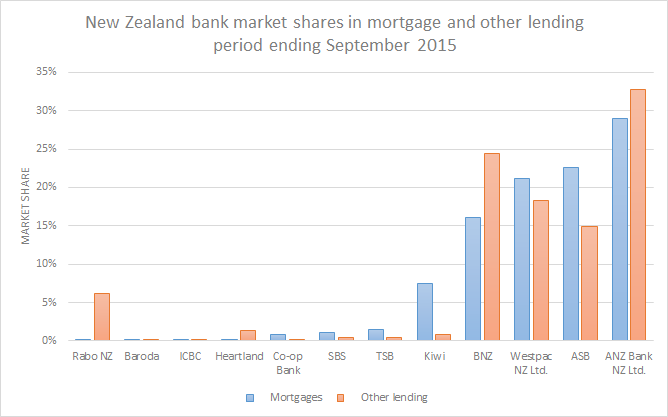
if Kiwibank is part of the competitive fringe of an oligopoly made up of the 4 Australian banks, it is not very profitable for a competitive fringe of a cartel as the chart below shows. The other New Zealand owned small banks in that competitive fringe are not that profitable at all. Undercutting an oligopoly and its high prices and above-average cost and above marginal cost pricing is not what it used to be for the competitive fringe in New Zealand banking, if there ever was a cartel.
Bank customers can choose between four major banks and a competitive fringe. If those major banks are indeed overcharging because of price-fixing by a cartel or an oligopoly, that competitive fringe which includes Kiwibank has a real opportunity to expand profitably and with little risk.
…once a price is somehow agreed upon, there will be incentives for individual rivals to cheat on the [collusive] agreement. Whether cheating occurs depends on weighing the profits from not cheating against the profits from cheating and then being detected and having competition break out…
any agreement among sellers cannot ignore the incentives to cheat provided by lags in detection. So understanding when a price elevated above the competitive level can be an equilibrium requires an analysis of the dynamic consequences of cheating versus not cheating…
Collusion over retail banking services and prices faces major hurdles that will lead to most attempts at price-fixing having a short life. These barriers to successful collusion include:
numerous competitors,
expansion by the smaller banks were not part of the cartel or cheat on the cartel
the entry and expansion of new banks,
the lack of a standard product, and
a rapidly changing business environment.
Implicit understandings among the colluding banks may break down owing to conflicts over the most suitable price, the complexities of co-ordinating pricing across a diverse range of banking products, or the simple presence of a maverick bank.
As time passes, destabilising pressures within a banking cartel or oligopoly will build due to long-run substitution and the threat or actuality of entry by new banks and expansion by banks In the competitive fringe, which includes Kiwibank.
The first firm in any market may charge a high price relative to costs, but the entry of one or two more firms usually results in effective competition. Once there are three to five suppliers in a market, an additional entrant has little impact on prices because pricing is already as competitive as it can be.
When ANZ sought to acquire the National Bank of New Zealand in 2003, the Commerce Commission did not oppose this merger. The Commission did not consider that a substantial lessening of competition would follow this merger. The Commission said:
…the merger is unlikely to increase the likelihood of co-ordinated market power in the supply of transaction accounts because the fringe players are likely to provide some competition, the banks have different strengths and weaknesses and in particular ASB is unlikely to have the incentive to participate in co-ordinated power at the expense of its recent growth and customer satisfaction levels.
This analysis of co-ordinated market power applies to each of the relevant markets. Therefore the Commission concludes that the merger is unlikely to result in a substantial lessening of competition in the supply of transaction accounts.
In the supply of mortgages, savings accounts and credit cards the merger is unlikely to lead to a substantial lessening of competition, as in each of these markets, ASB, Westpac and BNZ are likely to provide sufficient competition to the combined entity.
An important driver of a competition in the mortgage market in 2003 was a high incidence of fixed-rate mortgages and the tendency of these fixed rate mortgagees to reconsider all their options at the end of each fixed rate term.
The Commission Commission noted that there was a large re-mortgaging market in New Zealand. Banks offer to do all the work for customers wishing to switch over bank accounts and direct debit arrangements.
In a very atypical move for a purported cartel, in 2010 the bank owned Payments New Zealand agreed to change over direct debits over automatically when a customer switched banks, which made switching banks even more easier.
At the time of the ANZ and National Bank merger, the Commerce Commission noted that Kiwibank was offering lower rates on its mortgages as a way of gaining a foothold in the market.
The Commerce Commission could not have been more right about the vigour in competition in retail banking with regard to re-mortgaging and switching between fixed and floating mortgages in New Zealand.
As the chart below of fixed and floating mortgage shares a New Zealand bank balance sheets shows, there is a rapid exodus from fixed rate mortgages at the time of the Global Financial Crisis.
I cannot see how any cartel or oligopoly could sustain price-fixing against such dynamic changes in market shares and product switching.
Cartels are is much more difficult to agree when there are many products about which to fix prices and market shares. At a minimum, this rapid movement of customers between mortgage products will sow suspicions that one or more rival banks is stealing customers thereby cheating on the cartel agreement. Not surprisingly, the history of cartels is a history of double-crossing. Banking is no exception.
The Greens are followed up on an earlier suggestion by Julie Anne Genter, the Green’s Shadow Minister of Finance, that KiwiBank should be refocused to keeping interest rates low. To that end, it would not be required to pay dividends to the government to help fund the effort. KiwiBank has only just started paying dividends to its parent, KiwiPost.
Banks failing to fully pass on benefits of OCR cut shows need to strengthen Kiwibank, give it mandate to compete on interest rates. #nzpol
If that were to be the case, that KiwiBank was no longer be required to pay dividends, that would blow quite a hole in the balance sheet of its parent company KiwiPost.
.@cjsbishop could do a lot more good for NZ economy, households and business driving interest rates down than returning a dividend to Govt.
KiwiPost owns the share capital of KiwiBank, which must be valued on a commercial basis to pass auditing as a state owned enterprise which is commercially orientated.
That share capital owned by KiwiPost in KiwiBank would be have to be written off if KiwiBank were to pay no further dividends because it is no longer commercially orientated entity. Such a write-off of its investment in KiwiBank would write off most of Kiwi Post’s equity capital.
The reason why state owned enterprises are required to be valued on commercial principles is to ensure that any subsidies or other favours sought by politicians show up in the profit and loss statement or the balance sheet through asset write-offs. Section 7 of the State-Owned Enterprises Act 1986 non-commercial activities states that:
Where the Crown wishes a State enterprise to provide goods or services to any persons, the Crown and the State enterprise shall enter into an agreement under which the State enterprise will provide the goods or services in return for the payment by the Crown of the whole or part of the price thereof.
This statutory safeguard ensures that the cost of any policies proposed by ministers, and the Greens are very keen on transparency and independent costing of political promises, are plain to all.
It is obvious that businesses find dividends sensible to pay because otherwise they will face disquiet from investors. Managers believe that higher dividends mean higher share prices.
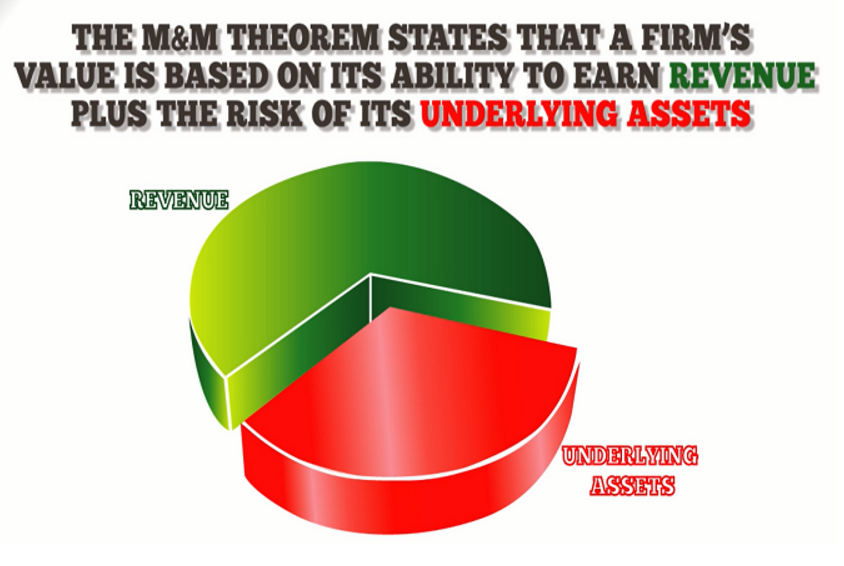
Economists finds dividends to be a mysterious (Easterbrook 1984). Miller and Modigliani (1958) declared dividends to be irrelevant because investors can homebrew their own dividends by selling shares or borrowing against their share portfolios.
Modigliani (1980, p. xiii) explains the Miller and Modigliani Theorem as follows:
… with well-functioning markets (and neutral taxes) and rational investors, who can ‘undo’ the corporate financial structure by holding positive or negative amounts of debt, the market value of the firm – debt plus equity – depends only on the income stream generated by its assets.
It follows, in particular, that the value of the firm should not be affected by the share of debt in its financial structure or by what will be done with the returns – paid out as dividends or reinvested (profitably).
Warren Buffett has never paid a dividend. He only agreed to a stock split. Shareholders pressed him to do so. They wanted to bequeath their shares to children without having to sell them.
What is even more mysterious is a simultaneous existence of dividends and the raising of new capital, either through the share market or from borrowing (Easterbrook 1984).
Dividends are costly and ubiquitous so something causes them. Even if investors were irrational, dividends would go away if there cost exceeds their benefits.
If dividends were a bad idea, firms that pay few dividends would prosper relative to others; investors who figure out the truth would also prosper relative to others and before long dividends will be features of failing firms (Easterbrook 1984).
Dividends exist because they influence the firms financing policies. Dividends dissipate free cash and thereby induce the firm to float new shares and borrow. If the firm is constantly in the market for new capital, it must constantly prove the value of the investment to the market (Easterbrook 1984).
The interests and incentives of managers and shareholders frequently conflict over the optimal size of the firm and paying free cash flows as dividends. Jensen (1986) defines free cash flow as follows:
Free cash flow is cash flow in excess of that required to fund all of a firm’s projects that have positive net present values when discounted at the relevant cost of capital. Such free cash flow must be paid out to shareholders if the firm is to be efficient and to maximize value for shareholders (Jensen 1986, p. 323).
The problem is how to motivate managers to pay out this cash rather than invested at below the cost of the capital. By issuing debt, managers bind themselves to pay out future cash flows in a way that a future dividend policy cannot.
Creditors can take the firm into bankruptcy court if they do not repay. Investors and bankers play an important role in monitoring the firm and its proposed projects.
The control function of debt is more important in organisations with large cash flows but low growth prospects. Investors in the share market are alert to the control function of debt. Most leverage increasing transactions result in positive increases in share prices while most transactions that reduce leverage results in share price falls (Jensen 1986).
There is nothing new about using high debt leverage ratios to create greater business value through limiting managerial discretion in focusing entrepreneurial attention on the bottom line.
One of the driving forces behind management leverage buyouts in the 1980s was that they borrowed to take over a company to run it better. The high levels of debt in management buyouts made sure that there was no incentives to tolerate waste or inefficiency or underperforming divisions or product lines of the firm. Any slack with the organisation would very quickly be punished perhaps in bankruptcy. Heavy debt ratios focused the attention of managers and boards of directors.
New debt puts managers under additional scrutiny of a range of bankers and the share market, which is the principal reason for keeping firms constantly in the market for capital. Managers of firms that do not have to go into the market repeatedly and regularly for new capital have more discretion to behave in their own interest rather than those of investors (Easterbrook 1984). The function of dividends is to keep firms in the capital market.
Managers of firms with unused borrowing power and large free cash flows are more like to undertake expansions that are less profitable. The burst of takeovers and leverage buyouts in the 1980s were very much driven by opportunities to profit from reducing corporate slack and downsizing flabby corporate headquarters of large publicly listed companies (Jensen 1986).
Dividends reduce the resources under managers’ control and subjecting them to the monitoring by the capital markets that occurs when a firm must obtain new capital. Financing projects internally avoids this monitoring and the possibility that funds will be unavailable or available only at high explicit prices. Project finance replicates the disciplinary effect of paying regular dividends by borrowing a huge amount at the start of the project. High debt prevents management wasting resources on low return projects.
Dividends are paid by companies to tie the hands of management. Dividends make sure that there is less free cash about for them to spend on projects at their own discretion. When a major expansion must be undertaken, the management of a company must either go to the share market or banks for it to go forward. This means multiple set of decision-makers agree that it is a worthwhile project and provide funding.
The art of business is identifying assets in low-valued uses and devising ways to profitably move them into higher values uses (Froeb and McCann 2008). Wealth is created when entrepreneurs move assets to higher-valued uses.
Froeb and McCann (2008) argued that mistakes are made – business opportunities are missed – for one of two reasons:
1. A lack of information; or 2. Bad incentives.
Rational, self-interested actors err because either they do not have enough information to make better decisions, or they lack incentives to make the best use of information they already have.
Froeb and McCann (2008) argued that three questions arise about all business problems:
1. Who is making the bad decision? 2. Does the decision maker have enough information to make a good decision? 3. Does the decision maker have the incentives to make a good decision?
For Froeb and McCann (2008), the answers to these questions immediately suggest ways to fix them:
1. Let someone else make the decision; 2. Give more information to the decision maker; or 3. Change the decision makers’ incentives.
Dividends follow all three points in this matrix. Dividends include others in investment and expansion decisions of the company. These bankers or new share investors must be given more information on the merits of the new or enlarged project.
The project will not go ahead and any benefits to the careers of the executives championing it will not be forthcoming unless they can persuade these outside parties with plenty of other investment options of the merits of the project.
Dividend show that the market process as well alert to the risks of separating ownership from control. Counter strategies are developed to channel the efforts and align the interests of management teams towards those of investors and owners.
The ownership structure and dividend policies of firms arise out of the search for the capital structure that maximises profits. Different divisions of risk between creditors and shareholders and decision-making rights between owners, boards of directors and managers all affect the value and profitability of a firm. Dividends contribute to that search more profitable forms of organisation by restricting free cash flows in the hands of management.
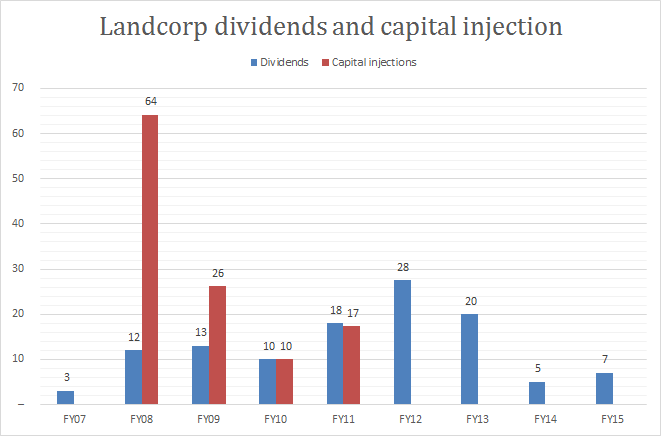
As cash cows go, Landcorp has had $2.25 million more in capital injections from taxpayers than it returned to them in dividends since 2007.
Source: data released by the New Zealand Treasury under the Official Information Act.
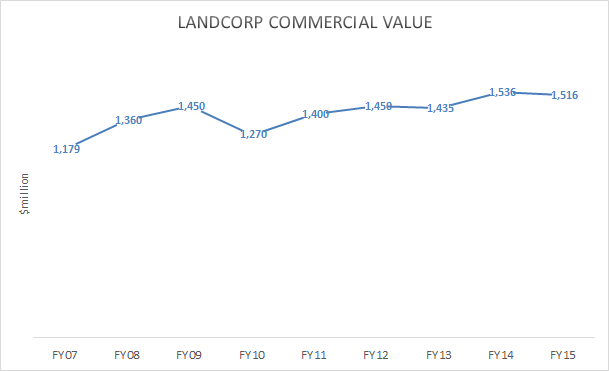
Those $1.5 billion in assets in Landcorp do not appear to be worth a cent in net cash to the long-suffering taxpayer.
Source: data released by the New Zealand Treasury under the Official Information Act.
Landcorp is a state-owned enterprise of the New Zealand government. Its core business is pastoral farming including dairy, sheep, beef and deer. In January 2012, Landcorp managed 137 properties carrying 1.5 million stock units on 376,156 hectares of land.
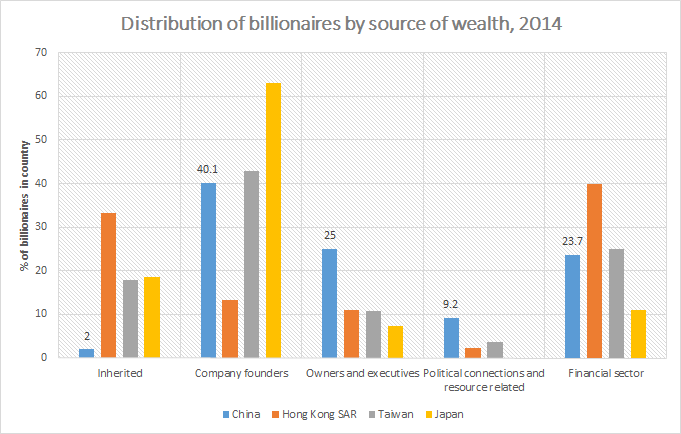
Surprisingly few billionaires in any of the 4 countries obtained their wealth through political connections. Founding a company seems to be still the path of great wealth even in Japan these days. Hong Kong is a financial centre so the large number of billionaires in its financial sector is no surprise.
Why Evolution is True is a blog written by Jerry Coyne, centered on evolution and biology but also dealing with diverse topics like politics, culture, and cats.
In Hume’s spirit, I will attempt to serve as an ambassador from my world of economics, and help in “finding topics of conversation fit for the entertainment of rational creatures.”
“We do not believe any group of men adequate enough or wise enough to operate without scrutiny or without criticism. We know that the only way to avoid error is to detect it, that the only way to detect it is to be free to inquire. We know that in secrecy error undetected will flourish and subvert”. - J Robert Oppenheimer.








 Utopia, you are standing in it!
Recent Comments