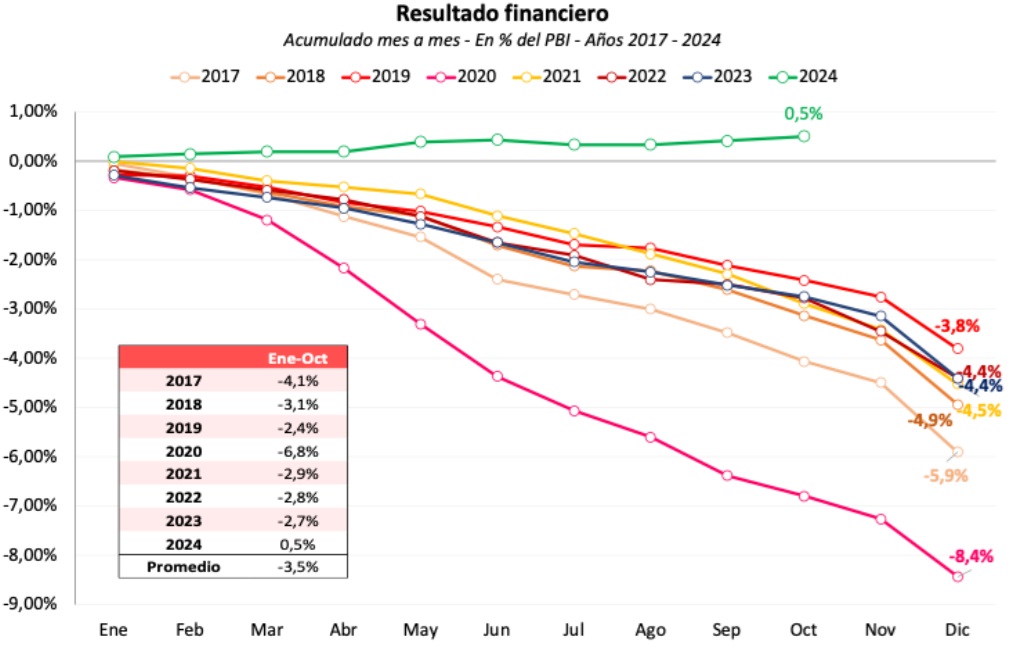
It’s easy to mock economists. Consider the supposedly prestigious left-leaning academics who asserted in 2021 that Biden’s agenda was not inflationary. At the risk of understatement, they wound up with egg on their faces.* Today, we’re going to look at another example of leftist economists making fools of themselves. It involves Argentina, where President Javier […]
Argentina’s bonds have already rallied dramatically. One gauge of the nation’s hard-currency debt, the ICE BofA US Dollar Argentina Sovereign Index, has generated a total return of about 90% this year. Meanwhile, the S&P Merval Index has risen more than 160% this year through Monday, far outpacing stock benchmarks in developed, emerging and frontier markets […]
Washington State’s unofficial state motto has long been “Al-ki” which means either “bye and bye” or “by and by” in Chinook. The former meaning now seems official as Gov. Jay Inslee pushed for a “wealth tax.” Wealthy citizens are already saying bye to the state in anticipation of what one Democratic billionaire recently called a […]
By Paul Homewood h/t Paul Kolk Why does Miliband think he has the right to spend our money as he sees fit? Ministers have been forced to step in and rescue a wind turbine factory after collapsing demand for blades pushed it to near collapse. Wind turbine maker Vestas on Wednesday said […]
For a civil society to work smoothly and effectively certain ‘social contracts’ need to have broad acceptance and be honoured by all individuals and groups. They are unwritten rules we tacitly observe. They provide a framework of understandings that allow us to live harmoniously. Some of these ‘rules’ or social contracts get defined or backed…
Only a few months ago, the Chair of the NZ Green Investment Fund (NZGIF) and Chancellor of the University of Auckland, Cecilia Tarrant, visited my “Law and Economics” class. Why? She’s a lawyer who worked in “structured products” and “real estate finance” at Morgan Stanley in New York – and knows a Kiwi friend of…
When now President-Elect Donald Trump was convicted, the thrill-kill atmosphere around the courthouse and the country was explosive, but no one was more ecstatic than liberal columnist and former prosecutor Harry Litman. The then L.A. Times columnist told MSNBC’s Nicolle Wallace that it was a “majestic day” and “a day to celebrate.” A lawfare advocate, […]
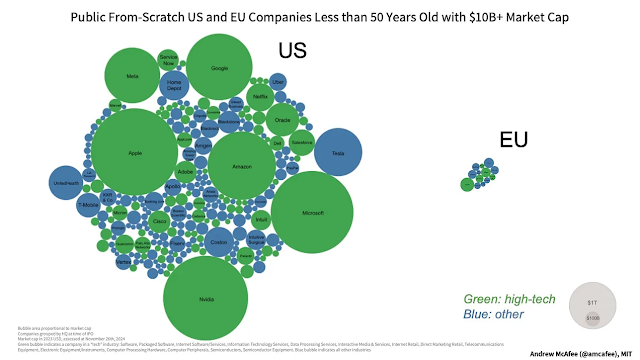
Over at the Geek Way, Andrew McAfee has created a startling visualization related to entrepreneurship in the US and EU. The Draghi Report on EU competitiveness is generating a small buzz among economists. One startling claim is thatthere is no EU company with a market capitalisation over EUR 100 billion that has been set up…
The prediction of inflation dynamics—how prices change over time—has increasingly confounded modern macroeconomists. Throughout much of the twentieth century, there seemed to be clear relationships linking the money supply, economic slack, and price levels. Monetarism, the school of thought that posits a stable connection between the growth rate of a money aggregate and the subsequent […]
Bronwyn Howell writes: KiwiRail is a state-owned enterprise, and so by law its principal objective is “to operate as a successful business”.1 Success in the business world means that you provide something that your customers are willing to pay for, at a price for that exceeds your cost of production, leaving something to reward your owners/investors…
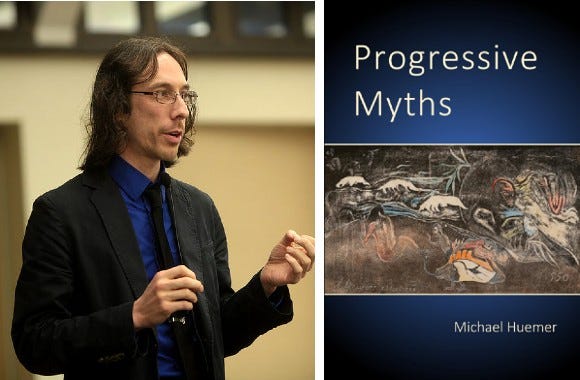
Michael Huemer’s Progressive Myths is the best book on wokeness. One of its many strengths is its focus on basic facts. As the author explains:I have selected beliefs that can be debunked fairly quickly and forcefully. Many other progressive beliefs require long argumentation and subjective judgment calls to assess. About these more difficult issues, I…
The Herald reported: The Government has $115 million at risk from the collapse of SolarZero. Finance Minister Nicola Willis said she was seeking urgent advice on the SolarZero situation. She had no further comment. NZ Green Investment Finance – a “green investment bank” created by the previous Government to fund environmentally-friendly businesses – made a $145m…
On the last day of 1945, with World War II finally behind it, Finland’s government announced a new and very strange policy.All Finns were required to take out a pair of scissors and snip their banknotes in half. This was known in Finland as setelinleikkaus, or banknote cutting. Anyone who owned any of the three…
The prediction markets predicted the election outcome more accurately and more quickly than polls or other forecasting methods, just as expected from decades of research. In this election, however, many people discounted the prediction markets because of large trades on Polymarket. Paul Krugman, for example, wrote: Never mind the prediction markets, which are thin and […]
Why Evolution is True is a blog written by Jerry Coyne, centered on evolution and biology but also dealing with diverse topics like politics, culture, and cats.
In Hume’s spirit, I will attempt to serve as an ambassador from my world of economics, and help in “finding topics of conversation fit for the entertainment of rational creatures.”







Recent Comments