This week in pseudoscience
12 Mar 2015 Leave a comment
in health economics Tags: conjecture and refutation, philosophy of science, pseudoscience, quackery
Does everything give you cancer?
12 Mar 2015 Leave a comment
in health economics Tags: Bayesian statistics, Bayesian updating, conjecture and refutation, philosophy of science, robustness testing
/cdn0.vox-cdn.com/uploads/chorus_asset/file/3523382/Medical_studies-05.0.png)
We might be at the right level of smoking regulation « Adam Smith Institute
11 Mar 2015 Leave a comment
in health economics Tags: economics of smoking

The average number of drinks men and women have at every age, charted – The Washington Post
11 Mar 2015 Leave a comment
in health economics Tags: alcoholics, binge drinking

Ample Proof That Cell Phone Towers DO NOT Cause Cancer
06 Mar 2015 Leave a comment
in economics of regulation, health economics, politics - New Zealand Tags: Anti-Science left, Greens, Quacks
Tin foil hat brigade has a recruit in New Zealand. Thousands more cellphone antennas could be installed without community consultation under a proposed environmental rule change.
Green Party environment spokeswoman Julie Anne Genter said the Government appeared to have little regard for environmental outcomes or community input.
“We support National Environmental Standards but they need to be used to protect the environment, not to override the right of local communities to have a say,” she said.


|
View original post 304 more words
Back when alternative medicine practised truth in advertising
06 Mar 2015 Leave a comment
in economics of information, health economics Tags: advertising, alternative medicine, quackery
At Last Count: Global status of GMO crops | Genetic Literacy Project
02 Mar 2015 Leave a comment
in economic history, economics of media and culture, health economics, politics - Australia, politics - New Zealand, politics - USA, technological progress Tags: Anti-Science left, GMOs

The impact of the polio vaccine – WSJ.com
02 Mar 2015 Leave a comment

The heat maps below show number of cases per 100,000 people.
via Battling Infectious Diseases in the 20th Century: The Impact of Vaccines – WSJ.com.
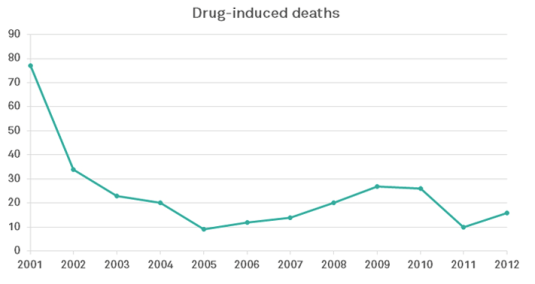
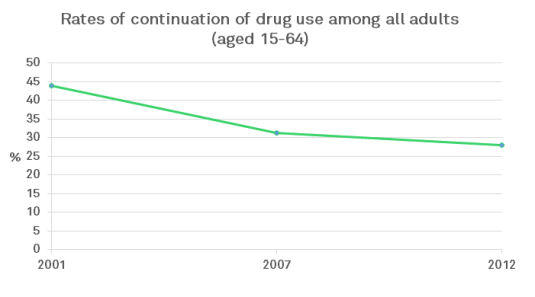
14 Years After Decriminalizing All Drugs, Here’s What Portugal Looks Like – Mic
02 Mar 2015 Leave a comment


How much is your body worth?
28 Feb 2015 Leave a comment
in health economics Tags: black markets, market for body organs, organ donation

Yes, Some Companies Are Cutting Hours In Response To ‘Obamacare’
28 Feb 2015 Leave a comment
in great recession, health economics, labour economics, labour supply, macroeconomics, politics - USA Tags: Obamacare, taxation and the labour supply
…the evidence suggests that the health law has likely led a few hundred thousand workers to see their hours cut or capped. That’s small in the context of an economy with 150 million workers.
But it isn’t a minor issue for those workers. Most of them are among the economy’s most vulnerable: low-wage, part-time workers who likely have few other options.


John Cleese on Stupidity
27 Feb 2015 Leave a comment
in behavioural economics, economics of education, economics of information, economics of media and culture, health economics, human capital Tags: Dunning-Kruger effect

The Great Escape (from mortality inequality).
27 Feb 2015 Leave a comment
in health economics, Sam Peltzman Tags: capitalism and freedom, industrial revolution, infant mortality, The Great Escape, The Great Fact
Sam Peltzman in "Mortality Inequality" used the Lorenz curve to measure mortality inequality. The top figure below is based on data for 1852; the bottom figure on data for 2002. A straight line in the figure below at a 45-degree angle shows perfect equality of mortality: that is, 20% of the population lives 20% of the total life-years at this time; 40% of the population lives 40% of the life-years for this group, and so on.
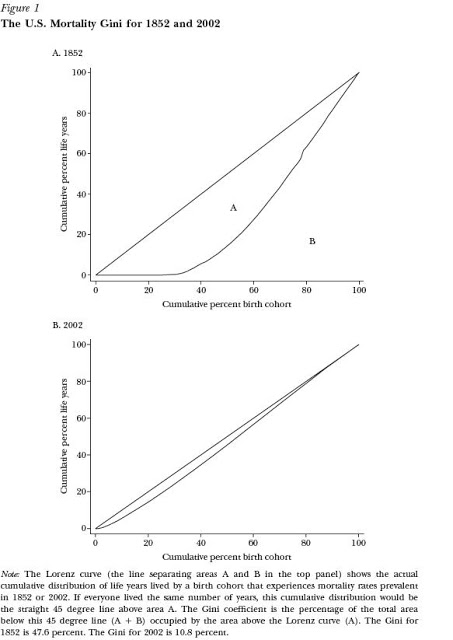
The curved line is the data In 1852 in the USA and in 2002. It shows that with high infant mortality, the bottom 30% of the distribution lived close to 0% of the life years in 1852.
 Utopia, you are standing in it!
Recent Comments