Here is the Washington Post’s Catherine Rampell on Harris’s price control policy: It’s hard to exaggerate how bad this policy is. It is, in all but name, a sweeping set of government-enforced price controls across every industry, not only food. Supply and demand would no longer determine prices or profit levels. Some far-off Washington bureaucrats […]
Rampell On Harris’s Economic Policy
Rampell On Harris’s Economic Policy
17 Aug 2024 1 Comment
in applied price theory, economics of regulation, history of economic thought, industrial organisation, politics - USA Tags: 2024 presidential election
Friedman vs Stiglitz, Chile vs Venezuela
16 Aug 2024 Leave a comment
in development economics, economic growth, economic history, economics of regulation, entrepreneurship, growth disasters, growth miracles, history of economic thought, income redistribution, labour economics, law and economics, liberalism, macroeconomics, Marxist economics, Milton Friedman, politics - USA, poverty and inequality, property rights, Public Choice, public economics, rentseeking Tags: Chile, free speech, political correctness, regressive left, The Great Enrichment, Venezuela
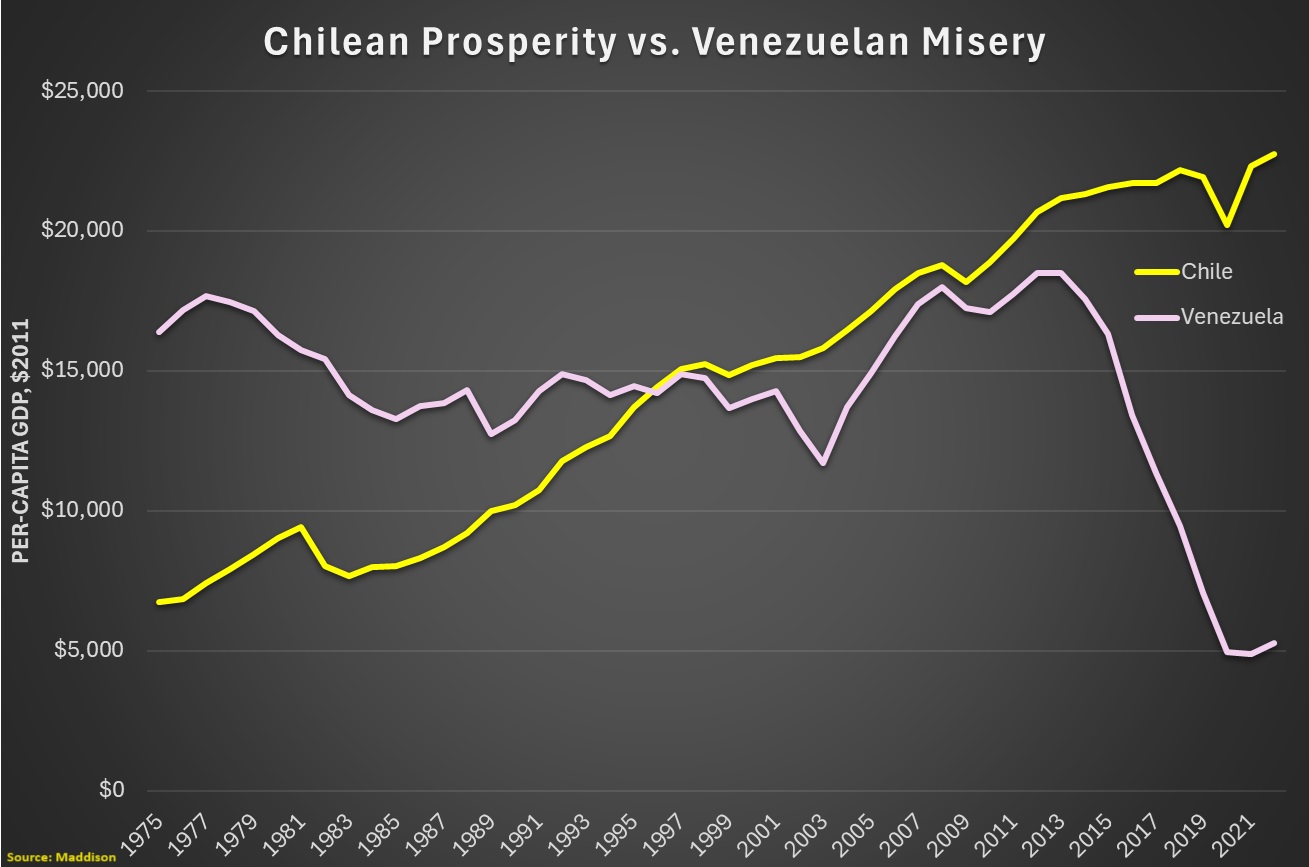
I’ve repeatedly praised Chile’s pro-market reforms (see here, here, and here) and I’ve repeatedly condemned Venezuela’s shift to socialism (see here, here, and here). But if you don’t have time to read all those columns, this chart from the Maddison database tells you everything you need to know. Simply stated, Chile’s reforms have delivered huge […]
Friedman vs Stiglitz, Chile vs Venezuela
Finally, exchange rate models seem to work pretty well
14 Aug 2024 Leave a comment
in budget deficits, business cycles, econometerics, economic history, financial economics, history of economic thought, inflation targeting, macroeconomics, monetary economics, politics - USA Tags: exchange rates, monetary policy
Exchange-rate models fit very well for the U.S. dollar in the 21st century. A “standard” model that includes real interest rates and a measure of expected inflation for the U.S. and the foreign country, the U.S. comprehensive trade balance, and measures of global risk and liquidity demand is well-supported in the data for the U.S. […]
Finally, exchange rate models seem to work pretty well
Stablecoins – a digital version of Swiss bearer savings books
13 Aug 2024 Leave a comment
in history of economic thought, law and economics, macroeconomics, monetary economics, property rights Tags: bitcoin, Switzerland

Before anti-money laundering laws arrived in Switzerland, anyone could walk into a Swiss bank and open an account without showing any ID. The bank would then issue you something called a bearer savings book, otherwise known as inhabersparheften or livrets d’épargne au porteur. Ownership of the savings book was considered by the bank to be…
Stablecoins – a digital version of Swiss bearer savings books
Joseph Schumpeter, Capitalism and Intellectuals
01 Aug 2024 Leave a comment
in comparative institutional analysis, constitutional political economy, development economics, economic growth, economic history, history of economic thought, macroeconomics
See Socialists, Knowledge of History and Agency. These are letters to the editor of The WSJ in response to an article about socialism by Joseph Epstein. The one below reminded me of a 1992 article by Robert Samuelson in Newsweek. “Joseph Epstein’s “Socialists Don’t Know History” (op-ed, May 30, 2019) on the abysmal historical knowledge…
Joseph Schumpeter, Capitalism and Intellectuals
Frank DiTraglia on how to read econometrics papers
31 Jul 2024 Leave a comment
in econometerics, history of economic thought
Reading economics research papers is hard work when you are doing it for the first time as a graduate student. That’s why I try to get as many undergraduate students as possible engaged in some ‘inspectional reading’ (a term I learned from Marc Bellamare’s book Doing Economics, which I reviewed here), through the Waikato Economics Discussion…
Frank DiTraglia on how to read econometrics papers
Thought and Details on the Fiscal Theory of the Price Level
30 Jul 2024 Leave a comment
in applied price theory, budget deficits, business cycles, economic growth, economic history, history of economic thought, labour economics, macroeconomics, monetarism, monetary economics, unemployment Tags: monetary policy

The Fiscal Theory of the Price Level has been percolating among monetary theorists for over three decades: Eric Leeper being the first to offer a formalization of the idea, with Chris Sims and Michael Woodford soon contributed to its further development. But the underlying idea that the taxation power of the state is essential for […]
Thought and Details on the Fiscal Theory of the Price Level
Interview with Edmund Phelps: Macro and Capitalism
21 Jul 2024 Leave a comment
in business cycles, fiscal policy, great depression, great recession, history of economic thought, job search and matching, labour economics, labour supply, macroeconomics, monetary economics, unemployment
Edmund Phelps won the Nobel prize in economics in 2006 for “for his analysis of intertemporal tradeoffs in macroeconomic policy.” However, he has spent a considerable chunk of this time in the last few decades musing over strengths and weaknesses of capitalism and, more generally, a dynamic economy. Jon Hartley interviews Phelps on both topics,…
Interview with Edmund Phelps: Macro and Capitalism
Needed in Empirical Social Science: Numbers
29 Jun 2024 Leave a comment
in econometerics, history of economic thought
By Aaron S. Edlin and Michael Love: Knowing the magnitude and standard error of an empirical estimate is much more important than simply knowing the estimate’s sign and whether it is statistically significant. Yet, we find that even in top journals, when empirical social scientists choose their headline results – the results they put in […]
Needed in Empirical Social Science: Numbers
The Evolving Economic Role of Women: Goldin’s Nobel Lecture
29 Jun 2024 Leave a comment
in discrimination, economic history, economics of education, gender, history of economic thought, human capital, labour economics, labour supply, occupational choice, politics - USA, poverty and inequality Tags: gender wage gap, sex discrimination

Claudia Goldin’s Nobel prize lecture, “An Evolving Economic Force,” has now been published in the June 2024 issue of the American Economic Review. Or if you prefer, you can watch the watch the lecture (with more numerous slides!) from the link at the Nobel website. She writes: Women are now at the center of the…
The Evolving Economic Role of Women: Goldin’s Nobel Lecture
When life imitates comedy: FTC’s Amazon Flip Flop
26 Jun 2024 Leave a comment
in applied price theory, entrepreneurship, history of economic thought, industrial organisation, law and economics, Ronald Coase Tags: competition law
Nobel Laureate Ronald Coase once quipped that he left antitrust because “When prices go up, its monopolization, when prices fall it’s predation, and when they stay the same it’s collusion.” As if to illustrate this idea, the FTC’s Chair is reversing herself to bring a case against Amazon. On one hand, booksellers argue that Amazon…
When life imitates comedy: FTC’s Amazon Flip Flop
Murphy’s Law of Economic Policy
21 Jun 2024 Leave a comment
in applied price theory, applied welfare economics, comparative institutional analysis, economics of bureaucracy, economics of regulation, history of economic thought, Public Choice, public economics

Economists have the least influence on policy where they know the most and are most agreed; they have the most influence on policy where they know the least and disagree most vehemently.” I’d never heard of it before and it’s quoted in this review of a book called “Free Lunch Thinking – How Economics Ruins […]
Murphy’s Law of Economic Policy
Monetary Policy and the Great Crash of 1929: A Bursting Bubble or Collapsing Fundamentals?
11 Jun 2024 Leave a comment
in business cycles, economic growth, economic history, great depression, history of economic thought, macroeconomics, monetarism, monetary economics Tags: monetary policy
By Timothy Cogley. He was then at the Federal Reserve Bank of San Francisco (1999). He is now at New York University. “In recent years, a number of economists have expressed concern that the stock market is overvalued. Some have compared the situation with the 1920s, warning that the market may be headed for a…
Monetary Policy and the Great Crash of 1929: A Bursting Bubble or Collapsing Fundamentals?
‘Arguments Libertarians shouldn’t make’ with David Friedman
30 May 2024 Leave a comment
in applied price theory, comparative institutional analysis, constitutional political economy, David Friedman, defence economics, economic history, economics of crime, environmental economics, history of economic thought, law and economics, liberalism, libertarianism
Almost Observable Human Capital
24 May 2024 Leave a comment
in applied price theory, economic history, economics of education, history of economic thought, human capital, industrial organisation, labour economics, labour supply, occupational choice

Previously, we could observe a higher proportion of men than women in, say, steel fabrication and suspect that men have “some sort” of physical or mental comparative advantage related to steel fabrication. But what does that mean?
Almost Observable Human Capital
 Utopia, you are standing in it!
Recent Comments