Regulating Monopolies: A History of Electricity Regulation
09 Feb 2016 Leave a comment
in applied price theory, economic history, economics of bureaucracy, economics of religion, industrial organisation, law and economics, Public Choice, rentseeking, survivor principle Tags: competition law, electricity industry, natural monopolies, network industries
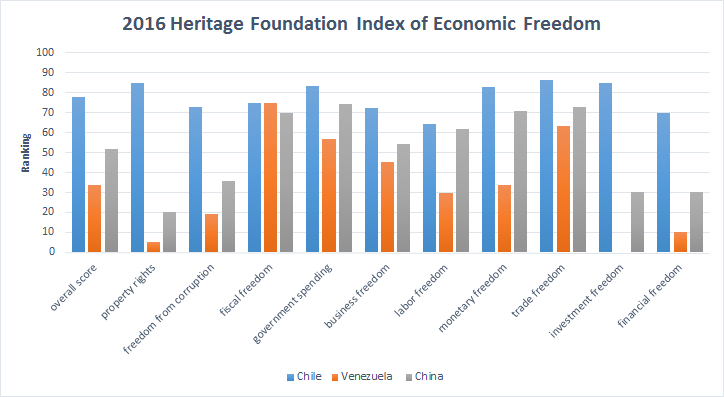
@OwenJones84 @K_Niemietz Venezuelan, Chilean and Chinese index of economic freedom rankings 2016
06 Feb 2016 Leave a comment
in development economics, economics of regulation, entrepreneurship, fiscal policy, growth disasters, growth miracles, industrial organisation, labour economics, law and economics, macroeconomics, monetary economics, property rights, public economics Tags: capitalism and freedom, Chile, China, The Great Escape, Venezuela
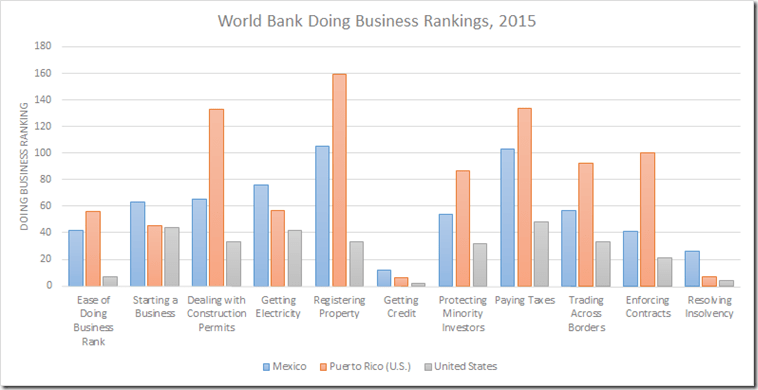
Much more than a high minimum wage – Puerto Rican, Mexican and U.S. Doing Business rankings 2015
05 Feb 2016 Leave a comment
in economics of religion, entrepreneurship, industrial organisation, law and economics, politics - USA, property rights Tags: doing business, Mexico, Puerto Rico
Having a high minimum wage is the least of the problems that the US territory of Porto Rico has when you consider reasons from its recent sovereign default. It owes about US$70 billion. It is a terrible place to do do business – worse than Mexico! Mexicans find it easier to export to the USA!
Media outlets by the ideological composition of their audiences
01 Feb 2016 Leave a comment
in economics of media and culture, industrial organisation, survivor principle Tags: media bias
and people do go about Amazon not paying enough tax
29 Jan 2016 Leave a comment
in economics of media and culture, entrepreneurship, industrial organisation
There is nothing new about the coming of robots
28 Jan 2016 Leave a comment
in economic history, economics of media and culture, entrepreneurship, industrial organisation, labour supply, survivor principle, technological progress Tags: automation, rational irrationality, skill bias technical change, technological unemployment
@BillEnglishMP @NZTreasury too busy to report on SOE portfolio returns
28 Jan 2016 Leave a comment
in applied price theory, economics of bureaucracy, financial economics, industrial organisation, politics - New Zealand, public economics
Today the Treasury advised that it no longer calculates an annual rate of return on the portfolio of state owned enterprises as a whole. It no longer publishes an annual portfolio report (APR).

Source: Treasury response to Official Information Act request by Jim Rose, 14 January 2016.
The Treasury regards the crown portfolio report which contains performance indicators on the state owned enterprises portfolio as a whole as too resource intensive.
The Treasury prefers to be more forward-looking in their reporting on a quarterly basis to the Minister of Finance. Unfortunately, the Treasury refused to my requests for access to this forward-looking reporting to the Minister of Finance on commercial-in-confidence grounds.
The forward-looking approach to state-owned enterprise performance is now only by the Treasury and the Minister of Finance. No one else has access to this financial performance information.
It is no longer possible to say using a figure calculated by the Treasury whether the portfolio of state owned enterprises as a whole are a good return to the taxpayer or not. Individual annual reports of the state owned enterprises can be reviewed but the portfolio wide rate of return is no longer available from the Treasury with the associated credibility of the same.
A common argument against state ownership is that as a whole government ownership is a bad investment. Specifically, the portfolio of state owned enterprises struggle to pay a return in excess of the long-term bond rate.
A common argument for continued state ownership is the loss of the dividends from privatisation. The vulgar argument such as by the New Zealand Labor Party and New Zealand Greens is if a state owned enterprise is privatised either partially or fully, the taxpayers no longer receive dividends. The fact that the sale price reflects the present value of future dividends is simply ignored.

Source: Treasury, Crown Portfolio Report 2013.
The sophisticated argument is the assets are under-priced such as for political reasons. Failed privatisations are indeed the best case against state ownership because governments cannot even sell an asset with such any degree of competence.
Governments are so bad as business owners and so incapable of running a commercial process free of politics that governments cannot even sell a state-owned enterprise for a good price under the full glare of the media and public.
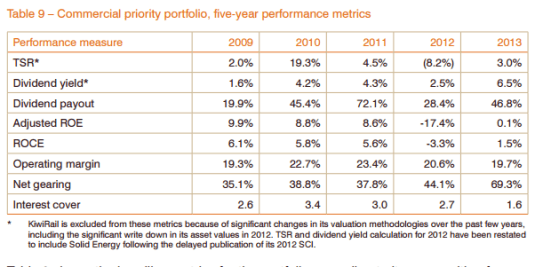
Source: Treasury, Crown Portfolio Report 2013.
A reply to the loss of dividends argument is the dividends from the portfolio as a whole do not repay the government debt incurred to fund capital infusions into state-owned enterprises both when initially established and through time. In that case, it is better to leave your money in the bank than in the state of enterprise.
John Quiggin often criticises privatisation on the grounds that state owned enterprises can invest at a cheaper rate because they are financed at the long-term bond rate:
In general, even after allowing for default risk, governments can borrow more cheaply than private firms. This cost saving may or may not outweigh the operational efficiency gains usually associated with private ownership.
It is not possible to scrutinise that argument without an annual rate of return on the portfolio of state owned enterprises as a whole to see if it is true at first pass at least. As the Treasury no longer calculates a rate of return on the portfolio and taxpayers’ equity, that debate comes to something of a crashing halt in New Zealand.
If these state owned enterprises were privately owned and listed on the share market, investors would just look at trends in share prices for daily measure of expected future profitability.
John Quiggin made the best simple summary of the case for privatisation which was the selling the dogs in the portfolio:
The fiscal case for privatisation must be assessed on a case by case basis. It will always be true for example that if a public enterprise is operating at a loss, and can be sold off for a positive price with no strings attached, the government’s fiscal position will benefit from privatisation.
Various early ventures in public ownership, such as the state butcher shops operated in Queensland in the 1920s (apparently a response to concerns about thumbs on scales) met this criterion, and there doesn’t seem to be much interest in repeating this experiment.
Quiggin also made a measured statement of why state ownership should be limited at most to monopolies:
In most sectors of the economy, the higher cost of equity capital is more than offset by the fact that private firms are run more efficiently, and therefore more profitably, than government enterprises.
But enterprises owned by governments are usually capital intensive and often have monopoly power that entails close external regulation, regardless of ownership. In these situations, the scope to increase profitability is limited, and the lower value of the asset to a private owner is reflected in the higher rate of return demanded by equity investors.
Quiggin is wrong about government enterprises have been a lower cost of capital because it contradicts the most fundamental principles of business finance as explained by Sinclair Davidson:
…it is clear that the Grant-Quiggin view violates the Modigliani-Miller theories of corporate finance. The cost of capital is a function of the riskiness of the investment projects and not a function of a firm’s ownership structure.
How the cash flows of a business are divided between owners and creditors does not matter unless that division changes the incentives they have to monitor the performance of the firm and keep it on its toes. Those lower down the pecking order if things go wrong such as owners have much more of an incentive to monitor the success of the business and lift its performance.
Capital structures of firms, the property rights structures of firms, matter precisely because they influence incentives of those with different claims on the cash flows of the firm.
Having to pay debt disciplines managerial slack and ensures that free-cash flows are used to repay debt (or pay dividends) rather than be invested in low quality new ventures. Having to borrow from strangers such as banks ensures regular scrutiny of the soundness and prospects of the company from a fresh set of eyes. Capital structures made up of both debt and equity keeps the firm on its toes.
Unfortunately, in New Zealand it is much more difficult to review the arguments for and against the current size and shape of the state owned enterprise portfolio as for example summarised by John Quiggin:
Technologies and social priorities change over time, with the result that activities suitable for public ownership at one time may be candidates for privatization in another. However, the reverse is equally true. Problems in financial markets or the emergence of new technologies may call for government intervention in activities previously undertaken by private enterprise.
In summary, privatization is valid and important as a policy tool for managing public sector assets effectively, but must be matched by a willingness to undertake new public investment where it is necessary.
As a policy program, the idea of large-scale privatization has had some important successes, but has reached its limits in many cases. Selling income-generating assets is rarely helpful as a way of reducing net debt. The central focus should always be on achieving the right balance between the public and private sectors.
This balancing of public and private ownership is more difficult in New Zealand because portfolio wide rates of return are unavailable unless you calculate them yourself. That must be labour-intensive given the Treasury thought it was too labour-intensive for it to do for itself.
An obvious motive to start a review the extent of state ownership is the portfolio is performing poorly. That warning sign is no longer available because the crown portfolio report is no longer published.
One way to fix an underperforming portfolio is to sell the dogs in the portfolio. One of the first ways owners notice dogs in their portfolio is the portfolio not returning as well as it used too because of the emergence of these dogs so further enquiries are made and explanations sought.
Taxpayers, ministers and parliamentarians are all busy people with little personal stake in the rate of return on the state owned enterprises portfolio.
Taxpayers, ministers and parliamentarians will all first look at the portfolio wide rate of return to see whether more detailed scrutiny of individual investments is required. That quick check against poor value for money and trouble ahead is no longer available on the state owned enterprises portfolio in New Zealand.
Creative destruction in storage costs
21 Jan 2016 1 Comment
in economic history, entrepreneurship, industrial organisation Tags: creative destruction
The growth of Wal-Mart mapped
20 Jan 2016 Leave a comment
in economic history, entrepreneurship, industrial organisation, survivor principle Tags: creative destruction, entrepreneurial alertness, technology diffusion, Walmart
Workplace safety, spans of control and directors’ duties
19 Jan 2016 Leave a comment
in applied price theory, applied welfare economics, economics of regulation, entrepreneurship, health and safety, industrial organisation, labour economics, law and economics, occupational choice, politics - New Zealand, survivor principle, theory of the firm Tags: job safety, workers compensation
Unharnessed painters work amid the Eiffel Tower. Circa 1910. http://t.co/N7yE7OaKGm—
Old Pics Archive (@oldpicsarchive) June 13, 2015
Workplace safety arises as a by-product of economic growth. Risks in the workplace and outside that would not countenance now were routine a few decades ago because the risk of eliminating them was high.
The soon to take effect New Zealand health workplace safety legislation makes it much more difficult to have independent directors and part-time directors of companies. That will both weaken the ability of shareholders to prevent insider control as well as introduce a diversity of views onto boards of directors.
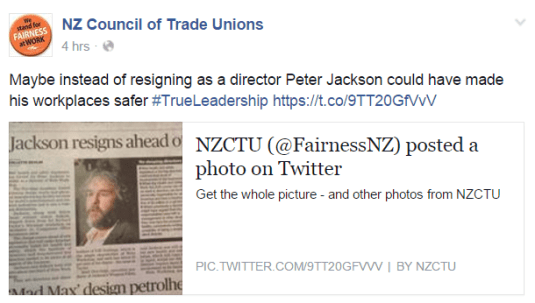
The resignation of Sir Peter Jackson is an example of this. Talented entrepreneurs are no longer able to run large numbers by sitting on the board and intervening on a management by exception basis.
Rupert Murdoch as an example of an executive able to run a global empire. He would ring up the chief executives of his subsidiaries for one minute to month. If they are talking about something interesting, he would listen for longer. He was the ultimate one-minute manager who built a global empire around his supreme entrepreneurial talent.
The new legislation on workplace safety will increase the cost of building a successful business from the ground up. Entrepreneurs will not be able to quickly intervene in the company and dismiss underperforming executives who look after things while they are away. This is because they are not on the Board of Directors.
One constraint on the growth of any firm is entrepreneurs have a limited span of control (Coase 1937; Williamson 1967, Lucas 1978; Oi 1983a, 1983b). A span of control is the number of subordinates that an individual supervisor has to control and lead either directly or through a hierarchical managerial chain (Fox 2009). There are only so many tasks that even the most able of entrepreneurs can carry out in one day. Over-stretched spans of control motivate entrepreneurs to hire professional managers and delegate to them a wide range of decision-making rights over the firms they own (Williamson 1975; Foss, Foss and Klein 2008).
Entrepreneurs and the professional managers they hired to assist them must divide their respective time between monitoring employees, identifying new business opportunities, forecasting buyer demand and running the other aspects of their business (Lucas, 1978; Oi 1983, 1983b, 1988; Foss, Foss, and Klein 2008). The larger is the firm, the more employees there are for the entrepreneur to direct, monitor and reward. These costs of directing and monitoring employees will increase with the size of the firm and larger firms will encounter information problems not present in smaller firms (Alchian and Demsetz 1972; Stigler 1962)
The time of the more talented entrepreneurs is more valuable because they had the superior managerial skills and entrepreneurial alertness to make their firms large in the first place and remain deft enough to survive in competition. Time spent on the supervision of employees is time that is spent away from other uses of the talents that got these more able entrepreneurs to the top and keeps them there (Williamson 1967; Lucas 1978; Oi 1983b, 1988, 1990; Idson and Oi 1999; Black et al 1999).
Firms in the same industry tend to exhibit systematic differences in their organization of production and the structure of their workforces because entrepreneurial ability is the specific and scarce production input that limits the size of a firm (Lucas, 1978; Oi 1983b). The less able entrepreneurs tend to run the smaller firms while the better entrepreneurs tend to lead both the currently large firms and the smaller firms that are growing at the expense of market rivals (Lucas 1978, Oi 1983b; Stigler 1958; Alchian 1950).
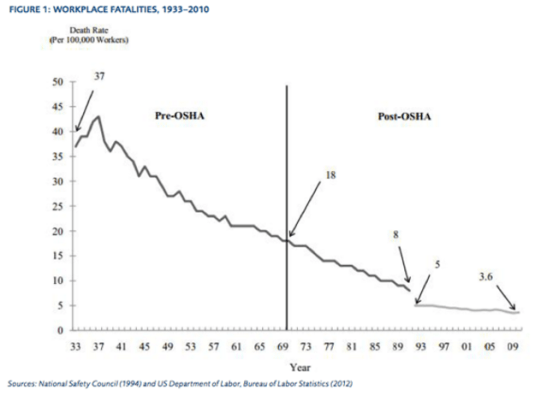
There has been a tremendous improvement in the working conditions over the 20th century. The main driver was the incentive and employers to provide safe workplaces as real wages grew. Adam Smith noted that more dangerous and unpleasant jobs always attracted a wage premium as he explains in the Wealth of Nations:
The five following are the principal circumstances which, so far as I have been able to observe, make up for a small pecuniary gain in some employments, and counterbalance a great one in others: first, the agreeableness or disagreeableness of the employments themselves; secondly, the easiness and cheapness, or the difficulty and expense of learning them; thirdly, the constancy or inconstancy of employment in them; fourthly, the small or great trust which must be reposed in those who exercise them; and, fifthly, the probability or improbability of success in them.
First, the wages of labour vary with the ease or hardship, the cleanliness or dirtiness, the honourableness or dishonourableness of the employment. Thus in most places, take the year round, a journeyman tailor earns less than a journeyman weaver. His work is much easier. A journeyman weaver earns less than a journeyman smith. His work is not always easier, but it is much cleanlier. A journeyman blacksmith, though an artificer, seldom earns so much in twelve hours as a collier, who is only a labourer, does in eight. His work is not quite so dirty, is less dangerous, and is carried on in daylight, and above ground.
Honour makes a great part of the reward of all honourable professions. In point of pecuniary gain, all things considered, they are generally under-recompensed, as I shall endeavour to show by and by. Disgrace has the contrary effect.
The trade of a butcher is a brutal and an odious business; but it is in most places more profitable than the greater part of common trades. The most detestable of all employments, that of public executioner, is, in proportion to the quantity of work done, better paid than any common trade whatever.
Hunting and fishing, the most important employments of mankind in the rude state of society, become in its advanced state their most agreeable amusements, and they pursue for pleasure what they once followed from necessity. In the advanced state of society, therefore, they are all very poor people who follow as a trade what other people pursue as a pastime. Fishermen have been so since the time of Theocritus. A poacher is everywhere a very poor man in Great Britain. In countries where the rigour of the law suffers no poachers, the licensed hunter is not in a much better condition. The natural taste for those employments makes more people follow them than can live comfortably by them, and the produce of their labour, in proportion to its quantity, comes always too cheap to market to afford anything but the most scanty subsistence to the labourers.
Disagreeableness and disgrace affect the profits of stock in the same manner as the wages of labour. The keeper of an inn or tavern, who is never master of his own house, and who is exposed to the brutality of every drunkard, exercises neither a very agreeable nor a very creditable business. But there is scarce any common trade in which a small stock yields so great a profit…
The wages in any particular job will vary with the risks that are known to the worker in that job. That is an important qualification.
Competition in labour markets ensures that the net advantages of different jobs will tend to equality. This theory of the labour market originating in Adam Smith, which drives much of modern labour economics became to be known as the theory of compensating differentials.

Firms can choose their production technology to offer workers greater safety or they can economize on safety and offer the savings to workers in the form of higher wages. There is a trade-off in offering more safety or higher wages, holding constant the level of profits. As Kip Viscusi explains:
Wage premiums paid to U.S. workers for risking injury are huge—in 1990 they amounted to about $120 billion annually, which was over 2 percent of the gross national product, and over 5 percent of total wages paid.
These wage premiums give firms an incentive to invest in job safety because an employer who makes his workplace safer can reduce the wages he pays. Employers have a second incentive because they must pay higher premiums for workers’ compensation if accident rates are high.
One of the effects of safety regulation is the employers no longer have to pay this wage premium in more dangerous or disagreeable jobs but as Fishback wrote:
Studies of wages before and after the introduction of workers’ compensation show, however, that non-union workers’ wages were reduced by the introduction of workers’ compensation. In essence, the non-union workers “bought” these improvements in their benefit levels.
Even though workers may have paid for their benefits, they still seem to have been better off as a result of the introduction of workers’ compensation. Many workers had faced problems in purchasing accident insurance at the turn of the century. Workers’ compensation left them better insured, and allowed many of them to spend some of their savings that they had set aside in case of an accident.
What literature there is about suggest that workers overestimate small risks and underestimate large risks. Surveys of manufacturing employment show that one third of workers quit because they found out the job they accepted was more dangerous than they expected.
Source: Evaluating OSHA’s Effectiveness and Suggestions for Reform | Mercatus
One clear trend of the 20th century is as countries got richer, workers demanded more safety at work and larger wage premiums. Market incentives for better worker safety dwarf legal incentives such as from being sued, which in turn dwarf regulatory incentives.
There is also evidence of a glass coffin effect. About 95% of workplace deaths of men. Indeed, there are some interesting journal papers about how occupational choice is affected by motherhood, sole motherhood and sole fatherhood. Single parents are more cautious about their occupational choices.
It is unfortunate that the unions in New Zealand opposes a risk based system of workers’ compensation. The current system is not only no fault, employers pay premiums based on the risks of their industry, not of their individual workplace. There is plenty of evidence to show the charging premiums based on the risks of an accident and the previous record of workplace safety greatly reduces workplace deaths and injuries as Viscusi explains:
The workers’ compensation system that has been in place in the United States throughout most of this century also gives companies strong incentives to make workplaces safe. Premiums for workers’ compensation, which employers pay, exceed $50 billion annually. Particularly for large firms, these premiums are strongly linked to their injury performance.
Statistical studies indicate that in the absence of the workers’ compensation system, workplace death rates would rise by 27 percent. This estimate assumes, however, that workers’ compensation would not be replaced by tort liability or higher market wage premiums.
Private equity firms experiment in many different strategies
18 Jan 2016 Leave a comment
in entrepreneurship, financial economics, survivor principle
David Friedman explains incentive incompatibility and comparative institutional analysis
18 Jan 2016 Leave a comment
in applied price theory, comparative institutional analysis, constitutional political economy, David Friedman, industrial organisation, law and economics, property rights Tags: incentive incompatibility, public goods

The firm has nothing to do with economies of scale
08 Jan 2016 Leave a comment
in applied price theory, industrial organisation, Ronald Coase, theory of the firm Tags: transaction costs
Competing views of induced innovation
06 Jan 2016 Leave a comment
in entrepreneurship, industrial organisation, labour economics, minimum wage, survivor principle, technological progress Tags: creative destruction, do gooders, expressive voting, induced innovation, rational irrationality
 Utopia, you are standing in it!
Recent Comments