28 Sep 2015
by Jim Rose
in economic history, industrial organisation, politics - New Zealand
Tags: expressive voting, NZ Post, privatisation, state owned enterprises, sunset industries
New Zealand Post is slowly going out the door with declining dividends to taxpayers, a sustained decline in its commercial valuation and a negative or poor Total Shareholder Return. Letter volumes declined by a one-half in 10 years but the parcels business is growing because of the rise of e-commerce and Internet shopping.

Source: The New Zealand Treasury – data released under the Official Information Act.
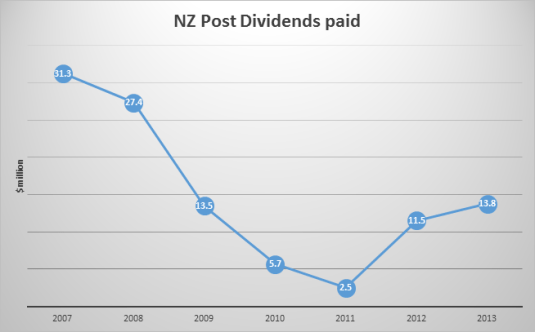
Source: The New Zealand Treasury – data released under the Official Information Act.

Source: The New Zealand Treasury – data released under the Official Information Act.
25 Sep 2015
by Jim Rose
in financial economics, industrial organisation, politics - New Zealand, public economics, rentseeking, survivor principle, transport economics
Tags: government ownership, KiwiRail, privatisation, rational ignorance, rational rationality, state owned enterprises, suppressive voting
The New Zealand Labour Party and New Zealand Greens both make much of the fact that when you privatise a state-owned enterprise the taxpayer is no longer entitled to dividends from the privatised business. The fact that the sale price is the net present value of those future dividends is a rating fallacy that is not the subject of this post.
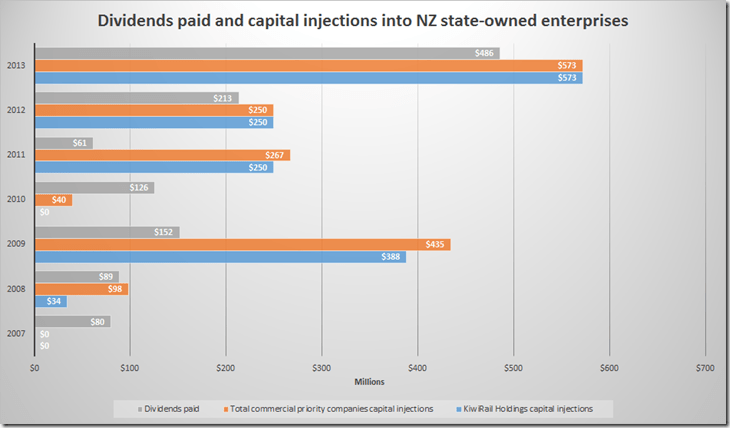
Source: New Zealand Treasury – data released under the Official Information Act.
What is the subject of this post is whether there are indeed any dividends paid to taxpayers after capital injections. 2007 was the last year in which dividends to the taxpayer exceeded capital injections. The reason was that dog called KiwiRail.
24 Sep 2015
by Jim Rose
in applied price theory, applied welfare economics, comparative institutional analysis, economics of regulation, entrepreneurship, health economics, industrial organisation, law and economics, politics - USA, property rights, survivor principle
Tags: creative destruction, endogenous growth theory, innovation, intellectual property rights, patents and copyrights, pharmaceutical innovation, price controls
Our research shows that when prices fall, innovation falls even more. Patients would see their lives cut short by delayed or absent drugs.
Source: Drug Price Controls End Up Costing Patients Their Health – NYTimes.com
…cutting prices by 40 to 50 percent in the United States will lead to between 30 and 60 percent fewer R and D projects being undertaken in the early stage of developing a new drug. Relatively modest price changes, such as 5 or 10 percent, are estimated to have relatively little impact on the incentives for product development – perhaps a negative 5 percent.
Source: The Effect of Price Controls on Pharmaceutical Research


Source: U.S. Pharmaceutical Policy In A Global Marketplace
21 Sep 2015
by Jim Rose
in applied price theory, Austrian economics, economic history, industrial organisation, Ludwig von Mises, survivor principle
Tags: competition and monopoly, consumer sovereignty, creative destruction, entrepreneurial alertness, market selection, The meaning of competition
17 Sep 2015
by Jim Rose
in applied price theory, economic history, economics of regulation, industrial organisation, job search and matching, labour economics, minimum wage, survivor principle, unions
Tags: Australia, employment law, employment protection law, federalism, labour market deregulation, labour market regulation, union power, unions
Previous Older Entries Next Newer Entries


 Utopia, you are standing in it!
Recent Comments