More minimum wage job replacement units spotted
26 Jun 2015 Leave a comment
in industrial organisation, labour economics, labour supply, minimum wage, survivor principle, unions Tags: antimarket bias, creative destruction, expressive voting, technological unemployment
Uber has grown faster in its first five years than Facebook
26 Jun 2015 Leave a comment
in economic history, economics of media and culture, financial economics, industrial organisation, survivor principle Tags: creative destruction, Facebook, Uber
Uber has grown faster in its first five years than Facebook did buff.ly/1eTxaNH http://t.co/dD1Gv1djkb—
Business Insider (@businessinsider) June 06, 2015
"You didn’t build that" – which of sport superstars, celebrities and top CEOs earn their pay more?
25 Jun 2015 Leave a comment
in applied price theory, applied welfare economics, entrepreneurship, financial economics, industrial organisation, Marxist economics, politics - New Zealand, politics - USA, rentseeking, sports economics, survivor principle Tags: CEO pay, Leftover Left, obama, superstar wages, superstars, top 1%
Defenders have also pointed to the pay of pro ballplayers or Hollywood stars, but they do not determine their own pay (as CEOs do) and are paid based on performance. Once they begin to fail, they are dumped. By contrast, CEO pay isn’t tied to performance in any meaningful way.
It’s a big concession to say that athletes and celebrities earn their pay but top CEOs don’t. Most of all, that concession changes the case against the top 1% from inequality to just desert – a big shift in theories of distributive justice. It’s also a big risk to base the argument for greater equality and a 80% top tax rate not only on the excesses of CEOs but on the very specific and testable hypothesis that these CEOs determine their own pay.
if we are to look at CEOs, top athletes and Hollywood celebrities, it is the athletes and celebrities who benefited the most from the windfall of been able to service huge markets through the global media market.
Figure 1: CEO pay and share market performance
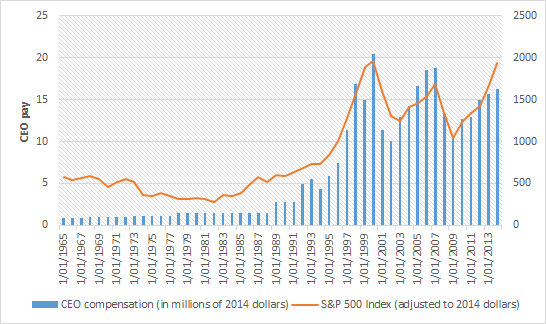
Source: Economic Policy Institute.
CEOs actually have to run large complex companies to earn their pay, which is why their compensation tracks the share market relatively closely. Athletes and celebrities don’t do that what they do any better than in the past. They simply do it in front of a global media market. Since the late 1970s, the ratio of average pay of CEOs of large public companies to the average market value of those companies has stayed relatively constant: CEO pay grew hand in hand with corporations.
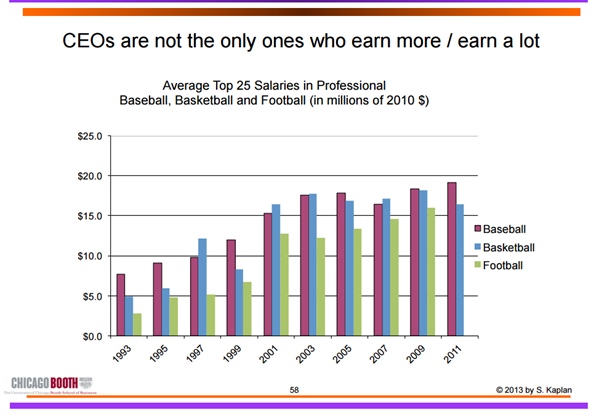
Steven Kaplan and Joshua Rauh make a number of basic points backed up by detailed evidence about CEO pay:
- While top CEO pay has increased, so has the pay of private company executives and hedge fund and private equity investors;
- ICT advances increase the pay of many – of professional athletes (technology increases their marginal product by allowing them to reach more consumers), Wall Street investors (technology allows them to acquire information and trade large amounts more easily), CEOs and technology entrepreneurs in the Forbes 400; and
- Technology allows top executives and financiers to manage larger organizations and asset pools – a loosening of social norms and a lack of independent control of CEO pacesetting does not explain similar increases in pay for private companies– technology explains it;
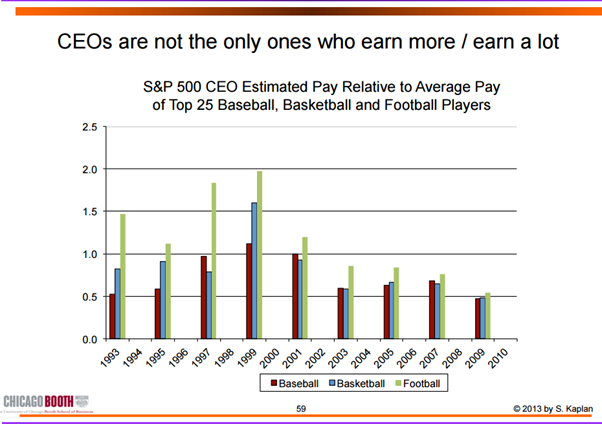
To put it simply:
If the reason for growth of incomes at the very top is, say, managerial power in publicly owned companies, then one would expect the increases in income at the top levels to be much larger for that group.
But the breadth of the occupations that have seen a rise in top income levels is much more consistent with the argument that the increase in “superstar” pay (or pay at the top) has been driven by the growth of information and communications technology, and the ways this technology allows individuals with particular skills that are in high demand to expand the scale of their performance.
As for the turnover argument, that underperforming athletes and celebrities are dropped, prior to the GFC, CEO turnover was already on the rise:
Turnover is 14.9% from 1992 to 2005, implying an average tenure as CEO of less than seven years. In the more recent period since 1998, total CEO turnover increases to 16.5%, implying an average tenure of just over six years.
Internal turnover is significantly related to three components of firm performance – performance relative to industry, industry performance relative to the overall market, and the performance of the overall stock market.
Only 21.3% of CEOs in 1992 remained in that role in 1999; only 16.35% of CEOS on the job in 2000 were there in 2007. In any given year, one out of six Fortune 500 CEOs loses their jobs, compared to one out of 10 in the 1970s.
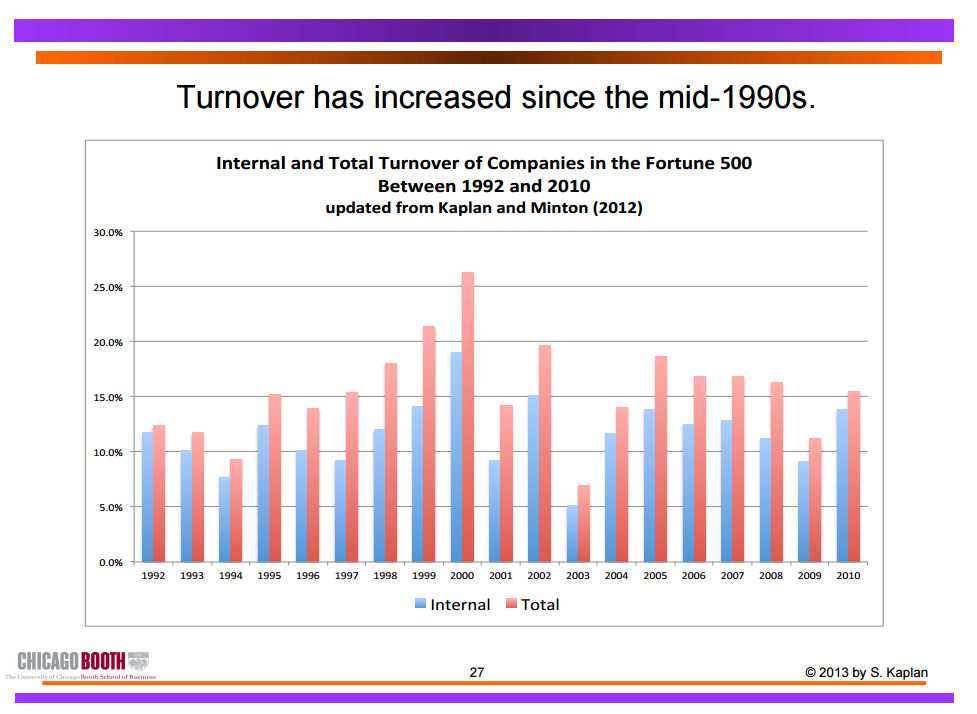
Dirk Jenter and Fadi Kanaan in a study of of 3,365 CEO turnovers from 1993 to 2009 found that:
CEOs are significantly more likely to be dismissed from their jobs after bad industry and, to a lesser extent, after bad market performance. A decline in industry performance from the 90th to the 10thpercentile doubles the probability of a forced CEO turnover.
In another study, Kaplan found that average CEO pay increased substantially during the 1990s, but declined by more than 30% from peak levels reached around 2000.
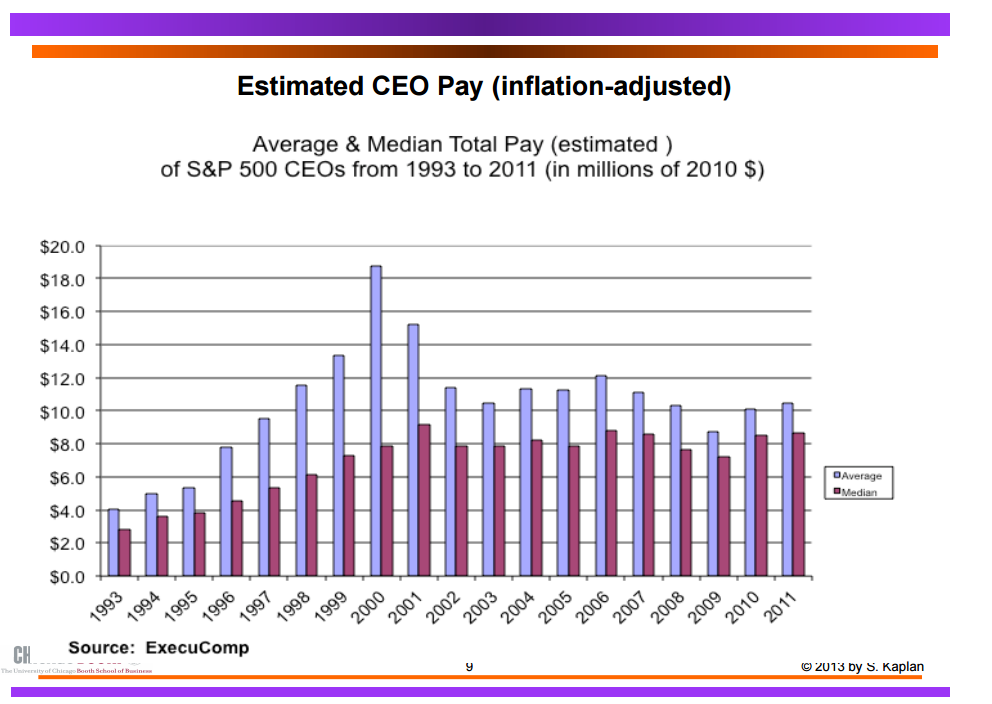
In addition, private company executives have seen their pay increase by at least as much as public companies. Private company executives with fewer agency problems have increased by more than public company executives. To close with another quote from Kaplan:
The point of these comparisons is to confirm that while public company CEOs earn a great deal, they are not unique. Other groups with similar backgrounds–private company executives, corporate lawyers, hedge fund investors, private equity investors and others—have seen significant pay increases where there is a competitive market for talent and managerial power problems are absent.
Again, if one uses evidence of higher CEO pay as evidence of managerial power or capture, one must also explain why these professional groups have had a similar or even higher growth in pay. It seems more likely that a meaningful portion of the increase in CEO pay has been driven by market forces as well.
Facebook is now worth more than Wal-Mart
25 Jun 2015 Leave a comment
in economic history, economics of media and culture, entrepreneurship, financial economics, industrial organisation, survivor principle Tags: creative destruction, entrepreneurial alertness, Facebook, Walmart
Facebook is now worth more than Walmart
buff.ly/1fuvV7V h/t @DKThomp
$FB $WMT buff.ly/1fuvSZB http://t.co/FtIIJP3EGN—
Ninja Economics (@NinjaEconomics) June 22, 2015
@MaxRashbrooke The top 1% in New Zealand are lazy and incompetent as a ruling class
24 Jun 2015 1 Comment
in applied price theory, applied welfare economics, economic history, entrepreneurship, health and safety, human capital, industrial organisation, liberalism, Marxist economics, poverty and inequality, Rawls and Nozick, unions Tags: capitalism and freedom, Class war, Joan Robinson, Joseph Schumpeter, social insurance, The Great Enrichment, top 1%, welfare state, withering away in the proletariat
New work by Chris Ball and John Creedy shows substantial *declines* in NZ inequality.
initiativeblog.com/2015/06/24/ine… http://t.co/f94fw4Bhae—
Eric Crampton (@EricCrampton) June 24, 2015
The top 1% in New Zealand really have been dropping the class war ball for at least a generation.
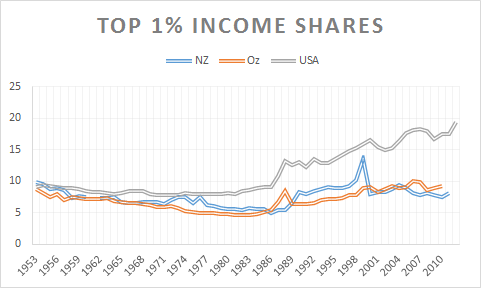
Source: The World Top Incomes Database.
Not only have the New Zealand top 1% been pretty miserable at increasing their share of incomes, hardly any change since 1990 and not much before that, the top 1% allowed inequality in both consumption and disposable income to actually fall since 1990 as shown by Treasury analysis published today.
Joan Robinson was on to this in the 1940s when she said the battle cry of Marxists would have to change from the 1848 version “rise up ye workers, rise up for you have nothing to lose but your chains” to “rise up ye workers, rise up for you have nothing to lose but the prospect of a suburban home and a motorcar”.

Today that battle cry of the Marxist revolution would have to be “rise up ye workers rise up for you have nothing to lose but your iPhone and your air points”. As Joan Robinson observed in the 1940s, that’s not much of a basis for a revolutionary movement.
GM’s 1956 vision of a self drive car by 1976
22 Jun 2015 Leave a comment
in economic history, economics of media and culture, entrepreneurship, industrial organisation, survivor principle, transport economics Tags: creative destruction, self drive cars
Biggest box office successes by profit ratio
21 Jun 2015 Leave a comment
in economics of media and culture, entrepreneurship, industrial organisation, movies, survivor principle Tags: entrepreneurial alertness, markets selection, The meaning of competition
Paranormal Activity earned 3,592x its budget in domestic ticket sales alone. #dataviz
Source: randalolson.com/2014/12/29/the… http://t.co/i6RALzOChI—
Randy Olson (@randal_olson) December 30, 2014
The difference between tariffs and quotas
18 Jun 2015 Leave a comment
in applied price theory, applied welfare economics, industrial organisation, international economics Tags: antimarket bias, import competition, international trade, protectionism, quotas, tariffs
What’s the difference between #tariffs and #quotas? Let’s find out buff.ly/1FS7QkZ http://t.co/hsx2VVG5e6—
MRUniversity (@MRevUniversity) May 30, 2015
Every 20 years we worry about losing jobs to technology
17 Jun 2015 Leave a comment
in economics of education, entrepreneurship, human capital, industrial organisation, labour economics, labour supply, occupational choice, Public Choice, rentseeking, survivor principle Tags: antimarket bias, creative distraction, expressive voting, make-work bias, rational ignorance, rational irrationality, technological unemployment
Every 20 years we worry about losing jobs to tech. books.google.com/ngrams/graph?c… http://t.co/KW47Iwzsp9—
James Bessen (@JamesBessen) August 10, 2014
Creative destruction in legacy media revenues
16 Jun 2015 Leave a comment
in economics of media and culture, entrepreneurship, industrial organisation, survivor principle Tags: creative destruction, economics of advertising, entrepreneurial alertness, legacy media, market selection
The media needs a new formula for paying for news gathering, says @bradwarthen: brook.gs/1JlfWUT http://t.co/QDGti24x1f—
Brookings (@BrookingsInst) May 15, 2015

The Value of Steve Jobs
15 Jun 2015 Leave a comment
in entrepreneurship, industrial organisation, managerial economics Tags: CEO pay, superstar wages, superstars, top 1%

| Peter Klein |
As you have likely heard, Steve Jobs is taking an indeterminate leave of absence from Apple to deal with his continuing health problems. How will this affect Apple? How important is one person — albeit the founder and CEO — to a diversified multinational company with tens of thousands of employees? Apple’s stock slipped slightly on the news of Jobs’ leave (down 2.3 percent today, the first trading day after the announcement), but Jobs’s health problems are well known and Apple’s stock price presumably already included a discount reflecting the possibility he’d step down. To estimate the value of a particular employee to the firm in this way, we need an unanticipated departure, one that isn’t a response to poor performance and isn’t expected in advance.
Sure, enough, there’s an app for that — I mean, there’s a literature on that. An influential 1985 paper by Bruce Johnson, Robert Magee, Nandu…
View original post 429 more words
Is Uber taking British customers for a ride?
14 Jun 2015 Leave a comment
in economics of regulation, entrepreneurship, industrial organisation, survivor principle Tags: creative destruction, taxi regulation, Uber
Is Uber taking British customers for a ride? i100.io/40kqOqH http://t.co/ok7UJmmgNQ—
i100 (@thei100) June 11, 2015

Milton Friedman on the essence of the Age of the Worker
13 Jun 2015 Leave a comment
in applied price theory, applied welfare economics, economic growth, economic history, health and safety, income redistribution, industrial organisation, labour economics, labour supply, macroeconomics, Milton Friedman, occupational choice, politics - Australia, politics - New Zealand, politics - USA, Public Choice, rentseeking, unions Tags: competition and monopoly, The Great Enrichment, union power, union wage premium
 Utopia, you are standing in it!
Recent Comments