22 Aug 2015
by Jim Rose
in applied price theory, applied welfare economics, economics of bureaucracy, economics of regulation, financial economics, income redistribution, industrial organisation, politics - Australia, politics - New Zealand, politics - USA, Public Choice, rentseeking, survivor principle
Tags: Australia, billionaires, Russia, top 0.1%, top 1%

…Bagchi and Svejnar carefully went through the lists of all the Forbes billionaires, and divided them into those who had acquired their wealth due to political connections, and those who had not. This is kind of a slippery slope — almost all billionaires have probably benefited from government connections at one time or another.
But the researchers used a very conservative standard for classifying people as politically connected, only assigning billionaires to this group when it was clear that their wealth was a product of government connections. Just benefiting from a government that was pro-business, like those in Singapore and Hong Kong, wasn’t enough.
Rather, the researchers were looking for a situation like Indonesia under Suharto, where political connections were usually needed to secure import licenses, or Russia in the mid-1990s, when some state employees made fortunes overnight as the state privatized assets.
…The negative effects of wealth inequality are largely being driven by politically connected wealth inequality. That seems to be the primary channel that drives this relationship…
a 3.72 percent increase in the level of wealth inequality would cost a country about half a percent of real GDP per capita growth. That’s a big impact, given that average GDP growth is in the neighbourhood of two percent per year
18 Aug 2015
by Jim Rose
in applied price theory, applied welfare economics, entrepreneurship, industrial organisation, Public Choice, rentseeking, survivor principle
Tags: competition as a discovery procedure, economics of science, industry policy, losers, picking winners, R&D, The meaning of competition, The pretence the knowledge
17 Aug 2015
by Jim Rose
in applied price theory, applied welfare economics, economic growth, economic history, entrepreneurship, financial economics, fiscal policy, industrial organisation, labour economics, labour supply, macroeconomics, politics - New Zealand, public economics
Tags: ageing society, company tax rate, deadweight cost of taxes, demographic crisis, efficient markets hypothesis, laffer curve, New Zealand superannuation fund, old age pensions, retirement savings, social insurance, sovereign wealth funds, taxation and entrepreneurship, taxation and investment, taxation and labour supply
The New Zealand Superannuation Fund, the sovereign wealth fund part funding New Zealand’s old-age pension from 2029/2030 onwards, has been a bit of a wild ride. Sometimes the earnings of the Fund were well below and sometimes earning well above the long-term bond rate.
![image_thumb[3]](https://utopiayouarestandinginit.com/wp-content/uploads/2015/08/image_thumb3_thumb.png?w=709&h=442 "image_thumb[3]")
Source: New Zealand Superannuation Fund Annual Report 2014.
Since its inception, the Fund earned an average annual return of 9.78%, which was 5.06% above the long-term bond rate, and 1.03% above its reference portfolio.

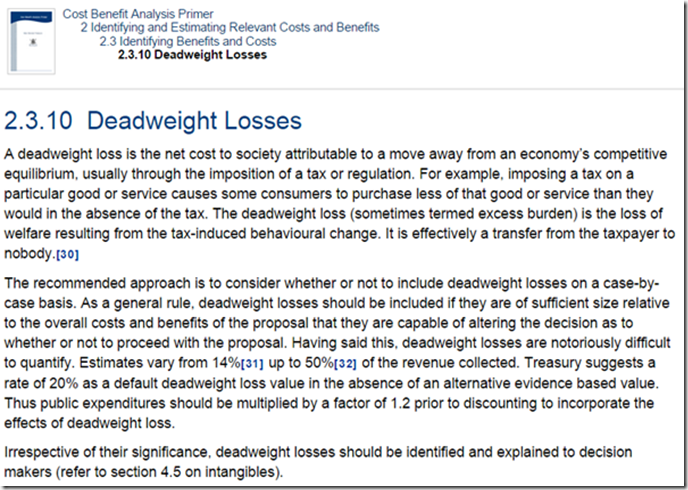
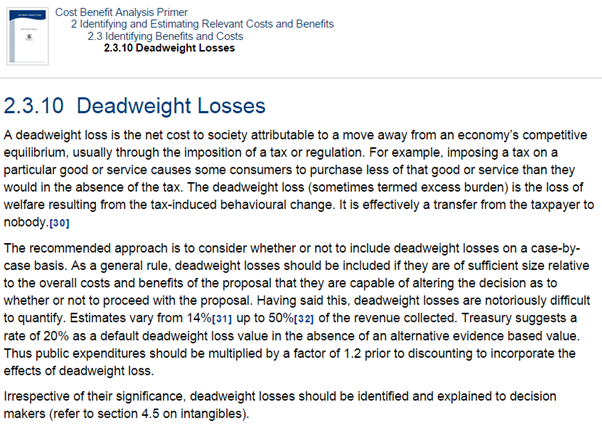
No information was given in the annual report of the New Zealand Superannuation Fund on the marginal dead weight cost of the taxes raised to fund the New Zealand Superannuation Fund to see whether there is any net benefit to taxpayers from its establishment and continued operation.
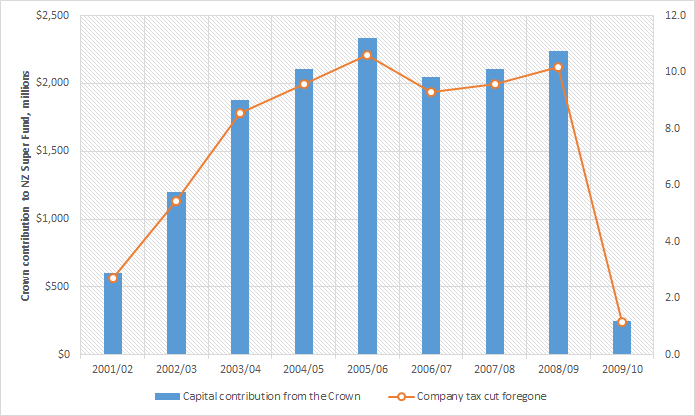
The New Zealand Government has contributed $14.88 billion to the fund from prior its inception in 2001 to the suspension of contributions in 2009 by the incoming National Party Government.
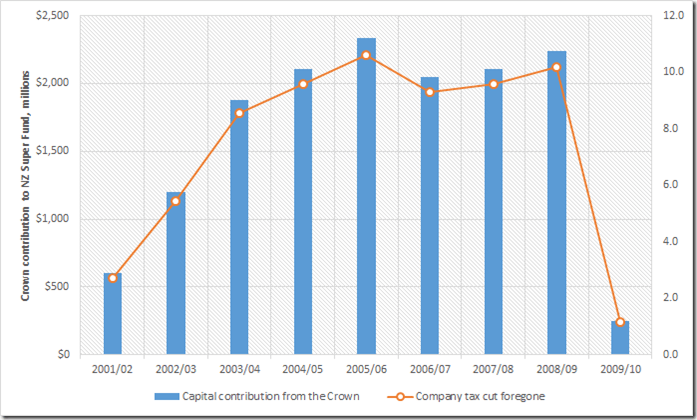
Source: New Zealand Treasury.
Over the nine years in which contributions were made, the company tax rate of 28% could have easily been up to 10 percentage points lower.
The New Zealand Treasury estimates that a one percentage point cut in the company tax costs about $220 million in forgone revenue if there are no other changes to the tax system. These are static estimates that do not include any feedback from greater investment and higher growth.
The New Zealand Superannuation Fund must beat the market every single year to make up for the deadweight cost of its funding, a premium for the investment risk added to the Crown’s portfolio and the cost to New Zealand’s growth rate of higher than otherwise taxes on income, entrepreneurship and investment.
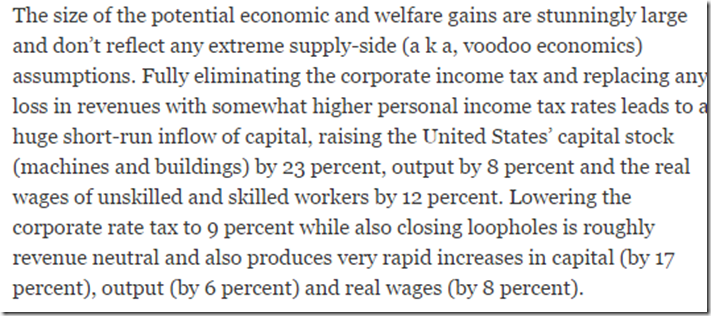
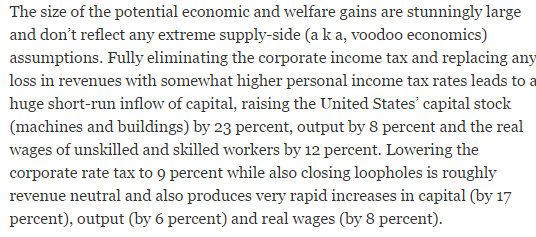
Source: Abolish the Corporate Income Tax – The New York Times.
15 Aug 2015
by Jim Rose
in applied price theory, industrial organisation, politics - New Zealand, public economics
Tags: privatisation, state owned enterprises
In the editorial today in the Dominion Post on the Solid Energy fiasco, the editorial writer made quite an extraordinary statement:
“Ideologues of the Right will claim that the whole sad fiasco shows the dangers of the state getting into business. This is simple-minded. Not all SOEs have ended up hundreds of millions of dollars in debt. Some SOEs have been well run; some have not.”
It is absurd to claim that making a $20 million net profit on a portfolio of $30 billion in state owned enterprises in 2013 is some sort of reasonable investment for the taxpayer.
 Homepaddock
Opponents to the sale of minority shareholdings in a few state owned assets would have us believe that the government is selling the family silver.
Treasury’s annual portfolio return shows that silver isn’t returning much:
Government businesses with assets worth $45 billion made a total net profit of just $20 million in the year to June 30, according to the Treasury’s annual portfolio report.
The assets don’t include Meridian Energy, Air New Zealand and Mighty RiverPower, which were partially privatised, but cover troubled entities like KiwiRail, Solid Energy and New Zealand Post, which are all struggling to make their business models work.
The annual review covers Crown-owned assets valued at $125b.
A return of just $20 million on $125b is lamentably low.
“For the residual commercial priority portfolio, overall performance (with some notable exceptions) was mediocre,” the Treasury’s Crown Ownership Monitoring Unit says in the report. . .
Total shareholder…
View original post 332 more words
15 Aug 2015
by Jim Rose
in applied price theory, economics of bureaucracy, economics of crime, history of economic thought, industrial organisation, law and economics, liberalism, Milton Friedman, Public Choice
Tags: cartel theory, crime and punishment, criminal deterrence, organised crime, war on drugs
15 Aug 2015
by Jim Rose
in applied price theory, development economics, economic history, industrial organisation, politics - USA, public economics, rentseeking, survivor principle
Tags: Puerto Rico
 Arindrajit Dube
(Co-authored with Ben Zipperer. Posted at Washington Center for Equitable Growth)
Puerto Rico today faces a serious debt crisis, recently defaulting on a bond payment. The proximate cause is a slowdown in economic growth since the mid-2000s, which has reduced tax revenues, and a declining labor market, where employment growth has been mostly in the red since 2007.
There are many explanations for the economic downturn and the resulting fiscal crisis, but some commentators have incorrectly blamed the island’s high minimum wage. To be sure, the federal minimum wage—which has applied to Puerto Rico since 1983—is much more binding there than it is on the mainland. Because hourly wages are substantially lower in Puerto Rico compared to the U.S. mainland, the federal minimum wage policy affects more of the workforce there. In 2014, for example, the federal minimum wage stood at 77 percent of the median hourly wage in Puerto Rico…
View original post 117 more words
15 Aug 2015
by Jim Rose
in applied price theory, applied welfare economics, economic history, entrepreneurship, industrial organisation, survivor principle
Tags: antimarket bias, entrepreneurial alertness, superstar wages, superstars, top 0.1%, top 1%, top wage earners
14 Aug 2015
by Jim Rose
in development economics, economic history, entrepreneurship, growth miracles, industrial organisation, international economics, survivor principle
Tags: automotive industry, car industry, comparative advantage, creative destruction, entrepreneurial alertness, manufacturing industry, market selection, The meaning of competition
Previous Older Entries Next Newer Entries

![image_thumb[3]](https://utopiayouarestandinginit.com/wp-content/uploads/2015/08/image_thumb310.png "image_thumb[3]")
/cdn0.vox-cdn.com/uploads/chorus_asset/file/3966560/11754389_920572351334762_1285855543300283646_o.jpg)


Recent Comments