

HT: Do nine out of 10 new businesses fail, as Rand Paul claims? – The Washington Post.
For venture capital start-ups, about three or 4 out of 10 fail; three or 4 out of 10 return the original investment, with the rest offering a substantial profit.
Celebrating humanity's flourishing through the spread of capitalism and the rule of law
02 Mar 2015 Leave a comment
in economic history, entrepreneurship, survivor principle
HT: Do nine out of 10 new businesses fail, as Rand Paul claims? – The Washington Post.
For venture capital start-ups, about three or 4 out of 10 fail; three or 4 out of 10 return the original investment, with the rest offering a substantial profit.
02 Mar 2015 Leave a comment
in economics of media and culture, industrial organisation, survivor principle Tags: creative destruction, legacy media
28 Feb 2015 Leave a comment
in economics of media and culture, industrial organisation, survivor principle Tags: creative destruction, legacy media
20 Feb 2015 Leave a comment
in economics of media and culture, entrepreneurship, rentseeking, survivor principle Tags: legacy media, The Guardian

A small levy on UK broadband providers – no more than £2 a month on each subscriber’s bill – could be distributed to news providers in proportion to their UK online readership. This would solve the financial problems of quality newspapers, whose readers are not disappearing, but simply migrating online.
via A £2-a-month levy on broadband could save our newspapers | Media | The Guardian.
Did The Guardian just come out in support of a poll tax? Most people have broadband, so it’s the same practical effect?
20 Feb 2015 Leave a comment
in entrepreneurship, financial economics, industrial organisation, survivor principle Tags: active investing, efficient markets hypothesis, passive investing, William F. Shape
After costs, the return on the average actively managed dollar will be less than the return on the average passively managed dollar for any time period.
—William F. Sharpe, 1990 Nobel Laureate
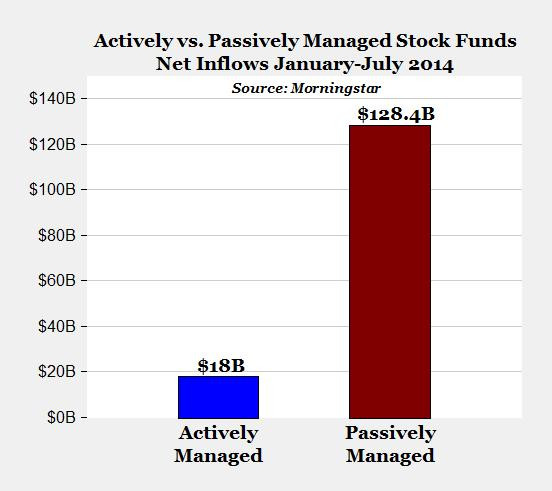
4 out of 5 actively managed fund portfolios underperformed all index fund portfolios in all scenarios tested.


via The tide is turning as investors switch from high-cost, actively managed funds to index funds for lower costs, higher returns » AEI | Carpe Diem Blog » AEIdeas and Mutual Fund Expenses | Lion’s Share.
.
19 Feb 2015 Leave a comment
in entrepreneurship, industrial organisation, managerial economics, organisational economics, personnel economics, survivor principle Tags: entrepreneurial alertness, management, MBA

“Avoid jargon” because most people misuse it. Force yourself to spell out what you mean in simple plain English. It will help your thinking and communication.
“What about the organizational design?” Figure out what is causing the problem, and then think about how to avoid the problem. A lot of papers identified a bad decision, and then suggested reversing it. But they neglected to address the issue of why the bad decision was made, and how to make sure the same mistakes wouldn’t be made in the future.
“Don’t define the problem as the lack of your solution.” For example, if the problem is “the lack of centralized purchasing,” then you are locked into a solution of “centralized purchasing.” Instead, define the problem as “high acquisition cost” and then examine “centralized purchasing” vs. “decentralized purchasing” (or some other alternative) as two solutions to the problem.
“What is the trade-off?” Every solution has costs as well as benefits. If you list only the benefits, it makes your analysis seem like an ex post rationalization of a foregone decision, rather than a careful weighing of the benefits and costs. If you spent some time thinking through the tradeoffs, show it. If not, then you should.
“Which language is this?” I write this when I get gobbledygook written in the passive voice with big words that don’t mean anything. Instead write simple declarative sentences that clarify rather than obfuscate. Form is not a substitute for content.
via Managerial Econ: Top 5 problem-solving mistakes by MBA’s.
19 Feb 2015 Leave a comment
in Austrian economics, development economics, economic history, economics of media and culture, growth miracles, industrial organisation Tags: China, transitional economies

Use of the word “communal” rose sharply during the Cultural Revolution, especially from 1970 to 1976; it decreased during the 1980s. (China launched economic reforms in 1978, and they continue to this day.)
The word “autonomy” was used just one-third as frequently as “obedience” in 1970. In 2008, the ratio had flipped and “autonomy” appeared three times as much as “obedience.”
The increase in use of words like “choose,” “compete,” “private,” “autonomy” and “innovation” demonstrated a growing prevalence of individualistic values coinciding with sharp rises in urban population, household consumption and education levels.
Words reflecting communal values, such as “help” and “sacrifice,” declined in frequency.
via Words used in Chinese books illuminate how a nation’s values changed during economic reforms | UCLA.
18 Feb 2015 Leave a comment
Celebrating humanity's flourishing through the spread of capitalism and the rule of law
Celebrating humanity's flourishing through the spread of capitalism and the rule of law
Celebrating humanity's flourishing through the spread of capitalism and the rule of law
Celebrating humanity's flourishing through the spread of capitalism and the rule of law
Celebrating humanity's flourishing through the spread of capitalism and the rule of law
Celebrating humanity's flourishing through the spread of capitalism and the rule of law
Celebrating humanity's flourishing through the spread of capitalism and the rule of law
Celebrating humanity's flourishing through the spread of capitalism and the rule of law
A History of the Alt-Right
Econ Prof at George Mason University, Economic Historian, Québécois
Celebrating humanity's flourishing through the spread of capitalism and the rule of law
Scholarly commentary on law, economics, and more
Beatrice Cherrier's blog
Celebrating humanity's flourishing through the spread of capitalism and the rule of law
Celebrating humanity's flourishing through the spread of capitalism and the rule of law
Celebrating humanity's flourishing through the spread of capitalism and the rule of law
Why Evolution is True is a blog written by Jerry Coyne, centered on evolution and biology but also dealing with diverse topics like politics, culture, and cats.
Celebrating humanity's flourishing through the spread of capitalism and the rule of law
A rural perspective with a blue tint by Ele Ludemann
DPF's Kiwiblog - Fomenting Happy Mischief since 2003
Celebrating humanity's flourishing through the spread of capitalism and the rule of law
The world's most viewed site on global warming and climate change
Tim Harding's writings on rationality, informal logic and skepticism
A window into Doc Freiberger's library
Let's examine hard decisions!
Commentary on monetary policy in the spirit of R. G. Hawtrey
Thoughts on public policy and the media
Celebrating humanity's flourishing through the spread of capitalism and the rule of law
Politics and the economy
A blog (primarily) on Canadian and Commonwealth political history and institutions
Reading between the lines, and underneath the hype.
Economics, and such stuff as dreams are made on
"The British constitution has always been puzzling, and always will be." --Queen Elizabeth II
Celebrating humanity's flourishing through the spread of capitalism and the rule of law
Celebrating humanity's flourishing through the spread of capitalism and the rule of law
WORLD WAR II, MUSIC, HISTORY, HOLOCAUST
Undisciplined scholar, recovering academic
Celebrating humanity's flourishing through the spread of capitalism and the rule of law
Res ipsa loquitur - The thing itself speaks
In Hume’s spirit, I will attempt to serve as an ambassador from my world of economics, and help in “finding topics of conversation fit for the entertainment of rational creatures.”
Researching the House of Commons, 1832-1868
Articles and research from the History of Parliament Trust
Reflections on books and art
Posts on the History of Law, Crime, and Justice
Celebrating humanity's flourishing through the spread of capitalism and the rule of law
Exploring the Monarchs of Europe




Recent Comments