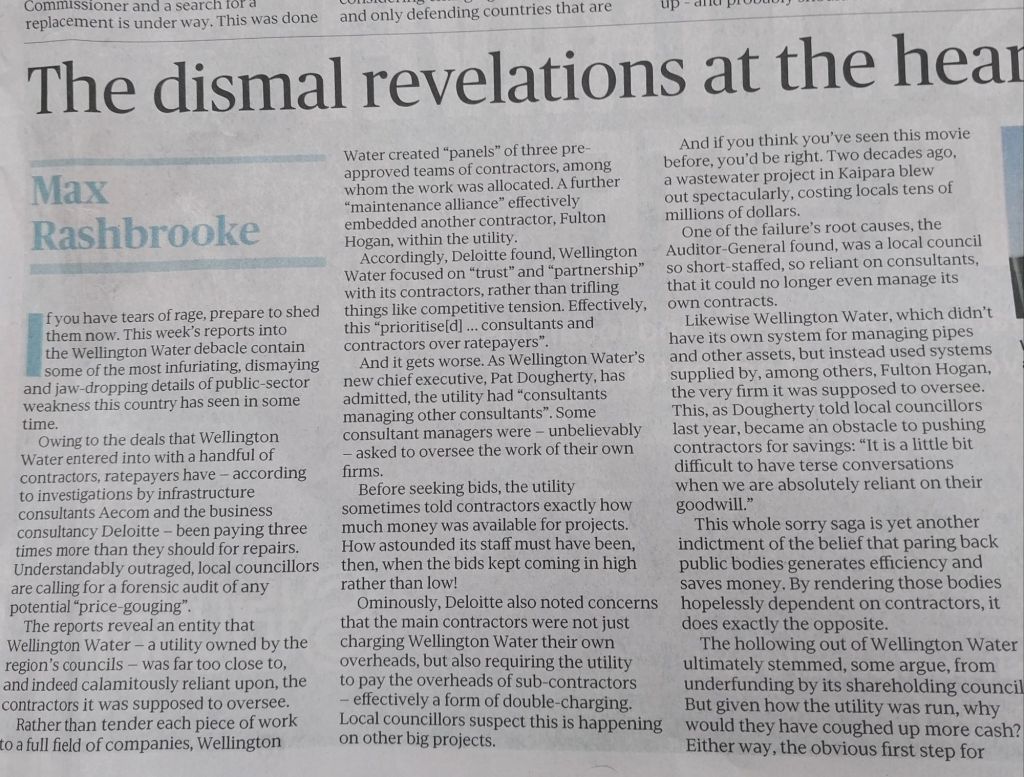
Max Rashbrooke has been kidnapped again to be replaced by a neoliberal doppelganger
08 Mar 2025 Leave a comment
in applied price theory, comparative institutional analysis, economics of bureaucracy, industrial organisation, managerial economics, market efficiency, organisational economics, politics - New Zealand, Public Choice, public economics Tags: privatisation
How Much Do Tariffs Raise Prices?
08 Mar 2025 Leave a comment
in applied price theory, economic history, history of economic thought, industrial organisation, international economics, politics - USA Tags: 2024 presidential election, free trade, tariffs
We break down how much of a tariff is ‘passed through’ to customersBy Jason Douglas, Anthony DeBarros and Danny Dougherty of The WSJ. Excerpts:”For example, a 10% tariff on shoes from China would raise their sticker price 4% or so, but on wine or olive oil from Italy, almost 10%.Why the difference? Tariffs aren’t the…
How Much Do Tariffs Raise Prices?
The Licensing Racket
08 Mar 2025 Leave a comment
in applied price theory, economics of bureaucracy, entrepreneurship, human capital, income redistribution, industrial organisation, labour economics, labour supply, law and economics, occupational choice, occupational regulation, property rights, Public Choice, rentseeking
I review a very good new book on occupational licensing, The Licensing Racket by Rebecca Haw Allensworth in the WSJ. Most people will concede that licensing for hair braiders and interior decorators is excessive while licensing for doctors, nurses and lawyers is essential. Hair braiders pose little to no threat to public safety, but subpar […]
The Licensing Racket
Peter Navarro Conducts a Master Class In Looking Only at That Which Is Seen
06 Mar 2025 Leave a comment
in applied price theory, history of economic thought, industrial organisation, international economic law, international economics, International law, survivor principle Tags: current account, free trade, tariffs
TweetHere’s a letter to USA Today. Editor: Defending Pres. Trump’s aluminum tariffs, Peter Navarro focuses exclusively on the effects of these tariffs on U.S. aluminum producers (“Trump tariffs will save American jobs and level the playing field,” Feb. 28). He points out what no serious defender of free trade denies, namely, that punitive taxation of…
Peter Navarro Conducts a Master Class In Looking Only at That Which Is Seen
More Deficient Economic Thinking
03 Mar 2025 Leave a comment
in applied price theory, industrial organisation, international economics Tags: current account, free trade, tarrifs
TweetHere’s a letter to the Wall Street Journal. Editor: Anthony deBarros and Peter Santilli report on “the countries fueling America’s $1.2 trillion goods trade deficit” (March 1). With respect, what’s the point of such a report? Eighty percent of U.S. GDP is produced by the service sector – implying that the vast majority of Americans…
More Deficient Economic Thinking
The 2023 Merger Guidelines Will Remain: What Does That Mean?
03 Mar 2025 Leave a comment
in applied price theory, economics of regulation, entrepreneurship, industrial organisation, politics - USA, survivor principle Tags: 2024 presidential election, competition law, merger law enforcement
Under current law, any US companies considering a merger or acquisition that is above $125 million in size must first report it to the government. The most recent data for 2023 says that 1,805 such transactions were reported in 2023, which was a relatively low number for recent years. In 2021 and 2022, for example,…
The 2023 Merger Guidelines Will Remain: What Does That Mean?
BP Faces “Existential Crisis” After Ruinous Attempt to Go Green
02 Mar 2025 Leave a comment
in applied price theory, economics of climate change, energy economics, entrepreneurship, environmental economics, environmentalism, financial economics, global warming, industrial organisation, politics - USA, survivor principle Tags: 2024 presidential election, climate activists, climate alarmism, efficient markets hypothesis, greenwashing
BP’s green pivot has backfired spectacularly, hammering profits and leaving the company vulnerable to a hedge fund siege, writes Jonathan Leake in the Telegraph.
BP Faces “Existential Crisis” After Ruinous Attempt to Go Green
DON BRASH: From the internet to medicines, nothing in New Zealand is safe from Treaty mania
01 Mar 2025 Leave a comment
in economics of education, economics of regulation, industrial organisation, labour economics, liberalism, Marxist economics, occupational regulation, politics - New Zealand Tags: affirmative action, free speech, political correctness, racial discrimination, regressive left
The following is written in Don’s capacity as Hobson’s Pledge trustee. You may not have heard of InternetNZ or know exactly what they…
DON BRASH: From the internet to medicines, nothing in New Zealand is safe from Treaty mania
$50 million of taxpayer money on a ski field
01 Mar 2025 Leave a comment
in applied price theory, fiscal policy, industrial organisation, macroeconomics, politics - New Zealand, Public Choice, public economics, rentseeking, survivor principle Tags: corporate welfare
Newsroom has a summary of taxpayer money spent on Mt Ruapehu: How often have we been told this is the final assistance. We are now deep into the sunk cost fallacy.
$50 million of taxpayer money on a ski field
Mandated Board Diversity Reduces Firm Value
27 Feb 2025 Leave a comment
in applied price theory, discrimination, econometerics, economics of regulation, financial economics, gender, industrial organisation, labour economics, occupational choice, politics - USA Tags: efficient markets hypothesis, sex discrimination
Jon Klick finds that when courts in CA surprisingly invalidated a set of DEI laws, the market value of firms subject to those laws increased: California mandated that firms headquartered in the state include women (SB 826) and underrepresented minorities (AB 979) on their corporate boards. These laws, passed in 2018 and 2020 respectively, were […]
Mandated Board Diversity Reduces Firm Value
The American Rōnin: How Displaced “Disinformation Experts” Are Seeking New Opportunities in Europe and Academia
27 Feb 2025 Leave a comment
in economics of bureaucracy, economics of education, economics of information, economics of media and culture, entrepreneurship, financial economics, industrial organisation, law and economics, liberalism, Marxist economics, politics - USA, property rights, Public Choice, rentseeking Tags: 2024 presidential election, free speech, political correctness, regressive left

Below is my column in the Hill on the new American emigres: “disinformation experts” who are finding themselves unemployed with the restoration of free speech protections. Here is the column:
The American Rōnin: How Displaced “Disinformation Experts” Are Seeking New Opportunities in Europe and Academia
The Spectacular Economic Ignorance of Peter Navarro
20 Feb 2025 1 Comment
in applied price theory, Austrian economics, history of economic thought, industrial organisation, international economics, labour economics, labour supply, survivor principle, unemployment Tags: 2024 presidential election, free trade, tarrifs
TweetHere’s a letter to the New York Times. Editor: Encountering, in David Leonhardt’s report, a summary of Peter Navarro’s attempted justifications of Trump’s tariffs makes the head spin (“A Disagreement on Tariffs,” February 18). Navarro’s arguments are so illogical, self-contradictory, and economically ignorant that they’d be merely laughable were he not an advisor to the…
The Spectacular Economic Ignorance of Peter Navarro
Trade 101 for Trumpies
08 Feb 2025 Leave a comment
in applied price theory, applied welfare economics, Austrian economics, comparative institutional analysis, constitutional political economy, development economics, entrepreneurship, industrial organisation, international economics, politics - USA Tags: 2024 presidential election
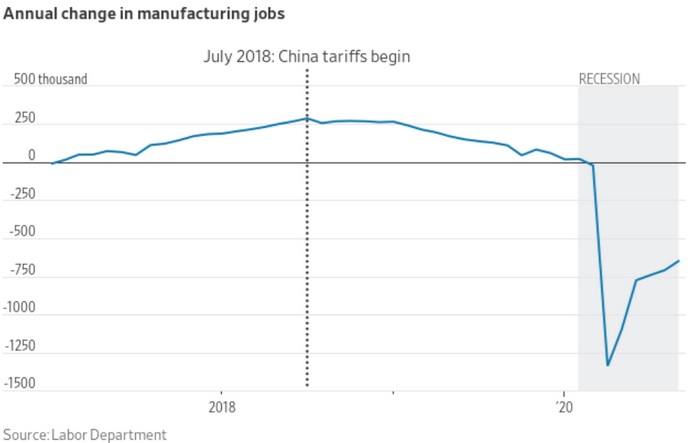
To augment my four-part video series about trade (dealing with the WTO, creative destruction, deficits, and economics), here’s part of my recent lecture about Trump’s trade policy to the Universidad de Libertad in Mexico City For those who (mistakenly) want to skip the video, my speech focused on these five themes. Trade deficits don’t matter. […]
Trade 101 for Trumpies
A negative productivity shock from working from home
08 Feb 2025 Leave a comment
in applied price theory, experimental economics, industrial organisation, labour economics, labour supply, managerial economics, occupational choice, organisational economics, personnel economics Tags: economics of pandemics
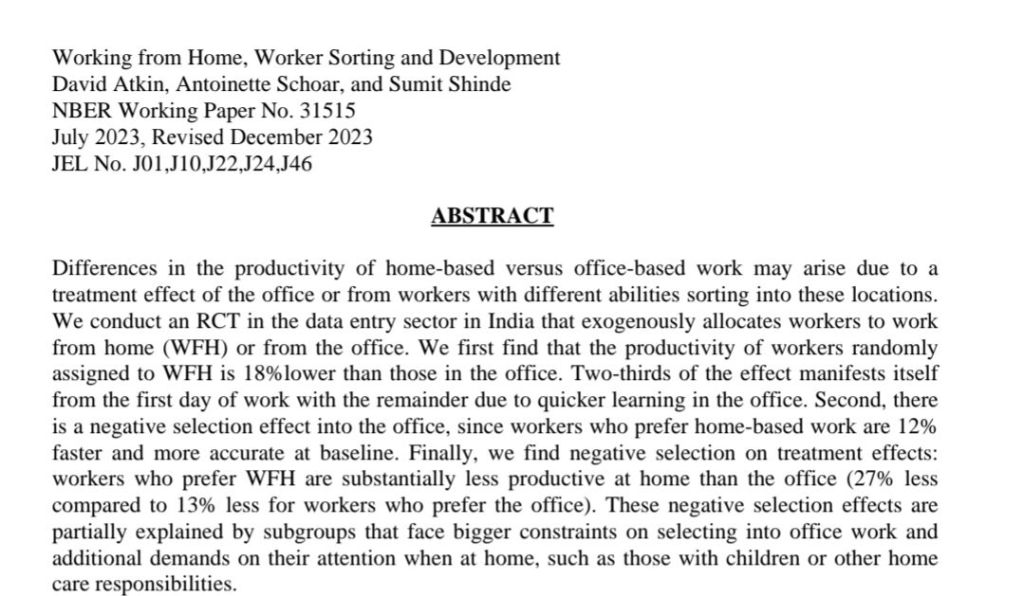
By 2025 we were supposed to have closed the gap
05 Feb 2025 Leave a comment
in economic growth, economics of regulation, entrepreneurship, human capital, industrial organisation, labour economics, labour supply, macroeconomics, politics - New Zealand, poverty and inequality
Don Brash and Michael Reddell write – When Don was young and Michael’s parents were young, New Zealand had among the very highest material standards of living in the world. It really was, in the old line, one of the very best places to bring up children. But no longer. For 75 years now, with […]
By 2025 we were supposed to have closed the gap
 Utopia, you are standing in it!
Recent Comments