QUESTION TO CLAUDE 3: The EU and China lag behind the US in economic dynamism, measured by start-up activity, number of unicorns, age of unicorns (younger indicates more rapid innovation), and in productivity growth. Can you document this and tell me why?ANSWER: Here is the data to document the economic dynamism gap between the US,…
Claude 3 on why the US leads China and the EU in economic dynamism
Claude 3 on why the US leads China and the EU in economic dynamism
21 May 2024 Leave a comment
in applied price theory, comparative institutional analysis, development economics, economics of regulation, entrepreneurship, growth miracles, industrial organisation, managerial economics, organisational economics, public economics, survivor principle Tags: taxation and entrepreneurship, taxation and investment
Debunking Bad Class Warfare and Debunking Nonsensical Class Warfare
19 May 2024 Leave a comment
in applied price theory, economic history, economics of education, entrepreneurship, human capital, income redistribution, industrial organisation, labour economics, labour supply, occupational choice, politics - USA, poverty and inequality, Public Choice Tags: taxation and entrepreneurship, taxation and investment

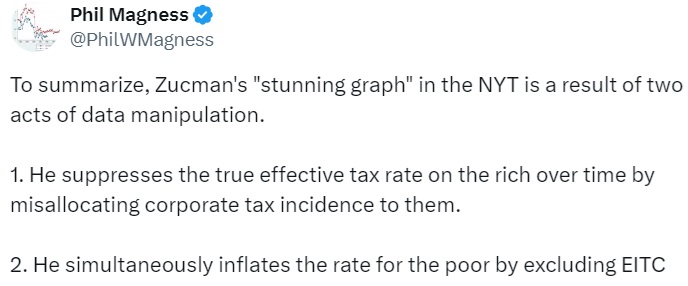
Like Thomas Piketty, Gabriel Zucman is a French economist who promotes economically destructive class-warfare tax policy. He’s also infamous for dodgy data manipulation, as Phil Magness explains in this Reason discussion. The interview lasts for 64 minutes, and I recommend the entire discussion. Yes, that’s a lot of time, but Phil has encyclopedic knowledge and […]
Debunking Bad Class Warfare and Debunking Nonsensical Class Warfare
Is it time to take the Interislander away from Kiwirail?
17 May 2024 Leave a comment
in applied price theory, economics of bureaucracy, industrial organisation, law and economics, managerial economics, politics - New Zealand, privatisation, property rights, Public Choice, survivor principle, theory of the firm, transport economics
The Herald reports: KiwiRail’s seemingly endless requests for more money is damning. At one point, KiwiRail assured Robertson when he was the Finance Minister that the worst-case scenario would be an extra $300 million before requesting $1.2 billion a few months later. Not what most people regard as worst case. It’s no wonder Ministry of Transport officials […]
Is it time to take the Interislander away from Kiwirail?
Business Freeze: Germany’s Last Solar Panel Manufacturers Finally Crushed
15 May 2024 Leave a comment
in energy economics, entrepreneurship, environmental economics, financial economics, global warming, industrial organisation, survivor principle Tags: Germany, solar power

Germany’s costly and chaotic wind and solar transition has served up plenty of casualties. Large numbers of energy intensive manufacturers have already bailed out – chasing cheap power prices in places like the US and Singapore. Now, in a rather ironic twist, its solar panel manufacturing industry has all but thrown in the towel. Notwithstanding […]
Business Freeze: Germany’s Last Solar Panel Manufacturers Finally Crushed
Full-blown Financial Meltdown: Offshore Wind Industry’s Collapse Accelerates
14 May 2024 Leave a comment
in energy economics, environmental economics, global warming, industrial organisation, politics - USA, survivor principle Tags: wind power

America’s offshore wind industry is collapsing, both figuratively and literally. Offshore turbines have grown in capacity and size to the point where they simply collapse into the ocean. As do the financial prospects of those seeking to profit from them. One of the key players offshore – GE’s renewables division – backed up a solid […]
Full-blown Financial Meltdown: Offshore Wind Industry’s Collapse Accelerates
The Rise and Decline and Rise Again of Mancur Olson
09 May 2024 Leave a comment
in applied price theory, comparative institutional analysis, constitutional political economy, development economics, economic history, growth disasters, growth miracles, history of economic thought, income redistribution, industrial organisation, law and economics, property rights, Public Choice, public economics, rentseeking

Mancur Olson’s The Rise and Decline of Nations is one of my favorite books and a classic of public choice. Olson may well have won the Nobel prize had he not died young. He summarized his book in nine implications of which I will present four: 2. Stable societies with unchanged boundaries tend to accumulate […]
The Rise and Decline and Rise Again of Mancur Olson
Dishonest Pimping for a Global Wealth-Tax Cartel
07 May 2024 Leave a comment
in applied price theory, economic growth, economic history, entrepreneurship, human capital, income redistribution, industrial organisation, labour economics, labour supply, macroeconomics, Marxist economics, politics - USA, Public Choice, public economics Tags: taxation and entrepreneurship, taxation and investment, wealth tax
Everything you need to know about wealth taxation can be summarized in two sentences. The biggest problem with most tax systems is the pervasive tax bias against income that is saved and invested, which discourages the accumulation of capital that helps to finance future growth. Wealth taxes would dramatically increase the tax bias against saving […]
Dishonest Pimping for a Global Wealth-Tax Cartel
Some Economics of Tipping
01 May 2024 Leave a comment
in applied price theory, economic history, industrial organisation, labour economics, labour supply Tags: asymmetric information, moral hazard, tipping
Why leave a tip? You have already received whatever food or service you are going to receive. Maybe if you are a very regular customer, tipping could lead to better service in the future. But most people who leave tips do so even if they are stopping off at, say, a restaurant in a city…
Some Economics of Tipping
Quotation of the Day…
28 Apr 2024 Leave a comment
in applied price theory, Austrian economics, history of economic thought, industrial organisation, law and economics Tags: competition law
Tweet… is from page 422 of Robert Bork’s masterful 1978 book, The Antitrust Paradox: Competition in open markets reflects the ideal of equality of opportunity, while antitrust’s longstanding and growing concern for the small and less efficient reflects a preference for equality of outcome. Outcomes are not equal in open competition, hence the pressure for…
Quotation of the Day…
Why Socialism Won’t Die
26 Apr 2024 Leave a comment
in applied price theory, comparative institutional analysis, constitutional political economy, development economics, economic history, economics of bureaucracy, entrepreneurship, growth disasters, history of economic thought, income redistribution, industrial organisation, law and economics, liberalism, Marxist economics, property rights, Public Choice Tags: economics of socialism

“to employ a hundred people is… exploitation, but to command the same number [is] honorable.” That’s an actual book by the way, explaining that although communism has failed in the past across different nations, races and cultures, it might work in the future where machines can create anything we want. Think Star Trek’s replicator technology. […]
Why Socialism Won’t Die
US v. Google: do complaints have to be internally consistent?
26 Apr 2024 Leave a comment
in applied price theory, entrepreneurship, industrial organisation, law and economics, managerial economics, organisational economics, politics - USA Tags: competition law, creative destruction
From former DOJ Economist Greg Werden: The governments case suggests that its exclusive deals with Apple and Mozilla to be the default search engine on their browsers “allowed Google to maintain its monopoly power [in “general search”] in violation of Section 2 of the Sherman Act.” However, the government’s brief also suggests that Google’s scale is very important,…
US v. Google: do complaints have to be internally consistent?
Is the Commerce Commission for consumers or suppliers
24 Apr 2024 Leave a comment
in applied price theory, applied welfare economics, economics of regulation, industrial organisation Tags: competition law, merger law enforcement
Max Salmon writes: Last week the Commerce Commission announced its concern with a proposed merger between Foodstuffs North Island and Foodstuffs South Island. Their concern is a decrease in competition in the market. It sounds crazy when you first hear it, but it’s even weirder when you see what the Commerce Commission is actually worried […]
Is the Commerce Commission for consumers or suppliers
Still no prudential regulation case around climate change
24 Apr 2024 Leave a comment
in economics of bureaucracy, economics of climate change, environmental economics, environmentalism, financial economics, global warming, industrial organisation, law and economics, macroeconomics, monetary economics, politics - New Zealand, Public Choice, survivor principle Tags: climate alarmism
Eric Crampton writes – The Reserve Bank of New Zealand desperately wants to find reasons to have workstreams in climate change. It makes little sense.
Still no prudential regulation case around climate change
Dumb Idea of the Month: Currency Devaluation
23 Apr 2024 Leave a comment
in applied price theory, applied welfare economics, industrial organisation, international economics
Five years ago, I shared this video explaining why trade deficits generally don’t matter. The most important thing to understand is that a trade deficit is the same thing as a financial account surplus (formerly known as a capital surplus), which is easy to understand when reviewing this graph. And that type of surplus occurs […]
Dumb Idea of the Month: Currency Devaluation
“The Simple Macroeconomics of AI”
21 Apr 2024 Leave a comment
in applied price theory, economic growth, entrepreneurship, human capital, industrial organisation, labour economics, labour supply, macroeconomics, poverty and inequality Tags: artificial intelligence
That is the new Daron Acemoglu paper, and he is skeptical about its overall economic effects. Here is part of the abstract: Using existing estimates on exposure to AI and productivity improvements at the task level, these macroeconomic effects appear nontrivial but modest—no more than a 0.71% increase in total factor productivity over 10 years.…
“The Simple Macroeconomics of AI”
 Utopia, you are standing in it!
Recent Comments