https://www.facebook.com/share/sBU4jrUEAUnL2CYs/?mibextid=xfxF2i
Celebrating humanity's flourishing through the spread of capitalism and the rule of law
28 Sep 2024 Leave a comment
in applied price theory, industrial organisation, labour economics, labour supply, managerial economics, occupational choice, organisational economics, personnel economics Tags: creative destruction, economics of pandemics
27 Sep 2024 Leave a comment
in applied price theory, economic history, entrepreneurship, history of economic thought, human capital, income redistribution, industrial organisation, labour economics, labour supply, liberalism, Marxist economics, occupational choice, poverty and inequality, Public Choice Tags: top 1%
Byrne Hobart writes to me: One of the purposes of inheritance taxes is to avoid compounding intergenerational wealth. But The Missing Billionaires points out that if all of America’s millionaires had put their money in broad market indices in 1900, their heirs would number 16,000 billionaires, even accounting for taxes, splitting estates among multiple children, etc. So […]
Should we keep the wealthy non-diversified? (from my email)
22 Sep 2024 Leave a comment
in applied price theory, economic growth, economics of bureaucracy, economics of regulation, energy economics, environmental economics, industrial organisation, labour economics, law and economics, macroeconomics, Public Choice, resource economics, transport economics, urban economics Tags: British politics
Between 2004 and 2021, before Russia’s invasion of Ukraine, the industrial price of energy tripled in nominal terms, or doubled relative to consumer prices. With almost identical population sizes, the UK has under 30 million homes, while France has around 37 million. 800,000 British families have second homes compared to 3.4 million French families. Per capita electricity generation in the UK […]
Facts about Britain
21 Sep 2024 Leave a comment
in applied price theory, economic history, health economics, industrial organisation Tags: drug lags
The US has high prices for branded drugs but it has some of the lowest prices for generic drugs in the world and generic drugs are 90% of prescriptions. I’ve been saying this for years but here is the latest study: U.S. prices for brand-name originator drugs were 422 percent of prices in comparison countries, […]
The US Has Low Prices for Most Prescription Drugs
15 Sep 2024 Leave a comment
in applied price theory, comparative institutional analysis, economic growth, economics of education, entrepreneurship, fiscal policy, health and safety, income redistribution, industrial organisation, labour economics, labour supply, macroeconomics, politics - USA, Public Choice, public economics, unions Tags: 2024 presidential election, taxation and entrepreneurship, taxation and investment, taxation and labour supply

For libertarians, this is a very depressing election (a feeling we tend to have every four years, so a familiar experience). What basically happens is that two politicians try to bribe us with our own money. This year, we have Kamala Harris, who was even worse than Bernie Sanders in the big-spender contest. And we […]
The Santa Claus Election
14 Sep 2024 Leave a comment
in economics of regulation, industrial organisation, law and economics, liberalism, politics - Australia, politics - USA, property rights Tags: free speech, media bias, political correctness, regressive left

We have previously discussed how Australia has eagerly joined the plunge into censorship and speech controls, including a court system that has repeatedly refused to protect free speech. It is now on the verge of enacting a new censorship bill that replicates the abuses under the European Union’s draconian Digital Service Act (DSA).
Australia Moves Toward Draconian Anti-Free Speech Law
11 Sep 2024 Leave a comment
in applied price theory, comparative institutional analysis, economics of regulation, entrepreneurship, industrial organisation, labour economics, labour supply, law and economics, occupational choice, politics - New Zealand, property rights, Public Choice, transport economics, urban economics Tags: employment law, Uber
Caught a fun phone call from an accountant after this week’s column over at the Dom Post (and Christchurch Press, etc) on the court’s decision in the Uber case.If Uber drivers are employees, rather than contractors, as the Court sees things, how will depreciation on their cars be handled? Contractors can count all those expenses…
Uber messy
06 Sep 2024 Leave a comment
in applied price theory, comparative institutional analysis, development economics, economic history, economics of bureaucracy, entrepreneurship, growth disasters, growth miracles, history of economic thought, income redistribution, industrial organisation, international economics, labour economics, law and economics, liberalism, Marxist economics, poverty and inequality, property rights, Public Choice, rentseeking, survivor principle Tags: Argentina, Chile, Poland, regressive left, Venezuela
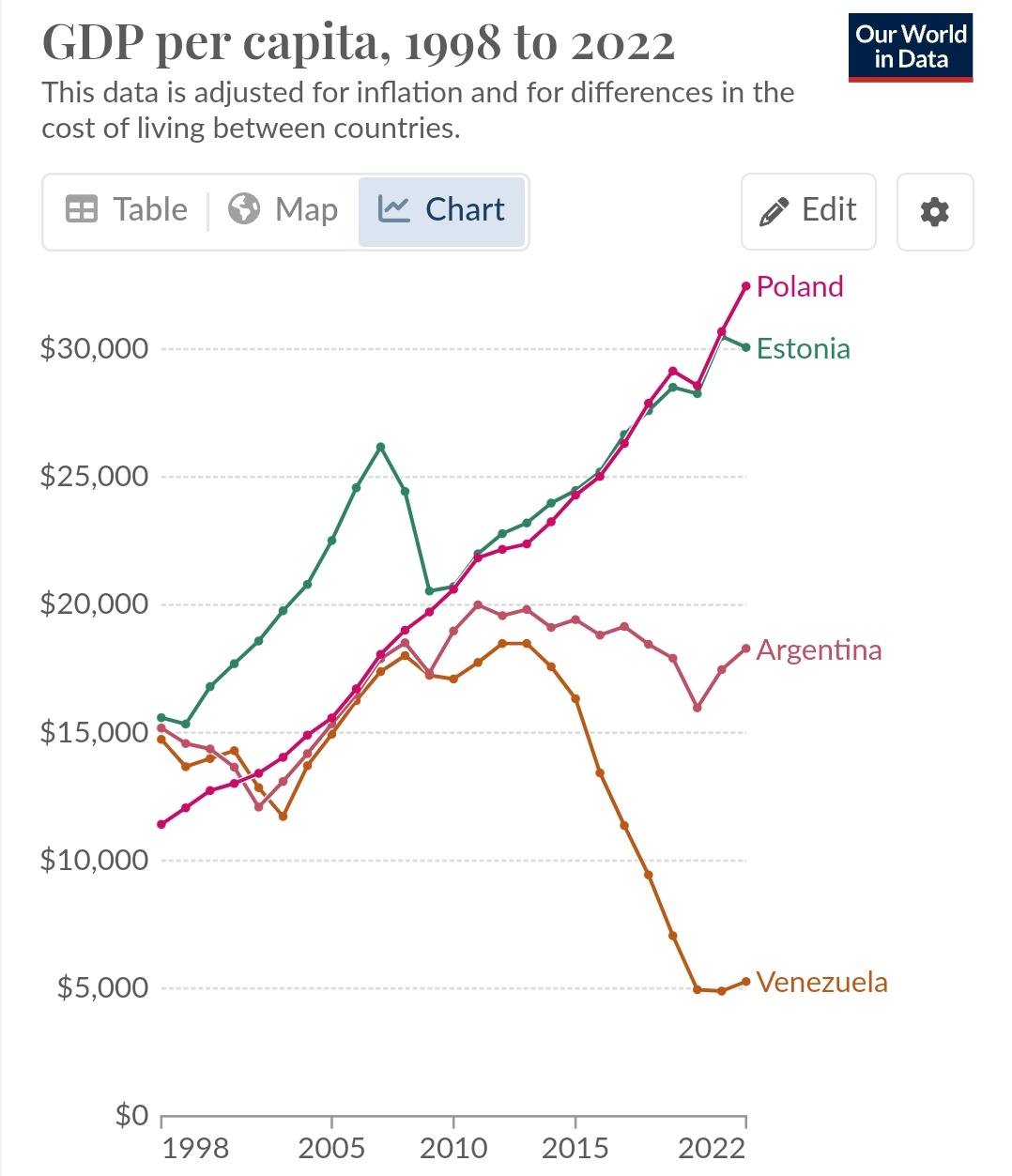
About 10 days ago, i showed that Milton Friedman was a much better economist than Joseph Stiglitz by comparing Chile (which followed Friedman’s ideas) and Venezuela (which followed Stiglitz’s ideas). It was a slam-dunk win for Friedman. Chile started poor and has become relatively prosperous. The opposite happened in Venezuela, which started relatively prosperous and […]
Friedman vs Stiglitz: Estonia and Poland vs. Argentina and Venezuela
03 Sep 2024 Leave a comment
in economic history, entrepreneurship, financial economics, industrial organisation, survivor principle Tags: creative destruction
31 Aug 2024 1 Comment
in applied price theory, econometerics, economic history, entrepreneurship, history of economic thought, industrial organisation, survivor principle Tags: creative destruction
The differences between the most and least productive companies can be startlingly high. By one estimate, in the US alone the most productive firms in a sector can be more than two to four times more cost-effective than the least productive ones. Given the size of those discrepancies, any expansion of trade or innovation that makes […]
It is wonderful to put inefficient firms out of business
31 Aug 2024 Leave a comment
in economic history, entrepreneurship, industrial organisation Tags: The Great Enrichment
31 Aug 2024 Leave a comment
in applied welfare economics, Austrian economics, comparative institutional analysis, constitutional political economy, development economics, economic growth, economic history, entrepreneurship, growth miracles, history of economic thought, human capital, income redistribution, industrial organisation, labour economics, labour supply, law and economics, liberalism, macroeconomics, Marxist economics, politics - New Zealand, poverty and inequality, property rights, Public Choice, rentseeking, technological progress Tags: child poverty, family poverty, The Great Enrichment
28 Aug 2024 1 Comment
in entrepreneurship, industrial organisation, survivor principle, television, TV shows Tags: media bias
28 Aug 2024 1 Comment
in economic history, economics of bureaucracy, health economics, industrial organisation, Marxist economics, politics - New Zealand, Public Choice, theory of the firm Tags: health insurance
Enough is enough. Former PMs Helen Clark and Jacinda Ardern should come clean about how they were the Chief Architects of the omni-shambles that has become our health system. They should take responsibility for the folks who suffered from long waiting lists and declining health-care quality, some of whom didn’t make it. The person who…
Former Labour PM’s Clark and Ardern wrecked NZ’s Health System: they should be held accountable for the lives that have been lost
26 Aug 2024 Leave a comment
in economics of regulation, energy economics, environmental economics, global warming, industrial organisation, politics - USA, survivor principle Tags: biofuels
…the biofuel experiment has left behind a trail of bankruptcies, environmental degradation, and unfulfilled promises.
The Cascade of Failures in the Biofuel Industry: A Case of Economic and Environmental Mismanagement
Celebrating humanity's flourishing through the spread of capitalism and the rule of law
Celebrating humanity's flourishing through the spread of capitalism and the rule of law
Celebrating humanity's flourishing through the spread of capitalism and the rule of law
Celebrating humanity's flourishing through the spread of capitalism and the rule of law
Celebrating humanity's flourishing through the spread of capitalism and the rule of law
A History of the Alt-Right
Econ Prof at George Mason University, Economic Historian, Québécois
Celebrating humanity's flourishing through the spread of capitalism and the rule of law
Scholarly commentary on law, economics, and more
Beatrice Cherrier's blog
Celebrating humanity's flourishing through the spread of capitalism and the rule of law
Celebrating humanity's flourishing through the spread of capitalism and the rule of law
Celebrating humanity's flourishing through the spread of capitalism and the rule of law
Why Evolution is True is a blog written by Jerry Coyne, centered on evolution and biology but also dealing with diverse topics like politics, culture, and cats.
Celebrating humanity's flourishing through the spread of capitalism and the rule of law
A rural perspective with a blue tint by Ele Ludemann
DPF's Kiwiblog - Fomenting Happy Mischief since 2003
Celebrating humanity's flourishing through the spread of capitalism and the rule of law
The world's most viewed site on global warming and climate change
Tim Harding's writings on rationality, informal logic and skepticism
A window into Doc Freiberger's library
Let's examine hard decisions!
Commentary on monetary policy in the spirit of R. G. Hawtrey
Thoughts on public policy and the media
Celebrating humanity's flourishing through the spread of capitalism and the rule of law
Politics and the economy
A blog (primarily) on Canadian and Commonwealth political history and institutions
Reading between the lines, and underneath the hype.
Economics, and such stuff as dreams are made on
"The British constitution has always been puzzling, and always will be." --Queen Elizabeth II
Celebrating humanity's flourishing through the spread of capitalism and the rule of law
Celebrating humanity's flourishing through the spread of capitalism and the rule of law
WORLD WAR II, MUSIC, HISTORY, HOLOCAUST
Undisciplined scholar, recovering academic
Celebrating humanity's flourishing through the spread of capitalism and the rule of law
Res ipsa loquitur - The thing itself speaks
In Hume’s spirit, I will attempt to serve as an ambassador from my world of economics, and help in “finding topics of conversation fit for the entertainment of rational creatures.”
Researching the House of Commons, 1832-1868
Articles and research from the History of Parliament Trust
Reflections on books and art
Posts on the History of Law, Crime, and Justice
Celebrating humanity's flourishing through the spread of capitalism and the rule of law
Exploring the Monarchs of Europe
Cutting edge science you can dice with
Small Steps Toward A Much Better World
“We do not believe any group of men adequate enough or wise enough to operate without scrutiny or without criticism. We know that the only way to avoid error is to detect it, that the only way to detect it is to be free to inquire. We know that in secrecy error undetected will flourish and subvert”. - J Robert Oppenheimer.



 Utopia, you are standing in it!
Recent Comments