Will automation take away all our jobs?
31 Jan 2017 Leave a comment
in economic history, entrepreneurship, industrial organisation, labour economics Tags: automation, technological unemployment
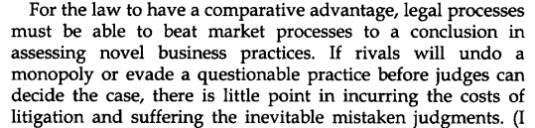
Frank Easterbrook, “The Supreme Court of the United States and Business Litigation”
31 Jan 2017 Leave a comment

Trailblazers: The New Zealand Story – trailer
25 Jan 2017 1 Comment
in comparative institutional analysis, constitutional political economy, economic history, economics of regulation, entrepreneurship, fiscal policy, industrial organisation, macroeconomics, survivor principle Tags: economic reform
The robots came in the 1950s for all our jobs
23 Jan 2017 Leave a comment
in economic history, industrial organisation, labour economics, labour supply, movies, survivor principle Tags: Apollo 13, automation, technological unemployment
The robots are coming have got nothing on the mid 20th century in terms of man being replaced by a machine.
One of my favourite scenes from Apollo 13 happens to be online. Tom Hanks and the Apollo 13 crew and ground control were using slide rules to make the critical calculations about re-entry trajectories. That had not been automated in 1969.
I went to high school just after slide rules were replaced by simple calculators.
I am reading some great essays from the 1960s at the moment about the great fear that people had from the computer entering the factory.
The reason for claiming that this time it was different was computed could automate calculations millions of times faster than people could. The computer could monitor and react to events without human intervention as Yale Brozen explained in the mid-60s
The hallmarks of automation, to distinguish it from mechanization or automatic
methods, are its sensing, feed-back, and self-adjusting characteristics. Because it senses changing requirements and adjusts without human intervention, it presumably does away with the need for human attendants or human labor. This is very fearful indeed to those who depend upon jobs for their livelihood.
Trailblazers: The New Zealand Story – Empowering Normal People
20 Jan 2017 Leave a comment
in economic history, entrepreneurship, industrial organisation Tags: agricultural economics
The Race between Machine and Man Daron Acemoglu
19 Jan 2017 Leave a comment
in applied price theory, industrial organisation, labour economics, survivor principle Tags: technological unemployment


How will ride-sharing shape the future of transport?
17 Jan 2017 Leave a comment
in entrepreneurship, industrial organisation, survivor principle, transport economics Tags: creative destruction, Uber
The robots have been coming from longer than you think
16 Jan 2017 Leave a comment
in economic history, industrial organisation, labour economics, labour supply, unemployment
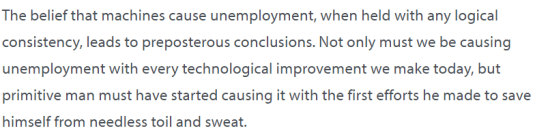
Source: Henry Hazlitt, Economics in One Lesson.
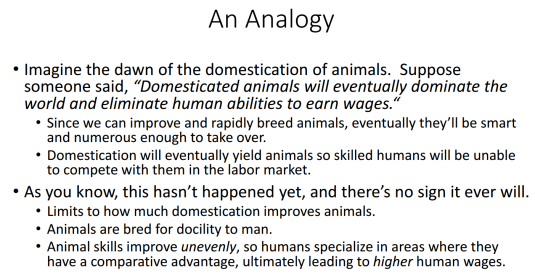
Source: Against Robotic Panic, Bryan Caplan | EconLog | Library of Economics and Liberty.


Recent Comments