People really forget how awesomely powerful IBM was in the 1980s: @evankirstel http://t.co/TkpuU5sAXg—
Marc Andreessen (@pmarca) April 04, 2015
I read a Steve Jobs biography 15 years ago when you couldn’t find him on this chart
21 Apr 2015 Leave a comment
in economic history, entrepreneurship, financial economics, industrial organisation, survivor principle Tags: Apple, creative destruction, entrepreneurial alertness, Steve Jobs
Still further evidence of the rise and rise of the working rich
21 Apr 2015 Leave a comment
in applied price theory, entrepreneurship, income redistribution, industrial organisation, survivor principle Tags: capitalism and freedom, entrepreneurial alertness, The Great Enrichment, top 1%, working rich
The comparative institutional analysis of stereotypes
21 Apr 2015 Leave a comment
in applied price theory, discrimination, economics of bureaucracy, entrepreneurship, gender, industrial organisation, labour economics, Public Choice, survivor principle Tags: labour market discrimination, markets selection, signaling and screening, stereotypes, The meaning of competition
If You’ve Got A Business, You Didn’t Build That
19 Apr 2015 Leave a comment
in entrepreneurship, industrial organisation, Public Choice, rentseeking, survivor principle Tags: creative destruction, entrepreneurial alertness, market selection, top 1%, working rich
The rich are working rich who earn their incomes through entrepreneurial alertness. They move assets from low value uses to higher value uses and profit through capital gains. Entrepreneurial alertness is not a skill that can be taught.
Where the rich make their income: Capital gains, writes @robtfrank urbn.is/1Gx6Eos (h/t @TaxPolicyCenter) http://t.co/LkErbQ25LW—
Urban Institute (@urbaninstitute) April 10, 2015
Biggest box office bonanzas by net profit
19 Apr 2015 Leave a comment
in economic history, economics of media and culture, entrepreneurship, industrial organisation, movies, survivor principle Tags: entrepreneurial alertness, Hollywood economics
The biggest box office "boom" of the last 30 years was made 30 years ago nerdist.com/2015/01/the-bi… feat. @randal_olson http://t.co/KiBrxKcbjO—
Kyle Hill (@Sci_Phile) January 14, 2015
Creative destruction in the tablet market
19 Apr 2015 Leave a comment
in economic history, entrepreneurship, industrial organisation, survivor principle Tags: creative destruction, market selection, The meaning of competition
Apple is losing the tablet market it created with the iPad read.bi/17zuReH http://t.co/odPeM5iWyX—
BI Tech (@SAI) February 25, 2015
50% more R&D since the 60s, but still no growth dividend?
18 Apr 2015 1 Comment
in applied price theory, economic growth, economics of education, entrepreneurship, history of economic thought, human capital, industrial organisation, macroeconomics, occupational choice, survivor principle Tags: Ben Jones, Chad Jones, creative destruction, endogenous growth theory, innovation, R&D
Spending on intellectual property products has risen in the USA from 1% in 1950 to 5% now. Public R&D spending in the USA has been pretty static for 60 years. Intellectual property products in the chart below includes traditional research and development, spending on computer software, and spending on entertainment such as movies, TV shows, books, and music. Spending on software and entertainment was only recently measured in the US national accounts. This inclusion of intangible capital investments will radically change the story of economic growth and the business cycle in the 20th century.
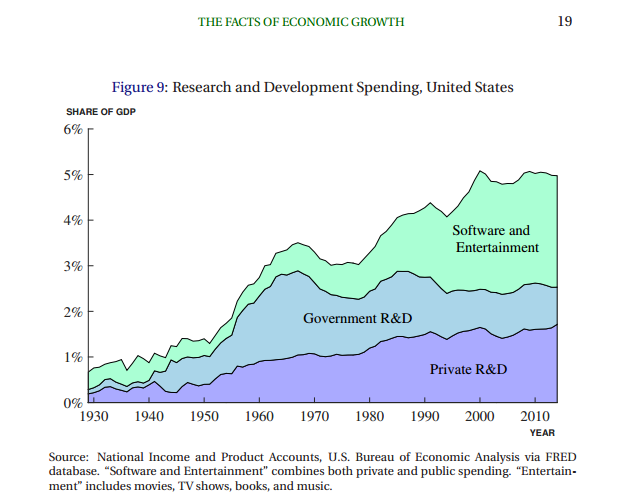
Source: Chad Jones (2015).
The growth rate in the USA hasn’t changed much despite this massive increase in intellectual property property product production. Is innovation getting harder? R&D is supposed to boost the growth rate, if you are to believe politicians bearing subsidies for it wherever they find it.
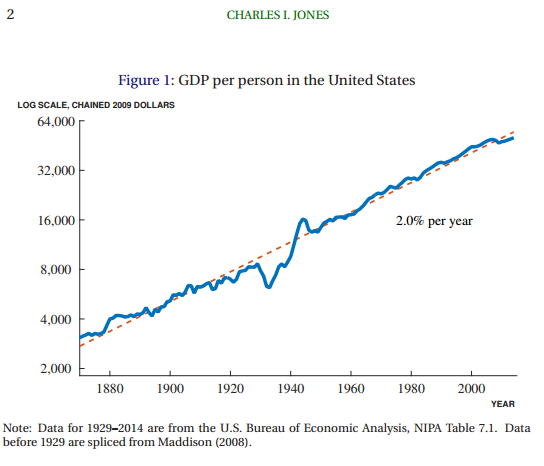
Source: Chad Jones (2015).
Ben Jones in The Burden of Knowledge and the Death of the Renaissance Man: Is Innovation Getting Harder? found that as knowledge accumulates as technology advances, successive generations of innovators may face an increasing educational burden. Innovators can compensate through lengthening their time in education and narrowing expertise, but these responses come at the cost of reducing individual innovative capacities. This has implications for the organization of innovative activity – a greater reliance on teamwork – and has negative implications for economic growth.
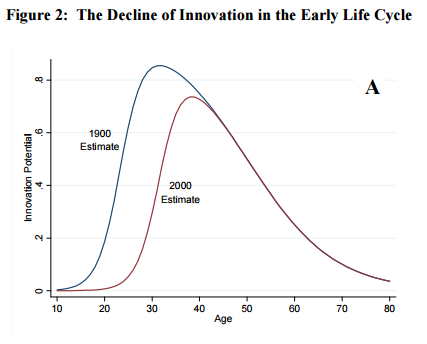
This longer period of education and initial study is not compensated by inventors innovating for longer spans of their lifestyle. This rising burden of knowledge is cutting into their best years of their lives. Jones found a broad and dramatic declines in early life-cycle productivity among great minds and ordinary inventors, and a close relationship of these trends with increased training duration.
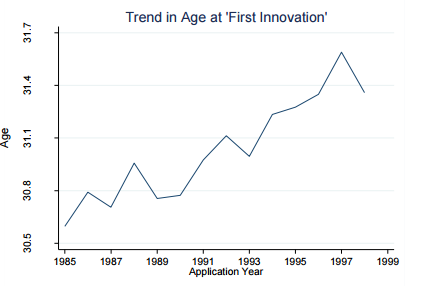
Jones found that the age at first invention, specialisation, and teamwork increased over time in a large micro-data set of inventors. Upward trends in academic collaboration and lengthening doctorates can also be explained in his framework of innovation getting harder because of a rising burden of knowledge. Co-authorship in academic literature has increased, including physics, biology, chemistry, mathematics, psychology, and economics. This measure of teamwork has increased 17% per decade.
Using data on Nobel Prize winners, Jones found that the mean age at which the innovations are produced to win the Prize has increased by 6 years over the 20th Century.
- Before 1901, two-thirds of the Nobel laureates did their prize-winning work before the age of 40 and 20 per cent did it before age of 30.
- By 2000, however, great achievements seldom occurred before the age of 40.
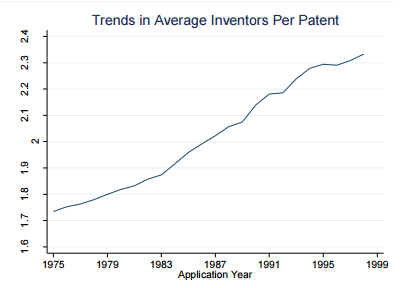
It’s now taking longer for scientists to get their basic training and start their careers. There is simply more to learn because knowledge in all fields has grown by quantum leaps in the past century. Nobels are being handed out for different types of work than a century ago.
- There has been a trend away from awarding prizes for abstract, theoretical ideas.
- Now more honours are being bestowed on people who have made discoveries through painstaking lab work and experimentation – which takes a lot of time to do.
Jones’ theory provides an explanation for why productivity growth rates did not accelerate through the 20th century despite an enormous expansion in collective research effort and levels of education and many more graduates. Innovation is getting harder?
What happened when the robots took all the agricultural jobs?
18 Apr 2015 Leave a comment
in entrepreneurship, industrial organisation, survivor principle Tags: agricultural economics, creative destruction, technological unemployment
around 1910, about a third of all US workers were in agriculture. It's now about 2%. conversableeconomist.blogspot.com/2015/03/snapsh… http://t.co/wUd8tbk0n6—
Catherine Rampell (@crampell) March 09, 2015
Creative destruction in CD sales
17 Apr 2015 Leave a comment
in applied price theory, economic history, economics of media and culture, entrepreneurship, industrial organisation, Music, survivor principle Tags: creative destruction, entrepreneurial alertness
Digital music sales have exceeded those from CDs for the first time: on.wsj.com/1yp37FW http://t.co/LDOdrgGap9—
Wall Street Journal (@WSJ) April 15, 2015
Uber is bringing a new meaning to creative destruction
14 Apr 2015 Leave a comment
in economics of regulation, entrepreneurship, industrial organisation, survivor principle Tags: creative destruction, entrepreneurial alertness, Uber
Uber's astounding rise: onforb.es/1yiZFNp http://t.co/VocIl3EogE—
Forbes Tech News (@ForbesTech) April 10, 2015
Zero hour contracts may be outlawed in New Zealand–updated
13 Apr 2015 1 Comment
in entrepreneurship, industrial organisation, labour economics, labour supply, managerial economics, occupational choice, organisational economics, personnel economics, politics - New Zealand, survivor principle, unions Tags: Aaron Director, creative production, David Friedman, inherent inequality of bargaining power between workers and employers, Richard Epstein, Ronald Coase, The fatal conceit, The pretence to knowledge, zero hours contracts

In another triumph of the Socialist Left of the National Party, the supposedly centre-right New Zealand government is considering outlawing zero hours contracts:
ONE News can exclusively reveal the Workplace Relations Minister is leaning towards outlawing the contracts and other employment provisions that he sees as unfair…
The Minister of Workplace Relations said the most punitive aspects of zero-hour contracts will be banned:
Mr Woodhouse has previously said a ban of zero-hour contracts would be an overreaction, but signalled the outlawing of aspects including:
•Restraint of trade clauses that stop someone working for a competing business if an employer does not provide the desired hours of work.
•The cancellation of shifts at short or no notice.
One reason for this is to neutralise a wedge issue with the Labour Party. The labour parties in both New Zealand and United Kingdom plan to outlaw zero hours contracts.
The NZ Labour Party’s Certainty at Work private member’s bill would require employment agreements to include an indication of the hours an employee will have to work to complete tasks expected of them.

Aaron Director pointed out that there are many real world business practices that behave differently from the caricatures in textbooks and arouse suspicious responses from economists (as well as from lay observers including lay observers with no ideological agenda).
Director said that visions of market power dance their heads and some of these suspect practices have been regulated for reasons he attributed in a large part to intellectual laziness. Ronald Coase made the same observation about knee-jerk responses to perplexing new business practices:
One important result of this preoccupation with the monopoly problem is that if an economist finds something—a business practice of one sort or other—that he does not understand, he looks for a monopoly explanation.
And as in this field we are very ignorant, the number of ununderstandable practices tends to be rather large, and the reliance on a monopoly explanation, frequent.
Much of the lasting influence of Aaron Director and of Ronald Coase came from their ability to show that simple judgements about business practices often cannot withstand rigorous scrutiny.
The organisation of and the contracting practices in the labour market is not a complicated despite the best efforts of the Left over Left and unions to pretend that it is so, as Richard Epstein explains:
Labour markets are not characterized by tricky externalities. They do not pollute streams or require the creation of public goods.
They are not characterized by genuine breakdowns in information, as workers are in a position to observe the conditions of their employment on a day-to-day basis.
Left to their own devices, without explicit support from union activities, they will be highly competitive, and thus work hard to allocate scarce human capital to its most productive use.
Workers have the option to quit for higher wages, and employers can always seek out low cost techniques to reduce their labour costs. Any short-term dislocation for firms or individuals is more than offset by the overall increase in the system productivity, spurred in part by clear signals that should increase investments in human capital.
In the UK, the Work Foundation found that 80% of those on zero hours contracts are not looking for another job; only 26% wanted longer hours. This implies that 74% were content with their current work times arrangements.
Labour's zero hours myth breitbart.com/london/2015/04… http://t.co/M8JsW6NWSF—
Alex Wickham (@WikiGuido) April 07, 2015
The inherent inequality of bargaining power between employers and workers and the reserve army of the unemployed must not be all that they are cracked up to be these days if low paid workers have to sign legally enforceable restraint of trade agreements, which is a common complaint about zero hours contracts. The worker does not have guaranteed hours but must promise not to work for someone else in the same line of business.
Obviously, the few members of the reserve army of the unemployed lucky enough to have a low pay, insecure job that offers no regular hours have so many other job options that their employers must get them to agree not to quit and job-hop at will. Jobs must be readily available to low paid workers for otherwise why do employers insist on this restraint of trade in employment agreements?
If there is an inherent inequality of bargaining power between the bosses and the workers, why do employers seek restraint of trade agreements against these downtrodden workers who are supposed to have few options but to accept the miserable zero hours job offer before them?
The question that must always be asked is why do people deemed competent to vote and drive cars sign zero hours contract? What is in it for them – for the worker who signs these contracts – especially for workers who already have a job and are switching to a zero hours contract? David Friedman asked this question about the economics of restraint of trade agreements for employees:
…the employer who insists on an employee signing a non- competition agreement will find that he must pay, in additional wages or other terms of employment, the cost that the agreement imposes upon the employee, as measured by the employee and revealed in his actions.
It follows that the employer will insist on such an agreement only if he believes that its value to him is greater than its cost to the employee… The contract is designed, after all, with the objective of getting the other party to sign it.
If I am designing the contract and offering it to many other parties, that may put me in a position to commit myself to insisting on terms that give me a large fraction of the benefit that the contract produces. But it is still in my interest to maximize the size of that net benefit-which I do by only insisting on terms that are worth at least as much to me as they cost the other party.
If zero hours contracts are as bad as the Left over Left claim, the job quit rates for these contracts should be high, and people moving from existing jobs should be under-represented in this section of the labour force. If a worker already has a job, they have few reasons to sign up to such a purportedly poor job offer. Show me the evidence.
Unless we have a good idea about why firms are moving to zero hours contracts, which we don’t, and why employees sign these contracts rather than work for other employers who offer more regular hours of work, meddling in these still novel to the officious observer arrangements is risky.
Facebook makes most of its money from mobile ads
12 Apr 2015 Leave a comment
in economics of media and culture, entrepreneurship, industrial organisation, survivor principle Tags: advertising, creative destruction, entrepreneurial alertness, Facebook, mobile phones
Saving jobs thwarts the emergence of better paid new jobs
09 Apr 2015 Leave a comment
in applied price theory, applied welfare economics, economic history, industrial organisation, survivor principle Tags: creative destruction, Henry Hazlett, Joseph Schumpeter
Creative destruction in Internet desktop browsers
07 Apr 2015 Leave a comment
in economics of media and culture, entrepreneurship, industrial organisation, survivor principle Tags: creative destruction, entrepreneurial alertness, innovation, markets selection, The meaning of competition
This is why @Microsoft is killing off the Internet Explorer brand: dadaviz.com/i/3622 #dataviz http://t.co/EikfbZFe2N—
Randy Olson (@randal_olson) March 17, 2015


Recent Comments