The tariffs also bring to mind several ironies: I only have the time, and frankly the stomach, to put down these few quick thoughts on this one. More later. ** Postscript: Tariffs rather than immigration is the topic of the day, but I was reminded in perusing the Declaration of Independence for this post that…
Two Questions and Four Ironies About Trump’s Tariffs
Two Questions and Four Ironies About Trump’s Tariffs
03 Apr 2025 1 Comment
in history of economic thought, international economics, liberalism, Marxist economics, politics - USA Tags: 2024 presidential election, free trade, tariffs
Uneducated vs educated
03 Apr 2025 Leave a comment
in comparative institutional analysis, constitutional political economy, economics of bureaucracy, economics of education, economics of information, economics of media and culture, international economics, law and economics, liberalism, Marxist economics, politics, property rights, Public Choice Tags: Brexit, British politics, political psychology
Political battles historically have been framed as contests between left-wing and right-wing ideologies, with clear distinctions based on policy preferences and socio-economic class interests. However, contemporary political dynamics reveal a new axis of conflict: the division between the educated and the uneducated. This emerging distinction marks a significant departure from traditional political alignments, reshaping electoral […]
Uneducated vs educated
The Protectionism Edition of Economics Humor
01 Apr 2025 Leave a comment
in applied price theory, applied welfare economics, comparative institutional analysis, economic history, history of economic thought, income redistribution, industrial organisation, international economics, politics - USA, Public Choice, rentseeking, survivor principle Tags: 2024 presidential election, free trade, tarrifs

It appears that Trump wants to repeat the mistakes of the 1930s with a global trade war. That is going to be very bad news for workers, consumers, taxpayers, manufacturers, farmers, and exporters. But there are two bits of good news. At least for small slices of the populations First, lobbyists will get rich as […]
The Protectionism Edition of Economics Humor
U.S. Trade Deficit Do Not Mean that We Americans Are Living Beyond Our Means
31 Mar 2025 Leave a comment
in applied price theory, Austrian economics, industrial organisation, international economics, labour supply Tags: free trade, tariffs
TweetHere’s a note to a new correspondent. Mr. P__: Thanks for your feedback on Phil Gramm’s and my piece, in yesterday Wall Street Journal, on trade deficits. You believe that I “and Sen. Gramm omit that every US trade deficit means Americans are consuming more than they are producing, a habit that is unsustainable.” With…
U.S. Trade Deficit Do Not Mean that We Americans Are Living Beyond Our Means
At the end of World War I, Britain was in heavy financial debt to the U.S. The question of repayments would bedevil both countries for decades
27 Mar 2025 Leave a comment
in defence economics, economic history, financial economics, international economic law, international economics, International law, war and peace Tags: British politics France, World War I
See ‘Mellon vs. Churchill’ Review: The Payback Problem by Benn Steil. He reviewed the book Mellon vs. Churchill: The Untold Story of Treasury Titans at War by Jill Eicher. Excerpts:”In a nutshell, the debt story of the 1920s goes like this. Following World War I, 10 countries owed the U.S. more than $10 billion ($190 billion…
At the end of World War I, Britain was in heavy financial debt to the U.S. The question of repayments would bedevil both countries for decades
What does India want – and what is New Zealand willing to give?
25 Mar 2025 Leave a comment
in applied price theory, comparative institutional analysis, development economics, economic history, economics of education, growth disasters, growth miracles, human capital, income redistribution, industrial organisation, international economic law, international economics, labour economics, labour supply, occupational choice, politics - New Zealand, poverty and inequality, Public Choice, rentseeking, survivor principle Tags: India, preferential trade agreements
Chris Trotter writes – What does India want from New Zealand? Not our dairy products, that’s for sure, it’s got plenty of those. Indeed 45 percent of the Indian population are small-scale farmers, most of them running a few head of cattle – not to eat, you understand – but to milk. If it once […]
What does India want – and what is New Zealand willing to give?
Commerce Secretary Lutnick Is Among Those Government Officials Who Are Ignorant of Basic Economic Facts
21 Mar 2025 Leave a comment
in applied price theory, economic history, industrial organisation, international economics, market efficiency, politics - USA, survivor principle, transport economics Tags: 2024 presidential election, free trade, tarrifs
TweetHere’s a note to the Highland County Press. Editor: Commerce secretary Howard Lutnick asserts that NAFTA allowed U.S. automobile producers to “screw” American auto workers by shifting auto-industry production to Mexico and Canada (“Trump Cabinet members: Tariff plans are working; tariffs could eliminate federal income tax for those earning less than $150,000,” March 20). Mr.…
Commerce Secretary Lutnick Is Among Those Government Officials Who Are Ignorant of Basic Economic Facts
McCaskill: Trump is Trying to “Disappear” People Like Putin
20 Mar 2025 Leave a comment
in economics of crime, Economics of international refugee law, international economics, International law, labour economics, labour supply, law and economics, politics - USA Tags: 2024 presidential election, economics of immigration, law and order, law enforcement

MSNBC analyst and former Democratic Sen. Claire McCaskill has long been criticized for unhinged rhetoric. That was evident on “Morning Joe” recently when McCaskill said that the deportation of alleged Venezuelan gang members was akin to Putin “disappearing” people. It is not the first such analogy by McCaskill, who has called those opposing the censorship […]
McCaskill: Trump is Trying to “Disappear” People Like Putin
Why tit-for-tat tariffs may not work against Trump
16 Mar 2025 Leave a comment
in applied price theory, industrial organisation, international economics, International law, politics - USA, Public Choice, rentseeking Tags: 2024 presidential election, game theory, tariffs

Last week, my ECONS101 class covered game theory. At the end of the final lecture, after we had been covering repeated games and tit-for-tat strategies, a really perceptive student asked me about Trump’s tariffs. A lot of the rhetoric about tariffs has been posed in terms of tit-for-tat (see here and here, for example). The…
Why tit-for-tat tariffs may not work against Trump
Did you know the Magna Carta was against tariffs?
13 Mar 2025 Leave a comment
in applied price theory, economic history, history of economic thought, industrial organisation, international economics Tags: 2024 presidential election, constitutional law, tariffs
One clause of the Magna Carta says: All merchants shall have safe and secure exit from England, and entry to England, with the right to tarry there and to move about as well by land as by water, for buying and selling by the ancient and right customs, quit from all evil tolls So tariffs […]
Did you know the Magna Carta was against tariffs?
Trump Doubles Down on Protectionist Failure
12 Mar 2025 1 Comment
in applied price theory, industrial organisation, international economics, politics - USA, survivor principle Tags: 2024 presidential election, tarrifs
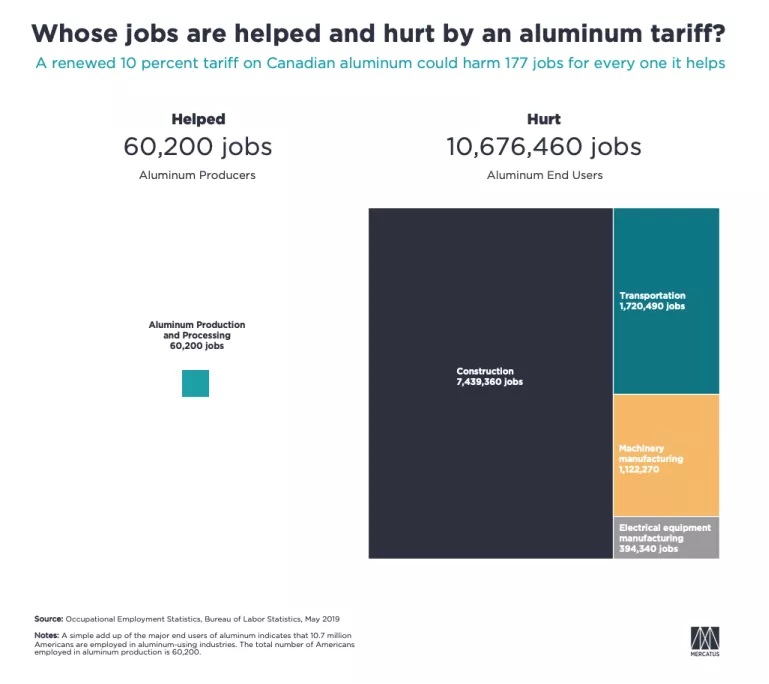
I shared a “Trade 101 for Trumpies” presentation last month in hopes of educating people about the foolishness of protectionism. Perhaps it should have been a remedial class because the president has just announced another increase in taxes on steel and aluminum from Canada. This is insanely bad economic policy for the simple reason that […]
Trump Doubles Down on Protectionist Failure
How Much Do Tariffs Raise Prices?
08 Mar 2025 Leave a comment
in applied price theory, economic history, history of economic thought, industrial organisation, international economics, politics - USA Tags: 2024 presidential election, free trade, tariffs
We break down how much of a tariff is ‘passed through’ to customersBy Jason Douglas, Anthony DeBarros and Danny Dougherty of The WSJ. Excerpts:”For example, a 10% tariff on shoes from China would raise their sticker price 4% or so, but on wine or olive oil from Italy, almost 10%.Why the difference? Tariffs aren’t the…
How Much Do Tariffs Raise Prices?
Peter Navarro Conducts a Master Class In Looking Only at That Which Is Seen
06 Mar 2025 Leave a comment
in applied price theory, history of economic thought, industrial organisation, international economic law, international economics, International law, survivor principle Tags: current account, free trade, tariffs
TweetHere’s a letter to USA Today. Editor: Defending Pres. Trump’s aluminum tariffs, Peter Navarro focuses exclusively on the effects of these tariffs on U.S. aluminum producers (“Trump tariffs will save American jobs and level the playing field,” Feb. 28). He points out what no serious defender of free trade denies, namely, that punitive taxation of…
Peter Navarro Conducts a Master Class In Looking Only at That Which Is Seen
More Deficient Economic Thinking
03 Mar 2025 Leave a comment
in applied price theory, industrial organisation, international economics Tags: current account, free trade, tarrifs
TweetHere’s a letter to the Wall Street Journal. Editor: Anthony deBarros and Peter Santilli report on “the countries fueling America’s $1.2 trillion goods trade deficit” (March 1). With respect, what’s the point of such a report? Eighty percent of U.S. GDP is produced by the service sector – implying that the vast majority of Americans…
More Deficient Economic Thinking


Recent Comments