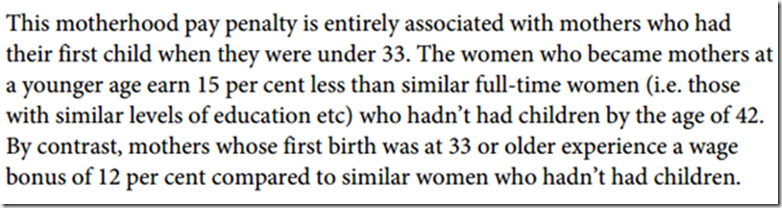
Source: Trades Union Congress – The Motherhood Pay Penalty.
The British Trades Union Congress (TUC) has released the preliminary findings of research into the 1970 Birth Cohort Study. The union research into the gender wage gap finds that
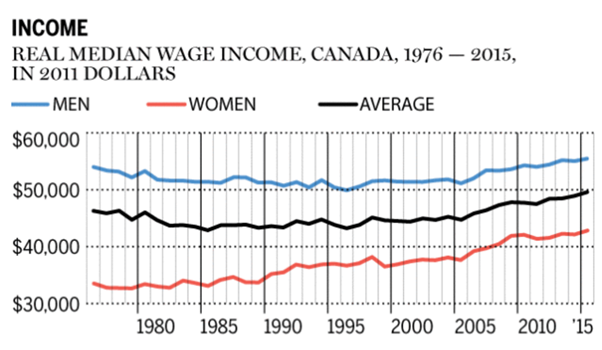
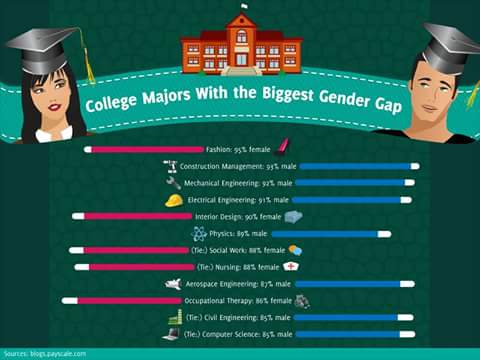
The overall gender pay gap of 34 per cent for this cohort of full-time workers who were born in 1970. This gap is largely due to the impact of parenthood on earnings – the women earning less and the men earning more after having children.
Mothers in the 1970 Birth Cohort Study who are in full-time work earn 11 per cent less than full-time women without children at age 42. When factors such as education, region and occupation are taken into account, this motherhood pay penalty in full-work falls to 7 per cent.
This finding by the union research into the 1970 birth cohort is no surprise. For 40 years at least now it has been known that having children and and spacing those children over a longer period carries a career penalty for women.
More recent work has emphasised the motherhood penalty is larger for those women pursuing careers where long hours or rigid hours is required and if they wish to combine careers and motherhood. Much of that research is led by Claudia Goldin.
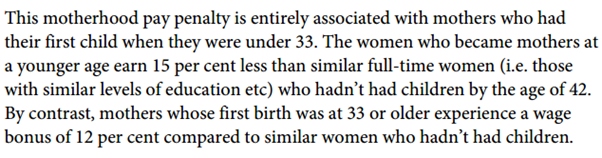
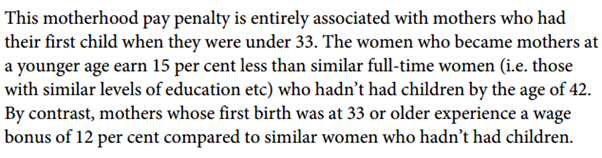
It is difficult for employers to discriminate against women if the gender wage gap is not only driven by motherhood but also by having their first child past the age of 33. Male chauvinistic employers simply do not have the necessary information about whether women are mothers and and whether they had their first child before or after the age of 33.
For employer discrimination to drive the gender wage gap, rather than women’s choices about balancing career and motherhood, these male chauvinist employers must know:
- whether female applicants are mothers, and
- the age of female applicants who are mothers when they had their first child.
This information on the age of first motherhood is essential for employer discrimination to be driving the gender wage gap. This information about the age of first motherhood must be in the hands of the employer so that they do not shortlist, do not promote and do not hire women who are mothers before the age of 33.
It would be handy to know why why these male chauvinistic employers have such strong prejudices against women who are mothers before the age of 33 but have no prejudices against women who are mothers after the age of 33. It would
Another piece of you useful information is how do male chauvinist employers get their hands on the partnership status of mothers when they had their first child. As the Trades Union Congress found
There is a bonus of 12 per cent for being in a couple when women had their first child.
Why are the prejudices of male chauvinist employers dampened when the mother is married or in a stable relationship when they had their first child? Why are these male chauvinist employers so prejudiced against in mothers?
There seems to be a 12% wage bonus for single mothers who can successfully lie to male chauvinist employers about whether they are in a stable relationship back when they had the first child.
Keeping up appearances for the sake of the children has a whole new meaning if there is a 12% wage bonus in it if male chauvinist employers can be fooled. There is a wage bonus of several times that if mothers can keep their children secret from their discriminating employer.
When there is a marriage bar in the Australian Public Service, there were instances where women kept their children or marriages secret to avoid being sacked. One woman had four children before she decided to make an honest man of the father. She lost her job.




Recent Comments