
Source: Earnings and wages – Gender wage gap – OECD Data.
..
Celebrating humanity's flourishing through the spread of capitalism and the rule of law
13 Apr 2016 Leave a comment
in discrimination, economic history, gender, human capital, labour economics, labour supply, politics - Australia, politics - New Zealand, politics - USA, poverty and inequality Tags: Australia, British economy, gender wage gap
13 Apr 2016 Leave a comment
in applied price theory, applied welfare economics, discrimination, gender, labour economics Tags: gender wage gap
Source: Farmer Hayek: Equal Pay Day
11 Apr 2016 Leave a comment
in discrimination, economic history, economics Tags: racism
10 Apr 2016 Leave a comment
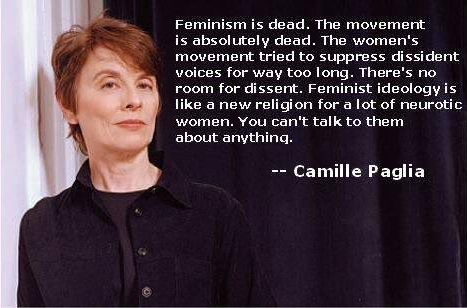
in discrimination, economics of love and marriage, economics of media and culture, gender, labour economics, law and economics, politics - Australia, politics - New Zealand, politics - USA, television Tags: feminism
09 Apr 2016 Leave a comment
in discrimination, economics of crime, law and economics, politics - USA, poverty and inequality Tags: 2016 presidential election, Bill Clinton, crime and punishment, law and order, police shootings, street gangs
04 Apr 2016 Leave a comment
in discrimination, economics, gender, labour economics Tags: gender gap
01 Apr 2016 Leave a comment
in discrimination, gender, labour economics, sports economics Tags: customer discrimination, employer discrimination, gender wage gap, television ratings, women's sports
If women soccer players are discriminated against, their employers must be making a lot of extra profits of their toil. If women soccer players are paid less than their marginal revenue product, the organisers of their tournaments and those that broadcasted them must be doing very well indeed.
The reality is pay in sports these days is determined by revenue from television rights. Players can top that up with sponsorship deals.
Do television commercials for men’s and women’s soccer tournaments sell for the same price? If so, do women receive a smaller percentage of that revenue stream? That is a good test of the hypothesis that they are discriminated against.
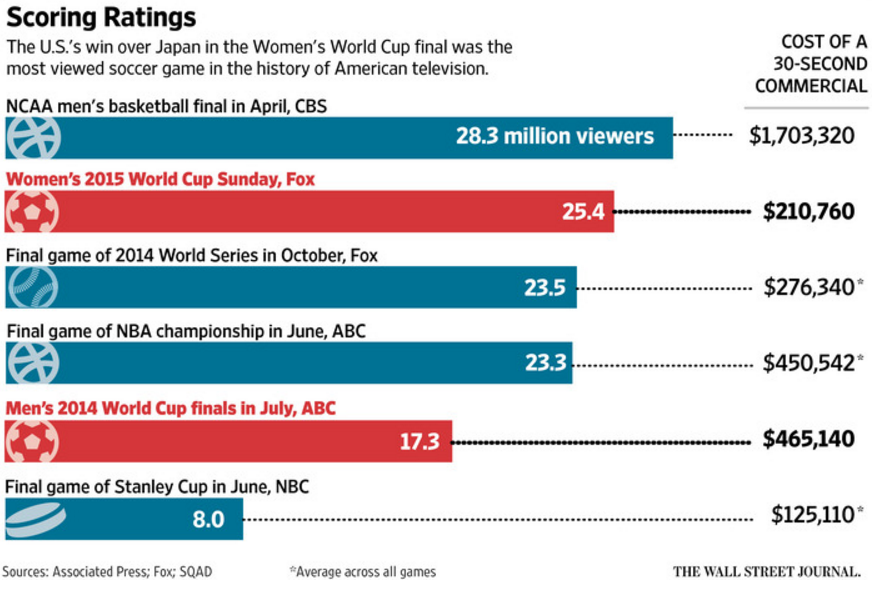
Despite the novelty of the US getting into the women’s World Cup, a 30 second commercial was sold for much much less. There may have been a ratings bonanza, but there was no accompanying revenue bonanza that could feed through to the pay of players from more generous television rights for future tournaments.
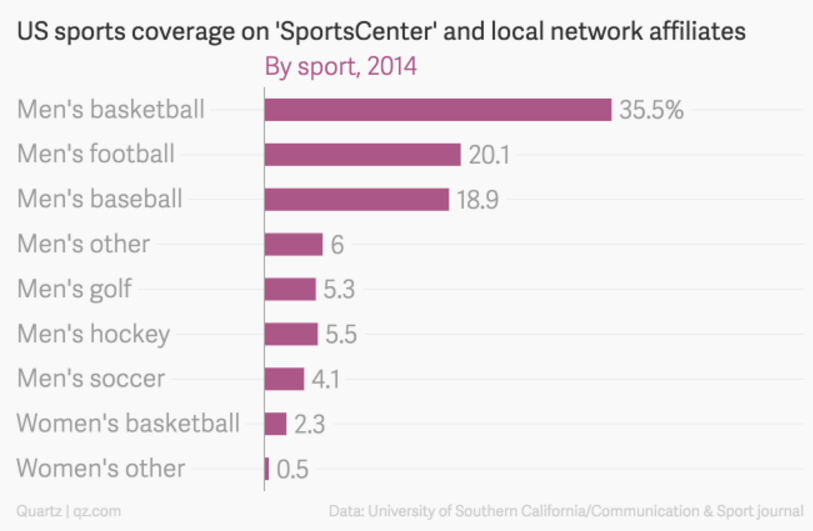
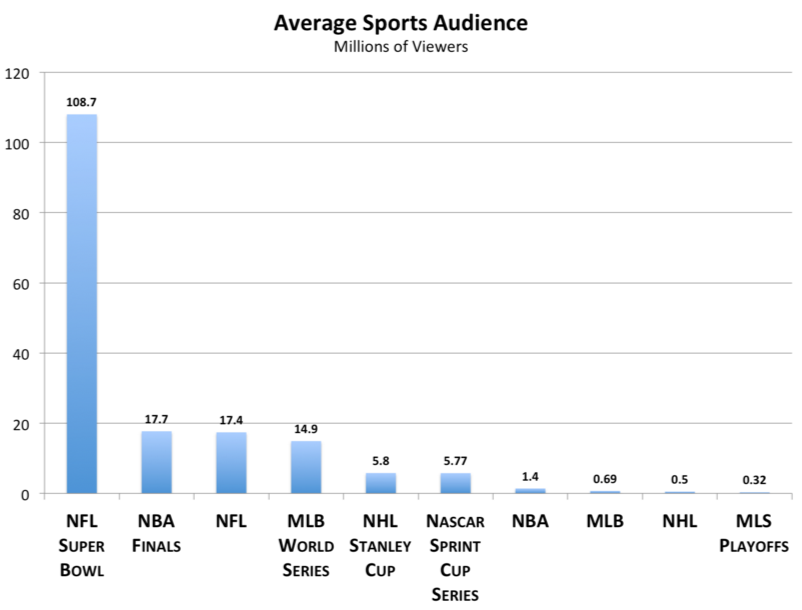
Women’s soccer is paid less because of the viewing preferences of audiences. Any sport that attracts high ratings will attract generous television rights. The money feeds through to the players.

This is a classic case of customer discrimination. Markets are very good at implementing customer discrimination, in this case giving viewers the sports they want to see.
A classic early example of that was the introduction of foreign and minority players. Part of sport is that could be me out there kicking the goal. In consequence, viewers had a lot of trouble identifying with people who are not like them. Mankiw explains:
Studies of sports teams suggest that racial discrimination is, in fact, common and that much of the blame lies with customers.
One study, published in the Journal of Labor Economics in 1988, examined the salaries of basketball players. It found that black players earned 20 percent less than white players of comparable ability. The study also found that attendance at basketball games was larger for teams with a greater proportion of white players.
One interpretation of these facts is that, at least at the time of the study, customer discrimination made black players less profitable than white players for team owners. In the presence of such customer discrimination, a discriminatory wage gap can persist, even if team owners care only about profit.
That barrier was quickly overcome when viewers discovered that these foreign players and minorities players were very good and helped the team win more. The preference for their team winning overcame the preference for the team winning with people who look like them.
The current successive US women’s soccer should not be overrated in terms of its implications for higher pay. The Women’s United Soccer Association (WUSA) was formed in 2000 after success in the 1999 FIFA Women’s World Cup. It lasted just three seasons before folding with losses of $100 million.
Women’s soccer in the USA did have one year broadcast deals with Fox sport and ESPN in 2014 and 2013. Although no TV deal is set for the 2015 season, the NWSL recently announced that all games will be broadcast on YouTube Live for free.
The women’s sports that are best paid without exception are the women’s sports with the most valuable television rights. Closing the gap between men’s and women’s sport is exclusively in the hands of viewer.
The sponsors of women’s sports are not hiding bags of money out the back which they could have paid for women out of secret television deals worth as the same as for men’s sports.
26 Mar 2016 Leave a comment
in discrimination, econometerics, gender, human capital, labour economics, labour supply, occupational choice Tags: gender wage gap
https://twitter.com/adchamberlain/status/712647716229111808
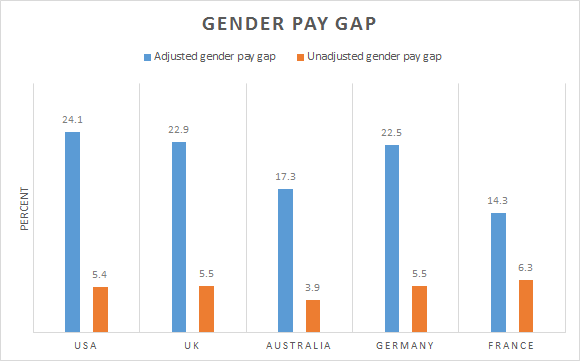
Source: Demystifying the Gender Pay Gap: Evidence from Glassdoor Salary Data – Glassdoor Economic Research via Wednesday evening links – AEI | Carpe Diem Blog » AEIdeas.
https://twitter.com/adchamberlain/status/713097526878953472
.
25 Mar 2016 Leave a comment
in discrimination, economics of information, entrepreneurship, human capital, labour economics, personnel economics Tags: asymmetric information, counter-signalling, employer discrimination, racial discrimination, screening, signalling, statistical discrimination
Statistical discrimination is a harsh mistress. If reliable measures of the quality of job applicants are unavailable for short-listing, such as credit checks, coarser, less reliable screening devices will be employed. That was the case when credit checks were prohibited in employment recruitment:
Looking at 74 million job listings between 2007 and 2013, Clifford and Shoag found that employers started to become pickier, especially in cities where there were a lot of workers with low credit scores. If a credit-check ban went into effect, job postings were more likely to ask for a bachelor’s degree, and to require additional years of experience.
There are other ways that employers could have also become more discerning, Shoag says. They might have started to rely on referrals or recommendations to make sure that applicants were high-quality. In the absence of credit information to establish trustworthiness, they may even have fallen back on racial stereotypes to screen candidates. The researchers couldn’t measure these tactics, but they’re possibilities.
Drug testing allows employers to dispel less accurate stereotypes about drug use among different ethnic and social groups. They increased hiring of minorities because a reliable measure became available of their drug use:
…after a pro-testing law is passed in a state, African-American employment increases in sectors that have high testing rates (mining, manufacturing, transportation, utilities, and government).
These increases are substantial: African-American employment in these industries increases by 7-30%. Because these industries tend to pay wage premia and to have larger firms offering better benefits, African-American wages and benefits coverage also increase. Real wages increase by 1.4-13% relative to whites. The largest shifts in employment and wages occur for low skilled African-American men.
I also find suggestive evidence that employers substitute white women for African-Americans in the absence of testing. Gains in hiring African-Americans in these sectors may have come at the expense of women, particularly in states with large African-American populations.
Employers test for drug use both for health and safety reasons and as a way of screening out less reliable employees. People who break the rules are not reliable employees and that includes taking drugs. In low skill jobs, what employers seek is a recruit who is friendly and reliable.

Testing of the skills of workers also showed similar results. What happened is that the ratio of black to white hirings do not change. The administration of these skills tests allowed the more productive of both white and black job applicants to be identified and hired.
Employers already had an accurate stereotype of the average skills of different ethnic groups. Administration of tests allow them to identify which members of each group were the most productive.
It is a standard result that statistical discrimination improves the chances of below-average applicants subject to the stereotype but harms those of above average quality. For that reason, applicants look for what methods of counter-signalling to show that they are indeed a quality applicant – make themselves stand out from the crowd.
Employers profit from developing screening devices that go beyond stereotypes to identify above-average applicants. They want screening devices that find those who do not otherwise stand out from the crowd because of difficulties in transferring credible information about their quality. This is a special difficulty with low-skilled vacancies because hiring is made based much more than on character than experience.
20 Mar 2016 Leave a comment
in discrimination, economics of education, gender, human capital, labour economics Tags: gender wage gap
19 Mar 2016 Leave a comment
in discrimination, economic history, gender, human capital, labour economics, labour supply, occupational choice Tags: compensating differentials, gender wage gap
Much ducking and diving is required to explain why the women with most options in life have the largest gender wage gap.
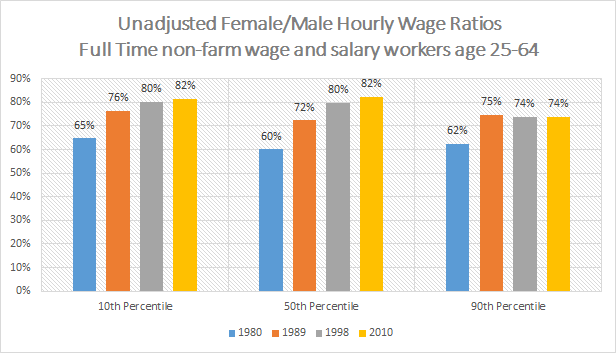
Source: The Gender Wage Gap: Extent, Trends, and Explanations by Francine D. Blau, Lawrence M. Kahn :: SSRN via Panel Study of Income Dynamic (PSID).
19 Mar 2016 Leave a comment
in discrimination, gender, human capital, labour economics, labour supply, occupational choice, politics - USA Tags: compensating differentials, gender wage gap
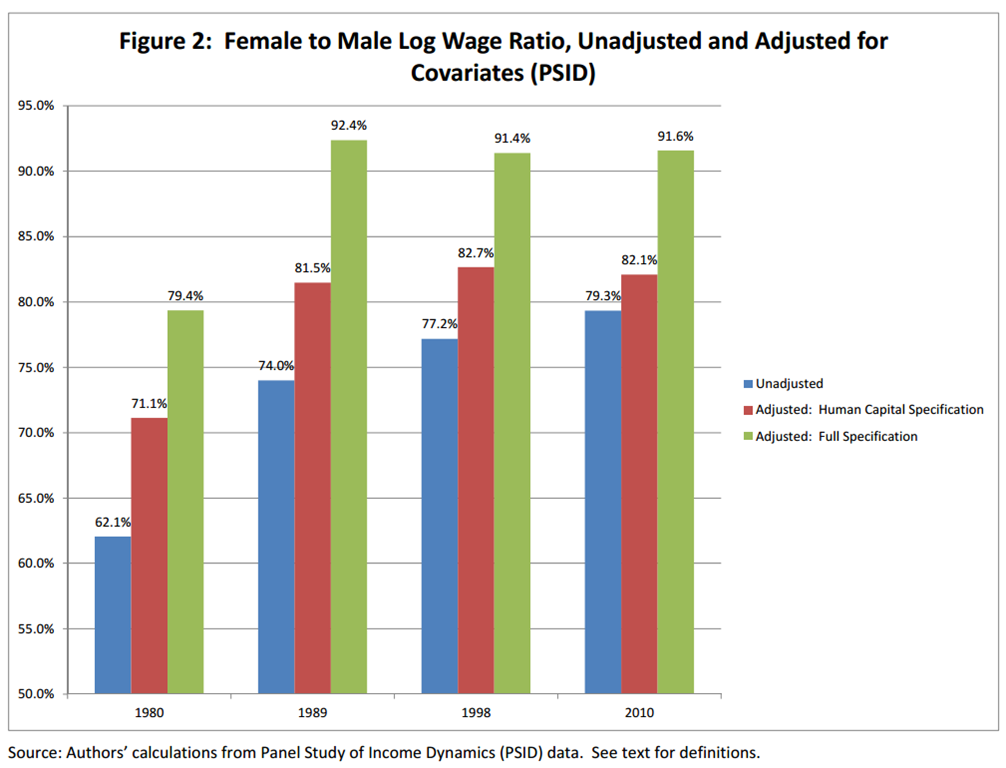
Source: The Gender Wage Gap: Extent, Trends, and Explanations by Francine D. Blau, Lawrence M. Kahn :: SSRN
12 Mar 2016 Leave a comment
in applied price theory, constitutional political economy, discrimination, economics of education, economics of media and culture, rentseeking
Thomas Borcherding “An Economic Approach to School Integration: Public Choice with Tie-ins.” Public Choice, 1977, argues that a reason for racial or ethnic discrimination in the public sector is politics encourages the coercive transfer of income from the racial, religious or ethnic group to those with more political influence.
Race can be used as a means of organizing coalitions to lobby for fiscal and economic discrimination in favour of even a previously unprejudiced group.
Preferences of each group to locate in a common geography and the severe control over entry or exit from the group that such things as skin colour, language, caste, and religious dogma impose make the organization of racial or ethnic coalitions by political entrepreneurs fairly cheap and minimises free riding and defection.
Prejudice may reinforce the solidarity of each group and help to monitor via custom, mores, and folkways the behavior of those that would attempt to bring persons of other groups into the former coalition. Further, prejudice may also serve as a device to rationalize exploitation of another group by fiscal or other means.

Borcherding argues that integration, racial balancing, quotas, and busing of school children take on a new logic when income transfers can be tied to fairly immutable characteristics such as race.
Mixing of children by race reduces the ability of a white dominated school board to differentially favour its own partisans’ children and to discriminate against those of blacks.
This paper anticipated Becker’s point that the competition among pressure groups for political influence for looks for lower cost ways of redistributing wealth so as to as much as possible limits the largess as much as possible to the pressure groups that lobby for it and their allies.
10 Mar 2016 Leave a comment
in discrimination, economics of education, gender, human capital, labour economics, labour supply, occupational choice Tags: compensating differentials, education premium, female labour force participation, gender wage gap, graduate premium, maternal labour force participation
The USA, the gender pay gap gets worse if you go to college. By contrast, in Sweden and especially Canada the gender pay gap is much less for graduates than for those with a high school education.
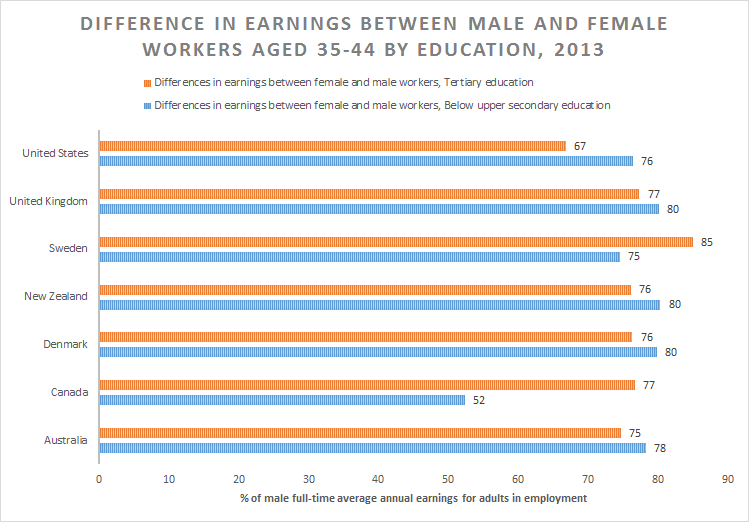
Data extracted on 09 Mar 2016 22:28 UTC (GMT) from OECD.Stat.
In most countries in the chart above, going on to university and graduating does not reduce the gender pay gap by the time you reach your late 30s and early 40s. Best explanation for that is that part of the graduate wage premium is traded for work-life balance.
Celebrating humanity's flourishing through the spread of capitalism and the rule of law
Celebrating humanity's flourishing through the spread of capitalism and the rule of law
Celebrating humanity's flourishing through the spread of capitalism and the rule of law
Celebrating humanity's flourishing through the spread of capitalism and the rule of law
Celebrating humanity's flourishing through the spread of capitalism and the rule of law
Celebrating humanity's flourishing through the spread of capitalism and the rule of law
Celebrating humanity's flourishing through the spread of capitalism and the rule of law
Celebrating humanity's flourishing through the spread of capitalism and the rule of law
A History of the Alt-Right
Econ Prof at George Mason University, Economic Historian, Québécois
Celebrating humanity's flourishing through the spread of capitalism and the rule of law
Scholarly commentary on law, economics, and more
Beatrice Cherrier's blog
Celebrating humanity's flourishing through the spread of capitalism and the rule of law
Celebrating humanity's flourishing through the spread of capitalism and the rule of law
Celebrating humanity's flourishing through the spread of capitalism and the rule of law
Why Evolution is True is a blog written by Jerry Coyne, centered on evolution and biology but also dealing with diverse topics like politics, culture, and cats.
Celebrating humanity's flourishing through the spread of capitalism and the rule of law
A rural perspective with a blue tint by Ele Ludemann
DPF's Kiwiblog - Fomenting Happy Mischief since 2003
Celebrating humanity's flourishing through the spread of capitalism and the rule of law
The world's most viewed site on global warming and climate change
Tim Harding's writings on rationality, informal logic and skepticism
A window into Doc Freiberger's library
Let's examine hard decisions!
Commentary on monetary policy in the spirit of R. G. Hawtrey
Thoughts on public policy and the media
Celebrating humanity's flourishing through the spread of capitalism and the rule of law
Politics and the economy
A blog (primarily) on Canadian and Commonwealth political history and institutions
Reading between the lines, and underneath the hype.
Economics, and such stuff as dreams are made on
"The British constitution has always been puzzling, and always will be." --Queen Elizabeth II
Celebrating humanity's flourishing through the spread of capitalism and the rule of law
Celebrating humanity's flourishing through the spread of capitalism and the rule of law
WORLD WAR II, MUSIC, HISTORY, HOLOCAUST
Undisciplined scholar, recovering academic
Celebrating humanity's flourishing through the spread of capitalism and the rule of law
Res ipsa loquitur - The thing itself speaks
In Hume’s spirit, I will attempt to serve as an ambassador from my world of economics, and help in “finding topics of conversation fit for the entertainment of rational creatures.”
Researching the House of Commons, 1832-1868
Articles and research from the History of Parliament Trust
Reflections on books and art
Posts on the History of Law, Crime, and Justice
Celebrating humanity's flourishing through the spread of capitalism and the rule of law
Exploring the Monarchs of Europe


Recent Comments