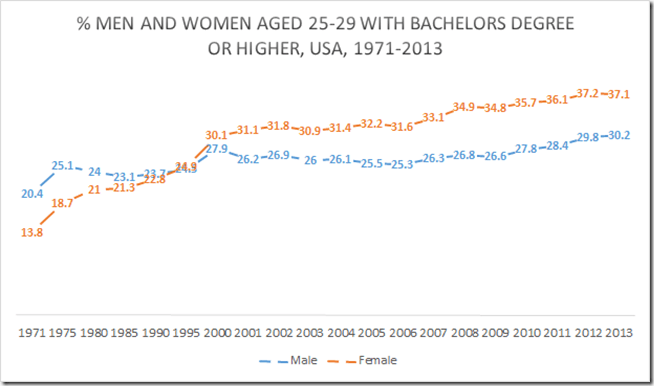
The gender gap in higher education reversed in the year 2000
Celebrating humanity's flourishing through the spread of capitalism and the rule of law
13 Jan 2016 1 Comment
in discrimination, economic history, economics of education, gender, human capital, labour economics Tags: College premium, education premium, graduate premium, reversing gender gap
The gender gap in higher education reversed in the year 2000
10 Jan 2016 Leave a comment
in discrimination, economic history, gender, human capital, labour economics, labour supply, occupational choice, politics - USA Tags: gender wage gap, middle class stagnation, reversing gender gap, wage stagnation
09 Jan 2016 2 Comments
in discrimination, economic history, politics - USA
The heat maps showing the density of the listings, first in 1947 and then in 1956 in the Green Book.

Source: The forgotten way African Americans stayed safe in a racist America – The Washington Post.
According to the Washington Post article today:
in 1936, a postal worker named Victor Green began publishing a guide to help African American travellers find friendly restaurants, auto shops and accommodations in far-off places. Green dubbed the guide after himself – the “Green Book” – and published it for decades. Green says he was inspired by the Jewish press, which had long published information on restricted places…
The Green Book included listings for hotels, restaurants, gas stations, bars and beauty salons across the U.S., as well as travel articles, paid advertisements, and stories about local attractions.
The rise of car ownership among the black middle class made it more and more costly for businesses to turn away their trade despite threats of local lawlessness sanctioned by the police and local and state governments.
07 Jan 2016 Leave a comment
30 Dec 2015 Leave a comment
in discrimination, economic history, gender, labour economics Tags: gender wage gap, middle-class wage stagnation
29 Dec 2015 Leave a comment
in discrimination, economic history, gender Tags: reverse gender gap
23 Dec 2015 Leave a comment
in discrimination, economics of education, human capital, labour economics Tags: affirmative action, racial discrimination
22 Dec 2015 Leave a comment
in discrimination, gender, labour economics, labour supply Tags: family wage gap, gender wage gap, implicit bias
The gender wage gap from married women is 3 to 30 times that of single women. This was actually have a positive gender wage gap.
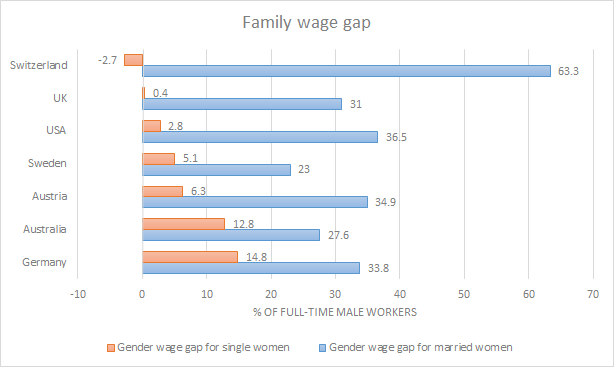
Source: IZA World of Labor – Equal pay legislation and the gender wage gap.
The smallest of the gender wage gap for single women, which has been well known for a long time, does not bode well for those such as Geoff Simmons who argue that implicit bias is an important driver of the gender pay gap.
Why are there vast differences in this implicit bias against women between countries. Why is this implicit bias so much stronger against married women? Having an implicit bias against married women but not single women is a very odd implicit bias.
These puzzles are before considering the information extraction problem facing employers who are implicitly bias against married women. Employers do not know whether an applicant is married or single and pay less accordingly. As Polachek observed:
Corporate discrimination cannot explain these wage patterns. Were corporate discrimination the reason, one would need an explanation why corporations hardly discriminate against single women, but discriminate enormously against married women, especially married women with children spaced widely apart, given that they often cannot legally ask questions about marital status in employment applications.
Even if they could get this marital status information, they wouldn’t have information on the number and spacing of one’s children. But even if supervisors knew number of children, they are far less knowledgeable about children’s ages, and hence less likely to know much about child spacing.
Employers who are slightly less implicitly biased against married women would have a far higher quality recruitment pool which gives them a competitive advantage. Employers who are implicitly biased against women and married women are less likely to survive in competition.
19 Dec 2015 1 Comment
in applied price theory, discrimination, economics of education, gender, human capital, labour economics, labour supply, politics - New Zealand, politics - USA, poverty and inequality Tags: charter schools, racial discrimination, Roland Fryer

19 Dec 2015 Leave a comment
in discrimination, gender, labour economics, labour supply, law and economics, occupational choice
Many young women choose to not pursue science, technology, engineering and maths (STEM) careers because there are other career options that allow them to better use their superior verbal and reading abilities.
Further reasons for women to hesitate entering STEM occupations is their faster rate of human capital depreciation. It has been well known for a long time that human capital atrophy rates differ greatly by occupation and are much higher in professional, managerial and craft occupations.
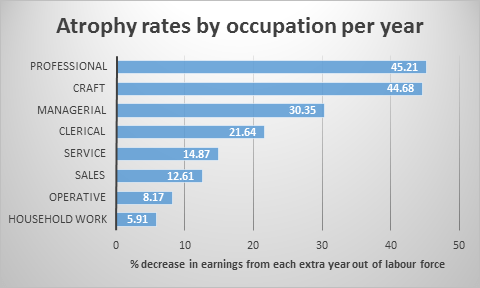
Source: Polachek (1981).
Even a year out of the workforce can greatly reduce earning power because of a rapid depreciation of the human capital accumulated from certain occupations. Women make education and career choices that minimise these losses in light of periods away from work because of motherhood.
Women self-selecting to those occupations with low rates of human capital depreciation. As De Grip explains using German data:
…women who anticipate career interruptions for family reasons take account of the wage penalties related to such a break when they choose their occupational field, i.e. women select occupations where human capital deprecation during a career interruption is the lowest…
Our estimation results have important implications for public policies which attempt to encourage the interest of female students in technical studies and occupations. Obviously, the higher human-capital depreciation rates for workers with family-related career breaks in these male occupations can be a serious threshold for women to choose these occupations
Women choose the occupations that maximise the returns from their skills. Occupations that neither well-reward superior verbal and reading skills and have rapid rates of depreciation on occupational human capital are not a good investment for many of the women anticipating spells out of the workforce because of motherhood.
Rendall and Rendall (2015) recently investigated differential depreciation rates on verbal and maths skills in competing occupational choices for college educated women. Not surprisingly, they found that in the USA verbal skills suffered only minor depreciation during career interruptions but maths skills experience costly depreciation. They found that:
…college educated women avoid occupations requiring significant math skills due to the costly skill atrophy experienced during a career break. In contrast, verbal skills are very robust to career interruptions. The results support the broadly observed female preference for occupations primarily requiring verbal skills – even though these occupations exhibit lower average wages.
Thus, skill-specific atrophy during employment leave and the speed of skill repair upon returning to the labour market are shown to be important factors underpinning women’s occupational outcomes. This research suggests that a substantial portion of female occupational sorting could be determined by skill-specific atrophy-repair characteristics.
This is no surprise as verbal skills improve with age because of expanding vocabularies and better judgement based on accumulated experience. Maths skills tend to be the type of skills where your best years in your 20s and after that things fall away.
These findings by Rendall and Rendall reinforce the initial bias women have against STEM occupations because of their superior reading and verbal skills. STEM occupations are a poor career choice for women because they undervalue their innate skills and heavily penalise career interruptions.
Such is the fatal conceit of politicians is they want to encourage women to make poor education and occupational investments. Women self-selecting into vastly different occupations to men because they are smarter than the average politician about what is the best of them.
Differential atrophy rates on human capital as drivers of the gender wage gap and occupational segregation have nothing to do with the choices of employers – nothing to do with blameworthy behaviour on their part. The blameworthy behaviour can be explicit prejudice, implicit bias or statistical discrimination.
Much of occupational segregation is the result from self-selection by women into occupations on the basis of superior innate skills and the slow rates at which these verbal and reading skills depreciate with time both in general and with time away from the workforce.
19 Dec 2015 Leave a comment
in discrimination, gender, human capital, labour economics, occupational choice Tags: gender wage gap, superstar wages, superstars, top 1%
18 Dec 2015 Leave a comment
in discrimination, gender, labour economics, labour supply, politics - USA, poverty and inequality, welfare reform Tags: economics of fertility, female labour force participation, maternal labour force participation, single mothers
17 Dec 2015 Leave a comment
in discrimination, economics of education, labour economics, politics - USA Tags: early childhood education, racial discrimination
09 Dec 2015 1 Comment
in applied price theory, discrimination, economic history, gender, minimum wage, politics - New Zealand, politics - USA
Geoff Simmons is one of many to argue that the gender wage gap is smaller at the bottom end of the labour market because of the minimum wage. For example, the explanation of the Economic Policy Institute for greater gender pay equality at the bottom is the minimum wage:
The minimum wage is partially responsible for this greater equality among the lowest earners—it sets a wage floor that applies to everyone, which means that people near the bottom of the distribution are likely to make more equal wages. Also, low-wage workers are disproportionately women, which means that the minimum wage particularly bolsters women’s wages.
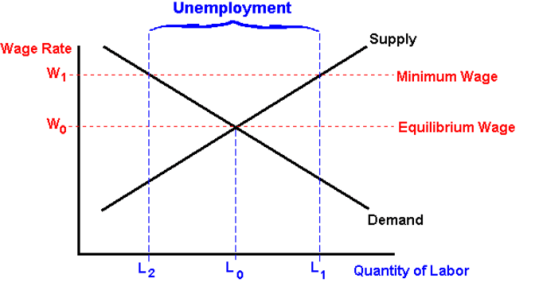
This is plainly wrong as a question of economic theory and political history. One effect of minimum wages is it lowers the cost of discrimination against the employment of less-preferred workers. Since the employer has to pay the minimum wage hour no matter whom he hires, the cost of discriminating on the basis of sex or race is less.
That is why South African whites at the beginning of and all through the apartheid era demanded that blacks be paid the minimum wage: they wanted to cheapen the cost of discrimination.
Minimum wages were initially introduced in the USA shortly after 1900 solely for women and children. The express aim was to price women out of jobs and raise men’s wages by enough so that they could provide for their families.
Tim Leonard in Protecting Family and Race The Progressive Case for Regulating Women’s Work showed that these women-only minimum wages were justified by political progressive including women on grounds that they would:
(1) Protect the biologically weaker sex from the hazards of market work;
(2) Protect working women from the temptation of prostitution;
(3) Protect male heads of household from the economic competition of women; and
(4) Ensure that women could better carry out their eugenic duties as “mothers of the race.”
These days some argue that minimum wages actually increase employment. Times change, and the slopes of supply and demand curves for labour must change with them.
If there is a minimum wage, the cost to employers of indulging their conscious prejudices or an unconscious bias are less. This is because a minimum wage set above the market clearing wage will cause unemployment. Because jobs must be rationed, the costs of indulging a prejudice or succumbing to an unconscious bias are reduced and along with that the market mechanisms that wear down discrimination by employers.
Part of the explanation of the gender wage gap is interruptions in labour force participation because of motherhood reduces the time available to them for job shopping. The first 10 to 15 years of most careers, most working lives, is spent job shopping.
Job shopping is where wages grow through the accumulation of search capital. By moving between 6 to 10 jobs in their first 10 to 15 years in the workforce, a worker finds better and better matches for their skills and talents. They worked their way into the better paying job simply because they have had more time to find a good job match between the changing array of vacancies and their idiosyncratic set of skills and work history.
Great quote on the cruelty of the minimum wage from Nobel economist Vernon Smith, illustrated by Henry Payne https://t.co/Lwch51acEY—
Mark J. Perry (@Mark_J_Perry) October 24, 2015
The minimum wage frustrates this job shopping by denying some women their initial stepping stone into the labour market both when they are a teenager and when they are returning from time spent caring for children. This is in addition to the minimum wage increasing the gender wage gap from reducing the costs of discrimination to employers.
The minimum wage reduces women’s opportunities to get a foothold in the labour market and build on that foothold through job shopping.
08 Dec 2015 Leave a comment
in applied price theory, discrimination, economics of education, gender, human capital, labour economics, managerial economics, occupational choice, organisational economics, personnel economics, politics - Australia, politics - New Zealand, politics - USA Tags: economics of personality traits, gender wage gap, reversing gender gap

Women started drifting away from computer science in the mid-1980s. The interpretation put forward by the professional grievance industry, that is, by National Public Radio in the USA is:
The share of women in computer science started falling at roughly the same moment when personal computers started showing up in U.S. homes in significant numbers.
These early personal computers weren’t much more than toys. You could play pong or simple shooting games, maybe do some word processing.
And these toys were marketed almost entirely to men and boys. This idea that computers are for boys became a narrative. It became the story we told ourselves about the computing revolution. It helped define who geeks were, and it created techie culture.
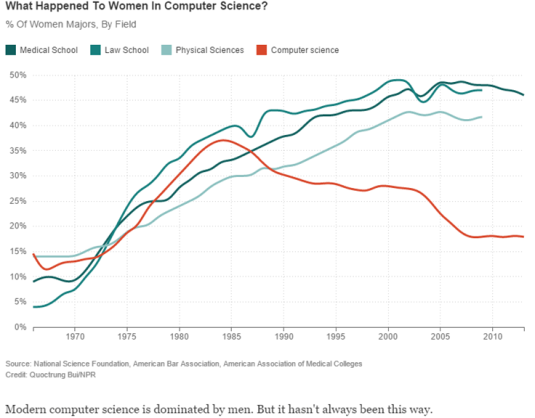 Source: NPR
Another interpretation is there are systematic differences between teenage boys and teenage girls in verbal and written skills. Young women moved away from enrolling in computer…
View original post 224 more words
Celebrating humanity's flourishing through the spread of capitalism and the rule of law
Celebrating humanity's flourishing through the spread of capitalism and the rule of law
Celebrating humanity's flourishing through the spread of capitalism and the rule of law
Celebrating humanity's flourishing through the spread of capitalism and the rule of law
Celebrating humanity's flourishing through the spread of capitalism and the rule of law
Celebrating humanity's flourishing through the spread of capitalism and the rule of law
Celebrating humanity's flourishing through the spread of capitalism and the rule of law
Celebrating humanity's flourishing through the spread of capitalism and the rule of law
A History of the Alt-Right
Econ Prof at George Mason University, Economic Historian, Québécois
Celebrating humanity's flourishing through the spread of capitalism and the rule of law
Scholarly commentary on law, economics, and more
Beatrice Cherrier's blog
Celebrating humanity's flourishing through the spread of capitalism and the rule of law
Celebrating humanity's flourishing through the spread of capitalism and the rule of law
Celebrating humanity's flourishing through the spread of capitalism and the rule of law
Why Evolution is True is a blog written by Jerry Coyne, centered on evolution and biology but also dealing with diverse topics like politics, culture, and cats.
Celebrating humanity's flourishing through the spread of capitalism and the rule of law
A rural perspective with a blue tint by Ele Ludemann
DPF's Kiwiblog - Fomenting Happy Mischief since 2003
Celebrating humanity's flourishing through the spread of capitalism and the rule of law
The world's most viewed site on global warming and climate change
Tim Harding's writings on rationality, informal logic and skepticism
A window into Doc Freiberger's library
Let's examine hard decisions!
Commentary on monetary policy in the spirit of R. G. Hawtrey
Thoughts on public policy and the media
Celebrating humanity's flourishing through the spread of capitalism and the rule of law
Politics and the economy
A blog (primarily) on Canadian and Commonwealth political history and institutions
Reading between the lines, and underneath the hype.
Economics, and such stuff as dreams are made on
"The British constitution has always been puzzling, and always will be." --Queen Elizabeth II
Celebrating humanity's flourishing through the spread of capitalism and the rule of law
Celebrating humanity's flourishing through the spread of capitalism and the rule of law
WORLD WAR II, MUSIC, HISTORY, HOLOCAUST
Undisciplined scholar, recovering academic
Celebrating humanity's flourishing through the spread of capitalism and the rule of law
Res ipsa loquitur - The thing itself speaks
In Hume’s spirit, I will attempt to serve as an ambassador from my world of economics, and help in “finding topics of conversation fit for the entertainment of rational creatures.”
Researching the House of Commons, 1832-1868
Articles and research from the History of Parliament Trust
Reflections on books and art
Posts on the History of Law, Crime, and Justice
Celebrating humanity's flourishing through the spread of capitalism and the rule of law
Exploring the Monarchs of Europe



Recent Comments