What is happening to the New Zealand gender pay gap?
06 May 2017 Leave a comment
in discrimination, economic history, gender, labour economics Tags: gender wage gap, New Zealand Greens
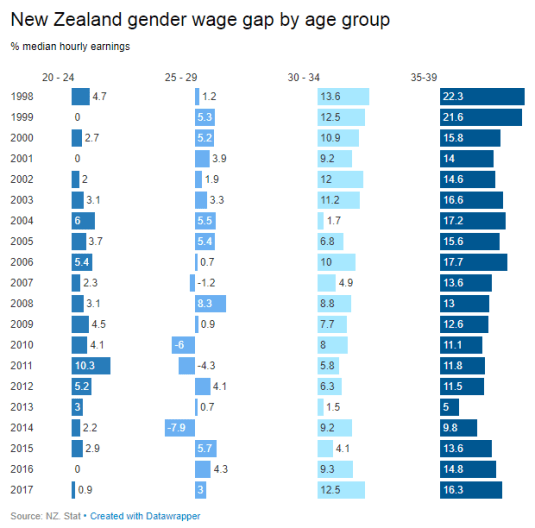
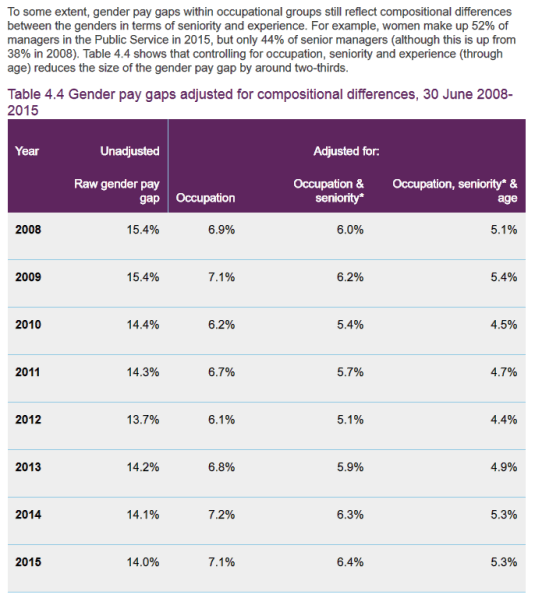
Source: Statistics New Zealand Measuring the gender pay gap.

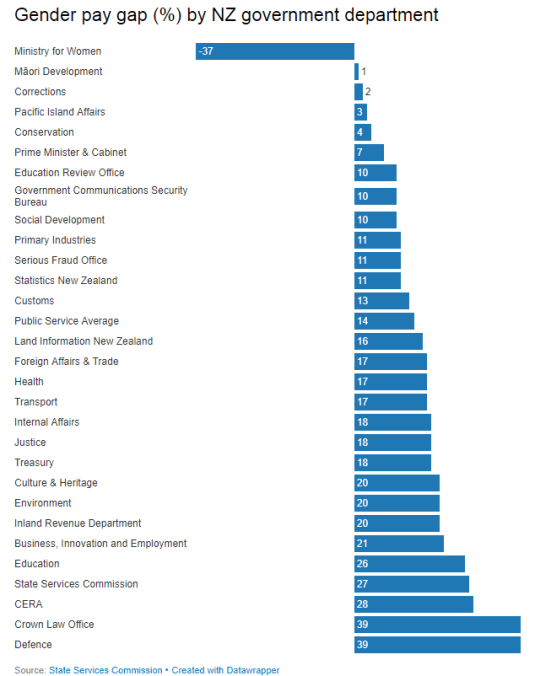
Source: Statistics New Zealand Effect of motherhood on pay – summary of results.
Why is the Swedish gender wage gap so stubbornly stable (and high)?
06 May 2017 Leave a comment
in discrimination, gender, human capital, labour economics, labour supply, occupational choice Tags: economics of fertility, female labour force participation, gender wage gap, maternity leave, preference formation, statistical discrimination, Sweden, unintended consequences
The Swedes are supposed to be in a left-wing utopia. Welfare state, ample childcare and long maternity leave but their gender wage gap is almost as bad as in 1980. They must be a misogynist throwback.
Maybe Megan McArdle can explain:
There are countries where more women work than they do here, because of all the mandated leave policies and subsidized childcare — but the U.S. puts more women into management than a place like Sweden, where women work mostly for the government, while the private sector is majority-male.
A Scandinavian acquaintance describes the Nordic policy as paying women to leave the home so they can take care of other peoples’ aged parents and children. This description is not entirely fair, but it’s not entirely unfair, either; a lot of the government jobs involve coordinating social services that women used to provide as homemakers.
The Swedes pay women not to pursue careers. The subsidies from government from mixing motherhood and work are high. Albrecht et al., (2003) hypothesized that the generous parental leave a major in the glass ceiling in Sweden based on statistical discrimination:
Employers understand that the Swedish parental leave system gives women a strong incentive to participate in the labour force but also encourages them to take long periods of parental leave and to be less flexible with respect to hours once they return to work. Extended absence and lack of flexibility are particularly costly for employers when employees hold top jobs. Employers therefore place relatively few women in fast-track career positions.
Women, even those who would otherwise be strongly career-oriented, understand that their promotion possibilities are limited by employer beliefs and respond rationally by opting for more family-friendly career paths and by fully utilizing their parental leave benefits. The equilibrium is thus one of self-confirming beliefs.
Women may “choose” family-friendly jobs, but choice reflects both preferences and constraints. Our argument is that what is different about Sweden (and the other Scandinavian countries) is the constraints that women face and that these constraints – in the form of employer expectations – are driven in part by the generosity of the parental leave system
Most countries have less generous family subsidies so Claudia Goldin’s usual explanation applies to their falling gender wage gaps
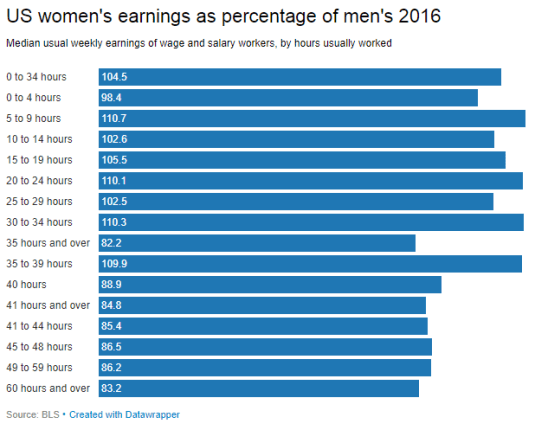
Quite simply the gap exists because hours of work in many occupations are worth more when given at particular moments and when the hours are more continuous. That is, in many occupations earnings have a nonlinear relationship with respect to hours. A flexible schedule comes at a high price, particularly in the corporate, finance and legal worlds.
Gender pay gap shown to be a myth by @paulabennettmp @women_nz
03 May 2017 Leave a comment
in discrimination, gender, labour economics, law and economics, politics - New Zealand Tags: conspiracy theories, economics of fertility, gender wage gap, implicit bias, unconscious bias
The Minister for Women Paula Bennett and the Ministry of Women published excellent research in February showing there cannot be a gender wage gap driven by unconscious bias. The Minister has blamed a large part of the remaining gender wage gap on unconscious bias.
… up to 84 per cent of the reason for the Pay Gap, that’s right, 84 per cent, is described as ‘unexplained factors.’ That means its bias against women, both conscious and unconscious.
It’s about the attitudes and assumptions of women in the workplace, it’s about employing people who we think will fit in – and when you have a workforce of men, particularly in senior roles then it seems likely you’re going to stick with the status quo – whether they do that intentionally or just because “like attracts like”.
It’s because there is still a belief that women will accept less pay than men – they don’t know their worth and aren’t as good at negotiating.
The reason why this February 2017 research on the motherhood penalty contradicts earlier Ministry of Women research on unconscious bias and the gender wage gap is simple.
There is a large difference in the gender wage gap from mothers and for other women. As the adjacent graphic from Ministry of Women research shows, the gender wage gap for mothers is 17% but it is only 5% from other women.

Source: Effect of motherhood on pay – summary of results Statistics New Zealand and Ministry of Women February 2017.
We men, us dirty dogs all, have no way of knowing whether a female applicant is a mother. Remember we are dealing with unconscious bias, the raised eyebrow, the prolonged pause, the lingering glance, not a conspiracy or a prejudice of which we are self-aware and take overt steps to implement. Unconscious bias is unconscious by definition.
Because the bias against women is implicit and unconscious, we men, dirty dogs all, do not know we are biased, so we do not know we have to make further enquiries to check if the female applicant is a mother so we can discriminate against her more than we do for other women.That is before we consider other drivers of the gender wage gap such as whether there are relatively large spaces between the births of her children.
Large spaces between the birthdays of children greatly increases the gender wage gap because women spend much more time out of the workforce and part-time if they spread births. This reduces their accumulation of on-the-job human capital and encourages women who plan large families to choose occupations and educational majors that do not depreciate rapidly during career interruptions.
I have no idea how an unconsciously biased employer can discover if a woman has children with spaced out ages and therefore discriminate against an even more, unconsciously, of course. We men, dirty dogs all, do not know that in order to discriminate against them, especially in shortlisting for initial hiring when we have no information beyond the application about them.
Do women have more unconscious bias against women than men? If not, there should be differences in the gender pay gap in firms with more women managers or owners.
Becoming a mother and going part time is seriously bad for women's incomes ft.com/content/94e2e7… https://t.co/2bFfELztnX—
Chris Giles (@ChrisGiles_) August 23, 2016
Perhaps there is more unconscious biased in promotions because managers may have accidentally learnt are the ages of the children of female applicants and unconsciously taken a note to remember that when unconsciously discriminating against them in promotion. This unconscious bias involves a lot of very conscious data collection and retention.
All in all, the unconscious bias hypothesis simply cannot explain such a large difference between the gender wage gaps of parents and non-parents. There is too much evidence whose existence that is strictly forbidden by the hypothesis of unconscious bias against women in the workplace.
But @NZLabour must be guilty of racism if it uses its own evidence standards
03 May 2017 Leave a comment
in discrimination, gender, politics - New Zealand Tags: affirmative action, implicit bias, New Zealand Labour Party, political correctness, racial discrimination, racism, sex discrimination, sexism, unconscious bias
Prominent New Zealand Labour Party stalwart Sunny Kaushal has resigned from the Party amidst allegations of hostilities and bullying from Party Membership and Party Hierarchy.

With the growing use of arguments about unconscious bias, it is near impossible to rebut an accusation of racism.
Certainly, once the accusation is spit at you, the onus is on you to prove to a stranger who never met you before beyond reasonable doubt that you are not a racist. One misfortunate glance, a raised eyebrow, a jumbled sentence is enough to undo a life of principle

Unconscious bias is the main driver of the gender wage gap if my betters are to be believed. Why not racism? What is the view of the New Zealand Labour Party on unconscious bias in proving racial discrimination and pay inequity?
The Labour Party wants to reverse the onus of proof in sexual assault trials. Certainly these standards should filter down into civil proceedings and pub conversations.

The Labour Party must be a cauldron of sexism if the only way it can get gender balance in caucus is quotas. Why is racism not any less insidious within Labour decision-making than sexism?
The rapid adaptation of women to changing prospects
01 May 2017 1 Comment
in discrimination, economics of education, gender, human capital, labour economics, labour supply, occupational choice Tags: College premium, gender way, reversing gender gap
On the upside, Goldin (2006) showed that women adapted rapidly over the 20th century to changing returns to working and education as compared to options outside the market. Their labour force participation and occupational choices changed rapidly into long duration professional educations and more specialised training in the 1960s and 1970s as many more women worked and pursued careers. The large increase in tertiary education by New Zealand after 1990 and their move into many traditionally male occupations is another example.
The key is what drives the rapid changes in the labour force participation and occupational choices of women. Some of the factors are global technology trends such rising wages and the emergence of household technologies and safe contraception and antidiscrimination laws. All of these increased the returns to working and investing in specialised education and training.
Up until the mid-20th century, women invested in becoming a teacher, nurse, librarian or secretary because these skills were general and did not deprecate as much during breaks. When expectations among women of still working at the age of 35 doubled, there were massive increases in female labour force participation and female investments in higher education and specialised skills (Goldin and Katz 2006). These trends continue to today.
Women and in particular those women making education choices need good information on their prospects in different occupations. The evidence is they adapt rapidly to changing prospects (Goldin 2004, 2006). Goldin (2004, 2006) referred to a quiet revolution in women’s employment, earnings and education because the changes in female labour supply and occupational choices were abrupt and large.
Women adapted rapidly to changes in their expectations about their future working life, graduation rates, attainment of professional degrees, age of first marriage, and the timing and number of children. These expectations of women about their futures turned out the surprisingly accurate (Katz 2004, 2006). Young women are surprisingly good forecasters of their labour market involvement. Any gender policy options must be sensitive to the high level of responsiveness of women to changing educational opportunities and prospects and their precision to date as forecasters.
The complex decisions youth make about education and occupational choices is driven by many sources. Women are interested in issues that are of less importance to men such as work-life balance and the costs of career breaks to their earning power and human capital. Goldin (2004, 2006) argued that women who have a more accurate assessment of their future labour market involvement will invest more wisely in education and occupational choice.
The market process rewards the skills and commitment the men and women bring to the labour market. The differences in skills and commitment the men and women bring arise from a gendered division of labour and effort in the household and in raising families that appears to be open to only minor changes that are expensive in terms of growth and prosperity. This is because most gains in the status of women were the result of economic growth rather than legal interventions. Child care subsidies and parental leave arose after rising income made them and the modern welfare state fiscally affordable rather than the other way around.
Interview with Gary Becker on Globalization and inequalities
30 Apr 2017 Leave a comment
in applied price theory, development economics, discrimination, economic history, Gary Becker, growth miracles, labour economics Tags: The Great Escape
A gendered division of labour and household effort
30 Apr 2017 Leave a comment
in discrimination, economics of love and marriage, gender, labour economics, labour supply Tags: gender gap, gender wage gap, household production, housework, leisure time, marriage and divorce
A major factor driving the gendered division of labour and household effort is technology. Tiny differences in comparative advantage such as in child rearing immediately after birth can lead to large differences in specialisation in the market work and in market-related human capital and home production related work and household human capital (Becker 1985, 1993).
These specialisations are reinforced by learning by doing where large differences in market and household human capital emerge despite tiny differences at the outset (Becker 1985, 1993). This gendered division of labour and household effort is hard to change because large payments must be made to influence choices about care giving by highly specialised people with large but different accumulations of market and household human capital.
From a luck egalitarian perspective, many of the differences in earnings and occupations flow accidents of birth in deciding gender and who parents might be. Social inequalities that flow from brute bad luck call for interventions to put them right, if they work.
Many laws already make up for brute bad luck such as job protections while on maternity leave, and government funded parental leave pay and child care subsidies. Employers can do little to redress these accidents of birth nor do they have sufficient resources to put them right. For this reason, for example, parental leave pay is usually taxpayer funded rather than employer funded.
…
Ayaan Hirsi Ali talks about Linda Sarsour’s “hate” for her as a woman
29 Apr 2017 Leave a comment
in discrimination, economics of religion, gender, politics - USA Tags: political correctness
Forward looking behaviour and occupational segregation
28 Apr 2017 Leave a comment
in discrimination, economics of education, gender, human capital, labour economics, labour supply, occupational choice Tags: college major, College premium, gender wage gap, graduate premium, reversing gender gap
Rosen (2004) suggests that the engineering market responds strongly to economic forces. The demand for engineers responds to the price of engineering services and demand shocks such as recessions and defence cuts. Supply and enrolment decisions are remarkably sensitive to career prospects in engineering. Students also appear to use some forward-looking elements to forecast demand for engineers. Many students also change their majors in light on more information on whether the like their current choices and other news (Bettinger 2010).
This evidence of students use forward-looking elements to forecasting the occupational demand for human capital suggests that better information may improve these choices. The government has made a distributional judgment to expand the choices open to women. The growing evidence of relatively accurate forward looking decisions making by students suggests that they will respond to additional information on prospects in different careers.
In addition, earnings from some occupations are also more uncertain than others. The STEM occupations are an example where shortages and, in particular, surpluses are more common because durable goods industries bear the bulk of business cycle risk. There is also the political unpredictability of defence and R&D spending. Women seem to prefer jobs that are more secure. Some occupations have higher risks of injury than others. Fewer parents, and both single fathers and single mothers, in particular, enter these more injury prone occupations.
These gender-based preferences about hazards and uncertainties will lead to fewer women entering occupations that are more injury prone or more at risk to recessions and industry-specific downturns. Occupational segregation will still persist in the labour market in the relative absence of either discrimination or a gendered division of labour and household effort.
Choice and Change: How to Close the Gender Gap | Learn Liberty
27 Apr 2017 Leave a comment
in applied price theory, discrimination, gender, human capital, labour economics, labour supply Tags: gender wage gap
Changing labour supply composition and the supply of work-life balance by employers
27 Apr 2017 Leave a comment
in discrimination, gender, labour economics, labour supply Tags: compensating differentials, female labour force participation, female labour supply, gender wage gap, part-time work, worklife balance
The growing number of women in the workforce and the domination of women of the graduate labour supply will increase the incentive of employers to make the workplace more family-friendly. Those that do not will lose access to the majority of graduate and other talent.
Various work place amenities can be traded-off in salary packages. In industries and occupations where this is cheap to do, the wage offset will be least. These industries and occupations will attract a large number of women because the net returns to them in cash wages plus amenities is higher than for men who value the greater work life balance less.
Occupational segregation around the clock illustrates the delicate trade-off between cash wages and the costs of flexible hours. Men and women work in much the same occupations between 8 and 6. There are big gaps if you are an early starter or work over dinner time.
Changing the production processes of these industries to induce more women to work unsocial hours would require large reduction in production and pay. Fewer women will not enter occupations with more unsocial hours unless they are paid more than in other jobs where it is cheaper to provide work-life balance and still pay higher cash wages.
Occupations and industries where family friendliness is more costly will be male dominated because women qualified enough to enter these occupations will go elsewhere where the cash wages sacrifice is less for work-life balance. Influxes of women will occur in industries where technological trends lower the cost of work-life amenities and the growing number of female skilled workers forces employers’ hands. They must adapt or lose out in competition for talent. The large influx of women into male dominated higher skilled occupations and professions suggests that some occupations can provide work-life balance at a lower cost than others.
Newer drivers of occupational segregation
26 Apr 2017 Leave a comment
in discrimination, economic history, economics of education, gender, human capital, labour economics, labour supply, occupational choice Tags: College premium, gender, reversing gender gap
There are important drivers of occupational segregation that are not related to either discrimination or a gendered division of labour. These newer drivers are strong enough to explain most of the gender differences in tertiary education attainment. These gender differences in tertiary attainment and the drivers behind them will be important determinates of the future occupational segregation and entry into male dominated professions.
An important driver of occupational segregation is modern technological trends ranging from ICT to the emergence of a larger service sectors that have worked to the comparative advantage of women. Many more service jobs and fewer jobs based on brawn have increased the returns to women of working more in the market. In addition, a range of personality traits and skills work to the advantage of women in some occupations more than others.
Another driver of occupational segregation is women have more occupation choices than men because of different personality traits and superior verbal and readings skills. The superior verbal and reading skills of teenage girls are the equivalent of ½ a year’s extra schooling (OECD 2012). Teenage girls also score higher on personality traits such as persistence. Teenage boys have many more behavioural problems. Boys do especially poorly in broken families (Bertrand and Pan 2013).
Jacob (2002) found that higher non-cognitive skills and larger college premiums for women accounted for 90 percent of the gender gap in higher education. Becker, Hubbard and Murphy (2010) found that differences in the costs of college for women and men are primarily due to differences in the distributions of non-cognitive skills and explain most of the world-wide overtaking of men by women in higher education.
About 64% of recent New Zealand graduates were women but they have personality traits and verbal and reading skills that will be rewarded more in interactive professions and occupations. Women are pursuing these comparative advantages and maximising the rewards on their skills and natural talents. These differences in skills and talents will lead to different occupational and sub-occupational distributions and mixes as compared to men despite any differences arising from the gendered division of labour and effort and costs of care giving.
There are fewer women in STEM occupations because they have better options elsewhere to reward both their mathematical and scientific talents and their superior verbal and reading skills.
The wage premium for STEM occupations for women is much smaller because they have options elsewhere that reward all of their skills, not just their STEM related talents. Young women and well as young men do equally will in the STEM prerequisites. Women have more options is other higher power occupations that make full use of their more diverse talents.
Occupational segregation in the future in part will be driven the same factors behind much higher female tertiary educational attainment. Superior verbal and readings skills and greater persistence and self-organisation among women will make some occupations more rewarding for them as compared to males who have, on average, fewer of these innate talents.
The traditional drivers of occupational segregation
23 Apr 2017 Leave a comment
in discrimination, gender, human capital, labour economics, labour supply, occupational choice Tags: economics of fertility, female labour force participation, female labour supply, gender wage gap, marriage and divorce, occupational segregation
The main drivers of female occupational choice are supply-side (Chiswick 2006, 2007). This self-selection of females into occupations with more durable human capital, and into more general educations and more mobile training that allows women to change jobs more often and move in and out of the workforce at less cost to earning power and skills sets.
Chiswick (2006) and Becker (1985, 1993) then suggest that these supply side choices about education and careers are made against a background of a gendered division of labour and effort in the home, and in particular, in housework and the raising of children. These choices in turn reflect how individual preferences and social roles are formed and evolve in society.
These adaptations of women to the operation of the labour market, in turn, reflect a gendered division of labour and household effort in raising families and the accidents of birth as to who has these roles (Chiswick 2006, 2007; Becker 1981, 1985, 1993).
The market is operating fairly well in terms of rewarding what skills and talents people bring to it in light of a gendered division of labour and household effort and the accidents of birth. The issue is one of distributive justice about how these skills and family commitments are allocated and should be allocated outside the market between men and women when raising children. As in related areas such as racial and ethnic wage and employment gaps, these gaps are driven by differences in the skills and talents that people acquired prior to entering the labour market. …
The changing nature and scale of the gender gap
22 Apr 2017 Leave a comment
in discrimination, gender, human capital, labour economics, labour supply, occupational choice Tags: female labour supply, gender wage gap, occupational segregation, worklife balance
Developments in recent decades greatly increased the options for women to combine careers and family. The unadjusted gender wage gap is narrow while the gender education gap has reversed. The progress with closing the gender gaps in employment and education in recent decades makes the crafting of further gender-based policy interventions more challenging.
The remaining gender gaps reflect much more thorny issues such as work-life balance rather than mid and late 20th century concerns such as large gender differences in education participation and attainment, sex discrimination and full-time motherhood raising much larger families.
Parental leave, early childhood education and child care subsidies have increased in New Zealand in recent years. Early childhood education spending is high in New Zealand by international standards but spending on child care subsidies is less generous (OECD 2012).
The main drivers of greater female labour force participation and greater investment in long-duration professional educations were access to reliable contraception, the rise of service sector and other jobs that depend on brains instead of brawn, the automation of housework with white goods, and rising incomes increasing the opportunity cost of having a large number of children.
This is a first in a series of blogs on occupational segregation and gender.
Recent Comments