
Source: Why Are Women Paid Less? – The Atlantic.
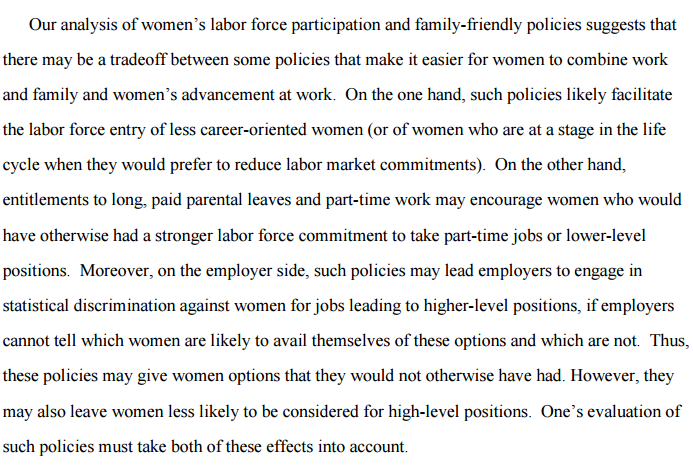
Source: AEAweb: AER (103,3) p. 251 – Female Labor Supply: Why Is the United States Falling Behind?
Celebrating humanity's flourishing through the spread of capitalism and the rule of law
07 Dec 2015 Leave a comment
in applied price theory, discrimination, economics of love and marriage, gender, labour economics, labour supply, law and economics, occupational choice, politics - New Zealand Tags: do gooders, expressive voting, female labour force participation, gender wage gap, maternal labour supply, maternity leave, The fatal conceit, unintended consequences
Source: Why Are Women Paid Less? – The Atlantic.
Source: AEAweb: AER (103,3) p. 251 – Female Labor Supply: Why Is the United States Falling Behind?
06 Dec 2015 Leave a comment
in discrimination, gender, labour economics
The gender pay gap the top 10% of earners is about 25% in the majority of English-speaking countries. That gap is less than 20% in Canada and New Zealand.
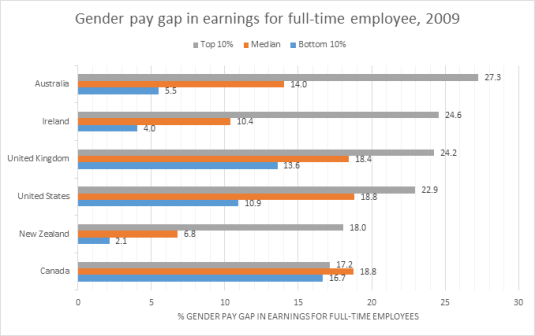
Source: Closing the Gender Gap: Act Now – OECD 2012.
There are much larger differences across the English-speaking countries in the gender pay gap at the median and more so bottom than at the top. Canadians, as usual and just to be difficult, have pretty much the same gender pay gap the bottom, middle and top of the labour market.
06 Dec 2015 Leave a comment
in discrimination, econometerics, gender, labour economics, politics - Australia, politics - USA
There are vast differences in the percentage of the gender wage gap that is left unexplained after adjusting for age, work experience, hours worked, education and job characteristics.
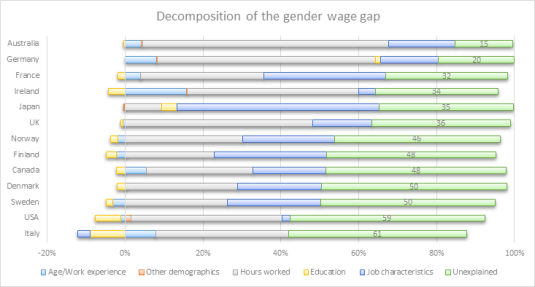
Closing the Gender Gap: Act Now – © OECD 2012 – OECD Secretariat estimates, based on EUSILC (2008), HILDA (2009), CPS (2008), KLIPS (2007), SLID (2008), JHPS (2009), CASEN (2009) and ENIGH (2010) (Annex III.A3).
Attributing this residual in gender pay gaps to discrimination implies vast differences in sex discrimination between countries with similar cultures. Furthermore, a large part of the gender wage gap is unexplained in countries such as Scandinavia which are held up as models in commitment to gender equality and have many family friendly policies including maternity leave that is generous by New Zealand and American standards.
06 Dec 2015 Leave a comment
in discrimination, gender, health and safety, labour economics Tags: gender gap, job safety, reversing gender gap, workplace fatalities
04 Dec 2015 Leave a comment
in discrimination, gender, labour economics, labour supply
The gender employment gap is much smaller in Scandinavian. The reason is their taxes are high but then are paid back through churning. A considerable amount of those taxes fund employment contingent payments for child care and elder care.
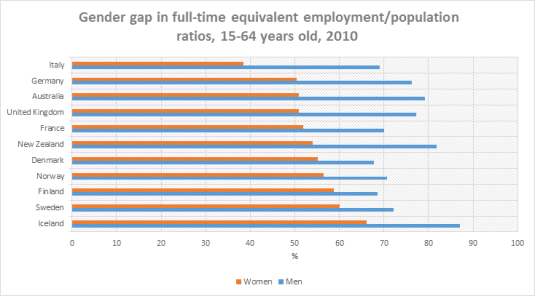
Source: Closing the Gender Gap: Act Now – © OECD 2012.
Richard Rogerson found in Taxation and market work: is Scandinavia an outlier? that how the government spends tax revenues imply different rates of labour supply with regard to tax rate increases.
Rogerson considered that differences in the composition of government spending can potentially account for the high rate of labour supply in Sweden and elsewhere in Scandinavia. Examining the conditions on which how tax revenue is returned to Swedes as income transfers or other conditional payments is central to understanding the labour supply effects of taxes:
A much higher rate of government employment and greater expenditures on child care and elderly care explain the high rates of Swedish labour supply. Swedes are taxed heavily, but key parts of this tax revenue are then given back to them conditionally if they keep working.
04 Dec 2015 Leave a comment
in discrimination, economics of love and marriage, gender, labour economics, labour supply
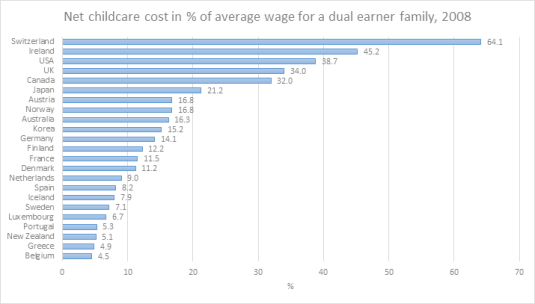
Closing the Gender Gap: Act Now -OECD 2012.
Note: Net childcare costs among couple families where one adult earns 100% of the average wage and the other earns 50% of the average wage.
04 Dec 2015 Leave a comment
in discrimination, gender, labour economics
I can only speculate for the reasons why Italy has the smallest gender pay gap when there are children. One possibility is low fertility rates. Another is that Italian mothers either work full-time or don’t work at all.
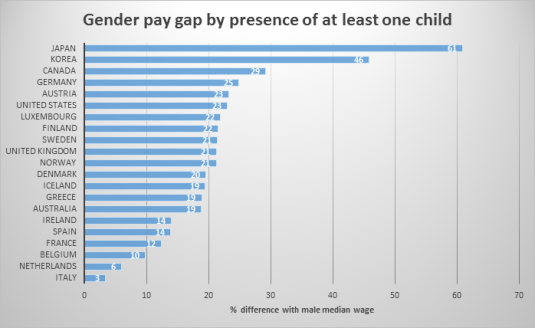
Closing the Gender Gap: Act Now – © OECD 2012: OECD Secretariat estimates based on EUSILC (2008), HILDA (2009), CPS (2008), SLID (2008), KLIPS (2007), JHPS (2009), CASEN (2009) and ENIGH (2010) (Annex III.A3).
As for the remaining countries, having children increases the gender wage gap. This increase in the gender wage gap cannot be attributed to employer bias. They don’t know whether the female applicant has children. It is unlawful to ask.
The number of children and the spacing between their births has been a major driver of the gender wage gap for decades. These long-standing findings have been devastating to the notion that there is discrimination against women on the demand side of the labour market. Employer discrimination is unimportant to the gender wage gap as Polachek explains:
The gender wage gap for never marrieds is a mere 2.8%, compared with over 20% for marrieds. The gender wage gap for young workers is less than 5%, but about 25% for 55–64-year-old men and women.
If gender discrimination were the issue, one would need to explain why businesses pay single men and single women comparable salaries. The same applies to young men and young women. One would need to explain why businesses discriminate against older women, but not against younger women. If corporations discriminate by gender, why are these employers paying any groups of men and women roughly equal pay?
Why is there no discrimination against young single women, but large amounts of discrimination against older married women? …Each type of possible discrimination is inconsistent with negligible wage differences among single and younger employees compared with the large gap among married men and women (especially those with children, and even more so for those who space children widely apart).
The main drivers of the gender wage gap are unknown to employers such as whether the would-be recruit or employer is married, the father is present to help with childcare, how many children they have, how many of these children are under 12, and how many years between the births of their children. These are the main drivers of the gender wage gap.
All of these factors that drive much of the gender wage gap are totally unknown to employers and of no relevance to making a profit. Furthermore, it is costly to discover this information about family composition as well as illegal. Where is the profit in that information? Searching for information only sacrifices more profit. That is not a good business survival strategy: searching for irrelevant information.
04 Dec 2015 Leave a comment
in discrimination, gender, labour economics
03 Dec 2015 Leave a comment
in discrimination, gender, human capital, labour economics, labour supply, politics - Australia, politics - New Zealand, politics - USA Tags: compensating differentials, gender wage gap, labour demographics
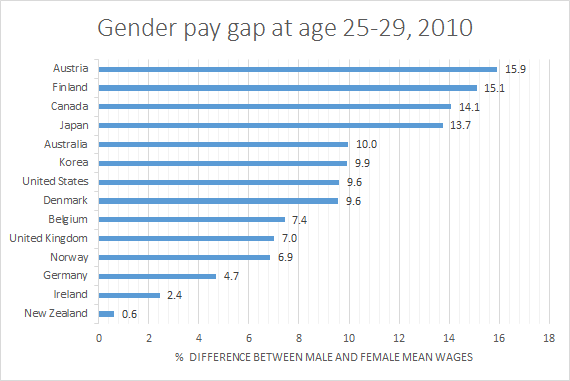
The gender pay gap in New Zealand rounds down to zero for women in their mid-20s!
02 Dec 2015 Leave a comment
in applied price theory, discrimination, economic history, economics, economics of love and marriage, gender, human capital, labour economics, occupational choice, personnel economics Tags: asymmetric marriage premium, compensating differentials, entrepreneurial alertness, gender wage gap, marital division of labour
When I was studying in Japan, they were at the end of phasing out working on Saturdays. The staff at my university work on Saturday mornings for four hours and then went home.
The Japanese working week was reduced by law from 48 to 44 hours per week in 1988 and to 40 hours per week from 1993 (Prescott 1999; Hayashi and Prescott 2002). The Japanese stopped routinely working on Saturdays over the 1990s. The number of national holidays was increased by three and an extra day of annual leave was also prescribed by law.
While feuding with strangers on an unrelated matter about the gender wage gap, it somehow occurred to me that the six-day working week might have something to do with what is on the face of a large amount of sexism in Japan and a large gender wage gap.
That feud with strangers was about unconscious bias as a driver of the gender wage gap in New Zealand. The gender wage gap Japan is attributed to conscious prejudice.
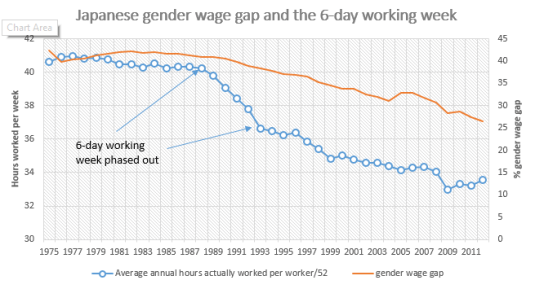
Source: OECD Stat.
In the above chart I have plotted the average weekly hours worked of Japanese workers and the Japanese gender wage gap. Two things can be noticed from the above chart:
In a country where it is standard to work six days a week, the price of motherhood would be much higher than in other countries industrialised countries that phased out the 48-hour week decades previous. The asymmetric marriage premium would also be much higher if one partner to the marriage worked a six-day week while the other looked after the children.
Other drivers of the gender wage gap that arise from human capital specialisation and depreciation and from the differences of a few years in the marrying ages of men and women would be intensified if people worked another day per week. The payoff from a marital division of labour and human capital specialisation where one worked long hours and the other focused on investing in human capital that allow them to care for the children and move in and out of the workforce with less human capital depreciation would be much larger.
Much is made of the distinctiveness of Japanese culture and its sexism. In my time in Japan, the thing I notice most distinctively about Japanese culture was its extraordinary pragmatism and willingness to change rapidly. The Japanese economic miracle was founded on rapid industrialisation, innovation and repeated renewal of human capital. That requires an entrepreneurial spirit and open-mindedness.
Cultural and preference based explanations of the gender wage Including that in Japan underrate the rapid social change in the role of women in the 20th century in all countries in all cultures. As Gary Becker explains:
… major economic and technological changes frequently trump culture in the sense that they induce enormous changes not only in behaviour but also in beliefs. A clear illustration of this is the huge effects of technological change and economic development on behaviour and beliefs regarding many aspects of the family.
Attitudes and behaviour regarding family size, marriage and divorce, care of elderly parents, premarital sex, men and women living together and having children without being married, and gays and lesbians have all undergone profound changes during the past 50 years. Invariably, when countries with very different cultures experienced significant economic growth, women’s education increased greatly, and the number of children in a typical family plummeted from three or more to often much less than two.
A good explanation of this rapid social change is in Timur Kuran’s “Sparks and Prairie Fires: A Theory of Unanticipated Political Revolutions” and “Now Out of Never: The Element of Surprise in the East European Revolution of 1989“.
Kuran suggests that political revolutions and large shifts in political opinion will catch us by surprise again and again because of people’s readiness to conceal their true political preferences under perceived social pressure:
People who come to dislike their government are apt to hide their desire for change as long as the opposition seems weak. Because of the preference falsification, a government that appears unshakeable might see its support crumble following a slight surge in the opposition’s apparent size, caused by events insignificant in and of themselves.
Kuran argues that everyone has a different revolutionary threshold where they reveal their true beliefs, but even one individual shift to opposition leads to many others to come forward and defy the existing order. Small concessions embolden the ground-swell of revolution.
Those ready to oppose social intolerance or who are lukewarm in their intolerance keep their views private until a coincidence of factors gives them the courage to bring their views into the open. They find others share their views and there is a revolutionary bandwagon effect.
Plenty of people have had personal experiences of this in the 1980s and the 1990s when there were rapid changes in social and political attitudes about racism, sexism and gay rights. This includes Japan.
In the case of the Japanese gender wage gap, the move from a six-day to a five-day working week radically changed the asymmetric marriage premium and the payoff from investing in both specialised human capital and in human capital that depreciates quickly when away from work.
This large shift in incentives to work and invest in human capital would embolden a change in social attitudes. This is because the previous views were no longer profitable and many would gain from the change. Others who prefer just to go along with crowd would quickly follow them in to stay in tune with whatever is now popular.
Much of Japanese sexism may be the preference falsification that was low-cost when there was a six-day working week. The move to a five-day working week greatly increased the cost of that sexism and the profits from finding new ways of organising the workplace that better matched motherhood and career in Japan.
Undervalued workers are an untapped business opportunity for more alert entrepreneurs to hire these undervalued workers. In the case of Japan, with a five-day working week, hiring women for jobs that involved considerable investment in firm-specific human capital became more profitable. Previously under a six-day working week it was more profitable to invest in men because they undertook few childcare responsibilities. Under a five-day working week, that payoff matrix favours women more than in the past.
02 Dec 2015 Leave a comment
in discrimination, gender, labour economics Tags: compensating differentials, gender wage gap
New Zealand is top of the world, as usual, in closing the gender wage gap.

30 Nov 2015 1 Comment
in discrimination, gender, minimum wage, politics - New Zealand
The minimum wage was pretty stable as a percentage of the median wage in New Zealand until recently. Nonetheless, the gender wage gap narrowed at the bottom of the labour market rapidly in the 1980s and 1990s.

Source: OECD Employment Database and Data extracted on 30 Nov 2015 04:03 UTC (GMT) from OECD.Stat.
In common with the USA, that narrowing of the gender wage gap stopped in the early 2000s after the minimum wage started increasing as a percentage of the median wage.
Again, that is contrary to the idea that the minimum wage is a failsafe that narrows the gender wage gap at the bottom. This failsafe is said to be the leading reason why the gender wage gap is much smaller at the bottom of the labour market than higher-up such as the median and in particular at the top.
30 Nov 2015 1 Comment
in discrimination, gender, labour economics, minimum wage, politics - USA
When feuding with strangers on Twitter about the gender wage gap, a common explanation for the much smaller gender wage gap at the bottom of the labour market is the power is the minimum wage to uplift women’s wages and with it narrow the gender wage gap at the bottom of the labour market.
Below I have plotted the minimum wage as a percentage of the median wage for the USA along with the gender wage gap for the bottom 10% of the U.S. labour market. Both are expressed as percentages of the median wage.
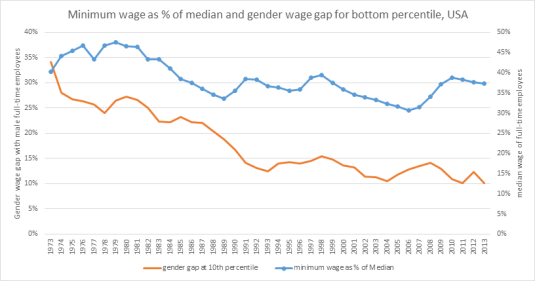
Source: OECD Employment Database and Data extracted on 30 Nov 2015 04:03 UTC (GMT) from OECD.Stat.
From what I can make of the above chart, the gender wage gap at the bottom of the labour market was closing rapidly when the minimum wage was falling as a percentage of the median wage. That gender wage gap then stabilised when the minimum wage stabilised as a percentage of the median. The gender wage gap increased when the minimum wage increased as a percentage of the median wage for full-time employees.
Should not this relationship between the minimum wage and the gender wage gap be the other way around if the minimum wage is a force for closing the gender wage gap at the bottom of the labour market?
Celebrating humanity's flourishing through the spread of capitalism and the rule of law
Celebrating humanity's flourishing through the spread of capitalism and the rule of law
Celebrating humanity's flourishing through the spread of capitalism and the rule of law
Celebrating humanity's flourishing through the spread of capitalism and the rule of law
Celebrating humanity's flourishing through the spread of capitalism and the rule of law
Celebrating humanity's flourishing through the spread of capitalism and the rule of law
Celebrating humanity's flourishing through the spread of capitalism and the rule of law
Celebrating humanity's flourishing through the spread of capitalism and the rule of law
A History of the Alt-Right
Econ Prof at George Mason University, Economic Historian, Québécois
Celebrating humanity's flourishing through the spread of capitalism and the rule of law
Scholarly commentary on law, economics, and more
Beatrice Cherrier's blog
Celebrating humanity's flourishing through the spread of capitalism and the rule of law
Celebrating humanity's flourishing through the spread of capitalism and the rule of law
Celebrating humanity's flourishing through the spread of capitalism and the rule of law
Why Evolution is True is a blog written by Jerry Coyne, centered on evolution and biology but also dealing with diverse topics like politics, culture, and cats.
Celebrating humanity's flourishing through the spread of capitalism and the rule of law
A rural perspective with a blue tint by Ele Ludemann
DPF's Kiwiblog - Fomenting Happy Mischief since 2003
Celebrating humanity's flourishing through the spread of capitalism and the rule of law
The world's most viewed site on global warming and climate change
Tim Harding's writings on rationality, informal logic and skepticism
A window into Doc Freiberger's library
Let's examine hard decisions!
Commentary on monetary policy in the spirit of R. G. Hawtrey
Thoughts on public policy and the media
Celebrating humanity's flourishing through the spread of capitalism and the rule of law
Politics and the economy
A blog (primarily) on Canadian and Commonwealth political history and institutions
Reading between the lines, and underneath the hype.
Economics, and such stuff as dreams are made on
"The British constitution has always been puzzling, and always will be." --Queen Elizabeth II
Celebrating humanity's flourishing through the spread of capitalism and the rule of law
Celebrating humanity's flourishing through the spread of capitalism and the rule of law
WORLD WAR II, MUSIC, HISTORY, HOLOCAUST
Undisciplined scholar, recovering academic
Celebrating humanity's flourishing through the spread of capitalism and the rule of law
Res ipsa loquitur - The thing itself speaks
In Hume’s spirit, I will attempt to serve as an ambassador from my world of economics, and help in “finding topics of conversation fit for the entertainment of rational creatures.”
Researching the House of Commons, 1832-1868
Articles and research from the History of Parliament Trust
Reflections on books and art
Posts on the History of Law, Crime, and Justice
Celebrating humanity's flourishing through the spread of capitalism and the rule of law
Exploring the Monarchs of Europe


Recent Comments