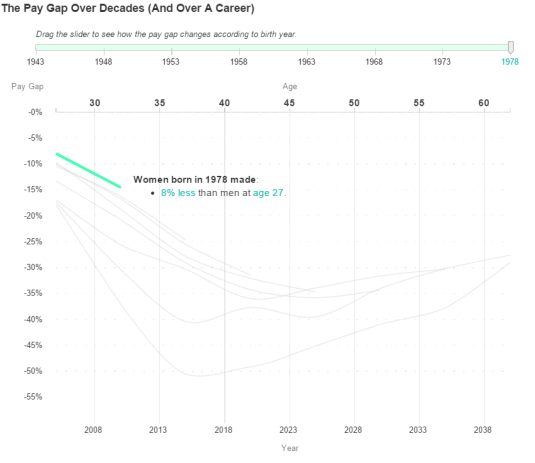
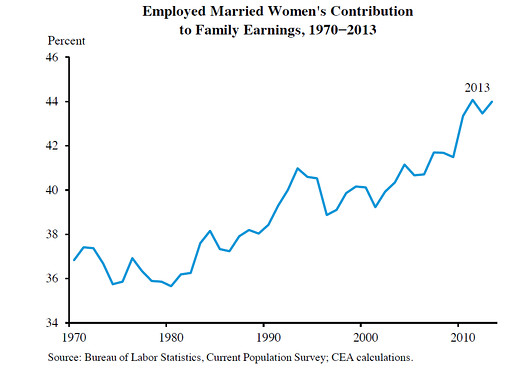
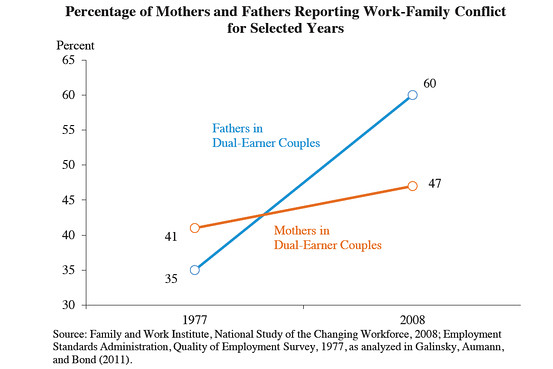
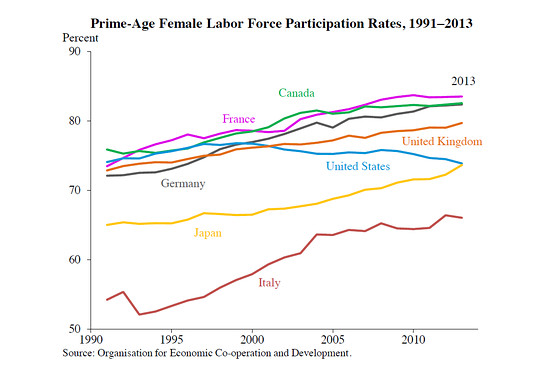
Source: whitehouse.gov
Celebrating humanity's flourishing through the spread of capitalism and the rule of law
05 Mar 2015 Leave a comment
in discrimination, economic history, gender, labour economics, labour supply, politics - USA

Source: whitehouse.gov
04 Mar 2015 Leave a comment
in applied price theory, applied welfare economics, discrimination, gender, labour economics Tags: economics of beauty

via How Your Face Shapes Your Economic Chances – The Atlantic.
04 Mar 2015 Leave a comment
in discrimination, gender, labour economics, law and economics, politics - New Zealand
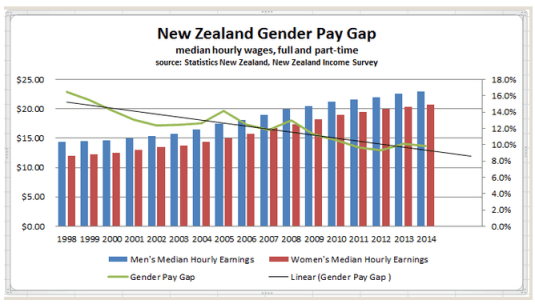
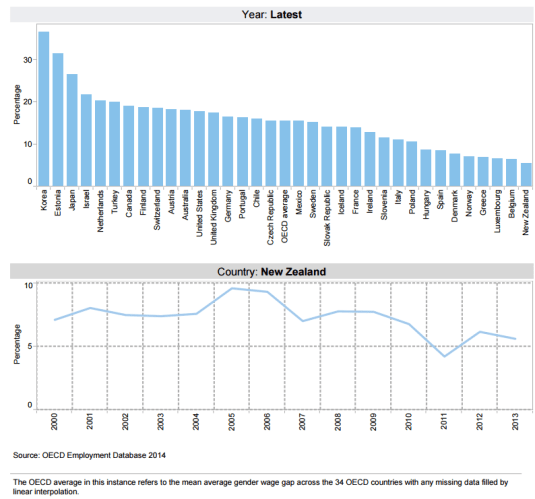
Late last year, the New Zealand Court of Appeal held that paying women in predominantly female occupations less than men in other occupations with similar skills and responsibilities may be illegal under the Equal Pay Act of 1972.
The Employment Court found that to assess whether a breach of the 1972 Act had occurred in a female intensive industry, it would be necessary, and within the scope of the Act to use external employers and other industries as comparators in determining what a notional male employee with similar skills and responsibilities would be paid. The comparison would not just be within the same workplace.
The Court of Appeal agreed with the Employment Court’s finding. In particular, the necessity to be able to look outside a female-intensive industry to properly ascertain what a notional male performing that role would be paid based on skills and similarities of duties where there is no appropriate comparator within the industry.

Rather than talk about this New Zealand employment case directly, my first post will be about the experiences in the USA. A later post will discuss New Zealand in more depth.
The US Supreme Court’s first decision on comparable worth was County of Washington v. Guenther. This 1981 case was about female prison guards being paid 70% of the wages of male guards in the same prison. The County of Washington did a study that show they should be paid 95% of male guards.
This particular case has a tremendous irony because it is actually reasonable to argue that male guards, and perhaps female guards in male prisons, should get danger money depending on the level of direct contact with high risk prisoners. Male prisoners are far more violent. I don’t think anyone disputes that.
Quite simply, a lot of people don’t accept that the wage setting processes results from two conditions: wages are limited from above by the workers’ marginal productivity in the job: a limited from below by the alternative job offers of other employers.

Rather than fight that battle for the 10,000th time, a considerable amount of the economic analysis of comparable worth in the 1980s took the principle of comparable worth for granted and simply traces out the unintended consequences of implementing comparable worth.
They then go on to argue, for example, Ed Lazear, that comparable worth is never the correct remedy for wage differentials and job segregation because it makes everything worse. Rather than persuade people that markets function well, he simply points out that comparable worth turns out to be a bizarre intervention and will do many things that its supporters don’t want.
As Richard Posner observed in a 1986 US appeal court opinion, under the principles of comparable worth, a perfectly decent and honest employer who behaves with complete honour towards women and their equality will nonetheless, if they lost comparable worth litigation, would have to pay back-pay despite the fact he paid the going wage and couldn’t afford to pay more.
The practical upshot of comparable worth is to introduce occupation by occupation and job by job minimum wages for women, with the burden of proof on the employer to show that a comparable worth ruling should not apply to them.
If comparable worth were to be applied to the aged care sector, such as is proposed in New Zealand, more women would move into that sector because of the higher wages, leaving to an over qualification problem with aged care workers.
Instead of moving women into better occupations – occupational upgrading – comparable worth based wage increases will keep low skilled women in the old occupations where they were previously supposedly discriminated against.
Furthermore, to the extent that the low pay of women in the aged care work is the product of sex discrimination and occupational segregation, comparable worth does nothing to reduce the barriers to entry into male dominated, better paid occupations.
To the extent that the wage increase because of comparable worth puts women out of work, not only do they not have a job, the purported barriers to entry into the better paid male dominated occupations are not addressed in any way.
Instead of reducing occupational segregation, comparable worth would increase it. More women would enter the low paid occupations to get the comparable worth wage increase, rather than try and move up the occupational ladder.
By increasing wages in the female dominated occupation, comparable worth causes more women and men to enter these occupations, not less, and at the same time shrinks the number of jobs available by driving down demand because of higher costs of labour.
One of the responses of employers to comparable worth is to change the composition of the recruitment poor from which they hire. They will hire better qualified workers and put out of work their existing workers. This is common with the teenage minimum wage: 17 and 18-year-olds tend to lose their jobs to more mature and responsible 18 to 19-year-olds after a minimum wage increase.
The better explanation of why so many women are in a particular occupation is job sorting: that particular job has flexible hours and the skills do not depreciate as fast for workers who take time off, working part-time or returning from time out of the workforce.
Women, including low paid women, select careers in jobs that match best in terms of work life balance and allows them to enter and leave the workforce with minimum penalty and loss of skills through depreciation and obsolescence.
This is the choice hypothesis of the gender wage gap. Women choose to train and be educated in occupations where human capital depreciates at a slower pace.
Comparable worth is a very 20th century concept:
Claudia Goldin has described pharmacy is the most family friendly occupation. She compares it to law. In law, if you work long hours, you are on partnership track and win the top clients. In pharmacy, the only advantage of working longer hours as you earn more money that week. Also, pharmacists are completely interchangeable. Do you care which pharmacist fills out your prescription at your local pharmacy or even know which one fills it out? Lawyers are not interchangeable: they cannot just handover a case. Detailed briefings would be required. You expect your lawyer to show up in court or at meetings on time anywhere without fail.
Claudia Goldin did a great study of Harvard MBA is using online surveys of their careers. She found that three proximate factors accounted for the large and rising gender gap in earnings:
The greater career discontinuity and shorter work hours for female MBAs are largely associated with motherhood. There are some jobs that are severely penalise any time out of the workforce.
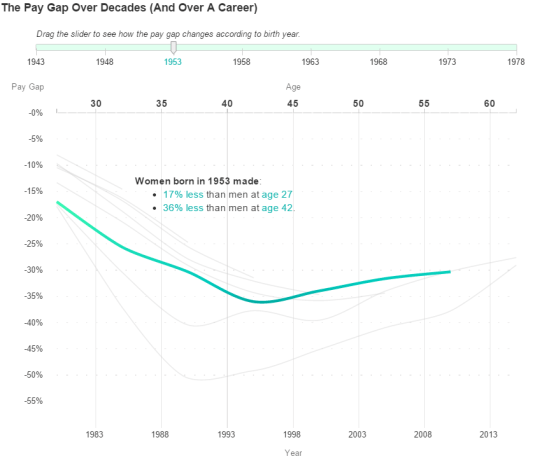
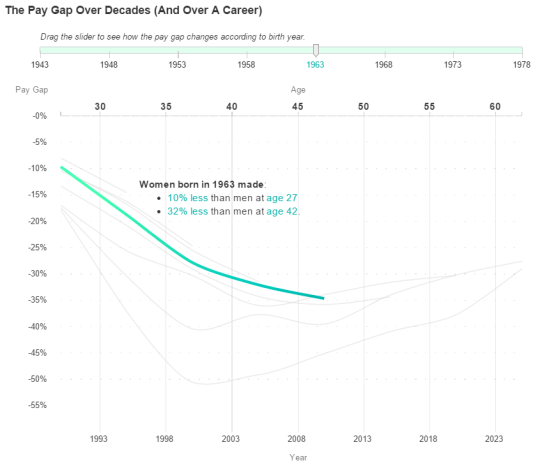
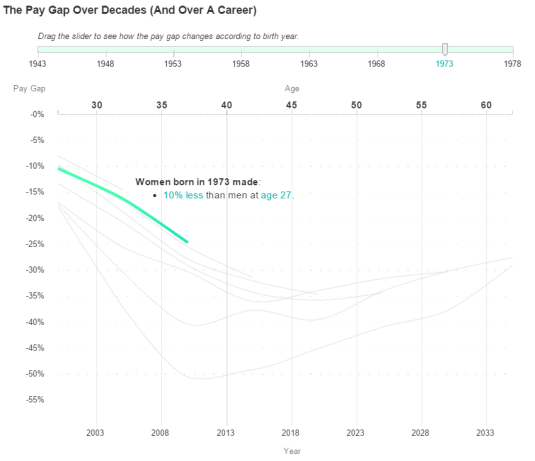
Goldin found one counterfactual that cancels out the gender wage gap amongst MBA professionals: hubby earns less! Female MBAs who’ve have a partner who earn less than them earn as much as the average MBA professional on an hourly basis but work a few less hours per week.
Interesting breakout of the gender wage gap by circumstances http://t.co/nzWiT6rXOu—
Chris (@forewit) December 11, 2014
When comparable worth was introduced by legislation in Ontario, any comparable worth wage increase was limited to 1% of the previous year’s payroll and then these payments could continue until pay equity is achieved. The pay equity legislation for the private sector in Ontario applied to any private sector employer with 10 or more employees.
A study found that the Ontario pay equity law had no effect on aggregate wages in female jobs or on the gender wage gap. Also, a lot of small firms completely ignored the law or didn’t even know about it.
The key point to make is if the New Zealand employment courts introduce comparable worth, it will be in one foul swoop with the possibility of substantial back-pay owing. If Parliament decided to act, it can introduce social reforms at a measured pace.
02 Mar 2015 1 Comment
in discrimination, economics of education, gender, human capital, labour economics, occupational choice Tags: gender wage gap, reversing gender gap
Women started drifting away from computer science in the mid-1980s. The interpretation put forward by the professional grievance industry, that is, by National Public Radio in the USA is:
The share of women in computer science started falling at roughly the same moment when personal computers started showing up in U.S. homes in significant numbers.
These early personal computers weren’t much more than toys. You could play pong or simple shooting games, maybe do some word processing.
And these toys were marketed almost entirely to men and boys. This idea that computers are for boys became a narrative. It became the story we told ourselves about the computing revolution. It helped define who geeks were, and it created techie culture.

Source: NPR
Another interpretation is there are systematic differences between teenage boys and teenage girls in verbal and written skills. Young women moved away from enrolling in computer science because they could make better use of their superior written and verbal skills in medicine and law. Computer science is for those with inferior social skills, on average.

As for computers in the early days been marketed to men and boys, people with inferior verbal and reading skills would be attracted to sitting in front of the computer playing games because of their inferior social skills. Computers were expensive back in the 80s so marketing them to people with fewer social skills is sensible as they were more willing to spend money to fill the extra time they spend on their own.
The difference in reading and verbal skills between girls and boys at the age of 15 is equal to 6-months extra schooling. Six months schooling explains a lot of the wage gaps on ethnic, racial and gender lines. Not surprisingly, fewer women do computer science because their superior reading and verbal skills qualify them for medicine and law where they can take greater advantage of their mix of talents.
It is all about being the best you can be. As many women as men ending up in STEM occupations does not necessarily mean people are making the choices that help them be the best they can be because some women may not be taking advantage of their superior reading skills.
02 Mar 2015 Leave a comment
in discrimination, gender, labour economics, labour supply Tags: family demographics, household production


27 Feb 2015 Leave a comment
in discrimination, gender, human capital, labour economics, poverty and inequality Tags: labour market discrimination, racial discrimination, sex discrimination
25 Feb 2015 Leave a comment
in discrimination, gender, human capital, labour economics Tags: compensating differences, gender wage gap, sex discrimination
Occupations that most value long hours, face time at the office and being on call — like business, law and surgery — tend to have the widest pay gaps. That is because those employers pay people who spend longer hours at the office disproportionately more than they pay people who don’t, Dr. Goldin found. A lawyer who works 80 hours a week at a big corporate law firm is paid more than double one who works 40 hours a week as an in-house counsel at a small business.
Jobs in which employees can easily substitute for one another have the slimmest pay gaps, and those workers are paid in proportion to the hours they work.
Pharmacy is Dr. Goldin’s favorite example. A pharmacist who works 40 hours a week generally earns double the salary of a pharmacist who works 20 hours a week, and as a result, the pay gap for pharmacists is one of the smallest.
via artdiamondblog.com.
25 Feb 2015 Leave a comment

25 Feb 2015 Leave a comment
in discrimination, gender, human capital, labour economics, labour supply, occupational choice Tags: asymmetric marriage premium, gender wage gap
23 Feb 2015 Leave a comment
in discrimination, economic history, economics of marriage, gender, labour economics, law and economics, occupational choice, politics - USA Tags: engines of liberation, gender wage gap
18 Feb 2015 Leave a comment
in discrimination, gender, liberalism Tags: feminism, feminists
Celebrating humanity's flourishing through the spread of capitalism and the rule of law
Scholarly commentary on law, economics, and more
Beatrice Cherrier's blog
Celebrating humanity's flourishing through the spread of capitalism and the rule of law
Why Evolution is True is a blog written by Jerry Coyne, centered on evolution and biology but also dealing with diverse topics like politics, culture, and cats.
Celebrating humanity's flourishing through the spread of capitalism and the rule of law
A rural perspective with a blue tint by Ele Ludemann
DPF's Kiwiblog - Fomenting Happy Mischief since 2003
Celebrating humanity's flourishing through the spread of capitalism and the rule of law
The world's most viewed site on global warming and climate change
Tim Harding's writings on rationality, informal logic and skepticism
A window into Doc Freiberger's library
Let's examine hard decisions!
Commentary on monetary policy in the spirit of R. G. Hawtrey
Thoughts on public policy and the media
Celebrating humanity's flourishing through the spread of capitalism and the rule of law
Politics and the economy
A blog (primarily) on Canadian and Commonwealth political history and institutions
Reading between the lines, and underneath the hype.
Economics, and such stuff as dreams are made on
"The British constitution has always been puzzling, and always will be." --Queen Elizabeth II
Celebrating humanity's flourishing through the spread of capitalism and the rule of law
WORLD WAR II, MUSIC, HISTORY, HOLOCAUST
Undisciplined scholar, recovering academic
Celebrating humanity's flourishing through the spread of capitalism and the rule of law
Res ipsa loquitur - The thing itself speaks
In Hume’s spirit, I will attempt to serve as an ambassador from my world of economics, and help in “finding topics of conversation fit for the entertainment of rational creatures.”
Researching the House of Commons, 1832-1868
Articles and research from the History of Parliament Trust
Reflections on books and art
Posts on the History of Law, Crime, and Justice
Celebrating humanity's flourishing through the spread of capitalism and the rule of law
Exploring the Monarchs of Europe
Cutting edge science you can dice with
Small Steps Toward A Much Better World
“We do not believe any group of men adequate enough or wise enough to operate without scrutiny or without criticism. We know that the only way to avoid error is to detect it, that the only way to detect it is to be free to inquire. We know that in secrecy error undetected will flourish and subvert”. - J Robert Oppenheimer.
The truth about the great wind power fraud - we're not here to debate the wind industry, we're here to destroy it.
Celebrating humanity's flourishing through the spread of capitalism and the rule of law
Economics, public policy, monetary policy, financial regulation, with a New Zealand perspective
Celebrating humanity's flourishing through the spread of capitalism and the rule of law
Restraining Government in America and Around the World
Recent Comments