


Walter Williams Asks: “How Much Can Discrimination Explain?”
04 Jul 2014 Leave a comment
via Cafe Hayek
The reversing gender gap in education
03 Jul 2014 Leave a comment
in economics of education, gender, human capital, labour economics, occupational choice Tags: reversing gender gap
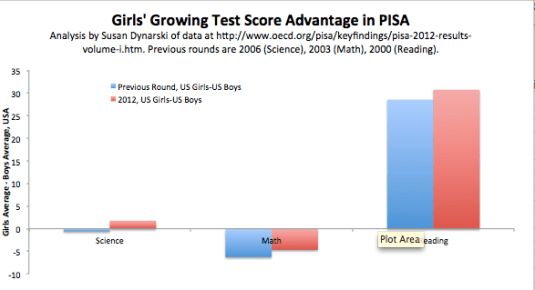
The difference in reading and verbal skills between girls and boys at the age of 15 is equal to 6-months extra schooling. Six months schooling explains a lot of the wage gaps with a long ethnic, racial and previously on gender lines.
Not surprisingly, fewer women do science and engineering degrees because their superior reading and verbal skills qualify them for medicine and other sciences that take advantage of these talents.
Piketty and Pension Fund Socialism
01 Jul 2014 1 Comment
in financial economics, human capital, income redistribution, rentseeking Tags: pension fund socialism, Peter Drucker, Piketty

Any attack on capitalism these days is a direct attack of the retirement savings of ordinary workers. We live in the age of what Peter Drucker called pension fund socialism in 1976. As Drucker added in 1991:
The rise of pension funds as dominant owners and lenders represents one of the most startling power shifts in economic history.
The first modern pension fund was established in 1950 by General Motors.
Four decades later, pension funds control total assets of $2.5 trillion, divided about equally between common stocks and fixed-income securities. Demographics guarantee that these assets will grow aggressively for at least another ten years.
The majority of equity capital is owned by pension funds and other collective investment vehicles corralling the savings of ordinary people. Much of the rest of physical capital is owned by workers through home ownership.
In the age of human capital, 70-90% of all capital in the economy is human capital. The notion of unskilled workers labouring away with the capital supplied by the bosses is 19th century throwback.
The rentier rich has been long replaced by the working rich. They make their fortunes in their own life times – sometimes as business entrepreneurs, sometimes through rent-seeking.
It is also the age of specific human capital, with a proliferation of technologies and products. The rising specialisation of firms and their production inputs has forced firms to try harder to find those inputs that suit their needs best. Management has the task of finding the right inputs. The role and reward to managers has therefore risen.
When the rise in returns on investments in human capital is beneficial and desirable, and policies designed to deal with inequality must take account of its cause. Growth in education levels has been a significant source of rising wages, productivity, and living standards over the past century.
The initial impact of higher returns to human capital is wider inequality in earnings, but that impact becomes more muted and may be reversed over time as young people invest more in their human capital.
The rentier class has been replaced by the working rich. The evidence on the top 1% is most consistent with theories of superstars, skill biased technological change, greater scale and their interaction of these factors.
Individuals who are really good at making money can now apply their skills to larger amounts of capital and reach far larger audiences and markets for their products and services. That favours CEOs, athletes, celebrities, corporate lawyers, successful entrepreneurs and other working rich Who have a skill or talent that can be supplied at little cost on a much larger scale. Some have a special dark place in their hearts for people who earned their money through honest hard work.

Adam Smith as a pioneering labour economist
21 Jun 2014 Leave a comment
in Adam Smith, health and safety, history of economic thought, human capital, labour economics, labour supply, occupational choice Tags: Adam Smith, Alfred Marshall, compensating differences, george stigler, human capital, The wealth of nations, wage determination

Adam Smith anticipated much of labour economics by basing it on his principle that individuals invest resources to earn the highest possible return. All uses of a resource must yield an equal rate of return adjusted for relative riskiness for otherwise reallocation would result.
The whole of the advantages and disadvantages of the different employments of labour and stock must, in the same neighbourhood, be either perfectly equal or continually tending to equality.
If in the same neighbourhood, there was any employment evidently either more or less advantageous than the rest, so many people would crowd into it in the one case, and so many would desert it in the other, that its advantages would soon return to the level of other employments.
Smith used this insight on be equality of returns to explain why wage rates differed. Workers care about the whole aspects of the job, not only the cash wage payment: it is the “whole advantages and disadvantages” of the job that is equated across jobs in a competitive market, not wage alone. Smith set out criteria that determined how wages compensated or were discounted for the different characteristics of specific jobs:
- the agreeableness or disagreeableness of the employments themselves: better for more enjoyable working conditions will lead an individual to accept lower wages for their labour. Likewise, unpleasant work will have a higher wage. Wages vary with the ease or hardship, the cleanliness or dirtiness, the honourableness or dishonourableness of a job.
- The easiness and cheapness, or the difficulty and expense of learning them: jobs that are difficult or time-intensive to learn will pay more. Those who invest the time are being compensated for their additional effort with higher wages. The opportunity cost of forgoing the time-spent in training will be compensated for through higher wages. The difference between the wages of skilled labour and common labour is founded upon this principle.
- The constancy or inconstancy of employment: workers who face only partial or inconsistent employment throughout the course of the year, such as seasonal workers of agriculture, must be paid more for their labour. Their wages carry them not only during times of employment, but also during times of unemployment.
- The small or great trust which must be reposed in those who exercise them: individuals who have high levels of responsibility in their jobs will be compensated with higher wages.
- The probability or improbability of success: this is an entrepreneurial element in wages. Employment where the chance of success is high will be paid lower than those who take more risks. If individuals were not compensated for risk, there would lack an incentive to seek employment that may not be successful.
The supply and demand for labour in different industries determines relative wages and the relative numbers of employees in different occupations. Individuals are willing to make a trade-off between less desirable occupations and increased income. Smith spoke of how these five circumstances listed above lead to considerable inequalities in the wages and profits.
George Stigler thought that the second greatest triumph of Adam Smith in his Wealth of Nations was his famous list of cost factors that generate apparent but not real differences in rates of wages and profits because of training, hardships, unemployment, risk and trust. This list was quoted almost verbatim by his successors down to this day and is the direct ancestor of both Alfred Marshall’s famous chapters on wages and of the modern theory of human capital.

Gender and education: Have American boys been left behind? – Christina Hoff Sommers
10 Jun 2014 Leave a comment
in gender, human capital, labour economics Tags: Christina Hoff Sommers, gender gap, lost boys, reverse gender gap
Charles Murray on the educational romanticism of the Left and of the Right
09 Jun 2014 Leave a comment
in economics of education, human capital, labour economics Tags: Charles Murray, The fatal conceit

HT: http://www.aei.org/publication/the-age-of-educational-romanticism/
Piketty: A Wealth of Misconceptions by Don Boudreaux
01 Jun 2014 2 Comments
in applied price theory, applied welfare economics, economic growth, entrepreneurship, human capital, labour economics, labour supply Tags: inequality and poverty, Piketty, seen and unseen, The Great Enrichment, The Great Fact

Piketty’s method of doing economics involves frequent grand proclamations about "social justice" and economic "evolutions," but he offers no analyses of the dynamics of individual decision-making, often referred to as "microeconomics," that should be central to the issues he raises…
Revealingly, Piketty writes of income and wealth as being claimed or "distributed," never as being earned or produced. The resulting statistics are too aggregated—too big-picture—to reveal what is happening to individuals on the ground…
He imagines that such aggregates interact in robotic fashion through a logic of their own, unmoved by individual human initiative, creativity, or choice…
If we follow the advice of Adam Smith and examine people’s ability to consume, we discover that nearly everyone in market economies is growing richer…
THE U.S. IS THE bête noir of Piketty and other progressives obsessed with monetary inequality.
But middle-class Americans take for granted their air-conditioned homes, cars, and workplaces—along with their smartphones, safe air travel, and pills for ailments ranging from hypertension to erectile dysfunction…
At the end of World War II, when monetary income and wealth inequalities were narrower than they’ve been at any time in the past century, these goods and services were either available to no one or affordable only by the very rich.
So regardless of how many more dollars today’s plutocrats have accumulated and stashed into their portfolios, the elite’s accumulation of riches has not prevented the living standards of ordinary people from rising spectacularly…
Piketty’s disregard for basic economic reasoning blinds him to the all-important market forces at work on the ground—market forces that, if left unencumbered by government, produce growing prosperity for all. Yet, he would happily encumber these forces with confiscatory taxes.
The Death of the Renaissance Man?
03 May 2014 Leave a comment
in human capital, industrial organisation, labour economics, technological progress Tags: Ben Jones, innovation, polymaths, renaissance man
Ben Jones in ‘The Burden of Knowledge and the Death of the Renaissance Man: Is Innovation Getting Harder? found that as knowledge accumulates as technology advances, successive generations of innovators may face an increasing educational burden.

Innovators can compensate through lengthening their time in education and narrowing expertise, but these responses come at the cost of reducing individual innovative capacities.
This has implications for the organization of innovative activity – a greater reliance on teamwork – and has negative implications for economic growth.
Jones found that the age at first invention, specialisation, and teamwork increased over time in a large micro-data set of inventors. Upward trends in academic collaboration and lengthening doctorates can also be explained in his framework.
Using data on Nobel Prize winners, Jones found that the mean age at which the innovations are produced to win the Prize has increased by 6 years over the 20th Century.
- Before 1901, two-thirds of the Nobel laureates did their prize-winning work before the age of 40 and 20 per cent did it before age of 30.
- By 2000, however, great achievements seldom occurred before the age of 40.
It’s now taking longer for scientists to get their basic training and start their careers. There is simply more to learn because knowledge in all fields has grown by quantum leaps in the past century.
Nobels are being handed out for different types of work than a century ago.
- There has been a trend away from awarding prizes for abstract, theoretical ideas.
- Now more honours are being bestowed on people who have made discoveries through painstaking lab work and experimentation – which takes a lot of time to do.
Jones’ theory provides an explanation for why productivity growth rates did not accelerate through the 20th century despite an enormous expansion in collective research effort and levels of education and many more graduates.
The more experienced readers of this blog might remember that the better of their professors seemed to be masters of the entire field of economics and could teach almost any subject.
These days, too many professors rely on textbooks with annual editions that come with the lecture notes, assignments and test-banks written for them by the publishing company.
Are there any polymaths left? Posner? Tullock?
Bill Gates “pre-reviewed” Piketty years ago
02 May 2014 Leave a comment
in entrepreneurship, human capital, labour economics Tags: Bill Gates, Piketty, top 1%, top talent
Bill Gates once said:
You take away the top 20 employees of Microsoft, we’ll just be an ordinary company. Top employees are what makes us.

via Gary Becker on Human Capital | Atanu Dey On India’s Development.
President Obama’s persistent ’77-cent’ claim on the wage gap gets a new Pinocchio rating–updated
13 Apr 2014 Leave a comment
in human capital, labour economics, occupational choice, politics - USA Tags: gender wage gap, lies dam lies and statistics, obama
The fact checker at the Washington Post said:
Few experts dispute that there is a wage gap, but differences in the life choices of men and women — such as women tending to leave the workforce when they have children — make it difficult to make simple comparisons.
…From a political perspective, the Census Bureau’s 77-cent figure is golden. Unless women stop getting married and having children, and start abandoning careers in childhood education for naval architecture, this huge gap in wages will almost certainly persist. Democrats thus can keep bringing it up every two years.
…There appears to be some sort of wage gap and closing it is certainly a worthy goal. But it’s a bit rich for the president to repeatedly cite this statistic as an “embarrassment.” …The president must begin to acknowledge that “77 cents” does not begin to capture what is actually happening in the work force and society.
In premiere episode of ‘Factual Feminist’ Christina Sommers explains how the gender wage gap is based on bogus statistics


Recent Comments