Average Income of Top 10% in 2010
31 May 2017 Leave a comment
in financial economics, human capital, labour economics, labour supply, occupational choice Tags: superstars, top 1%
Why African-Americans left the south in droves — and what’s bringing them back
29 May 2017 Leave a comment
in economic history, labour economics, labour supply Tags: internal migration
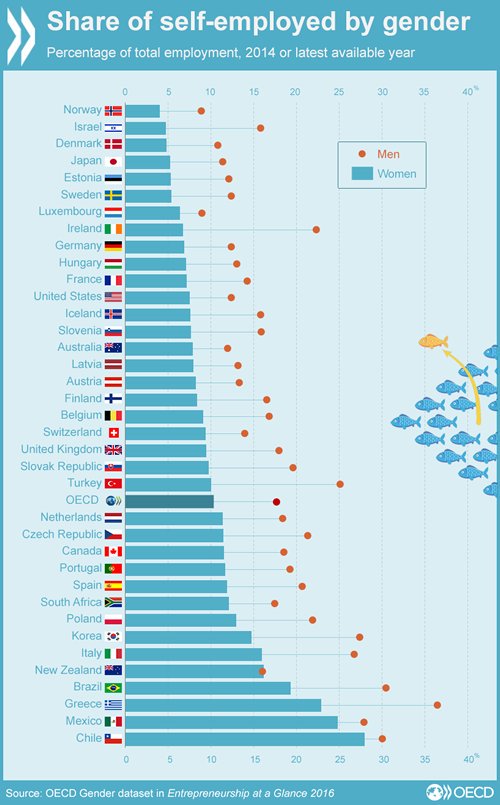
No gender gap in self-employment in New Zealand
26 May 2017 Leave a comment
in discrimination, entrepreneurship, gender, industrial organisation, labour economics, labour supply, occupational choice, Robert E. Lucas, survivor principle Tags: female labour supply
Thomas Sowell – Gender Bias and Income Disparity
26 May 2017 Leave a comment
in applied price theory, discrimination, economic history, gender, labour economics, labour supply, occupational choice Tags: gender wage gap, Thomas Sowell
How Capitalism Freed Victorian Women
24 May 2017 Leave a comment
in applied price theory, discrimination, economic history, gender, labour economics, labour supply Tags: engines of liberation
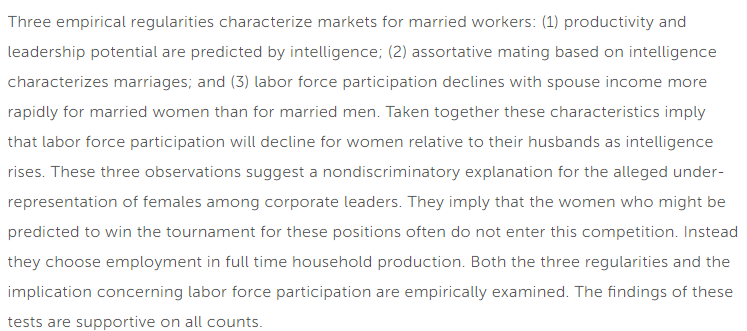
ASSORTATIVE MATING OR GLASS CEILING?
22 May 2017 Leave a comment
in discrimination, economics of love and marriage, gender, human capital, labour economics, labour supply, occupational choice Tags: assortative mating, dating market, gender wage gap, glass ceiling
Short Cut: Macron’s Scandi-Solution for France
16 May 2017 Leave a comment
in economics, fiscal policy, labour supply, macroeconomics, minimum wage, Public Choice, public economics, welfare reform
Sociologist documents what Gary Becker knew in 1957
12 May 2017 Leave a comment
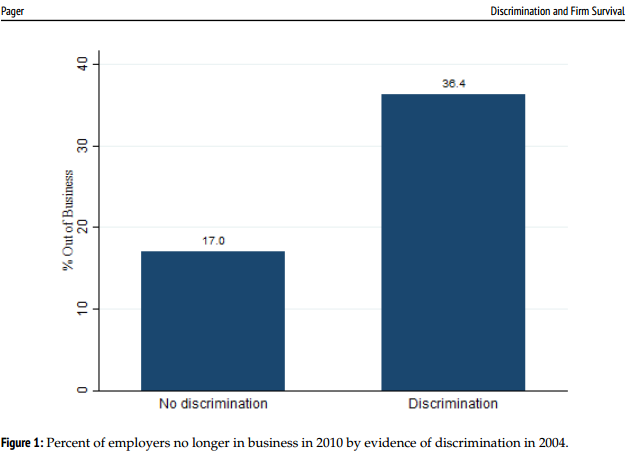
Source: Pager, Devah. 2016. “Are Firms that Discriminate More Likely to Go Out of Business?” Sociological Science (September):849-859. PDF
Free To Choose in Under 2 Minutes – Episode 1 The Power of the Market
09 May 2017 Leave a comment
in applied price theory, industrial organisation, international economics, labour economics, labour supply, Milton Friedman, occupational choice, survivor principle Tags: capitalism and freedom

Gary Becker (1991) on the power of culture and traditional women’s roles
08 May 2017 Leave a comment
in development economics, discrimination, economic history, Gary Becker, gender, human capital, labour economics, labour supply Tags: economics of culture, economics of tradition, gender wage gap, preference formation
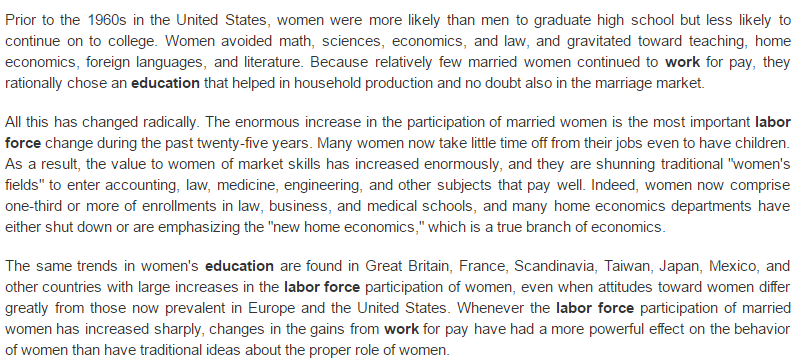
Source: The Adam Smith address: Education, labor force quality, and the economy. By: Becker, Gary S., Business Economics, Jan1992, Vol. 27, Issue 1
Why is the Swedish gender wage gap so stubbornly stable (and high)?
06 May 2017 Leave a comment
in discrimination, gender, human capital, labour economics, labour supply, occupational choice Tags: economics of fertility, female labour force participation, gender wage gap, maternity leave, preference formation, statistical discrimination, Sweden, unintended consequences
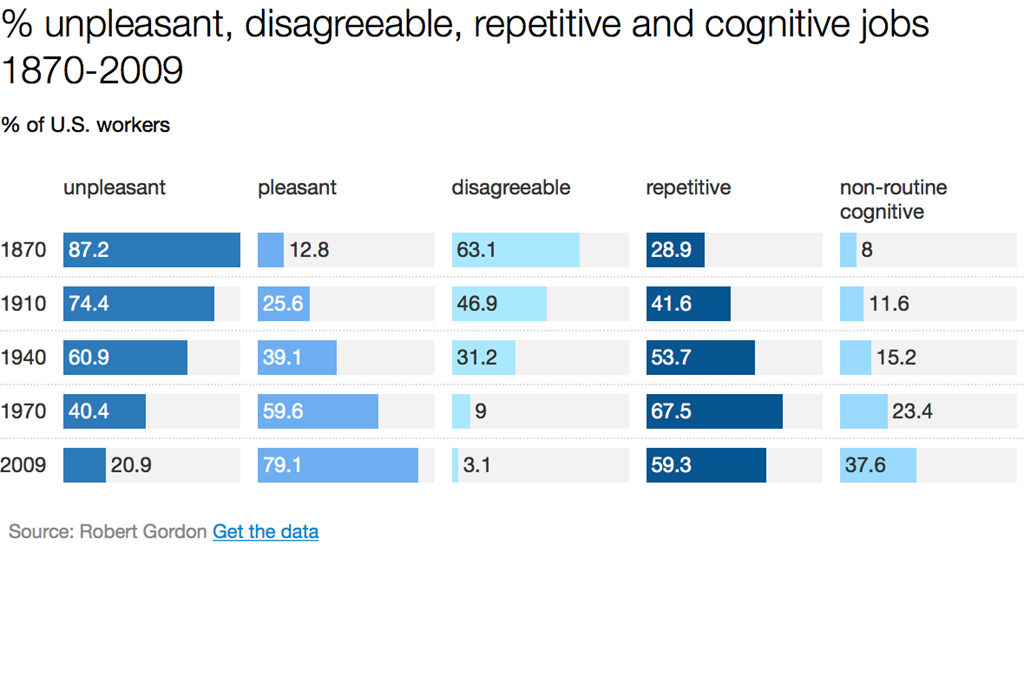
The Swedes are supposed to be in a left-wing utopia. Welfare state, ample childcare and long maternity leave but their gender wage gap is almost as bad as in 1980. They must be a misogynist throwback.

Maybe Megan McArdle can explain:
There are countries where more women work than they do here, because of all the mandated leave policies and subsidized childcare — but the U.S. puts more women into management than a place like Sweden, where women work mostly for the government, while the private sector is majority-male.
A Scandinavian acquaintance describes the Nordic policy as paying women to leave the home so they can take care of other peoples’ aged parents and children. This description is not entirely fair, but it’s not entirely unfair, either; a lot of the government jobs involve coordinating social services that women used to provide as homemakers.
The Swedes pay women not to pursue careers. The subsidies from government from mixing motherhood and work are high. Albrecht et al., (2003) hypothesized that the generous parental leave a major in the glass ceiling in Sweden based on statistical discrimination:
Employers understand that the Swedish parental leave system gives women a strong incentive to participate in the labour force but also encourages them to take long periods of parental leave and to be less flexible with respect to hours once they return to work. Extended absence and lack of flexibility are particularly costly for employers when employees hold top jobs. Employers therefore place relatively few women in fast-track career positions.
Women, even those who would otherwise be strongly career-oriented, understand that their promotion possibilities are limited by employer beliefs and respond rationally by opting for more family-friendly career paths and by fully utilizing their parental leave benefits. The equilibrium is thus one of self-confirming beliefs.
Women may “choose” family-friendly jobs, but choice reflects both preferences and constraints. Our argument is that what is different about Sweden (and the other Scandinavian countries) is the constraints that women face and that these constraints – in the form of employer expectations – are driven in part by the generosity of the parental leave system
Most countries have less generous family subsidies so Claudia Goldin’s usual explanation applies to their falling gender wage gaps
Quite simply the gap exists because hours of work in many occupations are worth more when given at particular moments and when the hours are more continuous. That is, in many occupations earnings have a nonlinear relationship with respect to hours. A flexible schedule comes at a high price, particularly in the corporate, finance and legal worlds.
The rapid adaptation of women to changing prospects
01 May 2017 1 Comment
in discrimination, economics of education, gender, human capital, labour economics, labour supply, occupational choice Tags: College premium, gender way, reversing gender gap
On the upside, Goldin (2006) showed that women adapted rapidly over the 20th century to changing returns to working and education as compared to options outside the market. Their labour force participation and occupational choices changed rapidly into long duration professional educations and more specialised training in the 1960s and 1970s as many more women worked and pursued careers. The large increase in tertiary education by New Zealand after 1990 and their move into many traditionally male occupations is another example.
The key is what drives the rapid changes in the labour force participation and occupational choices of women. Some of the factors are global technology trends such rising wages and the emergence of household technologies and safe contraception and antidiscrimination laws. All of these increased the returns to working and investing in specialised education and training.
Up until the mid-20th century, women invested in becoming a teacher, nurse, librarian or secretary because these skills were general and did not deprecate as much during breaks. When expectations among women of still working at the age of 35 doubled, there were massive increases in female labour force participation and female investments in higher education and specialised skills (Goldin and Katz 2006). These trends continue to today.
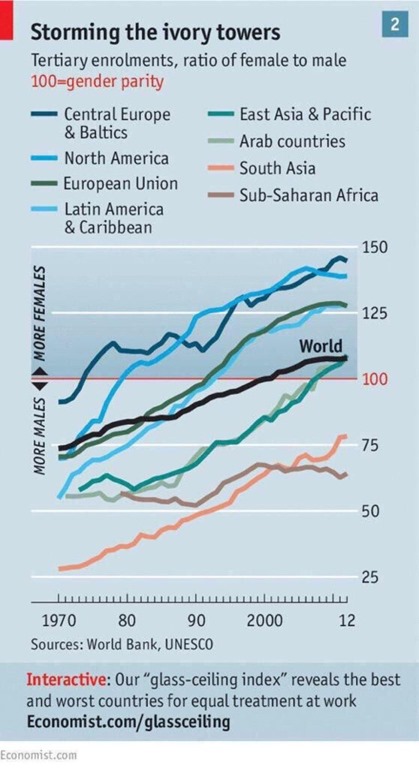 Women and in particular those women making education choices need good information on their prospects in different occupations. The evidence is they adapt rapidly to changing prospects (Goldin 2004, 2006). Goldin (2004, 2006) referred to a quiet revolution in women’s employment, earnings and education because the changes in female labour supply and occupational choices were abrupt and large.
Women adapted rapidly to changes in their expectations about their future working life, graduation rates, attainment of professional degrees, age of first marriage, and the timing and number of children. These expectations of women about their futures turned out the surprisingly accurate (Katz 2004, 2006). Young women are surprisingly good forecasters of their labour market involvement. Any gender policy options must be sensitive to the high level of responsiveness of women to changing educational opportunities and prospects and their precision to date as forecasters.
The complex decisions youth make about education and occupational choices is driven by many sources. Women are interested in issues that are of less importance to men such as work-life balance and the costs of career breaks to their earning power and human capital. Goldin (2004, 2006) argued that women who have a more accurate assessment of their future labour market involvement will invest more wisely in education and occupational choice.
The market process rewards the skills and commitment the men and women bring to the labour market. The differences in skills and commitment the men and women bring arise from a gendered division of labour and effort in the household and in raising families that appears to be open to only minor changes that are expensive in terms of growth and prosperity. This is because most gains in the status of women were the result of economic growth rather than legal interventions. Child care subsidies and parental leave arose after rising income made them and the modern welfare state fiscally affordable rather than the other way around.
 Utopia, you are standing in it!
Recent Comments