Tweet… is from page 53 of the late, great Harold Demsetz’s excellent 2008 book, From Economic Man to Economic System: Adam Smith and Thomas Malthus differed in their forecasts of mankind’s future. Smith (1776), in his Wealth of Nations, offered an optimistic view, basing this on his understanding of the new economic system that began…
In this 12-second video, Margaret Thatcher is talking about the Labour Party in the United Kingdom, but her warning has universal application. And when I say her warning has universal application, I’m not joking. Politicians generally can’t resist the temptation to buy votes. And I fear that this can and will happen at all levels […]
When Jacinda Ardern became Prime Minister, she was determined to increase income for children in welfare-dependent families – her magic bullet for solving child poverty. The Welfare Expert Advisory Group, led by Cindy Kiro, was convened to make the desired recommendations. A number of evidence briefs were provided to the group, one concerned the “likely…
Here is Daron Acemoglu’s Project Syndicate piece, mostly critical on high-skilled immigration. Here is the first argument from Acemoglu: …one would expect corporate America’s growing need for skilled STEM workers to translate into advocacy for, and investments in, STEM education. But an overreliance on the H-1B program may have broken this link and made American […]
TweetGMU Econ alum Holly Jean Soto busts the myth of “greedflation.” Scott Lincicome identifies an interesting contrast between the facts and opinion about China. George Will decries the spinelessness of the modern U.S. Congress. A slice: The incoming president will be able, on a whim, to unilaterally discombobulate international commerce — and the domestic economy…
Weanalyze trends in labor-market returns to psychological traits using data from half a million Finnish men from 2001 to 2015. Cognitive skills’ value declined, while noncognitive skills’ value increased. Our novel findings show that extraversion drives this rise, while conscientiousness remains stable. Extraversion’s rising returns are most pronounced for lower earners and those on the […]
Tweet… is from page 496 of the 2011 revised and enlarged edition of Thomas Sowell’s 2009 book Intellectuals and Society (original emphasis): Another common tactic and flaw in the arguments of the intelligentsia is eternalizing the transient. Thus statistical trends in the share of the nation’s income going to “the rich” (however defined) and “the…
The number one post this year was Tyler’s The changes in vibes — why did they happen? A prescient post and worth a re-read. Lots of quotable content that has become conventional wisdom after the election: The ongoing feminization of society has driven more and more men, including black and Latino men, into the Republican […]
What does the existing research evidence say about how to reduce crime? Jennifer Doleac offers and over overview in “Why Crime Matters, and What to Do About It.” It appear as an essay in a book published by the Aspen Economic Strategy Group, Strengthening America’s Economic Dynamism, edited by Melissa Kearney and Luke Pardue. You…
See $500,000 Pay, Predictable Hours: How Dermatology Became the ‘It’ Job in Medicine: Americans’ newfound obsession with skin care has medical students flocking to this specialty by Te-Ping Chen of The WSJ. Excerpts:”Four-day workweeks, double the salary of some colleagues and no emails at night. If those perks sound like they belong to a few vaunted…
There is a widespread belief that the US labor market has been undergoing a period of unprecedented chance in the last decade or two. On one hand, David Deming, Christopher Ong, and Lawrence H. Summers case doubt on this historical claim in their essay, ” Technological Disruption in the US Labor Market”–that is, they argue…
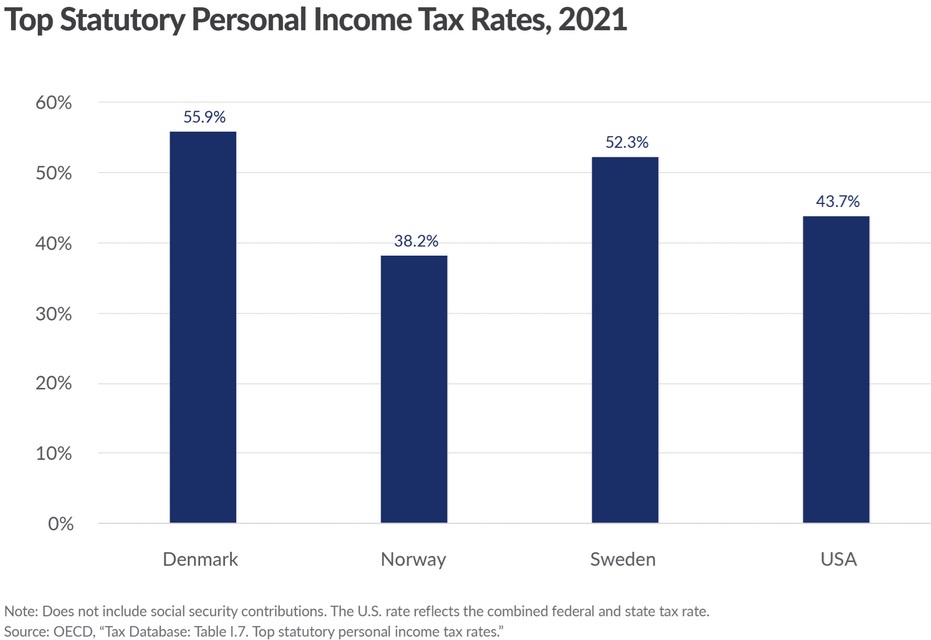
Scandinavian nations are not socialist, at least if we’re using the technical definition (government ownership, central planning, and price controls). But those countries do have big welfare states. And that means stifling tax burdens. And those harsh taxes don’t just apply to rich taxpayers. Lower-income and middle-class people also get pillaged. I’ve already explained that punitive value-added […]
Deming, Ong and Summers have a good overview of long-run and very recent changes in the US labor market. Using a measure of occupational titles the authors find: The years spanning 1990-2017 were the most stable period in the history of the US labor market, going back nearly 150 years. It’s a bit too early […]
TweetIn this video, GMU Econ alum – and my Mercatus Center colleague – Liya Palagashvili talks with John Stossel about the economic destructiveness of labor unions. The post Palagashvili and Stossel on How Vile Labor Unions Can Be appeared first on Cafe Hayek.
Over at the Geek Way, Andrew McAfee has created a startling visualization related to entrepreneurship in the US and EU. The Draghi Report on EU competitiveness is generating a small buzz among economists. One startling claim is thatthere is no EU company with a market capitalisation over EUR 100 billion that has been set up…
Why Evolution is True is a blog written by Jerry Coyne, centered on evolution and biology but also dealing with diverse topics like politics, culture, and cats.
“We do not believe any group of men adequate enough or wise enough to operate without scrutiny or without criticism. We know that the only way to avoid error is to detect it, that the only way to detect it is to be free to inquire. We know that in secrecy error undetected will flourish and subvert”. - J Robert Oppenheimer.



 Utopia, you are standing in it!
Recent Comments