
It took Japan a long time to realize that the 1970s drop in fertility wasn’t temporary
06 Jan 2015 Leave a comment
in labour economics, labour supply, political change, technological progress Tags: demographic crisis, demographics, fertility crisis, forecasting errors, Japan
The unbelievable rise of single motherhood in America over the last 50 years – The Washington Post
19 Dec 2014 Leave a comment
in applied welfare economics, labour economics, labour supply, poverty and inequality, welfare reform Tags: causes of poverty, single parenthood


via The unbelievable rise of single motherhood in America over the last 50 years – The Washington Post.
Obesity by occupation
19 Dec 2014 Leave a comment
in health and safety, health economics, labour supply, occupational choice, personnel economics Tags: compensating differentials, obesity
Men (No Longer) At Work
19 Dec 2014 Leave a comment
in human capital, labour economics, labour supply, politics - USA, population economics

by Dish Staff
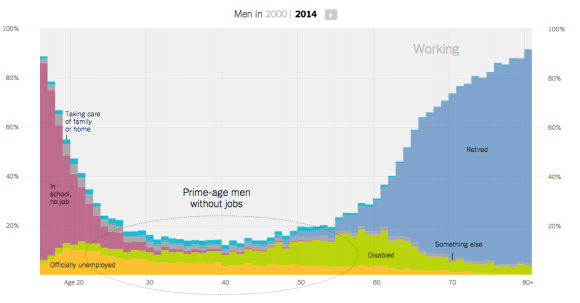
Binyamin Appelbaum looks into the causes of the decline in America’s male work force:
Working, in America, is in decline. The share of prime-age men — those 25 to 54 years old — who are not working has more than tripled since the late 1960s, to 16 percent. … Many men, in particular, have decided that low-wage work will not improve their lives, in part because deep changes in American society have made it easier for them to live without working. These changes include the availability of federal disability benefits; the decline of marriage, which means fewer men provide for children; and the rise of the Internet, which has reduced the isolation of unemployment. …
The resulting absence of millions of potential workers has serious consequences not just for the men and their families but for the nation as a whole. A smaller work force is likely to…
View original post 372 more words
The Gender-Pay Gap Is Largest for the Highest-Paying Jobs – The Atlantic
18 Dec 2014 Leave a comment
in discrimination, gender, human capital, labour economics, labour supply, occupational regulation Tags: employer discrimi, gender wage gap, sex discrimination

Japan’s demographic challenge
17 Dec 2014 Leave a comment
in labour economics, labour supply, population economics Tags: ageing society, demographics, Japan
As its new parliament comes in, here's a look at Japan's longer-term economic challenges pewrsr.ch/1pjgZx5 http://t.co/StGWEGdNfi—
PewResearch FactTank (@FactTank) December 16, 2014

Is welfare dependence optimal for whom – part 7: the role of tagging in welfare benefits system
16 Dec 2014 Leave a comment
in economics of love and marriage, labour economics, labour supply, welfare reform Tags: child poverty, labour supply, poverty and inequality, welfare reform
The unambiguously favourable labour supply effects of work requirements are often contrasted with the ambiguous results of changes in benefit abatement regimes.
The twist is work requirements need to be accompanied by a categorisation of the welfare population into those who can work and those who cannot work. The latter do need welfare support because they are unable to earn a wage in the labour market or have carer responsibilities such as for pre-schoolers.
There is already a large population on other welfare benefits with short and long-term barriers to work because of sickness or invalidity classifications.
The favourable labour supply effects of work requirements depend on an ability to adequately categorise the welfare population into different groups. The large differences between otherwise comparable countries in the number on sickness and disability benefits suggest that this classification and sorting process is knowledge intensive and error prone.

The original support for negative income taxes from Friedman (1962) and Stigler (1946) was born of the notion that welfare bureaucracies are unable to adequately screen, categorise and tag welfare claimants by their capacity to work and diligent job search in a dynamic world with dispersed knowledge and moral hazard.
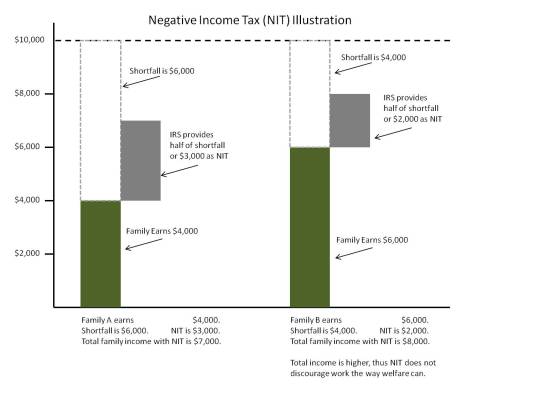
Negative income taxes were proposed as an administratively simple welfare reform to give adequate income support to the low paid, out of work and unable to work, while still providing reasonable work incentives for the low paid. The negative income tax was originally intended to replace existing welfare benefits for families at least.
The modern incarnations of negative income taxes manifest as in-work tax credits that supplement welfare benefits and reduce poverty among the working poor.

The ambiguous effect of negative income taxes on the net labour supply among the low-paid was acknowledged at the outset, and was borne out in experimental trials and experience with in-work tax credits.
The existing system of domestic purpose, unemployment, sickness and invalid benefits are all examples of screening, categorising and tagging of welfare claimants with varying degrees of success.
The tagging is based on relatively coarse screening devices such as job loss, sole parenthood and medical grounds.
Akerlof (1978) noted that the truly needy—those with low job skills who have extreme difficulty in becoming employed—can be partly identified by some measurable, observable characteristic, which he called tagging the poor. Some combination of indications of poor health, low levels of education and spotty employment histories might be indicators of low job skills.
If the government moves from a negative income tax, in which all those with income are paid benefits regardless of their characteristics, to a tagged system in which only the subset who have the particular set of characteristics indicating that they are needy are paid benefits, then higher benefits could be paid to the tagged individuals without changing total expenditure.
Depending on whether the welfare tag is job loss, sole parenthood, sickness or invalidity, different abatement regimes, benefit levels and work tests apply. ACC is another example of tagging with the screening based on accidental injury.
Most welfare systems tag Akerlof partly with family structure in mind as a characteristic, with benefits heavily concentrated on families with a single parent.
Family tax credits are based on tagging through the number of hours worked and the number of children that are dependent upon the wage earner.
Nichols and Zeckhauser (1982) argued that the imposition of “ordeals” on welfare recipients, of which work requirements were one example, but onerous application procedures and participation requirements are others, could serve to deter entry of the able-bodied.
The experience with tagging to date suggest that it’s not particularly accurate. social insurance systems for injury and illness have significant issues with moral hazard.
For example, before 15 July 1980, an employee injured in a workplace accident in Kentucky received compensations proportional to his or her wage with an upper limit of $131 per week.
On 15 July 1980, this limit was raised to $217 per week. The better paid wage-earners were substantially better compensated for accidents that occurred after that date.
The periods of convalescence of these better-paid workers grew 20 per cent longer. For accidents that occurred before 15 July, these employees had been off work for an average of 4.3 weeks; for accidents after 15 July caused the same employees to stay home for an average of 5.2 weeks.
The average convalescence period for injured workers who were less well paid was unaffected by the rise in the upper limit stayed the same before and after 15 July. It is absurd to suggest that workplace accidents had suddenly become more serious for these better-paid workers and only for them after 15 July 1980.
In the past three decades, the number of people who are on disability benefit has skyrocketed but incidence of disabling health conditions among the working age population is not rising. Autor (2006) found that disability rolls in the USA expanded because:
- congressional reforms to disability screening in 1984 that enabled workers with low mortality disorders such as back pain, arthritis and mental illness to more readily qualify for benefits;
- a rise in the after-tax income replacement rate, which strengthened the incentives for lower-skilled workers to seek benefits; and
- a rapid increase in female labour force participation that expanded the pool of insured workers.
Autor found that the aging of the baby boom generation has contributed little to the growth of disability benefit numbers to date.
David Autor and Mark Duggan (2003) found that low-skills and a poor education is predictor of disability: in the USA in 2004, nearly one in five male high school dropouts between ages 55 and 64 were in the disability program; that was more than double that of high school graduates of the same age and more than five times higher than the 3.7 % of college graduates of that age who collect disability. Unemployment is another driver of disability.
The only major success in reducing beneficiary numbers anywhere has been time limits in the USA in 1996. Time limits on welfare for single parents reduced caseloads by two thirds, 90% in some states.

The subsequent declines in welfare participation rates and gains in employment were largest among the single mothers previously thought to be most disadvantaged: young (ages 18-29), mothers with children aged under seven, high school drop-outs, and black and Hispanic mothers. These low-skilled single mothers were thought to face the greatest barriers to employment. Blank (2002) found that
nobody of any political persuasion predicted or would have believed possible the magnitude of change that occurred in the behaviour of low-income single-parent families.
Rebecca Blank is the field leader on the economics of welfare reform and got as high as Acting Secretary of the Department of Commerce for Obama.
Employment are never married mothers increased by 50% after the US reforms: employment a single mothers with less than a high school education increased by two thirds: employment of single mothers aged of 18 in 24 approximately doubled.

With the enactment of welfare reform in 1996, black child poverty fell by more than a quarter to 30% in 2001. Over a six-year period after welfare reform, 1.2 million black children were lifted out of poverty. In 2001, despite a recession, the poverty rate for black children was at the lowest point in national history.

This great success of US welfare reforms was that after decades of no progress, poverty among single mothers and among black children declined dramatically.
The best solution to poverty is to move people into a job. Simon Chapple is also quite clear in his mid-year book with Jonathan Boston that a sole parent in full-time work, and a two parent family with one earner with one full-time and one part-time worker, even at low wages, will earn enough to lift their children above most poverty thresholds. Welfare benefits trap children in poverty.
The best available analysis, the most credible analysis, the most independent analysis in New Zealand or anywhere else in the world that having a job and marrying the father of your child is the secret to the leaving poverty is recently by the Living Wage movement in New Zealand.
According to the calculations of the Living Wage movement, earning only $18.80 per hour with a second earner working only 20 hours affords their two children, including a teenager, Sky TV, pets, international travel, video games and 10 hours childcare.
This analysis of the Living Wage movement shows that finishing school so your job pays something reasonable and marrying the father of your child affords a comfortable family life.
Blogs so far:
part-one-the-labour-leisure-trade-off-and-the-rewards-for-working
part-two-the-labour-supply-effects-of-welfare-benefit-abatement-rate-changes
part-3-abatement-free-income-thresholds-and-labour-supply
part-4-in-work-tax-credits-and-labour-supply
part-5-higher-abatement-rates-and-labour-supply
Is welfare dependence optimal for whom – part 6: mandatory work requirements and labour supply
14 Dec 2014 Leave a comment
in labour economics, labour supply, occupational choice, welfare reform Tags: 1996 federal welfare reforms, Labour leisure trade-off, labour supply, mandatory work requirements, welfare reform
A mechanism for reducing welfare programme entries while increasing welfare exits is work requirements. These minimum hours can be spent working part time, in study and training, work preparation and job search assistance or volunteering.
A work requirement is a screening device removes any advantage of moving on to welfare in terms of more leisure time. U.S. welfare reform side-stepped the problem of programme entry with lifetime time limits on eligibility and work requirements making entry unrewarding. A lifetime time limit on eligibility also reduces inflow in to welfare receipt because workers have an incentive to bank their eligibility to hard time arise. Different work tests and abatement regimes that vary with circumstances on length of time on the benefit also increase exits without increasing entry.
Most work requirement schemes have waivers for those unable to work. Work requirements make welfare receipt less attractive and more hassle while not making welfare receipt any more or any less financially rewarding to those in work.
The gap between working and welfare receipt is larger because of the work requirements make the benefit less pleasant but no additional cash payments are made to encourage welfare programme entry.
Most welfare systems experiment with policy options to separate those who can work from the truly needy. Changes in financial incentives arising from abatement regimes, benefit levels and benefit durations are welfare reform workhorses. The clear-cut labour supply effects of work requirements are a useful contrast to the ambiguity of labour supply changes when benefit levels and abatement regimes change.
Figure 1 illustrates work requirements by introducing a minimum working hours requirement, which eliminates part of the budget constraint before the minimum hours. Work requirements combine a negative tied transfer – an obligation to work – with cash to induce those with a higher ability to work to self-select and opt out of the welfare system entirely.
Figure 1: The labour supply effects of mandatory work requirements as a condition of welfare benefit receipt
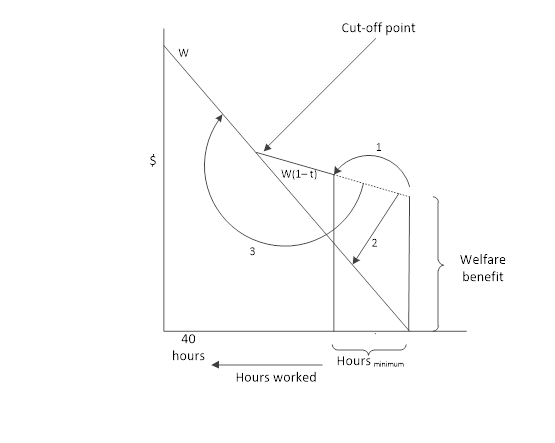
Arrows 1, 2 and 3 in Figure 1 represent possible labour supply responses to work requirements which lead to an increase in the hours worked by different types of workers, some moving to working part-time and others not working at all.
Arrow 1 shows some beneficiaries who are marginal workers increasing their hours from zero to the minimum. Other marginal workers will work more but no longer work enough hours to qualify for a benefit as shown by arrow 2.
This increase in labour supply, as shown by arrows 1 and 2 in Figure 1, is to be expected because a work requirement eliminates welfare benefits altogether over a certain range.
Welfare payments reduce the supply of labour unambiguously so reducing the generosity of welfare reduces the disincentives to supply labour.
A work requirement also reduces entry into and increases exit from the welfare system by more persistent workers as shown by arrow 3 in Figure 1.
This welfare exit effect and entry deterrence arises from the relative non-financial rewards of working and not working have changed in favour of staying in full-time and semi-work for persistent workers temporarily on a welfare benefit.
Persistent workers gain from anticipating the onerous nature of work requirements and searching more intensively for jobs which are more stable and enduring.
These job seekers may reduce their asking wage to win a lower paid but steadier job. Seasonal and temporary jobs will be less attractive if there are work requirements.
The incentive to cycle between the benefit and part-time and full-time work including seasonal and temporary jobs are reduce because work requirements make welfare receipt more onerous.
Those job seekers with fewer outside of the workforce obligations such as young children are the most likely to move to (stable) full-time work because of work requirements.
Those with more extensive outside commitments such as pre-schoolers work the minimum hours or make other arrangements because they now fail to qualify for welfare.
A work requirement unambiguously increases net labour supply and reduces the number of people relying on the welfare system now and into the future.
In contrast to abatement regime reforms, no one enters the welfare system as a new benefit claimant as the result of introducing work requirements.
The number of people working increase and some leave welfare rather than comply with the work programmes. Work requirements make welfare receipt unambiguously less attractive and will close the gap between earning full-time wages and the net rewards of not working or part-time work and partial benefit receipt.
The 60 per cent reduction in welfare caseloads that followed the 1996 federal welfare reform in the USA that introduced work requirement and time limits on a national basis.

The subsequent declines in welfare participation rates and gains in employment were largest among the single mothers previously thought to be most disadvantaged: young (ages 18-29), mothers with children aged under seven, high school drop-outs, and black and Hispanic mothers. These low-skilled single mothers who were thought to face the greatest barriers to employment. Blank (2002) found that:
At the same time as major changes in program structure occurred during the 1990s, there were also stunning changes in behaviour. Strong adjectives are appropriate to describe these behavioural changes.
Nobody of any political persuasion-predicted or would have believed possible the magnitude of change that occurred in the behaviour of low-income single-parent families over this decade.
The blogs so far
part-one-the-labour-leisure-trade-off-and-the-rewards-for-working
part-two-the-labour-supply-effects-of-welfare-benefit-abatement-rate-changes
part-3-abatement-free-income-thresholds-and-labour-supply
part-4-in-work-tax-credits-and-labour-supply
part-5-higher-abatement-rates-and-labour-supply
Is welfare dependence optimal for whom – part 5: higher abatement rates and labour supply
12 Dec 2014 Leave a comment
in labour economics, labour supply, poverty and inequality, welfare reform Tags: labour economics, welfare reform
Paradoxically, the main way of using financial incentives to increase net labour supply of beneficiaries and move more off the benefit is to toughen the benefit abatement regime.
This increase in the abatement rates on welfare benefits for earned income moves more off the benefit and moves more into full-time employment but still with an ambiguous effect on part-time employment. Some may prefer the benefit over their current part-time job.
The notion that tinkering with financial incentives will not have large effects on labour supply and benefit numbers is not new. Increase in the generosity of welfare benefits with increase the number of applicants.
Tinkering with the details of abatement rates and thresholds has ambiguous labour supply effects because exits from welfare are still offset by new entry onto welfare. The netting the labour supply changes of these diverse groups often leads to welfare reform leading to positive but small change in labour supply. Quantitatively, an old finding is the remarkable lack of effects of financial incentives on welfare participation (Moffitt 1992, 2002).
Under a move up to a 100 per cent benefit abatement rate as shown in Figure 1; arrow 1 in Figure 1 shows that some who were working part-time will now find not working at all to be the more attractive option. The new 100 per cent benefit abatement rate reduces their take-home pay but they enjoy more leisure time.
Figure 1: the labour supply effects of an increase to a 100 per cent benefit abatement rate

Arrow 2 in Figure 1 shows that some part-time workers increase their working hours because working a little more mitigates the reduction in their take-home pay and allow some leisure time.
Arrow 3 in Figure 1 shows that some part-timers return to full-time working hours because of the revised leisure-labour trade off that now makes a somewhat higher take-home pay worthwhile despite reduced leisure time.
Whether net labour supply increases or falls after a rise in the benefit abatement rate to 100 per cent depends on the relative numbers of workers at different points on the budget constraint that are working full-time, not working, and working part-time and the magnitudes of their responses.
Some will stay as they are working either full-time, not working or working part-time. Others supply more labour. Working more hours may increase their take-home pay depending on how productivity they are.
Some part-timers will move to full-time in low paid jobs with take-home pay because of the loss of benefit income, they will enjoy less leisure time and there can be additional costs such as child care.
More productive workers in better paid jobs will take home more in pay by moving to full-time but will enjoy less leisure time. Some workers that were previously working part-time stop working and rely in welfare benefits.
If reduced welfare dependence is the objective, high abatement rates and low abatement thresholds are the path to follow. With a move to 100 per cent abatement of benefits, some leave the welfare system but no one joins it because of the higher abatement rate.
Less generous abatement will see some who claim the benefit while working part-time move to a lower take-home pay. Some will be on a higher take-home pay working full-time. The net labour supply effect is ambiguous because some leave work altogether while others work more hours.
The net labour supply depends on the relative numbers at different points on the budget constraint working full-time, not working, or working part-time and the magnitudes of their respective individual labour supply responses. Some people will stay as they are working full-time, not working or working part-time.
No one who previously did not work is worse off under the benefit abatement rate increase to 100 per cent because they are unaffected by abatement. Some who were working part-time and previously claiming the benefit take-home less but enjoy more leisure as shown by arrow 2 in Figure 1. The remaining part-time workers now take-home more pay but enjoy less leisure because they are working more hours and even full-time as shown by arrow 3 in Figure 1.
The blogs so far
part-one-the-labour-leisure-trade-off-and-the-rewards-for-working
part-two-the-labour-supply-effects-of-welfare-benefit-abatement-rate-changes
part-3-abatement-free-income-thresholds-and-labour-supply
part-4-in-work-tax-credits-and-labour-supply
part-5-higher-abatement-rates-and-labour-supply
Tom Sargent’s Keynote Address BYU CPEC 2012 on taxation and redistribution
11 Dec 2014 Leave a comment
in fiscal policy, labour economics, labour supply, macroeconomics, public economics Tags: taxation and the labour supply, Tom Sargent
Charles Murray and the OECD’s Trends in Income Inequality and its Impact on Economic Growth – IQ, signalling, over-education and plain bad career advice
11 Dec 2014 Leave a comment
in economics of education, human capital, international economics, labour supply, occupational choice, poverty and inequality Tags: Bryan Caplan, Charles Murray, IQ and education, poverty and inequality, signalling
Charles Murray has been cooking with gas lately – on fire. One of his points is too many go to college. Murray points out that succeeded at college requires an IQ of at least 115 but 84% of the population don’t have this:
Historically, an IQ of 115 or higher was deemed to make someone “prime college material.”
That range comprises about 16 per cent of the population.
Since 28 per cent of all adults have BAs, the IQ required to get a degree these days is obviously a lot lower than 115.
Those on the margins of this IQ are getting poor advice to go to college. Murray argues that other occupational and educational choices would serve them better in light of their abilities and likelihood of succeeding at college. Moreover, Murray is keen on replacing college degrees with certification after shorter periods of study such as in the certified public accountants exam.
Murray believes a lot of students make poor investments by going on to College, in part, because many of them don’t complete their degrees:
…even though college has been dumbed down, it is still too intellectually demanding for a large majority of students, in an age when about 50 per cent of all high school graduates are heading to four-year colleges the next fall.
The result is lots of failure. Of those who entered a four-year college in 1995, only 58 per cent had gotten their BA five academic years later.
Murray does not want to abandon these teenagers:
Recognizing the fact that most young people do not have ability and/or the interest to succeed on the conventional academic track does not mean spending less effort on the education of some children than of others.
…Too few counsellors tell work-bound high-school students how much money crane operators or master stonemasons make (a lot).
Too few tell them about the well-paying technical specialties that are being produced by a changing job market.
Too few assess the non-academic abilities of work-bound students and direct them toward occupations in which they can reasonably expect to succeed.
Worst of all: As these students approach the age at which they can legally drop out of school, they are urged to take more courses in mathematics, literature, history and science so that they can pursue the college fantasy. Is it any wonder that so many of them drop out?
To add to that, he is in the Bryan Caplan School: education is often an elaborate former of signalling for many degrees. Murray says that college is a waste of time because:
Outside a handful of majors — engineering and some of the sciences — a bachelor’s degree tells an employer nothing except that the applicant has a certain amount of intellectual ability and perseverance.
Even a degree in a vocational major like business administration can mean anything from a solid base of knowledge to four years of barely remembered gut courses.
If the OECD is to be believed, that not enough people are going to college from lower middle class families, obviously IQ is not one of the constraints on access to college Charles Murray suggested it to be.

The growing strength of the case that education is a form of signalling is a literature that the now famous OECD paper reviewed, found wanting, but did not have time to discuss in the working paper.

Another contemporary theme the OECD paper reviewed, found wanting, but did not have time to discuss is a large number of graduates who end up holding jobs that do not require a university education – going to college:
About 48 per cent of employed U.S. college graduates are in jobs that the Bureau of Labor Statistics (BLS) suggests requires less than a four-year college education.
Eleven per cent of employed college graduates are in occupations requiring more than a high-school diploma but less than a bachelor’s, and 37 per cent are in occupations requiring no more than a high-school diploma.
The proportion of overeducated workers in occupations appears to have grown substantially; in 1970, fewer than one per cent of taxi drivers and two per cent of fire-fighters had college degrees, while now more than 15 per cent do in both jobs
All in all, the OECD has gone into the dragons den by backing the accumulation of human capital as its mechanism to link inequality with lower growth. No matter how you spin it, this linking of lower economic growth to greater inequality through financial constraints on the accumulation of human capital by the lower middle class was a bold hypothesis.

The case for investing more in education is not a slam dunk. Higher education – university or polytechnic – is a rat race that many don’t need to join.The case for the government paying a great many more to join that rat race is rather weak.
 Utopia, you are standing in it!
Recent Comments