The Affordable Care Act and the Labor Market
15 Feb 2015 Leave a comment
in fiscal policy, great recession, labour economics, labour supply, macroeconomics Tags: Casey Mulligan, Obamacare, taxation and the labour supply
Lower Working Age Population and Secular Stagnation
11 Feb 2015 Leave a comment
in labour economics, labour supply, population economics Tags: ageing society, ageing workforce, Population demographics


The division of labour between modern parents
10 Feb 2015 Leave a comment
in labour economics, labour supply Tags: engines of liberation, female labour force participation, household production, motherhood penalty
Notice that mothers spent about 30 hours per week on housework in the 1960s. The engines of liberation were smaller families and the availability of a large number of labour saving household white goods, and preprepared and takeaway food.


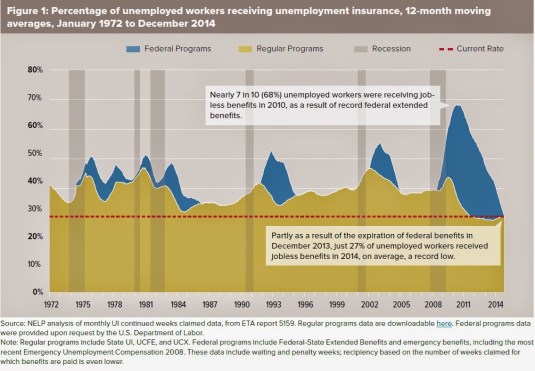
How many were on Unemployment Insurance
09 Feb 2015 Leave a comment
in labour economics, labour supply, unemployment Tags: unemployment insurance
The Evolution Of The Employee
09 Feb 2015 Leave a comment
in health and safety, human capital, labour economics, labour supply, managerial economics, market efficiency, occupational choice, organisational economics, personnel economics Tags: modern human resource management

Why Don’t More People Want a Job?
08 Feb 2015 Leave a comment
in labour economics, labour supply, unemployment Tags: ageing society, ageing workforce, labour force participation, labour market demographics

Twice as many on disability benefits, less than half as many families on welfare in the USA
06 Feb 2015 Leave a comment

Union density has taken a bit of a battering in US manufacturing and construction
05 Feb 2015 Leave a comment


Spurious correlations alert: executions and murder rates – updated
30 Jan 2015 Leave a comment
in applied price theory, economics of crime, labour economics, labour supply, law and economics, occupational choice Tags: crime and punishment, death penalty, deterrence, occupational hazards, prison conditions, punishment
– Updated
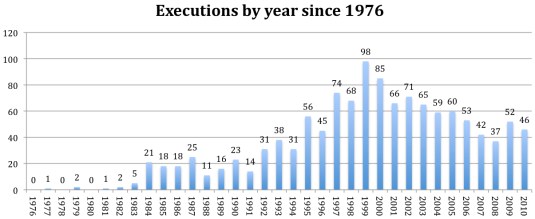
Many a data shyster will make hay with the above chart on the simple correlation between executions and the drop in the US murder rate.

The reality is there are so few executions and they are so infrequent with the exception of Texas that any purported correlation between the death penalty and murder rates requires careful study.

Indeed, for some condemned prisoners, gang bangers are an example, their life expectancy may be increased by the long time they spend on death row versus been murdered by a business associated or a business rival on the streets. As Levitt noted:
no rational criminal should be deterred by the death penalty, since the punishment is too distant and too unlikely to merit much attention.
As such, economists who argue that the death penalty works are put in the uncomfortable position of having to argue that criminals are irrationally overreacting when they are deterred by it.
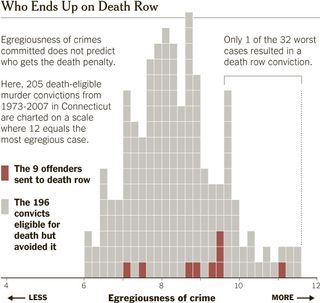
The occupational hazard of been murdered by business rival for gang bangers is higher than the chance of them been arrested, tried , convicted, and condemned to death and then executed after a long appeals process. Not surprisingly, Levitt argued that:
…the quality of life in prison is likely to have a greater impact on criminal behaviour than the death penalty.
Using state-level panel data covering the period 1950–90, we demonstrate that the death rate among prisoners (the best available proxy for prison conditions) is negatively correlated with crime rates, consistent with deterrence. This finding is shown to be quite robust.
In contrast, there is little systematic evidence that the execution rate influences crime rates in this time period.
The labour force participation of mothers in the 20th century
30 Jan 2015 Leave a comment
in gender, labour economics, labour supply Tags: engines of liberation, female labour force participation, gender wage gap, sex discrimination

First, work changed to offer more jobs to women. Farming declined sharply; industrial jobs peaked and then declined. Brawn became less important; precise skills, learning, and personal service became more important.
The new economy generated millions of white-collar and “pink-collar” jobs that seemed “suited” to women. That cannot be the full story, of course; women also took over many jobs that had once been men’s, such as teaching and secretarial work.
Second, mothers responded to those job opportunities. Some took jobs because the extra income could help families buy cars, homes, furnishings, and so on. Some took jobs because the family needed their income to make up for husbands’ stagnating wages (a noteworthy trend after the 1970s). And some took jobs because they sought personal fulfilment in the world of work.
via Why Did Married Mothers Go To Work? » Sociological Images.


Recent Comments