
The population bust
05 Aug 2026 Leave a comment
in development economics, economic history, labour economics, labour supply, population economics
The Most Depressing Chart about Germany
31 Jul 2026 Leave a comment
in applied price theory, fiscal policy, human capital, labour economics, labour supply, macroeconomics, poverty and inequality, welfare reform Tags: Germany

I’ve used the “most depressing chart” approach when writing about the United States, about Europe, about Japan, and about the western world. Today, let’s focus on Germany. And I’ll start with a caveat. I wrote about Germany earlier this month and that column included several charts that might qualify. Especially the last visual which showed […]
The Most Depressing Chart about Germany
The economic effects of GLP-1s
30 Jul 2026 Leave a comment
in applied price theory, entrepreneurship, industrial organisation, labour economics, labour supply, survivor principle
We estimate the causal impacts of GLP-1 treatment on labor market outcomes using linked Danish administrative data and a matched stacked difference-in-differences design. We compare patients who initiate GLP-1 treatment during the first two years of Semaglutide availability to observably similar patients who initiate four years later. We find that GLP-1 treatment reduces long-term sickness…
The economic effects of GLP-1s
The Apples and Oranges Tribunal
28 Jul 2026 Leave a comment
in applied price theory, discrimination, economics of education, economics of regulation, gender, labour economics, labour supply, law and economics, liberalism, Marxist economics, poverty and inequality, property rights Tags: gender wage gap, sex discrimination
Suppose that apples sell for more than oranges and Parliament in it’s wisdom decides that, at last, apples and oranges must be compared. Not by shoppers — shoppers are biased, they merely reveal what they are willing to pay — but by a tribunal, which will determine whether apples and oranges are of truly equal…
The Apples and Oranges Tribunal
Goldman’s Demand for “One Case” of Immigration Obstruction Fails Spectacularly When DHS Offers 7,000 in New York Alone
27 Jul 2026 Leave a comment
in economics of crime, labour economics, labour supply, law and economics, politics - USA Tags: economics of immigration
An over-30-point primary loss would ordinarily produce a degree of introspection and self-reflection in a politician. Indeed, even such a…
Goldman’s Demand for “One Case” of Immigration Obstruction Fails Spectacularly When DHS Offers 7,000 in New York Alone
Occupational Licensing: US and International
25 Jul 2026 Leave a comment
in applied price theory, economics of information, economics of regulation, human capital, income redistribution, labour economics, labour supply, occupational choice, occupational regulation, politics - USA, Public Choice, rentseeking

The potential benefit of having the government require that certain jobs require an official license is quality control and protection. Personally, I rather like knowing that my nurse or doctor or dentist has gone through courses and training. The potential cost is that requirement to have a government license can become a way for those…
Occupational Licensing: US and International
The Case Against a Universal Basic Income
23 Jul 2026 1 Comment
in applied price theory, fiscal policy, income redistribution, labour economics, labour supply, macroeconomics, politics - New Zealand, poverty and inequality, Public Choice, welfare reform
A Universal Basic Income, or UBI, is a superficially attractive idea. Under such a scheme, every adult would receive a regular payment from the government, regardless of income, employment or need. Supporters argue that it would reduce poverty, simplify welfare, provide security in an uncertain labour market and give people greater freedom to choose how […]
The Case Against a Universal Basic Income
Oren Cass Again Swings and Misses in His Attempt to Discredit Economists
21 Jul 2026 Leave a comment
in human capital, labour economics, labour supply, politics - USA Tags: economics of immigration
TweetHere’s a letter to the Financial Times. Editor: Oren Cass’s attempt to discredit economists’ support for a policy of liberal immigration is flawed (“Mass immigration is not the silver bullet economists think it is,” July 10). For example, consider this question that he poses rhetorically: “If employers believe they will always have access to a…
Oren Cass Again Swings and Misses in His Attempt to Discredit Economists
Pronatal policies
21 Jul 2026 Leave a comment
in applied price theory, labour economics, labour supply, population economics Tags: economics of fertility
The Institute for Family Studies puts up a pro-natal proposal that I’d not seen before.Most of the literature I’ve seen on baby bonuses suggests that the amount on offer would have to be hefty to have substantive effects. This version could harness a bit of loss aversion:President Trump launched a small savings account seeded with…
Pronatal policies
Occupational Licensing Around the World
18 Jul 2026 1 Comment
in economics of regulation, labour economics, labour supply, occupational regulation, politics - New Zealand, politics - USA
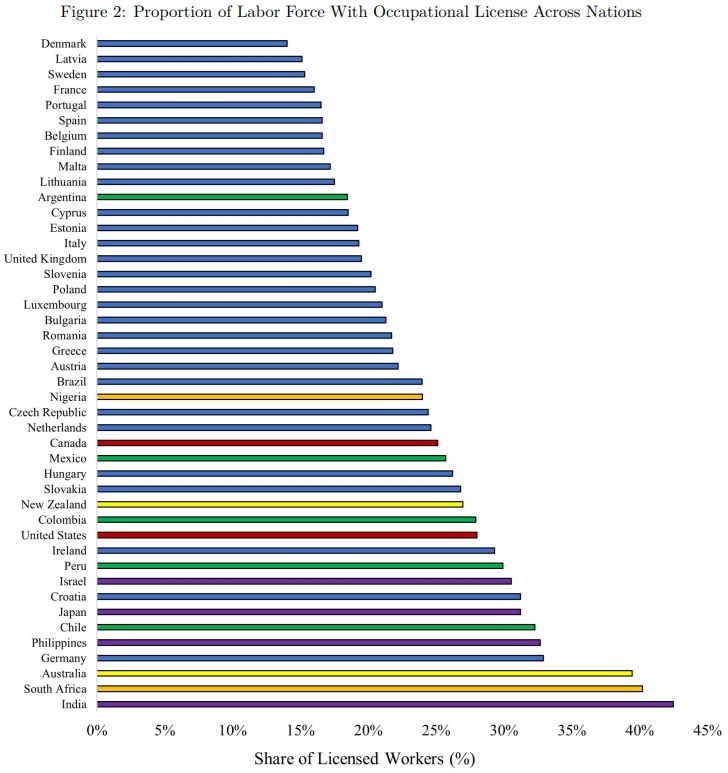
Hartley and Kleiner have a new Fed Minneapolis working paper surveying workers around the world to measure occupational licensing by country. In the United States, occupational licensing has increased substantially over time, so one might expect licensing to rise with income. Their headline result is the opposite: occupational licensing is negatively correlated with GDP per…
Occupational Licensing Around the World
The Equal Pay Madness Just Got Madder
17 Jul 2026 1 Comment
in applied price theory, discrimination, economics of regulation, gender, human capital, labour economics, labour supply, occupational choice Tags: gender wage gap
In my post Equality Act 2010 I discussed the UK’s absolutely insane wage policy: In short, supply and demand have been replaced by judges and labor boards with the authority to deem which jobs are “equal” and therefore should be paid equally….No one is alleging that male and female warehouse workers were paid unequally or…
The Equal Pay Madness Just Got Madder
Does Costco Follow The Efficiency Wage Theory?
13 Jul 2026 1 Comment
in applied price theory, entrepreneurship, industrial organisation, labour economics, labour supply, managerial economics, organisational economics, personnel economics
See He Earns $33 an Hour as a Costco Cashier, Now He’s a Millionaire: Long-tenured workers like cashier Tony Barzar are reliable, experienced and able to speed shoppers through a checkout line-Costco is willing to pay to keep them around by Sarah Nassauer of The WSJ. I explain The Efficiency Wage Theory below after article excerpts:”Costco has…
Does Costco Follow The Efficiency Wage Theory?
Do falling birth rates boost per capita income?
06 Jul 2026 Leave a comment
in applied price theory, econometerics, economic growth, human capital, labour economics, labour supply, macroeconomics Tags: economics of fertility
The secular decline in birth rates across the globe over the past seven decades has slowed population growth, raised average ages, and reshaped labor markets and the macroeconomy. Contrary to the widespread expectation that these trends hamper economic growth, we find lower birth rates are associated with higher growth in GDP per working-age adult across…
Do falling birth rates boost per capita income?
Typewriters and fertility
01 Jul 2026 1 Comment
in discrimination, economic history, gender, human capital, labour economics, labour supply, occupational choice Tags: economics of fertility
Workplace technological changes were instrumental in creating new tasks for women over the last century. This paper studies the adoption of the typewriter into US workplaces. Exploiting exogenous variation in typist demand across sectors, I document that the typewriter increased women’s labor force participation, leading to lower rates of marriage and fertility. These developments stemmed…
Typewriters and fertility
Adrian Wooldridge on Sweden and liberalism
20 Jun 2026 1 Comment
in economic growth, labour economics, labour supply, macroeconomics Tags: Sweden
Sweden is continuing to reap the rewards of this mixture of fiscal rectitude and pro-market reforms. GDP is projected to grow by 1.8% to 1.9% this year; headline inflation stands at 1.5%; debt-to-GDP ratio is one of the lowest in the world, at just above 35%. There are some flies in this ointment, of course:…
Adrian Wooldridge on Sweden and liberalism


Recent Comments