Labour leader Chris Hipkins has joined the chorus of those opposing changes to pay equity legislation. Does this mean he knows what a woman is now? It is easy for opposition parties and their allies to criticise proposed changes but Heather du Plessis-Allan points out the problem with existing legislation: . . . Those pay […]
Does he know what a woman is now?
Does he know what a woman is now?
07 May 2025 Leave a comment
in applied price theory, discrimination, economics of education, gender, health and safety, human capital, labour economics, labour supply, occupational choice, politics - New Zealand, poverty and inequality, Public Choice, rentseeking Tags: gender wage gap, sex discrimination
Squatter Syndrome: How the Inefficiencies of Our Legal System Are Making a Mockery of Our Immigration Laws
06 May 2025 Leave a comment
in Economics of international refugee law, International law, labour economics, labour supply, law and economics, politics - USA Tags: economics of immigration

It was once said that possession is nine-tenths of the law, an acknowledgement that the possessor of property generally has the advantage in keeping it. This principle has been taken to absurd extremes in some squatter cases, where people invade homes and then demand the right to stay pending long legal challenges. Today, under both […]
Squatter Syndrome: How the Inefficiencies of Our Legal System Are Making a Mockery of Our Immigration Laws
Some weak evidence in favour of an information intervention in economics to close the gender gap
05 May 2025 Leave a comment
in applied price theory, discrimination, econometerics, economics of education, experimental economics, gender, labour economics, labour supply, occupational choice Tags: gender gap, sex discrimination
I’ve written a couple of times about information interventions designed to attract more female students to study economics (see here and here). The results have generally been disappointing. That shouldn’t be too much of a surprise. If it was really simple to get people to change their behaviour with information, then advertising would be far…
Some weak evidence in favour of an information intervention in economics to close the gender gap
The First 100 Days: The Method Behind the Madness in Court Challenges
02 May 2025 Leave a comment
in economics of crime, labour economics, labour supply, law and economics, politics - USA Tags: 2024 presidential election, constitutional law, economics of immigration

Below is my column in the New York Post on the first 100 days of the Trump Administration in court. It is too early to handicap many of these lower courts decisions. I have been critical of some of these orders as either premature or unconstitutional. There is a reason for the hyperkinetic pace of […]
The First 100 Days: The Method Behind the Madness in Court Challenges
The Silver (-Haired) Economy
30 Apr 2025 Leave a comment
in labour economics, labour supply, population economics

In its most recent World Economic Outlook report, the IMF includes a chapter on “The Rise of the Silver Economy: Global Implications of Population Aging” (April 2025). Here are the big trends in a nutshell. The red line (measured on the right-hand axis) shows that the average age of the global poulation was about 27…
The Silver (-Haired) Economy
Raskin: Trump Officials Can Be Arrested for “Kidnapping” Undocumented Persons
28 Apr 2025 Leave a comment
in defence economics, economics of crime, labour economics, labour supply, law and economics, politics - USA Tags: 2024 presidential election, economics of immigration

For some on the far left, “The Rachel Maddow Show” is a godsend. Otherwise, you would have to go to the subway to compete against others raving about microchips and oligarchies. Just take Rep. Jamie Raskin (D-MD), who went on the show on Friday to explain that Trump officials can now be arrested for “interfering with […]
Raskin: Trump Officials Can Be Arrested for “Kidnapping” Undocumented Persons
Weak Essay? Student Rejected by Top Universities Despite Near Perfect Scores and $30 Million App
27 Apr 2025 Leave a comment
in discrimination, economics of education, human capital, labour economics, labour supply, politics - USA Tags: affirmative action, free speech, political correctness, racial discrimination, regressive left

After the Supreme Court declared an end to the use of race criteria in college admissions, many administrators pledged to find a way around the decision. Schools are using essay prompts to flag race while rejecting the use of standardized testing to boost diversity in admissions. In the meantime, these schools are rejecting students with […]
Weak Essay? Student Rejected by Top Universities Despite Near Perfect Scores and $30 Million App
Long-Run Effects of Trade Wars
24 Apr 2025 Leave a comment
in applied price theory, applied welfare economics, comparative institutional analysis, development economics, econometerics, history of economic thought, industrial organisation, labour economics, labour supply, politics - USA, unemployment Tags: 2024 presidential election, free trade, tariffs, unintended consequences
This short note shows that accounting for capital adjustment is critical when analyzing the long-run effects of trade wars on real wages and consumption. The reason is that trade wars increase the relative price between investment goods and labor by taxing imported investment goods and their inputs. This price shift depresses capital demand, shrinks the […]
Long-Run Effects of Trade Wars
The Supreme Court Halts Venezuelan Deportations as the Fourth Circuit Upholds Garcia Order
20 Apr 2025 Leave a comment
in labour economics, labour supply, law and economics, politics - USA Tags: economics of immigration

It has been a busy 24 hours in the courts. Early this morning, the Supreme Court blocked (for now) the deportations of any Venezuelans held in northern Texas under the Alien Enemies Act, a law only used three times before in our history. At the same time, the United States Court of Appeals for the […]
The Supreme Court Halts Venezuelan Deportations as the Fourth Circuit Upholds Garcia Order
Federal Judge Halts Trump Administration’s Deportation of Half a Million Biden “Parolees”
16 Apr 2025 Leave a comment
in labour economics, labour supply, law and economics, politics - USA, population economics Tags: 2024 presidential election, economics of immigration

The intense struggle between the Trump Administration and federal judges continued this week with another court ordering a halt to a nationwide program. In Massachusetts, District Judge Indira Talwani is preventing President Donald Trump from canceling a Biden program granting parole and the right to work to immigrants from Cuba, Haiti, Nicaragua, and Venezuela (CHNV). […]
Federal Judge Halts Trump Administration’s Deportation of Half a Million Biden “Parolees”
There’s little evidence that subsidies and protections have substantially raised the number of children women have over their lifetime
13 Apr 2025 Leave a comment
in economics of love and marriage, labour economics, labour supply, law and economics, population economics Tags: economics of fertility
See They Want More Babies: Now They Have Friends in the White House by Lydia DePillis of The NY Times. Excerpts: “In designing policy requests for federal legislators, however, pronatalists run into a problem: There’s little evidence that subsidies and protections have substantially raised the number of children women have over their lifetime. It’s not for…
There’s little evidence that subsidies and protections have substantially raised the number of children women have over their lifetime
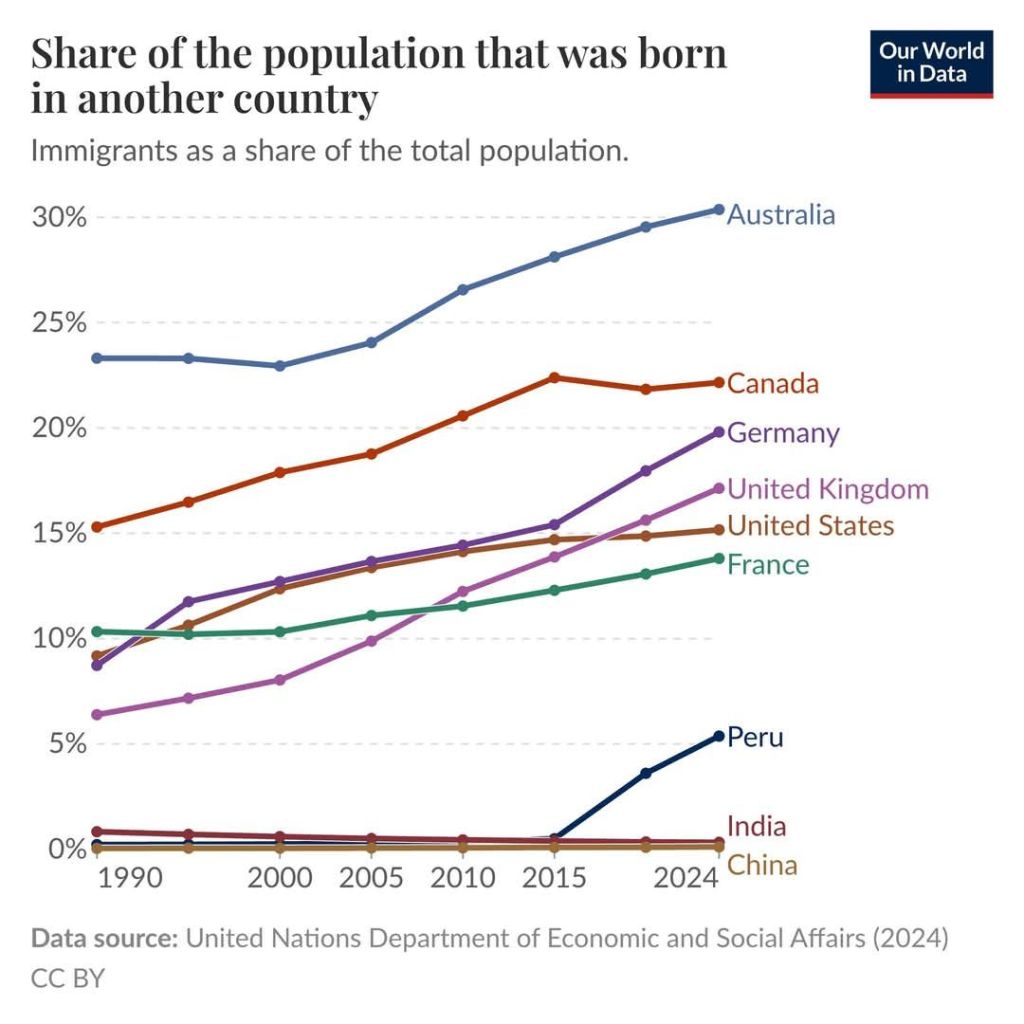
Foreigners
08 Apr 2025 Leave a comment
in human capital, labour economics, labour supply, population economics Tags: economics of immigration
The Regulation Review Committee’s tikanga decision
07 Apr 2025 Leave a comment
in economic history, economics of education, economics of regulation, human capital, labour economics, labour supply, law and economics, liberalism, Marxist economics, occupational regulation, politics - New Zealand, property rights Tags: Age of Enlightenment, free speech, political correctness, racial discrimination, regressive left
The Committee probably went as far as it could Gary Judd writes – What the Committee did The Regulation Review Committee decided (1) that making tikanga a compulsory subject for law students did not unduly trespass on personal rights and liberties, but (2) requiring tikanga to be incorporated in the other compulsory subjects was an […]
The Regulation Review Committee’s tikanga decision
Not much parliamentary scrutiny
01 Apr 2025 Leave a comment
in business cycles, econometerics, economic history, economics of bureaucracy, inflation targeting, labour economics, labour supply, macroeconomics, monetary economics, politics - New Zealand, Public Choice, unemployment Tags: economics of pandemics, monetary policy

This was the post I was planning to write this morning to mark Orr’s final day. That said, if the underlying events – deliberate attempts to mislead Parliament – were Orr’s doing, the post is more about the apparent uselessness of Parliament (specifically the Finance and Expenditure Committee) in holding him and the rest of […]
Not much parliamentary scrutiny
U.S. Trade Deficit Do Not Mean that We Americans Are Living Beyond Our Means
31 Mar 2025 Leave a comment
in applied price theory, Austrian economics, industrial organisation, international economics, labour supply Tags: free trade, tariffs
TweetHere’s a note to a new correspondent. Mr. P__: Thanks for your feedback on Phil Gramm’s and my piece, in yesterday Wall Street Journal, on trade deficits. You believe that I “and Sen. Gramm omit that every US trade deficit means Americans are consuming more than they are producing, a habit that is unsustainable.” With…
U.S. Trade Deficit Do Not Mean that We Americans Are Living Beyond Our Means
 Utopia, you are standing in it!
Recent Comments