Caplan Hanson Debate: Robots will eventually dominate the world
02 Jan 2017 Leave a comment
in applied price theory, economic history, entrepreneurship, industrial organisation, labour economics, labour supply Tags: automaton, Bryan Caplan, Robin Hanson, skill biased technological change
The first @PaulKrugman explains European labour market regulation
02 Jan 2017 Leave a comment
in applied price theory, income redistribution, labour economics, labour supply, law and economics, minimum wage, Public Choice, rentseeking Tags: employment law, labour market regulation, minimum wage laws, rent control, social insurance, unemployment insurance
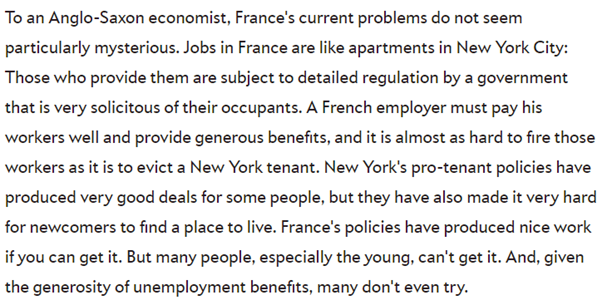
Source: Unmitigated Gauls (1998).
Mapping the World’s Immigration Flows, Country-by-Country
29 Dec 2016 Leave a comment
in development economics, labour economics, labour supply, population economics Tags: economics of immigration
Frank Easterbrook: Discussion of Robert Bork’s “Saving Justice” from Nixon
26 Dec 2016 Leave a comment
in constitutional political economy, economic history, labour economics, politics - USA Tags: economics of constitutional law, Frank Easterbrook, Richard Nixon, Robert Bork, Watergate scandal
Steven Pinker on the biology of sex differences
24 Dec 2016 Leave a comment
in applied price theory, discrimination, gender, labour economics Tags: gender gap, political correctness
A wages boom followed a surge in corporate profits and the Employment Contracts Act 1993 after 20 years of stagnation
21 Dec 2016 Leave a comment
in economic history, labour economics, politics - New Zealand
Child poverty and top 1% income shares seems to have been stable for 20 years, more or less
21 Dec 2016 Leave a comment
in economic history, politics - New Zealand, poverty and inequality
An Average Day in the Life of an American
21 Dec 2016 Leave a comment
in labour economics, labour supply Tags: time use
Who haggles over wage offers and why?
19 Dec 2016 Leave a comment
in human capital, job search and matching, labour economics, labour supply, occupational choice, personnel economics Tags: inequality of bargaining power, job search, search and matching
The strength of alternatives to no agreement drives wage bargaining as Alchian and Allen explain:
An important truth is that employers compete against other employers, and employees against other employees-not employees against employers, as folklore says. It is the availability of higher-valued alternatives, not the ability to bargain collectively, that increases bargaining power (Alchian and Allen 1967, p. 328).
The side with more outside options and a stronger ability to credibly commit to a specific wage offer wins the larger share of the split (Manning 2005; Cahuc and Zylberberg 2004; Lazear 1998).

Those searching for new jobs while on-the-job play a better hand than the unemployed (Manning 2005). Concerns about workers not holding their own in this wage bargaining date back to Adam Smith:
… in the long run the workman may be as necessary to his master as his master is to him; but the necessity is not so immediate (The Wealth of Nations).
Calls for a minimum wage arise partly out of concerns over who has the upper hand in bargaining:
… labour is often sold under special disadvantages arising from the closely connected group of facts that labour power is ‘perishable’, that the sellers of it are commonly poor and have no reserve fund… The want of reserve funds and of the power of long withholding their labour from the market is common to nearly all grades of those whose work is chiefly with their hands.
But it is especially true of unskilled labourers, partly because their wages leave very little margin for saving, partly because when any group of them suspends work, there are large numbers who are capable of filling their places (Marshall 1920).
Take-it-or-leave-it wage offers are more common for lower paid vacancies (Cahuc, Postel-Vinay and Robin 2006). Employers who post the going rate for lower-paid vacancies saves transaction costs for both sides of a more routine job match (Alchian and Allen 1967; Boeri and van Ours 2013).
The take-it-or-leave-it offer for a standard vacancy to be filled by similarly qualified job applicants may reflect where bargaining would have gone in any case and so saves that predictable journey. The market discipline on employers is posting an offer below the going rate attracts an inferior job applicant pool (Mortenson 2003; Boeri and van Ours 2013; Cahuc, Postel-Vinay and Robin 2006).

A well-matched recruit is a valuable find and the better paid is the job, the more it is worth haggling over the spilt (Alchian 1969; Lazear 1998). One-third of workers bargain over the wage paid in a new job; only about 5% for blue collar workers haggle but 86% for knowledge workers make counter-offers (Krueger and Hall 2012; Brenzel, Gartner and Schnabel 2014; Brenčič 2012). The less skilled job seeker finds new jobs faster because they have less specialised human capital to match up with prospective vacancies than say a knowledge worker (Alchian 1969; Oi 1983, 1987: Lazear 1998).
Lower paid jobs entail less search and bargaining because there is less to haggle over; there is more variance in applicant quality and goodness of fit for higher paid vacancies so both sides search for longer and haggle more (Lazear 1998; Alchian 1969; Oi 1987).
The going rate for low skilled vacancies is common knowledge. Employers that post an inferior offer risks lowering the quality of their recruitment pools. It saves search costs for both sides to post the going rate (Alchian and Allen 1967; Lazear 1998). The rub is less skilled employees are laid-off sooner in downturns because less firm-specific human capital is lost for both sides of the job match (Oi 1962, 1983; Becker 1993).

New Zealand pension fund assets since 2001
12 Dec 2016 Leave a comment
in economic history, financial economics, fiscal policy, labour economics, macroeconomics Tags: ageing society, demographic crisis, economics of retirement savings
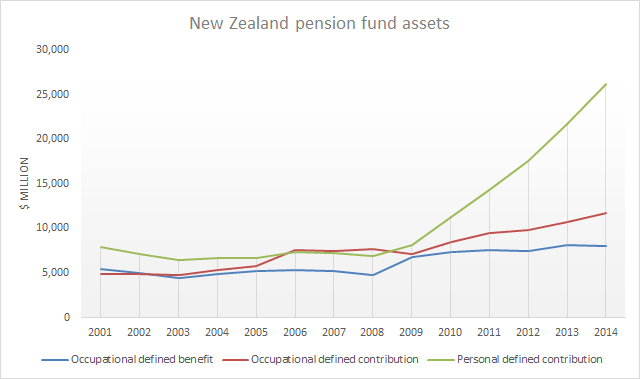
Source: OECD pension fund statistics and national sources via OECD Pension Outlook 2016.


Recent Comments