Mass kidnappings is the only reason why the Occupy activists are not dancing seen in the streets to celebrate the steady fall of poverty in New Zealand over the last 20 years but for the hick-up of the GFC.

Celebrating humanity's flourishing through the spread of capitalism and the rule of law
01 May 2015 Leave a comment
in applied welfare economics, labour economics, poverty and inequality Tags: capitalism and freedom, Left-wing hypocrisy, mass kidnappings, Occupy Wall Street, The Great Enrichment, top 1%
Mass kidnappings is the only reason why the Occupy activists are not dancing seen in the streets to celebrate the steady fall of poverty in New Zealand over the last 20 years but for the hick-up of the GFC.
01 May 2015 Leave a comment
in applied price theory, Austrian economics, F.A. Hayek, labour supply, occupational choice, Public Choice, rentseeking Tags: consultants, rent seeking, The pretence to knowledge
The life of an economist. http://t.co/gvBLa9Tk3h—
Justin Wolfers (@JustinWolfers) March 02, 2015
30 Apr 2015 Leave a comment
in discrimination, gender, labour economics, occupational choice Tags: gender analysis, gender wage gap, media bias, reversing gender gap, wage stagnation
30 Apr 2015 Leave a comment
in discrimination, gender, human capital, labour economics, labour supply Tags: gender wage gap
30 Apr 2015 Leave a comment
in labour economics, labour supply, occupational choice, politics - USA Tags: conscription, peace movements, Richard Nixon, Vietnam war
The Vietnam anti-war movement were primarily the result of the draft: hell no, we won’t go and the burning of draft cards. Richard Nixon was as cunning a rat who ever occupied the Oval Office. He was elected in 1968 to end the Vietnam war and to end the draft.
Nixon had an intuitive economic understanding that the anti-war movement’s rioting in the streets and campuses was very much motivated by private gain. In particular, the threat of being drafted. The notion that revolutions and political movements are motivated by private gain is not new.
Vietnamisation changed everything. In 1969, Nixon started the process of phasing down the sending of further combat troops to Vietnam and the phasing down of the draft. US troop withdrawal started on July 1st 1969 with completion dates – December 1970, June 1971 and December 1972.
By the beginning of 1972, over 400,000 U.S. military personnel had been withdrawn, virtually all combat troops. The protests were against ending up in the jungle – not up the rear with the gear. There were 24,000 US troops in Vietnam in 1972. This compares to 560,000+ in 1969.
A Vietnam vet told me that when he returned to his U.S. campus in 1971 for graduate studies, it was very quite compared to 1969 because the spectre of the draft had gone in their minds.

The anti-war movement was really motivated by hell no, we won’t go. As soon as the prospect of going to Vietnam faded away, so did the anti-war movement.
29 Apr 2015 1 Comment
in entrepreneurship, labour economics, labour supply, occupational choice Tags: creative destruction, entrepreneurial alertness, innovation, skill biased technical change, technological unemployment
29 Apr 2015 Leave a comment
in discrimination, gender, labour economics, labour supply Tags: family demographics, household production, marital division of labour
29 Apr 2015 Leave a comment
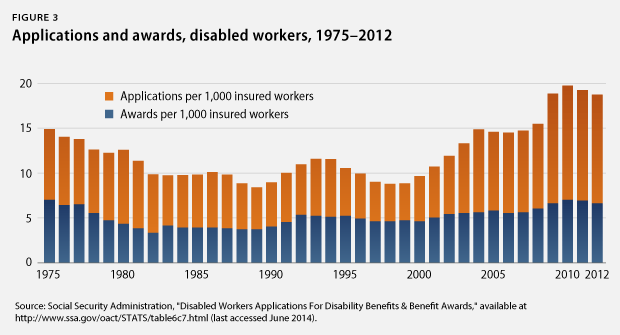
in health and safety, health economics, labour economics, labour supply, welfare reform Tags: disability benefits
29 Apr 2015 Leave a comment
in human capital, labour economics, labour supply, politics - Australia, politics - New Zealand, politics - USA Tags: economics of immigration
Migrants (esp. new ones) to UK more likely to have tertiary education than migrants to Australia [OECD[ http://t.co/xfOSQmiCxd—
Jonathan Portes (@jdportes) March 05, 2015
29 Apr 2015 Leave a comment
in labour economics, labour supply Tags: ageing society, labour demographics
28 Apr 2015 Leave a comment
in labour economics, minimum wage, politics - Australia, politics - New Zealand, politics - USA, poverty and inequality Tags: labour demographics, living wage, poverty and inequality
28 Apr 2015 Leave a comment
in labour economics, labour supply, occupational choice, poverty and inequality, welfare reform Tags: 1996 US welfare reforms, female labour supply, labour demographics, welfare state
The share of single mothers without a high school degree with earnings rose from 49 percent to 64 percent between 1995 and 2000 but has since fallen or remained constant almost every year since then. At 55 percent, it’s now just slightly above its level in 1997, the first full year of welfare reform (see first graph).

TANF now serves only 25 of every 100 families with children that live below the poverty line, down from AFDC’s 68 of every 100 such families before the welfare law
Over the last 18 years, the national TANF average monthly caseload has fallen by almost two-thirds — from 4.7 million families in 1996 to 1.7 million families in 2013 — even as poverty and deep poverty have worsened.
The number of families with children in poverty hit a low of 5.2 million in 2000, but has since increased to more than 7 million. Similarly, the number of families with children in deep poverty (with incomes below half of the poverty line) hit a low of about 2 million in 2000, but is now above 3 million.

The employment situation for never-married mothers with a high school or less education — the group of mothers most affected by welfare reform — has changed dramatically over the last several decades.
In the early 1990’s, when states first made major changes to their cash welfare programs, only about half of these mothers worked.
Importantly, there was a very large employment gap between the share of these never-married mothers and single women without children with similar levels of education, suggesting that there was substantial room for these never-married mothers to increase their participation in the labour force.
By 2000, the employment gap between these two groups of women closed, and it has remained so. But in the years since, the employment rate for both groups has fallen considerably.
The employment rate for never-married mothers is now about the same as when welfare reform was enacted 18 years ago. This suggests that the economy and low education levels are now the causes of limited employment among never-married mothers — not the availability of public benefits or anything particular to never-married mothers.

The Centre on Budget and Policy Priorities, who hail clearly from the Left of American politics, scrupulously documented the following:
Welfare dependency down by two thirds, employment of never married mothers up to levels no one thought possible, family poverty down, and economic independence is much more widespread and all because of the 1996 US Federal welfare reforms. That sounds like success to me – a great success.
via Chart Book: TANF at 18 | Center on Budget and Policy Priorities.
27 Apr 2015 Leave a comment
in cats, health and safety, labour economics, occupational choice Tags: daredevils
A lion riding in the sidecar of a go-kart at a wall of death, Massachusetts, c. 1929. http://t.co/Dlo7XcdhNC—
ClassicPics (@History_Pics) April 27, 2015
27 Apr 2015 Leave a comment
in economics of crime, health and safety, labour economics, law and economics Tags: workplace drug testing
27 Apr 2015 Leave a comment
The marriage squeeze in India and China is taking a third of humanity into uncharted territory econ.st/1IN2wyw http://t.co/GbjVDDqJ5h—
The Economist (@EconBizFin) April 26, 2015
Celebrating humanity's flourishing through the spread of capitalism and the rule of law
Celebrating humanity's flourishing through the spread of capitalism and the rule of law
Celebrating humanity's flourishing through the spread of capitalism and the rule of law
Celebrating humanity's flourishing through the spread of capitalism and the rule of law
Celebrating humanity's flourishing through the spread of capitalism and the rule of law
Celebrating humanity's flourishing through the spread of capitalism and the rule of law
Celebrating humanity's flourishing through the spread of capitalism and the rule of law
Celebrating humanity's flourishing through the spread of capitalism and the rule of law
Celebrating humanity's flourishing through the spread of capitalism and the rule of law
Celebrating humanity's flourishing through the spread of capitalism and the rule of law
Celebrating humanity's flourishing through the spread of capitalism and the rule of law
Celebrating humanity's flourishing through the spread of capitalism and the rule of law
A History of the Alt-Right
Econ Prof at George Mason University, Economic Historian, Québécois
Celebrating humanity's flourishing through the spread of capitalism and the rule of law
Scholarly commentary on law, economics, and more
Beatrice Cherrier's blog
Celebrating humanity's flourishing through the spread of capitalism and the rule of law
Celebrating humanity's flourishing through the spread of capitalism and the rule of law
Celebrating humanity's flourishing through the spread of capitalism and the rule of law
Why Evolution is True is a blog written by Jerry Coyne, centered on evolution and biology but also dealing with diverse topics like politics, culture, and cats.
Celebrating humanity's flourishing through the spread of capitalism and the rule of law
A rural perspective with a blue tint by Ele Ludemann
DPF's Kiwiblog - Fomenting Happy Mischief since 2003
Celebrating humanity's flourishing through the spread of capitalism and the rule of law
The world's most viewed site on global warming and climate change
Tim Harding's writings on rationality, informal logic and skepticism
A window into Doc Freiberger's library
Let's examine hard decisions!
Commentary on monetary policy in the spirit of R. G. Hawtrey
Thoughts on public policy and the media
Celebrating humanity's flourishing through the spread of capitalism and the rule of law
Politics and the economy
A blog (primarily) on Canadian and Commonwealth political history and institutions
Reading between the lines, and underneath the hype.
Economics, and such stuff as dreams are made on
"The British constitution has always been puzzling, and always will be." --Queen Elizabeth II
Celebrating humanity's flourishing through the spread of capitalism and the rule of law
Celebrating humanity's flourishing through the spread of capitalism and the rule of law
WORLD WAR II, MUSIC, HISTORY, HOLOCAUST
Undisciplined scholar, recovering academic
Celebrating humanity's flourishing through the spread of capitalism and the rule of law
Res ipsa loquitur - The thing itself speaks
In Hume’s spirit, I will attempt to serve as an ambassador from my world of economics, and help in “finding topics of conversation fit for the entertainment of rational creatures.”
Researching the House of Commons, 1832-1868
Reflections on books and art




Recent Comments