Are men inferior to women? Let’s check the data
01 Apr 2015 Leave a comment
in discrimination, gender, labour economics Tags: reverse gender gap
The poor are losing out most in the Generation Rent class struggle
01 Apr 2015 Leave a comment
in labour economics, poverty and inequality, urban economics Tags: Generation Rent


The Greens are determined to increase youth unemployment in New Zealand
01 Apr 2015 Leave a comment
in labour economics, minimum wage, politics - New Zealand, unemployment

Source: Short-Term Labour Market Statistics : Harmonised Unemployment Rates (HURs).
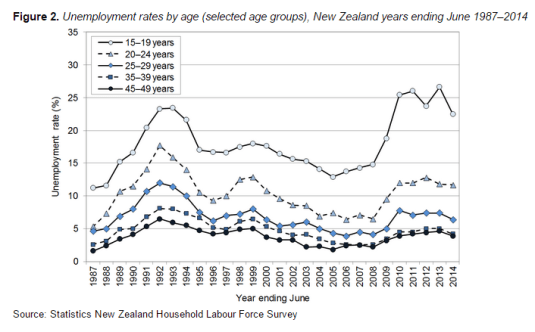
In New Zealand during June 1987–2014, unemployment rates were consistently higher for younger people aged 15–19 years than other age groups. Rates were lower for each age group, with those aged 45–49 years having the lowest). In the year ending June 2014, annual unemployment rates were 22.5% for those aged 15–19 years and to 11.7% for those aged 20–24 years – Child Poverty Monitor: Technical Report.
The time is not right, as they say, for New Zealand to increase its minimum wage rates after a sharp spike in the unemployment rates of youth and in particular of teenagers after the Global Financial Crisis.
The rising educational attainment of the poor
01 Apr 2015 Leave a comment
in economics of education, human capital, labour economics, labour supply, poverty and inequality, welfare reform Tags: educational attainment
@mattyglesias poverty trends a good example of why americanprogress.org/issues/poverty… http://t.co/tgn7RzBKzw—
Shawn Fremstad (@inclusionist) March 28, 2015
Musical life expectancy
31 Mar 2015 Leave a comment
in economics of media and culture, health economics, labour economics, Music, occupational choice Tags: compensating differentials, life expectancy


via The 27 Club is a myth: 56 is the bum note for musicians and Stairway to hell: life and death in the pop music industry..

A tale of two parents
30 Mar 2015 Leave a comment
in human capital, labour economics, labour supply, occupational choice, politics - USA, population economics, poverty and inequality, welfare reform Tags: child poverty, family demographics, family structures, single parents
Whitlam’s curse – How higher education drives inequality among the bottom 99%
30 Mar 2015 Leave a comment
in economics of education, human capital, labour economics, labour supply, occupational choice, politics - Australia, politics - USA Tags: David Autor, education premium, Gough Whitlam, top 1%
Gough Whitlam abolished tuition fees at Australian universities in 1972. The idea was to reduce inequality. He entrenched it instead, and gave a flying start to those of already above-average talents.
David Autor in a recent paper has illustrated how the gap between the highly educated and the less educated is growing at a far faster rate than the gap between the top 1% in the bottom 99% in the USA. David Autor argues that
a single minded focus on the top 1% can be counterproductive given that the changes to the other 99% have been more economically significant.

- since the early 1980s, the earnings gap between workers with a high school degree and those with a college education has become four times greater than the shift in income during the same period to the very top from the 99%.
- Between 1979 and 2012, the gap in median annual earnings between households of high-school educated workers and households with college-educated ones expanded from $30,298 to $58,249, or by roughly $28,000.
- If the incomes of the bottom 99% are grown at the same pace as the top 1% their incomes would have increased by $7000 per household.
Autor argues that the growth of skill differentials among the other 99% is more consequential than the rise of the 1% for the welfare of most citizens.

via How Education Drives Inequality Among the 99% – Real Time Economics – WSJ.
How Obamacare affected employment
30 Mar 2015 Leave a comment
in applied price theory, health economics, job search and matching, labour economics, labour supply, macroeconomics Tags: Obamacare

Five years later, how has the #ACA affected U.S. employment? brook.gs/1OtYpvy http://t.co/yrN5aWP4Ns—
Brookings (@BrookingsInst) March 28, 2015
Guess Who Cares For Young Adults When They Move Back Home | FiveThirtyEight
30 Mar 2015 Leave a comment
in discrimination, gender, labour economics Tags: household production

Did poverty increase after the 1996 US Federal welfare reforms?
29 Mar 2015 Leave a comment
in discrimination, labour economics, politics - USA, poverty and inequality, welfare reform Tags: 1996 US welfare reforms, child poverty, poverty and inequality

The downtrodden low paid workers are experiencing the fastest wages growth
29 Mar 2015 Leave a comment





Recent Comments