
Adjusting for transfers and taxes reduces income inequality between highest and lowest quintiles by 50% » AEI
02 Dec 2014 Leave a comment
in applied welfare economics, labour economics, poverty and inequality, welfare reform Tags: poverty and inequlaity
Some economics of zero-hours contracts – part 3: the fixed costs of working
02 Dec 2014 Leave a comment
in applied price theory, labour economics, labour supply, managerial economics, Marxist economics, organisational economics, personnel economics, politics - New Zealand, unions Tags: fixed cost of employment, fixed costs of working, inherent inequality of bargaining power between workers and employers, reserve army of the unemployed, The pretence to knowledge, zero hours contracts
The Unite Union, which represents about 7000 workers across New Zealand, has announced a campaign against zero-hours contracts. Zero-hours contracts have no specified hours or times of work so a worker could end up working 40 hours one week and none the next.
Unite national director Mike Treen did not know of the specific numbers of such contracts, but said these contracts were particularly common in the fast food industry, although they also appeared in some other industries.
Unite Union’s national director said that zero hours contracts made workers vulnerable to abuse as they became too nervous to speak out, for fear of having their hours reduced.
There’s no security and it puts enormous power in the hands of managers. People are extremely reluctant to assert their rights for simple things like breaks…
Treen admitted that zero-hours contracts gave employers flexibility, but pretended to know that the amount of flexibility employers actually needed was often exaggerated.
It’s not like they have huge swings or anything. They know how much they are going to sell on any particular day of the week during the year… We don’t expect everybody to have guaranteed hours but 80 per cent of the crew should be able to have it.
Treen said the union was not planning to push for a law change at this stage and would focus on addressing the issue during negotiations with fast food companies early next year.
The new leader of the opposition has promised to outlaw these zero our contracts when he gets into government. I wish him well in drafting a law that outlaws zero-hours contracts without outlawing some part-time and casual jobs as well.
Zero-hours contracts and the class war
As is to be expected, the Guardian is rather hot and bothered about zero hours contracts. One of its columnists referred to those on zero-hours contracts as the new reserve army of the unemployed:
It is a pity Karl Marx was not around last week to comment on the news that 90% of the workers at Sports Direct are on zero-hours contracts.
The author of the Communist Manifesto would also have had plenty to say about the news that the official estimates of those working in this form of casualised labour had shot up by 25%…
It is safe to say Marx would have cavilled with those who see zero-hour contracts as an expression of Britain’s economic strength, a demonstration of flexible labour markets in action.
He would have thought "reserve army of labour" a better description of conditions in which workers were expected to be permanently on call for an employer.
The Guardian went on to admit that the reserve army of unemployed are not as discontented as they should be:
It’s only fair to say that some employees are content to be on zero-hours contracts.
Some students, for example, want to combine work with study and are willing to turn up when summoned. That’s also true of older workers topping up their pensions with a bit of irregular, part-time work.
Despite this, the class war continues as does the immiseration of the proletariat and the long-term decline in profits that will lead to the crisis in capitalism and, with a bit of luck, the inevitable proletarian revolution:
Marx would have seen zero-hours contracts as the continuation of a long historical trend, stretching back to the mid-1960s when the profitability of western manufacturing firms started to fall.
From that moment, he would say, the search was on for measures to boost profits, and this has manifested itself in a number of ways: by direct attacks on organised labour; by the increased financialisation of the economy; by the search for cheap raw materials whatever the environmental cost; and by asset bubbles.
Accordingly, zero-hours contracts are the response to tougher conditions facing firms as a result of the financial crisis.
Reversing that trend will require more than legislation: it will mean tackling one of the root causes of that crisis: the imbalance of power in the labour market.
A more mellow writer in the Guardian brought up the imagery of the interwar depression:
Of course it is difficult for employers to match the demand to work nine to five and yet also to be served on a 24-hour basis, cheaply and effectively by someone, not them.
But there are other ways to solve this conundrum than indenturing workers or making them wait at the metaphorical factory gate for a tap on the shoulder.
The fixed costs of working
I will start my third blog on the economics of zero-hours by reviewing the economic literature on the fixed costs of working. Helpfully, this literature predicts that zero hours contracts really shouldn’t exist much at all.
The literature on the economics of the fixed costs of work arose out of the economics of retirement and the economics of the labour supply of married women, and in particular of young mothers. This literature was attempting to explain why older workers, or young mothers either worked a minimum number of hours, or not at all.
Fixed costs of working constrain the choices that older employees make about how many hours and days that are worthwhile working part-time. For employees, the fixed costs of going to work limit the numbers of days and number of hours per day that a worker is willing to work part-time. The timing costs of working at scheduled times and a fixed number of days per week can make working fewer full-time days, rather than fewer hours per day less disruptive to the leisure and other uses of personal time.
The fixed costs of working induced older workers to retire completely, and young mothers to withdraw from the workforce for extended periods of time, unless these workers worked either full-time or enough hours part-time each day and through the week to justify the costs of commuting and otherwise disrupting their day and week.
In the case of older workers, there were the fixed costs of commuting and other disruptions to their day. In the case of mothers, there are additional fixed costs of working arising from child care and the commuting and other rather rigid time commitments of picking up and dropping off younger children at school and to day care centres.
The fixed costs of going to work
There is a minimum number of hours of work that will be supplied by different workers that is set by the fixed costs of working. These fixed costs of work arise from commuting time and from dressing and other tasks involved in preparing for the trip to work. These costs are fixed because they do not vary with the number of hours to be worked per day and the amount of effort to be exerted while working (Cogan 1981; Hamermesh and Donald 2007).
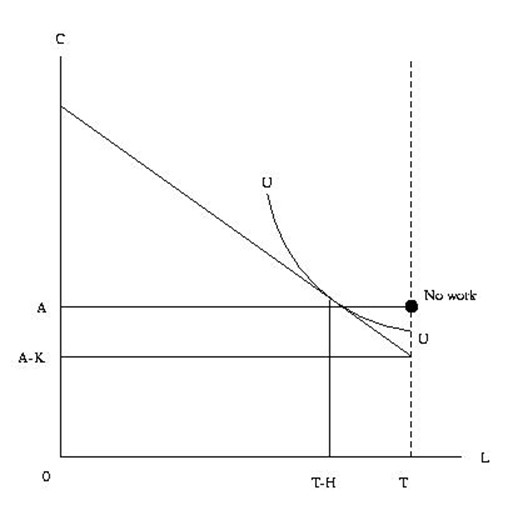
A worker will not accept a job offer or continue in a particular job unless they work sufficient hours so that these fixed costs of going to work are recovered along with receiving sufficient reward for giving up pursuing other job openings open now and in the future and for forgoing leisure and the option of making other uses of their time (Cogan 1981; Hamermesh and Donald 2007).
Cogan (1981) estimated that the average fixed time and money costs of married women entering the workforce was 28 per cent of their earnings, and also estimated that the minimum number of hours a married woman was willing to supply in the labour market was 1,300 hours per year.
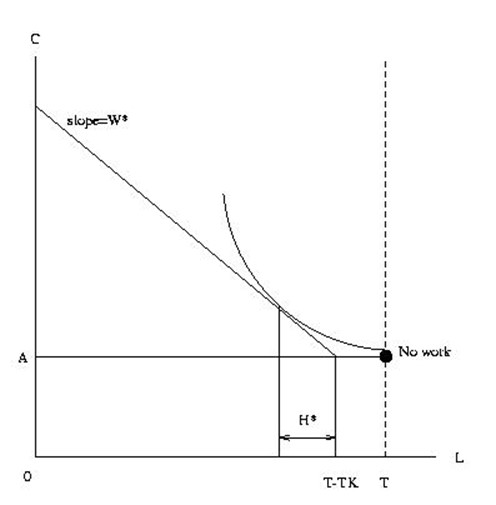
There may be a preference for fewer working days over fewer hours per day to reduce the time and money costs of going to work. Donald and Hamermesh (2009) estimated that fixed costs of going to work are equal to about 8 per cent of income. The fixed costs of working provide an incentive to workers to bunch activities.
The fixed timing costs of labour market entry
A surprisingly large part of the fixed costs of working comes from disruption in the ability to use spare time effectively (Donald and Hamermesh 2009, 2007). Entering or remaining in the workforce for any time at all significantly affects the effective allocation and enjoyment of time outside of working hours. This disruption to the effective use of the time that is left outside of working hours is the fixed timing cost of labour market entry.
One way to reduce this disruption from entering the labour force at all is to seek to reduce the number of days worked per week rather than the number of hours per day.
Leisure and other private uses of time are displaced if the individual takes or stays in even a small part-time job. Workers must use their reduced amount of remaining free time to catch-up on tasks, often at the weekend that they could have done if they were not working.
Leisure time may be the first to go because many personal tasks can be rescheduled but must be done eventually. These range from cooking, eating, and cleaning to personal upkeep, sleep and rest. Tasks must be hurried or done to a lower quality (Donald and Hamermesh 2009).
Routine – having the same schedule from day to day – saves time (Hamermesh 2005). Routine enables people to economise on the set-up costs of consumption, leisure and going to work.
Entering the work-force for any time at all to work even a small number of hours per day or per week calls for new daily and weekly routines and disrupts many existing routines that make better use of leisure, family and other uses of time (Hamermesh 2005).
Entering the workforce constrains the unfettered use of spare time. Working increases the fixed costs of coordinating family and leisure times. Workers must surround working times with buffers to ensure they are not late for work.
One reality of rising incomes is time become more valuable. A rise in wages raises the value of time because time is a finite and irreplaceable resource. Time cannot be stored or bought and sold but people can try and make better use of it.
With only 24 hours still in every day, the cost of time-intensive activities including working will rise as incomes increase. People shift away from time intensive activities and buy more of those products that are time saving or which are less time intensive to consume. Time is money and this maxim applies with greater resonance as incomes and wealth increase.
Another important fixed time costs of labour market entry is its impact on the efficiency of the remaining time devoted to leisure, household production and other activities when even a small amount of market work is undertaken. Spare time is of much less value if part of every day is to be spent at work.
Fixed timing costs arise because of a need to hurry to get to work on time and forego other activities to be rested for work the next morning. The requirement to attend work blocks out certain days from major other uses of that day and reduces the time available in any day of part-day work for leisure, family time and household production.
Household production refers to the goods and services made at home which could be purchased in the market from a third-party. These include food preparation, cooking, carer obligations, and household cleaning. There are also various other household tasks that must perform for one-self which are essentially personal maintenance and leisure.
Working even a few hours can reduce the worker’s efficiency in household production and other non-market activities and may require the worker to buy goods and services that were previously produced at home. This reduces the net financial rewards of working. Fewer full days of work, rather than fewer hours per day is less disruptive to leisure and the other uses of personal time.
The fixed time costs of market work might induce workers to engage in different mixes of other activities. The additional hours of work during the week affect the allocation of time on a non-working weekend day. They reduce leisure time on weekends and increase weekend time devoted to household production by those who do market work on week days. Workers catch up at the weekend on the household production that the rigidities of their market work prevented them from doing during the week.
Stress is an important fixed cost of working. Workers spend non-market time worrying or thinking about work-problems. Even a few hours of market work will place a worker at risk of some stress.
Floors and ceilings on the structure of the working week
The fixed costs of going to work and the fixed time cost of labour market entry both place constraints on the willingness of workers to accept a job offer involving a zero-hours contract. These contracts must offer something extra over competing job options.
The employer must offer something extra to prospective recruits to induce them to sign a zero-hours contract. There must be something substantial to overcome both the fixed costs of work, such as commuting, and the less obvious but still substantial fixed costs of labour market entry.
Any commitment to work, such as working on a zero hours contract, carries with it significant costs in terms of disruption to the rest of the day, the rest of the working week and the amount of the weekend that is spent on leisure versus resting from work and catching up on tasks that otherwise could have been done during the week but for work commitments.
A zero-hours contract must pay enough over the expected life time of the job to make up for the costs of going to work as well as the disruption and loss of leisure time and also the pure disutility of working before the worker breaks even on working.
As the Unite Union official noted, zero hours contracts appear to be most prevalent in the fast food sector. Job turnover rates in the sector can be several hundred per cent per year.
Many of the workers in the fast food sector, as the Unite union official himself noted, are young. Teenagers and young workers changed jobs frequently, particularly those who are studying part-time or full-time work, injuring the summer.
As such, zero-hours contracts in any particular job will have a short expected life over which the teenager or young worker would have to recoup for the fixed cost of working and the fixed cost of any labour market entry. Employers would have to offer some sort of premium or other implicit guarantee of regular work to induce prospective young recruits to sign a zero hours contract.
The type of workers who will profit from signing a zero hours contracts of those workers with few other demands on their time and flexible days. The workers who might find zero hours contract appealing will be those who do have much routine in their day. Workers who have a considerable amount of routine in their day such as because of family commitments will not find the wage offers in zero hours contracts appealing.
There will be job sorting: workers who have low fixed costs of working and low fixed costs of labour market entry will be attracted to zero-hours contracts.
Employers profit from offering zero hours contracts to workers who don’t want to make a regular commitment to come into work every day. Teenagers and students fall into this category, which makes it less surprising that zero hours contracts appear to be most common in the fast food sector.
There are mutual gains in the fast food sector to both employers and workers from zero hours contracts when there are peaks and troughs in product demand, and some teenagers and young workers have a low cost of coming into work at short notice.
Second law of supply and demand alert: There is no such thing as a skills shortage – updated
01 Dec 2014 Leave a comment
in applied price theory, labour economics, unemployment Tags: Alfred Marshall, Armen Alchian, comparative statics, labour market shortages, search and matching, second law of demand, second law of supply, skill shortages, unemployment
Could you define both a severe skills shortage and a skills shortage?
- How do these concepts differ from concepts such as rising demand, rapidly rising demand, and reduced and sharply reduced supply?
- Are the phrases severe skills shortage and a skills shortage more precise than the phrases rising demand, rapidly rising demand, and reduced and sharply reduced supply?
- Are the phrases severe skill shortage and a skill shortage more informative than referring to the short and long run elasticity of demand and supply as summed up in the second laws of demand and supply?
- Why are rising demand, rapidly rising demand, and reduced and sharply reduced supply considered to be social problems. What causes rising demand, rapidly rising demand, and reduced and sharply reduced supply?
- For whom are rising demand, rapidly rising demand, and reduced and sharply reduced supply considered to be problems? Employers? Employees? Others?
- Should governments intervene to stop employers from competing to set wages to reflect increases in the marginal revenue product of labour?
- Is not the purpose of short and long-term upward changes in relative prices or wages to induce people to buy less of a now scarcer resource and search for substitutes and additional sources of supply, and for new suppliers to enter the market in response to the higher prices or wages?
As a starter, I thought I would update Alchian and Arrow’s timeless 1958 analysis for the Rand Corporation of the purported shortage of engineers and scientists at the height of the missile gap in the cold war.
Alchian and Arrow tested the robustness of claims of a labour market shortage of scientists and engineers by investigating the sudden appearance of a servant shortage during World War II.
I will update this idea of a servant shortage to a purported shortage of nannies, as shown in figure 1 below which sets out the initial equilibrium and then an increase in demand.
Figure 1: the demand and supply for nannies by the old rich and power couples
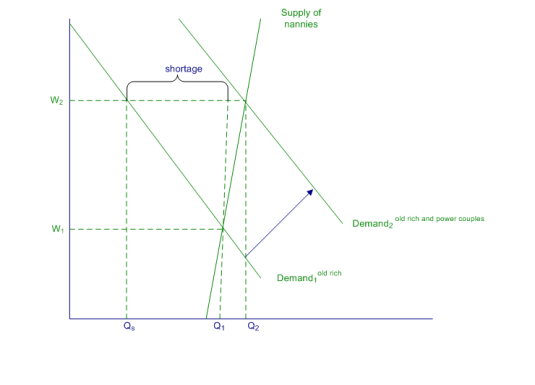
In the diagram above, the initial equilibrium has the old rich hiring Q1 nannies at a wage W1 with demand curve D1, and the supply curve for nannies.
- Power couples then enter the nannies market pushing total demand out to D2 with wages increasing to W2 and quantity supplied increasing a little to Q2;
- The old rich can now afforded to buy only Qs in nannies and power couples hire (Q2 – Qs) in nannies.
By construction, the quantity of nannies supplied increases slightly in the short-run, with a large increase in wages for nannies! (Q2 – Q1) new nannies enter the market, lured in by the higher wages.
The old rich now face a shortage of nannies equal to the quantity (Q1 – Qs). These nannies having switched to work for power couples on much better pay. (In the case of the original analysis Alchian and Arrow analysis, they switched into defence work or backfilled jobs of those that moved into defence work).
As with the wartime servant shortage, the old rich are unwilling to admit they are no longer able to keep themselves in the style they were accustomed too because the demand for domestic labour has increased.
Better to blame their loss of social status on a skills shortage in a poorly functioning market rather than accept the rise of middle class power couples outbidding them in the hire of domestic help. As Alchian and Arrow (1958, pp. 39-40) explain:
… Many people who formerly consumed some of the commodity or service in question and now find the price so high that they no longer want as much (or any) would describe the situation is one of “shortage”.
Actually, this is merely one way of saying that they can’t get the given commodity at its old price.
We can think of many examples of this use of the word “shortage”. For example, the “servant shortage” during World War II was a case in point.
Those with whom the increase in household servants wages were more than they could afford to pay, apparently found it more convenient to describe their change in circumstances as a result of a “shortage” than to admit baldly that they couldn’t afford to keep the servants…
It seems reasonable to explain a good deal of the current complaint about a shortage of scientists and engineers is a variant of the “servant shortage” phenomena.
Employers who find themselves losing engineers to other firms and at the same time find it uneconomic to try and keep these employees by offering them substantial salary increases may see the situation as a “shortage” rather than recognise that other firms can put these skills to more valuable uses…
While we lack specific evidence, we have the impression that the firms who have complained most consistently about “shortage” have been those whose demand has not increased or at least not increased as rapidly as that of other firms in their industry.
Why are people priced out of any market? Given a fixed income and the many other alternative uses of their incomes, any rise in price makes buying the old quantity no longer the best bargain.
Who will admit that they can no longer keep themselves in the style they were accustomed to when they complain of market failure, skill shortages and lack of government investment in skill formation.
Alfred Marshall’s comparative statics of price adjustment
The analysis of the time path of price adjustment for any commodity was developed by Alfred Marshall in 1890. He was concerned that time was an important factor in how the markets adjusted to demand and supply changes:
… markets vary with regard to the period of time which is allowed to the forces of demand and supply to bring themselves into equilibrium with one another, as well as with regard to the area over which they extend. And this element of Time requires more careful attention just now than does that of Space.
For the nature of the equilibrium itself, and that of the causes by which it is determined, depend on the length of the period over which the market is taken to extend.
We shall find that if the period is short, the supply is limited to the stores which happen to be at hand: if the period is longer, the supply will be influenced, more or less, by the cost of producing the commodity in question; and if the period is very long, this cost will in its turn be influenced, more or less, by the cost of producing the labour and the material things required for producing the commodity.
Marshall divided the price adjustment process into the market period, the short run, and the long run.
In the market period, production is fixed; and all factors of production are fixed in supply during this time period. The burden of price adjustment is on the demand side.

As the supply is fixed in the market period, it is shown as a vertical line SMP. It is also called as inelastic supply curve. When demand increases from DD to D1 D1, price increases from P to P1. Similarly, a fall in demand from DD to D2 D2 pull the price down from P to P2.
In the short run, supply to be partially adaptable, in the sense that increased production can occur but capital equipment and certain other overhead items are held constant.

SSP is elastic implying that supply can be increased by changing a variable input. Note that the corresponding increase in price from P to P1 for a given increase in demand from D to D1 is less than in the market period. It is because the increase in demand is partially met by the increase in supply from q to q1.
The short run is the conceptual time period in which at least one factor of production is fixed in amount and others are variable in amount. In the short run, a profit-maximising firm will:
- increase production if marginal cost is less than marginal revenue;
- decrease production if marginal cost is greater than marginal revenue;
- continue producing if average variable cost is less than price per unit, even if average total cost is greater than price;
- Shut-down if average variable cost is greater than price at each level of output.
In the long run, supply is fully flexible – there are no fixed factors of production. The Marshallian long-run allows for optimal capital stock adjustment.

The long period supply curve SLP is more elastic and flatter than that of the SSP. This implies the greater extent of flexibility of the firms to change the supply.
The price increases from P to P2 in response to an increase in demand from D to D1 and it is less than that of the market period (P1) and short period (P2). It is because the increase in demand is fully met by the required increase in supply. Hence, supply plays a significant role in determining the lower equilibrium price in the long run.
The market is cleared in the long run within a framework in which supply can be considered to be fully adaptable because all factors have adjusted to the new situation. Alfred Marshall explains:
In long periods on the other hand all investments of capital and effort in providing the material plant and the organization of a business, and in acquiring trade knowledge and specialized ability, have time to be adjusted to the incomes which are expected to be earned by them: and the estimates of those incomes therefore directly govern supply, and are the true long-period normal supply price of the commodities produced.
In addition, in the market period, the short run, and the long run, foresight is not perfect, information is not free, and the cost of adjusting something is not independent of the speed in which you wish to do so.
The 2nd laws of supply and of demand
Another way to discuss how time interacts with responsiveness of supply and demand are the second laws of supply and demand.
The Second Law of Supply states that supply is more responsive to price in the long run. The Second Law of Supply relates to how flexible producers are in terms of how much of a good they produce.
Supply is more elastic in the long run because given more time, producers can more easily adapt to the change in the price.
Within shorter periods of time, producers cannot as easily change the amount of a good they produce (since changes in production often require adjustments within factories, with workers etc.)
The Second Law of Demand states that demand is more responsive to price in the long run than in the short run. Initially, when the price of a good increases or decreases, consumption does not change drastically. However, when consumers are given more time to react to the change in price, consumption can either increase or decrease more dramatically. Demand is not only determined by price but also factors such as: income, tastes, and the price of related goods.
In the market period, any adjustment must be made through changes in price. This means that there could be initially a large price increase.
In the short run, there are some capability for more supply to come forward. This additional supply will temper the initial large price increase.
In the long run, producers are fully able to adapt their circumstances to the changing market conditions and higher prices. This will reduce prices as compared to the initial price spike when market conditions first changed.
In the long run, new firms can enter the industry and old firms can exit as required by the price change and their entrepreneurial expectations of the future of the industry.
Search and matching in a decentralised labour market
To cover off the bases, the simultaneous existence of vacancies and unemployed in a labour market is no evidence of either of surplus or shortage. It takes time for workers to locate vacancies and assess their competing job options. It takes time for employers to locate suitable workers to fill vacancies.
The simultaneous existence of vacancies and unemployed is the result of, as mentioned earlier, imperfect foresight, the fact that information is not free, nor freely available, and the costs of doing anything is not independent of the speed in which you wish to act. Searching for suitable vacancies, or suitable employees, is costly, and neither jobseeker nor employer knows whether any match will work out.
The one-price (one-wage) market that clears instantly will occur only where the cost of information about the prices (wages) offered by buyers and sellers is zero. As George Stigler observed in the opening paragraph of his famous 1961 paper The Economics of Information:
One should hardly have to tell academicians that information is a valuable resource: knowledge is power. And yet it occupies a slum dwelling in the town of economics.
Mostly it is ignored: the best technology is assumed to be known, the relationship of commodities to consumer preferences is a datum.
And one of the information producing industries, advertising, is treated with a hostility that economists normally reserve for tariffs or monopolists.
Job search cost are of two types: direct costs of gathering information about competing opportunities and the opportunity cost of being unemployed or staying in your current job at your current pay.
- The benefit from job search is the expected gain in earnings that will result from waiting for a better wage offer.
- The rational job searcher searches for better offers until the marginal benefit and cost of additional search are equal.
- A significant cost of continued job search is the earnings foregone by not taking the previous best opportunity.
Unemployment can be a cost-effective method of searching for better employment opportunities and higher wage offers as David Andolfatto observed:
One frequently reads that “unemployment represents wasted resources.”
But if job search is an information-gathering activity, designed to locate a high quality job match, in what sense does such an activity necessarily constitute wasted resources? (Does the existence of single people in the marriage market also represent wasted resources?)
If the unemployment rate were to suddenly plummet because a large number of workers aborted their job search activity–accepting crappy jobs, or exiting the labour force–is this a reason to celebrate?
The behavioural responses of employers and workers to change are so pronounced because the cost of acquiring new information is profound (Alchian 1969). Many such costs impede wages from instantly fluctuating to rebalance labour supply with demand. Hicks (1932) explained this uncertainty and state of flux as follows:
For although the industry as a whole is stationary, some firms in it will be closing down or contracting their sphere of operations, others will be arising or expanding to take their place.
Some firms then will be dismissing, others taking on, labour; and when they are not situated close together, so that knowledge of opportunities is imperfect, and transference is attended by all the difficulties of finding housing accommodation, and the uprooting and transplanting of social ties, it is not surprising that an interval of time elapses between dismissal and re-engagement, during which the workman is unemployed.
A job seeker does not initially know the location of suitable vacancies, the wages for various skills, differences in job security and other factors. Job seekers must search for this information, keep this knowledge current and forecast whether better vacancies may open soon. Employers must search to learn the location, availability and asking wages of applicants. There is a tendency for unpredicted wage changes to induce costly additional job search. Long-term contracts arise to share risks and curb opportunism over sunken investments in relationship-specific human and organisation capital. These factors all lead to queues, unemployment, spare capacity, layoffs, shortages, inventories and non-price rationing in conjunction with wage stability (Alchian 1969; Alchian and Allen 1967, 1973; Klein 1984; Hashimoto and Yu 1980; Hall and Lazear 1979).
By acquiring more information, a job seeker learns more about their options and can improve their prospects of finding better-paid job matches. Job seekers and employers invest time and resources to find one another, size each other up and form a job match or try their luck elsewhere. A job match is a pairing of a worker with a particular employer.
Job seekers will apply for a portfolio of job vacancies that reflect their asking wage and their known alternatives. An asking wage is the minimum that a job seeker is willing to accept given their options.
- The extent of job search depends on the costs of job-information production and acquisition, the income available to job seekers while searching, the frequency and the magnitude of shifts in the relative demand between different sectors, the costs of relocation and retraining, and the extent and frequency of declines in aggregate demand (Alchian and Allen 1967).
- The more varied will be the potential job opportunities and the greater will be the gains to job seekers from continued job search, the greater are the rate of change in tastes and demand, the greater are the differences in the skills of job seekers and the requirements of job vacancies, and the greater are the costs of moving (Alchian and Allen 1967).
Employers face an information dilemma as well. If they wait a bit longer, hold a job vacancy open, a better job applicant may come a long and a more profitable and longer lasting job match may result.
Of course, the employer is taking a chance here on the job applicant pool improving with time. There are elements of luck involved for both employers and job seekers when filling vacancies and finding jobs.
The employer must balance the costs of holding the vacancy open with his estimation of the value and probability of a better applicant applying at a later date if he searches further the prospective recruits. But reducing your ignorance has costs as Stigler (1961) explained:
Ignorance is like sub-zero weather: by a significant expenditure its effects upon people can be kept within tolerable or even comfortable bounds, but it would be wholly uneconomical entirely to eliminate all its effects.
The rate at which job vacancies are filled and the rate at which people leave unemployment and change jobs is determined by the job search decisions of job seekers and the recruitment decisions of employers. The way in which the process works is well explained by Andolfatto’s analogy to the marriage market:
In many ways, the labour market resembles a matching market for couples.
That is, one is generally aware that the opposite side of the market consists of better and worse matches (we seldom take the view that there are no potential matches).
The exact location of the better matches is unknown, but may be discovered with some effort.
In the meantime, it may make sense to refrain from matching with ‘substandard’ opportunities that are currently available.
But since search is costly, it will generally not be optimal to wait for ones “soul mate” to come along. Furthermore, since relationships are not perfectly durable, there is no reason to expect the stock of singles to converge to zero over time
As in the labour market, there are marriages and divorces and young people come of age and look for the first time; people also link up for short-term relationships; and some relationships do better than others.
To say there is involuntary unemployment is to say there is also involuntarily unmarried people. But we can always marry the first person we meet in the street, if they’ll have us. Search and matching is a two sided affair. I doubt that our first encounter in the street would accept this offer of marriage from a stranger. I doubt that anyone would want to marry a stranger who would so willingly marry a stranger. I think both sides suspect that such a random pairing would not last long because the pairing occurred after so little mutual scrutiny and measured assessment of alternatives, current and prospective. The same principles apply to search and matching in the labour market.
I told you so – The Psychology Behind Messy Rooms: Why The Most Creative People Flourish In Clutter
01 Dec 2014 1 Comment
in human capital, labour economics Tags: age of human capital, human capital
Did which of the Great Enrichment and OSHA make the workplace safer?
01 Dec 2014 Leave a comment
in economics of regulation, entrepreneurship, health and safety, labour economics Tags: health and safety, labour economics, The Great Enrichment

Original source of graph: Viscusi, W. Kip, John M. Vernon, and Joseph E. Harrington, Jr. Economics of Regulation and Antitrust. 2nd ed. Lexington, MA: D.C. Heath and Company, 1992, page 714.
HT: Art Diamond
Lindsay Mitchell – Labour’s Carmel Sepuloni: be careful what you ask for
01 Dec 2014 Leave a comment
in applied welfare economics, labour economics, labour supply, minimum wage, politics - New Zealand, poverty and inequality, welfare reform Tags: Carmel Sepuloni, inequality and poverty, James Heckman, James Julius Wilson, labour economics, Roland Fryer, welfare reform

Lindsay Mitchell has a nice blog today on the views of the new Labour Party spokesman on social development – the New Zealand ministerial portfolio covering social security and social welfare
Carmen Sepuloni disagrees with National Party’s policy of requiring solo mothers to look for work. She believed there should be support for sole parents to return to work, but not a strict compulsion:
It is a case by case basis. I don’t think it should be so stringent because it’s not necessarily to the benefit of their children.
The American sociologist James Julius Wilson in The Truly Disadvantaged (1987) and When Work Disappears (1996) wrote about how more children are growing-up without a working father living in the home and thereby gleaning the awareness that work is a central expectation of adult life:
. . . where jobs are scarce, where people rarely, if ever, have the opportunity to help their friends and neighbors find jobs. . . many people eventually lose their feeling of connectedness to work in the formal economy; they no longer expect work to be a regular, and regulating, force in their lives.
In the case of young people, they may grow up in an environment that lacks the idea of work as a central experience of adult life — they have little or no labor force attachment.
Carmel Sepuloni appears to believe that work is not a central expectation of adult life. Hard work used to be a core value of the Labour Party.
The toughest week of door knocking for the Labour Party in the 2011 general elections was after the Party promised that the in-work family tax credit should also be paid to welfare beneficiaries.
Voters in strong Labour Party areas were repulsed by the idea. These working-class Labour voters thought that the in-work family tax credit was for those that worked because they had earnt it through working on a regular basis. The party vote of the Labour Party in the 2011 New Zealand general election fell to its lowest level since its foundation in 1919 which was the year where it first contested an election.
When Sepuloni was on the Backbenchers TV show prior to the recent NZ general election, she was asked by the host whether she would support a $40 per hour minimum wage if that would mean equality. She did not hesitate to say yes.
Sepuloni does not seem to have noticed that wages must have something to do with the value of what you produce and the ability of your employer to sell it at a price that covers costs.
The economic literatures (Heckman 2011; Fryer 201o) and sociological literatures (Wilson 1978, 1987, 2009, 2011), particularly in the U.S. is suggesting that skill disparities resulting from a lower quality education and less access to good parenting, peer and neighbourhood environments produce most of the income gaps of racial and ethnic minorities rather than factors such as labour market discrimination.
Grounds for optimism about the effectiveness of welfare reform in overcoming barriers to employment lie in the success of the 1996 federal welfare reforms in the USA.
The subsequent declines in welfare participation rates and gains in employment were largest among the single mothers previously thought to be most disadvantaged: young (ages 18-29), mothers with children aged under seven, high school drop-outs, and black and Hispanic mothers. These low-skilled single mothers who were thought to face the greatest barriers to employment. Blank (2002) found that:
At the same time as major changes in program structure occurred during the 1990s, there were also stunning changes in behavior. Strong adjectives are appropriate to describe these behavioral changes.
Nobody of any political persuasion-predicted or would have believed possible the magnitude
of change that occurred in the behavior of low-income single-parent families over this decade.
People have repeatedly shown great ability to adapt and find jobs when the rewards of working increase and eligibility for welfare benefits tighten.
via Lindsay Mitchell: Carmel Sepuloni: be careful what you ask for.

Milton Friedman on Welfare
30 Nov 2014 Leave a comment
in Milton Friedman, welfare reform Tags: Milton Friedman, welfare reform
The Top Five Feminist Myths of All Time
30 Nov 2014 Leave a comment
in discrimination, gender, labour economics, liberalism Tags: feminist myths, gender wage gap
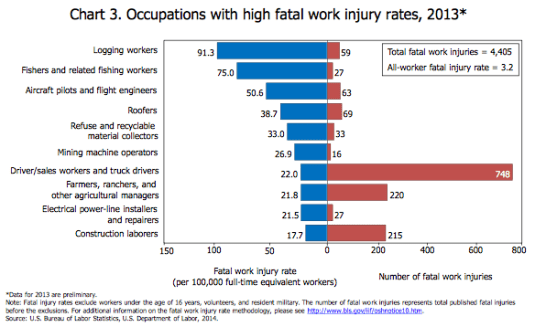
What occupations are the most dangerous?
29 Nov 2014 Leave a comment
in health and safety, labour economics, occupational choice Tags: health and safety, labour economics
Benjamin Powell, In Defense of “Sweatshops”
29 Nov 2014 1 Comment
in applied welfare economics, development economics, growth disasters, growth miracles, human capital, labour economics, labour supply, occupational regulation Tags: Ben Powell, development economics, do gooders, sweatshops

The last word on Piketty: Deirdre McCloskey, John McTernan, Chris Giles Panel
29 Nov 2014 Leave a comment
in applied price theory, applied welfare economics, poverty and inequality Tags: Deidre McCloskey, Piketty
In the good old days, everyone agreed on the employment effects of minimum wage laws, even their supporters
28 Nov 2014 Leave a comment

 g
g


Recent Comments