Is welfare dependence optimal for whom – part 3: abatement free income thresholds and labour supply

Another welfare reform is a modest income threshold below which benefits are not abated. This is low for unemployment and sickness beneficiaries and higher for domestic purposes and invalid beneficiaries.

The idea behind abatement-free income thresholds is to not penalise part-time work among sole mothers and encourage the unemployed and sick to return to full-time work.

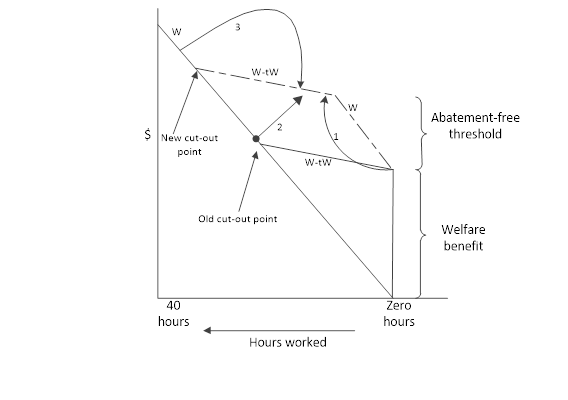
The Figure 1 shows that an increase in the benefit abatement threshold has similar ambiguous net labour supply effects to a lowering of welfare benefit abatement rates.

Figure 1: Impact of abatement thresholds on labour supply
abatement free income threshold

  • Arrow 1 in figure 1 shows that some who were not currently working will now find working part-time a more attractive option because of the introduction of a benefit abatement-free threshold. Their take-home pay is higher although they enjoy less leisure time.
  • Arrow 2 in figure 1 shows that some part-time workers will reduce their working hours because working less and claiming the benefit clearly increases both their take-home pay and allow for more leisure time.
  • Arrow 3 in figure 1 shows that workers who work a relative high number of hours per week for a relative low wage will reduce from full-time to part-time working hours because of a revised leisure-labour trade off now makes a somewhat lower take-home pay worthwhile because of increased leisure time.
  • No welfare recipients leave the welfare system but some join it because of the introduction or increase in the abatement-free income threshold.

The net labour supply effects of a higher benefit abatement-free threshold are ambiguous because the reduced hours of those already in work offsets the labour force participation of those previously not in work.

Whether net labour supply increases or decreases depends on the relative numbers of individuals at different points on the budget constraint working full-time, not working and working part-time and on the magnitudes of their responses. Some will stay as they were either working full-time, not working or working part-time.

The objective of reducing welfare dependency by encouraging part-time work by those not working has important unintended adverse consequences for the labour supply and welfare dependency of those currently working part-time and full-time on low wages.

A common result of welfare reforms that increase abatement thresholds or reduce abatement rates is that no welfare recipients leave the welfare system but some join it. Welfare dependency is not reduced by financial incentives that increase the generosity and the availability of welfare benefits.

The labour supply effects of welfare reforms that increase benefit abatement thresholds or reduce benefit abatement rates are ambiguous because the reduced working hours of existing workers offsets the hours worked by those not employed prior to the reform. A further complexity is that encouraging part-time work channels beneficiaries into low paid jobs that offer little training and other human capital benefits.

In summary, an increase in the benefit abatement-free income thresholds for welfare recipients has the following effects:

  • not all welfare recipients will respond to a higher abatement-free income threshold by supplying more labour;
  • those welfare recipients who do respond to a higher abatement-free income are better-off and supply more labour and take-home more pay;
  • the increase in labour supply is in part-time work by beneficiaries earning income up to the higher abatement-free income threshold;
  • No welfare recipient leaves the welfare system – those welfare recipients who respond to this welfare reform continue to collect their full welfare benefit and work a few more hours each week.

While reforming the welfare system is intended to change the labour market behaviour of welfare recipients, it also has unintended consequences on individuals who are not collecting welfare benefits.

An increase in the exemption level for earned income affects the labour market behaviour of someone who is not receiving welfare benefits has the following effects:

  • prior to the increase in the abatement-free threshold, the individual is best off by working part-time or full-time and not collecting welfare or even being eligible to collect welfare benefits; and
  • after an increase in the benefit abatement-free income threshold, a worker is better-off by supplying less labour and collecting a full welfare benefit, which raises their total income.

Permitting welfare recipients to keep larger amounts of income without losing any of their welfare benefits will attract more workers into the welfare system. Some workers will find that they are better-off by joining the welfare system and switch from full-time work to being a welfare recipient who works part-time (up to the new higher exemption level). The cost of the welfare programme increases, there are more welfare recipients, and no welfare recipient loses any benefits.

All welfare recipients who increase their labour supply up to the new higher exemption level (and lower abatement rates) and all workers who switch to the welfare system will be better-off.

The effect of the quantity of labour supplied is ambiguous: some old welfare recipients will increase their labour supply up to the new higher abatement-free threshold (probably by a relatively small amount) but new welfare recipients will decrease their labour supply (probably by a relatively large amount) as they move from full-time work to part-time work on welfare.

The overall effect of changes in benefit abatement regimes depends on the number of old and new welfare recipients and the size of the labour supply change for each.

  • The quality of labour supplied will deteriorate as some full-time workers switch to welfare and work part-time; part-time workers generally have less attachment to the labour force and tend to invest less in human capital to up-grade their labour market skills.
  • High-productivity workers are working fewer hours while lower-productivity workers work more hours.

If the objective is to reduce the number of people on welfare by moving some welfare recipients (those who are able to work) into work, increasing abatement free income thresholds or lowering abatement rates are not the solution. Both options increase the number of people on welfare.

A reduction in the amount of welfare benefits will reduce the number of people on welfare, reduce the cost of the welfare programme, increase the supply of labour, increase the number of full-time workers relative to part-time workers but make all current welfare recipients worse-off and risks providing inadequate income support to those who are unemployable.

The blogs so far

part-one-the-labour-leisure-trade-off-and-the-rewards-for-working

part-two-the-labour-supply-effects-of-welfare-benefit-abatement-rate-changes

part-3-abatement-free-income-thresholds-and-labour-supply

part-4-in-work-tax-credits-and-labour-supply

part-5-higher-abatement-rates-and-labour-supply

part-6-mandatory-work-requirements-and-labour-supply

part-7-the-role-of-tagging-in-welfare-benefits-system

Some economics of zero hours contracts – part 4: team production as a constraint on working time flexibility

To continue with my theme in my previous three blogs that zero hours contracts aren’t supposed to exist, a leading explanation for the hesitancy of employers to agree to part-time hours is team production (Hutchens and Grace-Martin 2004, 2006; Hutchens 2010).

Employers may want their employees to work a minimum number of working hours because of rigid production technologies and/or team production. Production technologies vary in the rigidity they impose on the hours worked by employees.

The co-ordination of working times is paramount to effective team production. Once the work time schedule is fixed for team, the worker faces a choice between working at the fixed schedule or working in another team or job.

Two common examples of teams are an assembly line and a football team. Both require a minimum number of workers with rigid starting and finishing times. The absence of a team member could reduce team productivity or safety or even stop production entirely.

When the cost of absence is higher such as for team production, there are more efforts to reduce absences. When a single employee absence is costly to employers, employers take steps to ensure that a minimum number of workers plus a reserve are present. There will be increased spending on monitoring, more cross-training, mutual monitoring by employees and the use of peer pressure. Multiple production lines reduce the risks of absence because spare staff can be hired to fill in across different teams.

Other workers can produce independently of their co-workers. One example is a member of a typing pool. The contribution of each typist depends on their efforts alone. The increment they add to production does not vary with the presence or absence of others, nor is the productivity of others affected by their output. If there is little teamwork, the absence of a worker does not affect other workers.

The Department of Labour (2009) found that about 60 per cent of New Zealand full-time employees did not have flexible hours.

A leading reason for employers hiring part-time workers is to solve scheduling problems that arise when hours of operation and peak periods of daily or weekly production do not easily divide into standard shift lengths.

For example, within the day and within the week variation in customer demand explains the heavy use of part-timers in restaurants, retails stores and many services outlets. Not surprisingly, zero hours contracts arise in industries such as the food services sector where there is already a long history of part-time work.

Different production technologies require their own levels of coordination and supervision. This complicates the use of part-timers. Scheduling problems can arise of workers arrive at different times.

A mix of full and part-time employees could increase supervision costs. There can be repetitions of instructions and different capabilities to perform the same tasks.

Two part-timers could be productive if job is repetitive and does not require much co-ordination. Again, and not surprisingly, zero hours contracts occur in industries where the jobs appear to be relatively simple and the worker can pretty much work out what to do after a little bit of training with little supervision.

A managerial employee is less likely to be allowed to be part-time because they will be absent when employees need direction (Hutchens and Grace-Martin 2004, 2006. Managerial employees have scale effects. Higher level management decisions percolate through the rest of the organisation. The interaction of talent and scale ensures that the impact of any loss of efficiency from having part-time managers compound geometrically into the efforts and productivity of those they lead. Sharing a managerial job has costs because information must be exchanged and a common agenda agreed.

The economics of team production suggests that zero hours contracts will occur in teams with peaks and ebbs in customer demand, where workers are pretty much interchangeable alone can take over with little or no instructional briefing, and the level of task dependency between workers is small.

When extra workers on zero hours contracts are brought on to deal with the spike in demand, they take over the servicing of this demand. There is little need for them to interact with existing workers. For example, in a restaurant situation, they could deal with the extra tables filled by the spike in demand. In a McDonald’s restaurant, for example, they could just take over that the till that was otherwise not in use and serve the extra queues of customers.

To summarise, unless we have a good idea about why firms are moving to zero hours contracts, which we don’t, and why employees sign these contracts rather than work for other employers who offer more regular hours of work, meddling in these still novel arrangements is pretty risky.

Is welfare dependence optimal for whom – part 2: the labour supply effects of welfare benefit abatement rate changes

Figure 1 shows that the introduction of a welfare benefit has both income and substitution effects. The welfare benefit abates at rate t so the take-home pay of workers is less than the full wage until the benefit cut out point shown by the arrow in Figure 1. After this cut-out point, no benefits are payable and the work receives a full wage of w times the hours worked.

Figure 1: the labour supply effects of the introduction of a welfare benefit

clip_image002

The income effect increases the consumption of all goods including leisure. The substitution effect increases the attractiveness of not-working relative to work because prior to the cut-out point, take-home pay is less.

· Some workers will choose to not work at all as indicated by arrow 1 in figure 1 because this makes them better off. They have more leisure time and more income.

· Other workers working at a relative low wage will work less hours than before as indicated by arrow 2 in Figure 1 because of the revised rewards of working. Working fewer hours for slightly less is a better labour-leisure trade-off for them. They earn less, but have more leisure time.

Figure 1 illustrates several of the ambiguities of welfare reform. A welfare benefit induces some workers to work fewer hours and others to stop working altogether. In addition, the abatement rate of less than 100 per cent increases the region in which workers working full-time or semi-full-time might find working less hours attractive. Some workers move from full-time work to part-time work on lower income but with more leisure time.

If the benefit abatement rate was 100 per cent, there is a larger gap between working full-time and not working at all. This large take-home pay gap makes jumps from not working to full-time work much more rewarding.

Several jurisdictions increased benefit abatement rates to 100 per cent to make full-time work more rewarding and part-time work less rewarding. Higher benefit abatement rates on earned income of welfare beneficiaries may actually increase net labour supply because fewer workers enter the benefit, more leave for full-time jobs, but fewer work part-time.

These intended and unintended consequences of welfare reform for abatement rate reforms are illustrated further in Figure 2.

Figure 2: Benefit abatement rate reductions and labour supply

clip_image004

Benefit abatement rates are reduced in Figure 2, which increases the cut-out point at which workers cease to be eligible for any welfare benefits.

· Arrow 1 shows the decision of those currently not working to start working part-time, which is a common motive for and the desired outcome behind reduced benefit abatement rates. These beneficiaries are working but are taking-home a higher income. Their labour leisure trade-off now favours more work and less leisure.

· Arrow 2 shows those currently working part-time reducing their hours because this clearly increases both their take-home pay and their leisure time.

· Arrow 3 shows the full-time workers working at a relative low wage have an incentive to reduce to part-time because this is a better labour-leisure trade-off for them. Their take-home pay is less, but they enjoy more leisure time.

The net labour supply effects of lower abatement rates are ambiguous because the reduced hours of those who are already in work offsets the labour force participation of those previously not working.

A key point to remember from this reduction in welfare abatement rates is no welfare recipients leaves the welfare system but some join the welfare rolls because of the reduction in the benefit abatement rate.

Whether labour supply on net actually increases or decreases depends on the relative numbers of individuals at different points on the budget constraint working full-time, not working and working part-time and on the magnitudes of their responses.

Some will stay as they are working full-time, not working and working part-time. Others will reduce their hours of work. The dictates of team production and co-ordinated working times may prevent this happening immediately. At the next job changes, those currently working full and part-time can take full advantage of lower benefits abatement rates as shown in Figure 2.

The objective of reducing welfare dependency and poverty by encouraging part-time work with lower benefit abatement rates has unintended consequences.

People focus on those who start working part-time as a conduit to eventual full-time work and self-sufficiency if welfare abatement rates are lowered to make part-time work more attractive.

What is forgotten is those who are currently working full-time, or part-time, who because of the increase in income from part-time work plus continued for partial benefit receipt find that part-time welfare dependency is optimal for them. They drop out of full-time work.

An additional reason for this entry of new people onto the welfare rolls is that welfare benefits come with a range of second tier benefits. In addition to housing supplements to pay the rent, there are special grants that can be applied for to pay for unexpected expenses such as medical and dental work or damaged around the house.

As alluded to previously, one of the welfare reforms introduced in the United States in the early 1980s was to increase the welfare abatement rate on earned income to 100% from 67% which it applied since the 1960s. This increase in welfare benefit abatement rates to 100% on earned income increased the gap between welfare dependency and working full time. The idea was to make full-time work a more attractive option relative to welfare benefit receipt.

The blogs so far

part-one-the-labour-leisure-trade-off-and-the-rewards-for-working

part-two-the-labour-supply-effects-of-welfare-benefit-abatement-rate-changes

part-3-abatement-free-income-thresholds-and-labour-supply

part-4-in-work-tax-credits-and-labour-supply

part-5-higher-abatement-rates-and-labour-supply

part-6-mandatory-work-requirements-and-labour-supply

part-7-the-role-of-tagging-in-welfare-benefits-system

Which countries attract the most immigrants who are graduates?

The Uber effect

image

Image

Is welfare dependence optimal for whom – part 1? The labour-leisure trade-off and the rewards for working

The higher is the welfare benefit, the greater the probability that an individual will choose to go on welfare rather than work. Welfare dependency is the most rewarding leisure-labour trade-off for them.

The higher the wage on offer to a given worker in the labour market, the greater is the probability that they will choose to work rather than go on welfare. Working is the most rewarding leisure-labour trade-off for them.

Both the income and substitution effects of welfare benefits provide a disincentive to work. Higher income levels from generous welfare benefits induce higher consumption of all normal goods, including leisure. Income taxes and a high benefit abatement rate provides little incentive to work (the substitution effect) for lower paid workers and some second earners.

When confronted with the choice of a low-paying job and a generous welfare benefit, some will choose welfare over work. These workers are responding rationally to the (dis)incentives embedded in the labour market and welfare system. For them, welfare dependency is optimal.

This is particularly true for single parents with low labour market skills. One or more children may generate more net income (from increased welfare benefits) than working in the labour market and paying child care. If there is no expiry date for these welfare benefits, some individuals who go on welfare will stay on welfare for a long period of time.

Of course, the economics of crime comes up. A condition of receipt of welfare benefits in just about every welfare state is healthy adults must make themselves available for work and actively look for work.

Most of the essentials of the impact of welfare reform on labour-leisure trade-offs are captured, and most policy dilemmas are clearly defined within the framework in Figure 1. Figure 1 illustrates the position of two workers regarding whether to work (the participation decision) and how many hours to work.

Figure 1: The basic leisure-labour trade-off

The hourly wage rate represented by the symbol W in Figure 1 is traded-off against working fewer or no hours. This additional of leisure time includes: pure leisure; household production such as child care, cooking and cleaning; education and other human capital investments; and personal time such as self-care and sleep.

  • Worker 1 in Figure 1 works 40 hours while worker 2 with different circumstances works part-time in Figure 1.
  • Worker 1 could be a male with no dependents so not working full-time has a relatively high opportunity cost even if low paid.
  • Women who higher qualifications are also more likely to be persistent workers alternating between full-time career and part-time work when there are child care responsibilities.
  • Worker 2 in Figure 1 could be a sole parent or a second earner in a married couple with young children. For these workers, working can have a high opportunity cost because of the cost of child care, especially if the sole parent or second earner is low paid.
  • For workers with a high opportunity cost of work and low wages from working, for them, welfare dependents can be quite optimal.
  • Not so for society because the welfare benefits conditional on people making themselves available for work and taking steps to find it and stay in work.

The next few blogs will explain how various welfare reforms change the labour leisure trade-off for welfare recipients. There are three main parameters in any welfare system:

  1. the amount of the welfare benefit,
  2. the threshold for the benefit abatement on earned income, and
  3. the benefit reduction rate for income exceeding the abetement-free threshold.

This is not to ignore work testing and work requirements, these complications are postponed to later blogs. All of these parameters and the implications of changing them on labour supply will be discussed in future blogs.

The blogs so far

is-welfare-dependants-optimal-for-whom-part-one-the-labour-leisure-trade-off-and-the-rewards-for-working

is-welfare-dependence-optimal-for-whom-part-two-the-labour-supply-effects-of-welfare-benefit-abatement-rate-changes

is-welfare-dependency-optimal-for-whom-part-3-abatement-free-income-thresholds-and-labour-supply

is-welfare-dependents-optimal-for-the-whom-part-4-in-work-tax-credits-and-labour-supply

is-welfare-dependence-optimal-for-whom-part-5-higher-abatement-rates-and-labour-supply

is-welfare-dependence-optimal-for-whom-part-6-mandatory-work-requirements-and-labour-supply

is-welfare-dependence-optimal-for-whom-part-7-the-role-of-tagging-in-welfare-benefits-system

Claudia Goldin and the power of the pill

Claudia Goldin has documented well that the availability of reliable contraception in the late 1960s led to an explosion in female investment in higher education, and in particular, long duration professional educations.

Although rapidly disseminated among married women once it came on the market in 1960, the pill at first was almost inaccessible to single females, due to the prevailing state laws on prescriptions of drugs.

Liberalisation of availability for single females was on a state-by-state basis and was staggered over a few years. This allowed Claudia Goldin to study what happened to investment in professional education by young women in each of those states as they reformed their laws on the dispensing of contraception to single females.

As contraception was made lawful for single women on a state-by-state basis in the USA in the late 60s and 1970s, young women started investing in long duration professional educations at an explosive rate. They stayed in high school the longer, more young women went on to college, and more of these college female students majored in long duration professional degrees.

In the 1960s, it was common to get engaged and even marry while at college in the USA. As Claudia Goldin, and her co-author Larry Katz explain:

It was a stark choice, you could be celibate, get your career started, and potentially face a very thin marriage market once you were done.

Or, you could have fun, get married earlier, and not necessarily have a career.

The availability of the pill allowed  college-age women to have certainty in their career investments and therefore the payoff of investing in professional educations was much greater.

Participation Rates Women

By decoupling sex for marriage, women could afford to defer marriage and shop around looking for better partners. Postponing marriage for at least a few years didn’t mean all the “good guys” would be taken. In addition, with higher career incomes for female college graduates, as Goldin explained:

You might think of it as the decline of the trophy wife, as women with careers who might not be as intrinsically good-looking became more highly valued than—or at least as equally valued as—women for whom appearance was a primary asset.

But as Goldin’s co-author Larry Katz explained:

Potential losers in this equation, in addition to trophy wives, are women with poor career prospects.

The clear winners are women with careers and, of course, the men they marry… Guys have more money, more sex, and less responsibility.

One side effect of the availability of contraception to better educated women was that young women with poor career prospects were also left with a pool of more unattractive men to marry.

Many of these young women who wanted to have  baby chose just to have the child, and perhaps marry the father later if the responsibilities of fatherhood turned him into marriage material.

This reversal in order of parenthood and marriage  among less well educated young women was one of the surprising social developments in the mid to late 20th century.

Why some economists would not oppose minimum wage increases

Image

The simple economics of minimum wage rises

Image

The world’s most and least racially tolerant countries

Image

The Economic Case Against Majoring in Fun Things – The Atlantic

via http://www.theatlantic.com/business/archive/2014/11/the-economic-case-against-majoring-in-fun-things/383008/

A favourite line from Seinfeld

Explicit and implicit marginal tax rate increases in the past seventy years in the USA

CaseyMulligan

HT: After New Keynesian Macroeconomics

New Zealand national labour force projections – the invasion of the 65+ worker

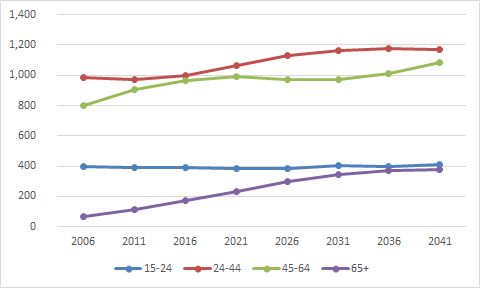
Figure 1: National labour force projections by age group, 2006-2041

image

Source: Statistics New Zealand, cyclical migration scenario

Not that many years time, about 2035, there will be almost as many workers as there are young workers – those between 15 and 24. About 400,000 workers in each age bracket.

Not that long ago all, in the early 1990s, there were about 25,000 workers in New Zealand were over 65 – they could fit in a football stadium. Soon, they will equal the population of the national capital: Wellington.

Workers aged 65+ moved from accounting for 1.5 per cent of workers in 1991 to 5 per cent in 2011 and 9 per cent in 2021!

Child poverty monitor report finds that housing unaffordability is the cause of rising child poverty in NZ

Image

Previous Older Entries Next Newer Entries

Arin’s Substack

Celebrating humanity's flourishing through the spread of capitalism and the rule of law

David Andolfatto

Celebrating humanity's flourishing through the spread of capitalism and the rule of law

Monetary Non-Neutrality

Celebrating humanity's flourishing through the spread of capitalism and the rule of law

Reason Magazine

Celebrating humanity's flourishing through the spread of capitalism and the rule of law

Coyote Blog

Celebrating humanity's flourishing through the spread of capitalism and the rule of law

Thoughts from the North

Celebrating humanity's flourishing through the spread of capitalism and the rule of law

Fardels Bear

A History of the Alt-Right

Vincent Geloso

Econ Prof at George Mason University, Economic Historian, Québécois

Bassett, Brash & Hide

Celebrating humanity's flourishing through the spread of capitalism and the rule of law

Truth on the Market

Scholarly commentary on law, economics, and more

The Undercover Historian

Beatrice Cherrier's blog

Matua Kahurangi

Celebrating humanity's flourishing through the spread of capitalism and the rule of law

Temple of Sociology

Celebrating humanity's flourishing through the spread of capitalism and the rule of law

Velvet Glove, Iron Fist

Celebrating humanity's flourishing through the spread of capitalism and the rule of law

Why Evolution Is True

Why Evolution is True is a blog written by Jerry Coyne, centered on evolution and biology but also dealing with diverse topics like politics, culture, and cats.

NoTricksZone

Celebrating humanity's flourishing through the spread of capitalism and the rule of law

Homepaddock

A rural perspective with a blue tint by Ele Ludemann

Kiwiblog

DPF's Kiwiblog - Fomenting Happy Mischief since 2003

The Dangerous Economist

Celebrating humanity's flourishing through the spread of capitalism and the rule of law

Watts Up With That?

The world's most viewed site on global warming and climate change

The Logical Place

Tim Harding's writings on rationality, informal logic and skepticism

Doc's Books

A window into Doc Freiberger's library

The Risk-Monger

Let's examine hard decisions!

Uneasy Money

Commentary on monetary policy in the spirit of R. G. Hawtrey

Barrie Saunders

Thoughts on public policy and the media

Liberty Scott

Celebrating humanity's flourishing through the spread of capitalism and the rule of law

Point of Order

Politics and the economy

James Bowden's Blog

A blog (primarily) on Canadian and Commonwealth political history and institutions

Science Matters

Reading between the lines, and underneath the hype.

Peter Winsley

Economics, and such stuff as dreams are made on

A Venerable Puzzle

"The British constitution has always been puzzling, and always will be." --Queen Elizabeth II

The Antiplanner

Celebrating humanity's flourishing through the spread of capitalism and the rule of law

Bet On It

Celebrating humanity's flourishing through the spread of capitalism and the rule of law

History of Sorts

WORLD WAR II, MUSIC, HISTORY, HOLOCAUST

Roger Pielke Jr.

Undisciplined scholar, recovering academic

Offsetting Behaviour

Celebrating humanity's flourishing through the spread of capitalism and the rule of law

JONATHAN TURLEY

Res ipsa loquitur - The thing itself speaks

Conversable Economist

In Hume’s spirit, I will attempt to serve as an ambassador from my world of economics, and help in “finding topics of conversation fit for the entertainment of rational creatures.”

The Victorian Commons

Researching the House of Commons, 1832-1868

The History of Parliament

Articles and research from the History of Parliament Trust

Books & Boots

Reflections on books and art

Legal History Miscellany

Posts on the History of Law, Crime, and Justice

Sex, Drugs and Economics

Celebrating humanity's flourishing through the spread of capitalism and the rule of law

European Royal History

Exploring the Monarchs of Europe

Tallbloke's Talkshop

Cutting edge science you can dice with

Marginal REVOLUTION

Small Steps Toward A Much Better World