



Two impossible things alert: supporting both a higher youth minimum wage and a larger youth wage subsidy
07 Aug 2014 Leave a comment
in labour economics, minimum wage Tags: minimum wage, wage subsidy
The New Zealand Labour Party is one of many parties on the Left and Right that support youth wage subsidies as a way of making it cheaper for employers to hire teenagers. The rationale is if you make it cheaper to hire teenagers, employers will hire more of them.

New Zealand Labour Party is one of many parties on the Left and occasionally on the Right that supports a youth minimum wage

Supporters of youth minimum wages do not believe that making teenagers more expensive to hire will harm their employment prospects.

Indeed, it is even argued that a higher minimum wage will increase the employment of teenagers and adults.
Minimum wages are supported because the price of labour doesn’t matter that much to the employment prospects of teenagers and adults.
Wage subsidies is supported because the price of labour is important to the employment prospects of teenagers and adults.


Recall and waiting unemployment
04 Aug 2014 Leave a comment
in business cycles, job search and matching, labour economics, labour supply, macroeconomics, occupational choice, unemployment Tags: recall unemployment, rest unemployment, temporary layoffs, waiting unemployment, work for the dole

Time use surveys in a range of countries show that the unemployed spend maybe a few hours per week looking for a new job. Krueger and Mueller (2008) found that:
…average search time is highest in the U.S.A., at 32.3 minutes per day, closely followed by Canada.
Europeans search much less, but there is considerable variation across countries.
In France the unemployed search around 21 minutes a day compared with 3 minutes in Finland
A small amount of job search per week is rational for many of the unemployed because a major form of job search doesn’t involve any job search any time soon. Instead, they are waiting for a call.
Also, Anglo-Saxon labour market are much more dynamic with many more vacancies opening every month as compared with the Eurosclerosis dual labour markets. In the European Union’s dual labour markets, it is not rational to search for vacancies that will never be there.
Job searches is an entrepreneurial venture that can involve a considerable amount of biding your time. Job seekers must choose between wider job search that may involve switching to a new industry or new occupation and investing in availability for suitable vacancies in their local labour markets or a recall to employment by old employers.
A spell of unemployment followed by a rehire by an old employer is known as recall unemployment or a temporary layoff.

Demand is less stable and more seasonal in industries such as construction, manufacturing and agriculture. When demand rebounds, recalling an old employee is a faster and cheaper hiring process than screening unfamiliar applicants of uncertain quality and training recruits.
Recall is not certain. Temporary layoffs will forecast their chances of recall and review these forecasts as they discover more about the length of drop in local labour demand and the general state of the rest of the labour market. the majority of unemployed who regard themselves as temporary layoffs are indeed recalled to their old job by their old employer after most downturns.
Better prospects of recall by old employers will reduce the intensity of job searches of temporary layoffs and increase their asking wages for other jobs. Workers with considerable industry and firm-specific human capital are likely to risk waiting longer for recall. Workers will search more intensively for other jobs as their forecasts of their chances of recall to old jobs become less encouraging.
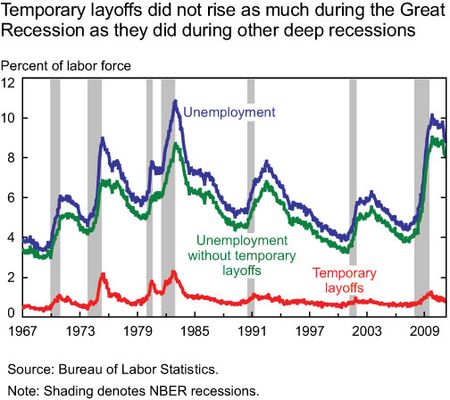
There are more temporary layoffs in milder recessions because the lull in demand is expected to be short and there are fewer business closures. The higher levels of recall unemployment will reduce downward pressure on asking wages and slow the filling of vacancies because many well qualified job applicants are waiting for recall to their old jobs rather than applying more widely for new jobs.
Dixon and Crichton (2006) found that 58% of New Zealand benefit-to-work transitions involved starting with a new employer, 30% continued with an employer for whom they worked part-time in the benefit spell and 12% returned to an employer they had worked for in the past 2 years. The prospect of a recall by an old employer has been important for unemployed workers in countries such as the US, Canada, Demark, Sweden, Austria and Norway.
In the context of work-for-the-dole schemes and activation programmes that involve intensive monitoring of job search by the unemployed on unemployment benefits, requiring workers who are temporarily laid off to search for jobs is in many ways counter-productive.
Developing a screening mechanism to find these temporary layoffs and distinguishing them from permanent layoffs would be quite challenging. Countries which have unemployment insurance premiums spend a lot of try trying to adjust those premiums for temporary layoffs. This is so employers and employees do not take advantage of unemployment insurance to have a week or two off work in slack periods at the expense of the unemployment insurance system and top up their wages in the interim.
A cousin of recall unemployment is rest unemployment or waiting unemployment – job seekers who are waiting for conditions in a depressed sector to improve (Hamilton 1988; Alvarez and Shimer 2008).

Some job seekers may wait for local labour market conditions to improve, rather than search for jobs in other industries and new occupations. A job seeker’s old industry may offer better wage and job finding prospects than other industries If the newly unemployed worker waits a while.
Rest unemployment or waiting unemployment strives to salvage as much of the occupation and industry-specific human capital of the newly unemployed worker as possible.
A significant share of job seekers have been found to be waiting for local labour market conditions to improve rather than searching further afield in different industries or new occupations (Alvarez and Shimer 2008).
Again, rest unemployment or waiting unemployment is a type of job search that cannot be well handled by work-for-the-dole schemes and intensive monitoring of the job search of unemployed workers.
Job finding rates under work for the dole when there is involuntary unemployment
03 Aug 2014 6 Comments
in business cycles, job search and matching, labour economics, labour supply, macroeconomics, welfare reform Tags: Active labour market programs, Jeff Borland, mandatory work requirements, search and matching, welfare reform, work for the dole
Jeff Borland is a critic of work for the dole. He points out that they do not improve the job finding rates of participants and in fact reduce the amount of job search because work for the Dole participants are busy undertaking work for the dole requirements:
The main reason is that participation in the program diverts participants from job seeking activity towards Work for the Dole activity. Research on similar programs internationally has come up with comparable findings.
This made me wonder. If unemployment is caused by deficient aggregate demand, and otherwise is involuntary, how can work for the dole increase unemployment or reduce the rate at which people exit unemployment?
‘Involuntary’ unemployment occurs when all those willing and able to work at the given real wage but no job is available, i.e. the economy is below full employment. A worker is ‘involuntary’ unemployment if he or she would accept a job at the given real wage. Keynesians believe money wages are slow to adjust (e.g. due to money illusion, fixed contracts or because employers and employees want long run money wage stability), and so the real wage may no adjust to clear the labour market: there can be ‘involuntary’ unemployment.

Under the deficient aggregate demand theory of unemployment, people have no control over why they are unemployed – that’s why their unemployment is involuntary.
Sticky wages are no less sticky when work for the dole is introduced and people search more intensively for jobs. Deficient demand unemployment is no less deficient when there is an increase in job search intensity.

Work for the dole must be carefully defined, of course, to differentiate it from the failed active labour market programs of the past that attempted to improve the employability of the unemployed. By work for the dole, I simply mean mandatory work requirements simply make it more of an ordeal to be on unemployment and thereby encourage people to find a job.
Mandatory work requirements simply tax leisure. By taxing leisure, mandatory work requirements change the work leisure trade-off between unemployment and seeking a job with greater zeal and a lower asking wage more attractive option. More applicants asking for lower wages will mean employers can fill jobs faster and at lower wages, which means our create more jobs in the first place.
The probability of finding a job for an unemployed worker depends on how hard this individual searches and how many jobs are available: Chance of Finding Job = Search Effort x Job Availability
Both the search effort of the unemployed and job creation decisions by employers are potentially affected by unemployment benefit generosity and mandatory work for welfare benefits requirements.
Modern theory of the labour market, based on Mortensen and Pissarides provides that more generous unemployment benefits put upward pressure on wages the unemployed seek. If wages go up, holding worker productivity constant, the amount left to cover the cost of job creation by firms declines, leading to a decline in job creation.
Everything else equal under the labour macroeconomics workhorse search and matching model of the labour market, reducing the rewards of being unemployed exerts downward pressure on the equilibrium wage. This fall in asking wages increases the profits employers receive from filled jobs, leading to more vacancy creation. More vacancies imply a higher finding rate for workers, which leads to less unemployment. The vacancy creation decision is based on comparing the cost of creating a job to the profits the firm expects to obtain from hiring the worker.
When unemployment benefits are less generous or more onerous work requirements are attached, some of the unemployed will become less choosey about the jobs they seek in the wages they will accept. a number of people at the margin between working or not. An example is commuting distance to jobs. A number of people turn down a job because is just that little too far to commute. A small change in the cost of accepting that job would have resulted in them moving from being unemployed to fully employed.
Unemployment is easy to explain in modern labour macroeconomics: it takes time for a job seeker to find a suitable job with a firm that wishes to hire him or her; it takes time for a firm to fill a vacancy. Search is required on both sides of the labour market – there are always would-be workers searching for jobs, and firms searching for workers to fill vacancies.
In a recession, a large number of jobs are destroyed at the same time. It takes time for these unemployed workers to be reallocated new jobs. It takes time for firms to find where it is profitable to create new jobs and find workers suitable to fill these new jobs.
Recessions are reorganisations. Unemployed workers look for jobs, and firms open vacancies to maximize their profits. Matching unemployed workers with new firms firms is a time-consuming and costly process.
The demand for labour is a derived demand
03 Aug 2014 Leave a comment
in human capital, labour economics, labour supply, occupational choice Tags: demand for labour, derived demand for labour, in reputation the, marginal revenue product of labour

The willingness to pay of buyers is the fundamental constraint on wages, conditions, and job amenities including reduced hours of work. Entrepreneurs will not pay no more for inputs – be it labour, land, machinery, or raw materials – than they expect to recoup later on from the sale of their final product (Hicks 1932; Hamermesh 1996).
Wages reflect the value the employee adds to the sales of the firm. The value of what an employee adds is set by the consumers who buy or abstain from buying the output of the firm.
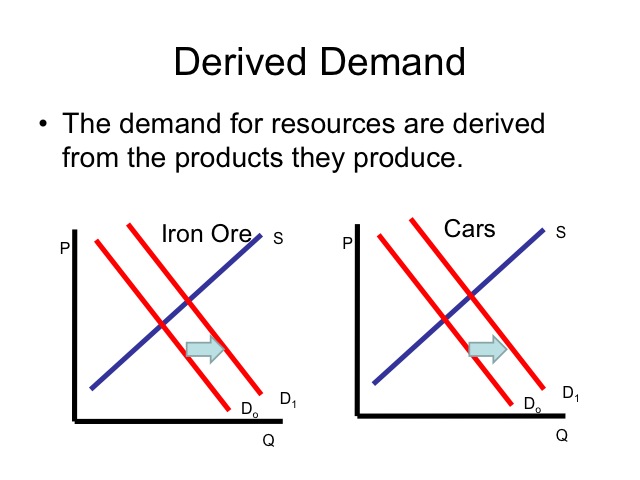
The prices that the final consumer will pay or refuse to pay for products assigns to each kind of labour used in its production a maximum profitable wage. An employer cannot pay higher wages or provide more generous working conditions if buyers are not willing to pay more to cover the extra cost of this (Hicks 1932; Stigler 1987). A profit minded employer cannot grant favours to employees at the expense of customers.

Employers compete for the services of workers who are seeking a range of jobs in industry and occupational labour markets in the areas in which they live. An employer who offers wages, working hours and conditions below what others are paying for the extra value added by a worker will experience higher staff turnover as employees quit to more rewarded jobs elsewhere (Stigler 1987).
These less alert employers will also struggle to recruit and retain the types of workers that are the most profitable for that firm to employ unless they pay the going rate. Rivalry with other sellers sets the maximum on what an employer can profitably pay in wages and survive.
Competition from other employers sets a minimum in wages, hours, working conditions and job amenities to recruit and retain a profitable workforce. Wages are demarked both by what consumers are willing to pay for what the firm produces and by what wages that rival employers are offering in comparable jobs (Stigler 1987).
H.L. Mencken on poverty as a cause of crime
03 Aug 2014 Leave a comment
in economics of crime, labour economics, law and economics, occupational choice Tags: crime and punishment, H.L Mencken

HT: David Skarbek
Teen employment and the minimum wage: sixty years of U.S. experience
02 Aug 2014 Leave a comment
in labour economics, minimum wage, politics - New Zealand, politics - USA Tags: minimum wage

In every episode, except 1996 (which is the smallest hike relative to average wages), there was a distinct decline in the trend of teen employment in the few months before the initial hike until a few months after the follow-up hike. This led Kevin Erdmann to ask:
Is there any other issue where the data conforms so strongly to basic economic intuition, and yet is widely written off as a coincidence?


Recent Comments