Calmfor’s Iron Law of Active Labour Market Policy.

Lars Calmfors is a Swedish economist whose main interest is labour makets.

His iron law of Active Labour Market Policy (ALMP) refers to a characteristic of make work schemes, like the WPA that operated in the United States in the 1930s.

The characteristic or problem with these schemes is that if people are attracted to these schemes by generous pay or conditions, their motive to search for regular work is necessarily reduced.

Assuming unemployment is anywhere near NAIRU, the effect of this reduced aggregate labour supply will be inflationary, which means that demand will have to be reduced, which in turn means that the jobs created by the make work scheme will be, at least to some extent, at the expense of regular jobs.

Alternatively, if people are coerced into joining make work schemes because of what might be called a “workfare” sanction, their job search efforts are not reduced, thus the jobs created by the make work scheme have a better chance of not being at the expense of normal jobs.

via RALPHONOMICS: Calmfor’s Iron Law of Active Labour Market Policy..

How flexible is the New Zealand labour market

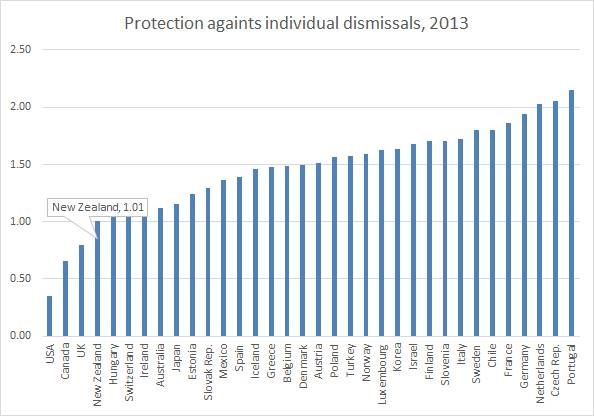
The first chart below shows that NZ is the 4th most deregulated labour market for individual dismissals.

clip_image002

Source: OECD employment protection index

The next figure below shows that NZ is top of the world for deregulation of lay-offs and redundancies.

clip_image002[7]

Source: OECD employment protection index

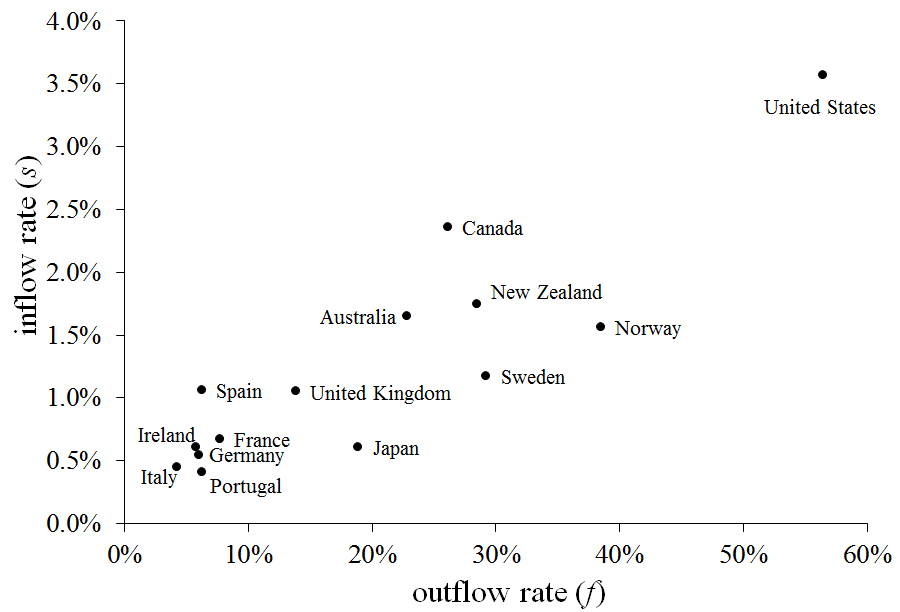
The chart below shows that New Zealand is far more flexible than in Western Europe and is pretty near the USA in terms of people moving in and out of the unemployment pool every month with great ease.

image

Source: Elsby, Hobijn  and Şahin (2013).

There are very high outflow rates from unemployment among the Anglo-Saxon and Nordic economies. The economies of Continental Europe stand in stark contrast. Unemployment outflow rates in these economies lie below 10% at a monthly frequency.

A major labour market reform in recent years in New Zealand was introduction of the option of a 90 day trial for new employees, initially in small businesses and then in all businesses.

The UK recently extended its trial period from one-year to two-years. Trial periods are common in OECD member countries.

There is plenty of evidence to back-up the notion that increased job security leads to less employee effort and more absenteeism. Some examples are:

· Sick leave spiking straight after probation periods ended;

· Teacher absenteeism increasing after getting tenure after 5-years; and

· Academic productivity declining after winning tenure.

The MBIE research into the actual operation of 90-day trials was highly favourable in terms of increased employment, the hiring of riskier applicants and lower costs of ending bad job matches (about 15-20% of trials did not work out). These outcomes are the usual importance of a test drive argument for employment trial periods.

Interestingly, the MBIE research also found that some employers hired new employees on 90-day trials for positions about which these employers were uncertain might be profitable. But for the option of the trial period, these jobs never would have existed.

This suggests that in some firms, 90-day trials are a decisively cheaper alternative to hiring an employee and perhaps making them redundant later if the new position does not pay for itself. No one’s fault: the market just did not sustain the expansion in staff as expected.

The MBIE research shows that winners from 90-day trials are new labour force entrants, the unemployed and beneficiaries, migrants and labour force re-entrants such as mothers.

I kept note of an interesting press report adding to this where Hospitality New Zealand Wellington president Jeremy Smith said he had hired dozens of staff he would not otherwise have considered. Because of the transient nature of the hospitality industry, it was often difficult to check references so a trial period “levelled the playing field”.

The politics of ethnicity-based research in New Zealand

When Simon Chapple in 2000 wrote “Māori Socio-Economic Disparity”, which showed that disadvantage in New Zealand is more closely tied to age, marital status, education, skills, and geographic location than it is to ethnicity, broadly conceived, such as Māori ethnicity:

  • He was summoned before the Māori Affairs Committee of parliament to defend his paper! His chief executive at the Ministry of Social Policy went along with him to defend what he wrote while employed as a senior analyst at the Department of Labour. Staff at his new ministry launched a petition to have Simon fired.
  • The head of the Māori Affairs Ministry accused Simon of breaching the public service code of conduct.

Chapple also found that there are important differences in socio economic development by Māori self-identity. Those who identified only as Māori did worse than those that are identified as Māori and another ethnicity. Identifying only as Māori also correlated with living in rural New Zealand.

In terms of employment discrimination, employers would not know whether a Māori job applicant identified as only as Māori or also with another ethnicity, so discrimination is not a good explanation of Māori disadvantage because of this counterfactual. A major driver of Māori disadvantage, which is identifying on the Census form solely as Maori, is simply unknown to discriminating employers as a basis for discrimination in hiring and promotion.

There were editorials in the Dominion Post, which I cannot find online,  and in the New Zealand Herald. The latter said:

The Government is being prodded to recognise that Maori deprivation has more to do with socio-economic factors than ethnicity.

This was the conclusion of a report by the Labour Department’s senior research analyst, Simon Chapple. Helen Clark might well have had that finding partly in mind when she referred to a lot of water having gone under the bridge since the Government first formulated legislation.

Mr Chapple said, in essence, that place of residence, age, education and skills had more to do with poverty than race. In areas such as South Auckland, Northland and the central North Island, there were poor Maori, but there were also poor Pākehā and poor Pasifika.

The Minister attacked him and the paper as well for contradicting the Minister’s claim during the election campaign that everything got worse for Maori in the 1990s.

image

Real equivalised median household income rose 47% from 1994 to 2010; for Māori, this rise was 68%; for Pasifika, 77% (Perry July 2014)

See Karen Baehler’s Ethnicity-based research and politics: snapshots from the United States and New Zealand for more information and a comparison with the similar response to Daniel Patrick Moynihan’s The Negro Family: A Case for National Action in 1965.

About a quarter of Negro families are headed by women. The divorce rate is about 2 1/2 times what it is [compared with whites],” Moynihan said. “The number of fatherless children keeps growing. And all these things keep getting worse, not better, over recent years.”

Moynihan, now retired from the United States Senate, was a senior official in LBJ’s Labor Department in 1965. He wrote his report on a typewriter over a few weeks and had the publications office in the basement of the Labor Department print 100 of them, marked “For Official Use Only.”

  • He warned about the breakdown of the African-American family where deprivation and disorganisation had formed their own vicious circle.
  • Many civil rights leaders had labelled Moynihan’s report a subtle form of racism because of its unflattering portrayal of the black family (Wilson 1987).
  • These accusations of racism helped make the breakdown of the family a taboo subject in social policy in the USA

see The Moynihan Report Revisited: Lessons and Reflections after Four Decades for a review by the best and the brightest in American economics and sociology on Daniel Patrick Moynihan’s prophetic warnings. Holzer says, for  example:

Moynihan was extremely insightful and even prescient in arguing that the employment situation of young black men was a “crisis . . . that would only grow worse.”

He understood that these trends involve both limits on labour market opportunities that these young men face as well as skill deficits of and behavioural responses by the young men themselves.

More children are growing-up without a working father living in the home and glean the awareness that work is a central expectation of adult life (Wilson 1987, 1996).

Single-parent households increased from 13 per cent of all Māori households in 1981 to 24.4 per cent in the 2006 Census. In the 2006 Census, 70 per cent of Māori single parent households were on a low income compared to 15 per cent of other Māori one family households (Kiro, Randow and Sporle 2010).

Most of the skill gaps that are present at the age of 18 – skill gaps which substantially explain gaps in adult earnings and employment in all groups – are also present at the age of five (Cunha and Heckman 2007). There is much evidence to show that disadvantaged children have lower levels of soft skills (non-cognitive skills): motivation, persistence, self-discipline, the ability to work with others, the ability to defer gratification and plan ahead, etc. (Heckman 2008). Most of the skills that are acquired at school build on these soft skills that are moulded and reinforced within whānau.

When I started working on labour economics in 2007 I found that the labour economics of Māori was very narrowly written and stayed well clear of the minefield that Simon braved about how ethnicity does not matter that much to Māori social disadvantage.

Lessons from field trials with work mandates

Table1_RANDRevRevised_1202

One of the most controversial aspect of the U.S. program changes are the negative incentives – time limits, sanctions, and diversion – that are built into their structure.

All of these policies limit the entitlement to cash public assistance, by either enforcing behavioural requirements (such as work search) or limiting the availability of assistance.

As Besley and Coate (1992) pointed out, linking such requirements with public assistance payments can help deter welfare participation among those who could find a job on their own.

The majority of evaluations of mandatory welfare-to-work programs show significant increases in labour supply and reduced welfare dependency. The drawback is the increase in wage income is greatly offset by the decline in benefit income. In–work tax credits played a major role in making work pay in 1996 U.S. welfare reform

The Minnesota Family Investment Program (MFIP) was implemented in 1994 and provided a strong earnings threshold, allowing women to receive some cash assistance until their earnings reached about 140 per cent of the U.S. poverty line. It also required participation in mandatory job search programs.

A randomly assigned control group remained in AFDC without work requirements or substantial earnings thresholds. MFIP involved both strong negative and positive work incentives. A subset of the treatment group (also randomly assigned) was provided with the earnings thresholds but not the mandatory work requirements.

The MFIP results allow the separate and joint effects of mandatory job search and earnings thresholds to be explored. When only positive work incentives are provided through an expanded earnings threshold, this has little effect on labour supply, consistent with earlier results. The additional income provided by these higher thresholds had strong income-increasing and poverty-reducing effects. Once mandatory work requirements are added to MFIP, then labour supply increases as well, but there is little further effect on income or poverty.

The evaluations of MFIP suggest that the stick of work requirements increases labour supply, but has little effect on overall income as increases in earnings are offset by reduced benefits.

The carrot of greater earnings thresholds provides an income enhancing effect. When used together, there is increased work and higher earnings, along with reduced poverty.

The relatively strong measures to mandate work participation can be effective. Work mandates with sanctions are more effective at inducing work than are more financial incentives. Strict work requirements by themselves may have little income-enhancing effects if they are not combined with some form of wage support for the low-skilled.

Education and training programs do not seem any more effective in promoting labour force attachment and increased earnings than work experience programs. In various welfare reform experiments in the U.S. during the 1990s, states tested training programs – human capital development programs — against work first programs – labour force attachment programs.

The work-first programs increased earnings and decreased welfare usage faster, while human capital development programs cost more, particularly in the first year when women were training rather than working.

But even three years out, after women from human capital development programs had been in the labour market two years, human capital development participants still did not outperform labour force attachment participants.

This may suggest that the gains to experience among women who have been out of the labour market may be larger than the gains to formal education and training. Employment outcomes did not seem significantly worse among less skilled participants or participants with identifiable barriers to work, such as child care or health problems. Learning by doing and job match and job search capital are major sources of hard-to-measure post-school human capital and wages growth even for less skilled workers. Work-first programmes suggest that the reward from working which is human capital as well as wages are greater than an investment in time away from working to train.

The dual emphasis in the U.S. welfare reforms on positive work incentives and more punitive work mandates seems to have been important.

Work mandates (mandatory welfare-to-work programs, backed by sanctions and time limits) forced more people into work faster than would have naturally left welfare even strong economic environments. With low wages and (often) part-time hours, many welfare leavers would have gained little in income without subsidies to low-wage work. Reduced earnings thresholds, the expanded EITC, and subsidies to assist with child care or other work related expenses, all helped make work pay.

Table4_RANDRevised_1202

Diagrams HT: rand.org Conflicting Benefits Trade-Offs in Welfare Reform by Jeffrey Grogger, Lynn A. Karoly, and Jacob Alex Klerman (2002).

Will work-for-the-dole work in Australia?

One of the strongest empirical findings of modern labour economics is the benefit exhaustion spike. This is the large increase, shown in the diagram, in the probability of finding a job on the eve of exhausting unemployment benefits or unemployment insurance eligibility.

This benefit exhaustion spike is mobile: when unemployment  insurance eligibility is lengthened, the benefit exhaustion spike moves out to the new benefit exhaustion date. For example, from 26 weeks, then to 39 weeks, then 52 weeks and then to 99 weeks. There is also a benefit exhaustion spike where the generosity of unemployment or other insurance decreases after a certain time. The alleged decay in the human capital of the  long-term unemployed does not seem to affect this benefit exhaustion spike.

In addition, in the EU,  the job finding probability of unemployment insurance recipients eligible for other welfare schemes are less sensitive to changes in the level and duration of their unemployment benefits benefits.

The benefit exhaustion spike shows that job seekers have much more control over their re-employment prospects than is commonly granted even in the worst of economic conditions such as in Pittsburgh in the early 1980s in a major recession  and when US manufacturing industry industry was in  a  long-term decline.

The individual’s reservation wage (i.e. the  lowest wage wage at which individuals  will accept a job offer) decreases whilst search intensity increases as they approach unemployment benefit eligibility  exhaustion.

This reduction in reservation wages or the asking wages of job seekers increases the incentives for employers to post new vacancies because they can fill them at a lower cost. Both more intensive job search and more vacancies will see jobs filled faster, and more jobs created and filled.
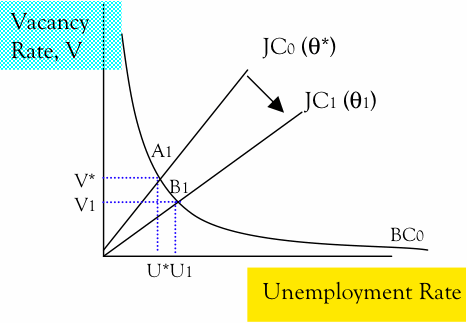
A mechanism for reducing welfare programme entry rate while increasing welfare benefit exits is mandatory  minimum job search and mandatory work requirements such as those proposed this week for Australia. These minimum hours can be spent working part time, in study and training, work preparation and job search assistance or volunteering. A work requirement is a screening device that removes any advantage of moving on to welfare in terms of more leisure time.

The proposals announced this week in Australia are most job seekers will be required to look for up to 40 jobs per month and work for the dole will be mandatory for all jobseekers younger than 50. Job seekers younger than 30 would have to work 25 hours a week under the expanded programme, while those between 30 and 49 will be asked to do 15 hours work a week, and those aged 50-60, 15 hours a week.

At least 13 OECD member countries require at least monthly visits to a local employment office by unemployment beneficiaries to present job-search evidence and also perhaps to receive advice and even referrals to specific job openings.

Reforms in a range of overseas countries that introduced more intensive monitoring of job search and stronger sanctions on benefits for non-compliance significantly reduced unemployment spells.

One of the surprising results of more intensive monitoring of job search and a requirement to sign on regularly at the local employment office or Social Security office is the sheer horror of having to sign-on and talk to caseworker for five minutes encourages  5 to 10% of unemployed beneficiaries to find a job. When unemployment and sickness beneficiaries are required to undergo a full reassessment of their eligibility, it is common for up to 30% of them simply to not reapply.

The stronger monitoring of job search and the real prospect of stiffer sanctions for non-compliance encourages all benefit claimants, current and future, and not just those actually sanctioned to search harder for jobs. This anticipation of stricter monitoring and more frequent eligibility reviews has a much larger effect of welfare dependency than the actual sanctioning of the non-complaint. People review their options and marshalled their resources to find or stay in work.

The welfare exit effect and welfare entry deterrence arises from mandatory work requirements from the relative non-financial rewards of working and not working having changed in favour of staying in full-time and semi-work for persistent workers temporarily on a welfare benefit.

Persistent workers gain from anticipating the onerous nature of work requirements and searching more intensively for jobs which are more stable and enduring. These job seekers may reduce their asking wage to win a lower paid but steadier job.

Seasonal and temporary jobs will be less attractive if there are work requirements. The incentive to cycle between the benefit and part-time and full-time work including seasonal and temporary jobs are reduce because work requirements make welfare receipt more onerous. Those job seekers with fewer outside of the workforce obligations such as young children are the most likely to move to (stable) full-time work because of work requirements.

A work requirement  as a condition for a welfare benefit  receive unambiguously increases net labour supply and reduces the number of people relying on the welfare system now and into the future.

The number of people working increase and some leave welfare rather than comply with the mandatory work programmes. Work requirements make welfare receipt unambiguously less attractive and will close the gap between earning full-time wages and the net rewards of not working or part-time work and partial benefit receipt.

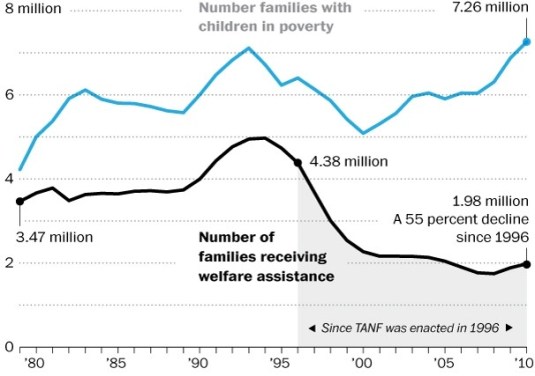
There was a more than 60% reduction in welfare caseloads after the 1996 federal welfare reform in the USA that introduced work requirement and  five year lifetime federal welfare eligibility time limits on a national basis. In the four decades preceding the 1996 welfare reform, the number of Americans on welfare had never significantly decreased.

The gains in U.S. employment after the 1996  Federal welfare reform were largest among the single mothers previously thought to be most disadvantaged: young (ages 18-29), mothers with children aged under seven, high school drop-outs, and black and Hispanic mothers. These low-skilled single mothers in the USA were thought to face the greatest barriers to employment.

The U.S. literature has many competing estimates of the relative effects of work requirements, lifetime time limits and a far more generous earned income tax credit  (EITC). It is agreed that work requirements and time limits reduced entry into welfare caseloads. The relative importance of time limits, work mandates and greater EITC generosity for exits is more disputed.

The Minnesota Family Investment Program (MFIP) had a more complex experimental design that allowed separate evaluation of the mandatory welfare-to-work program and the lower benefit reduction rate. The results indicated that the lower benefit abatement rates appear to have had little labour supply effect. The increase in labour supply seems to have come almost entirely from the mandatory welfare-to-work program and its associated sanctions.

Much was  initially made in the US empirical literature of the strong state of the American economy in the 1990s as an explanation for  part of the drop in welfare caseloads. The relevance of this faded when welfare caseloads did not increase again when the economy deteriorated after 2007 in the USA.
The gender occupational fatality gap

jobdeaths

Image

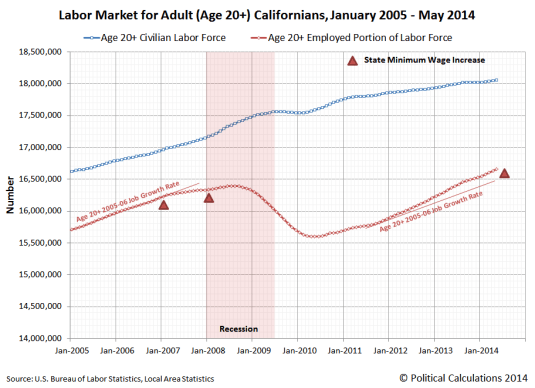
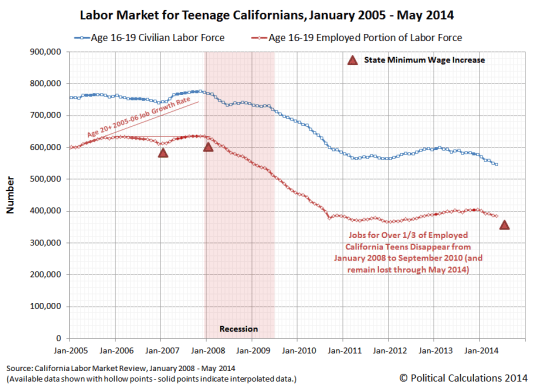
The Two Californias: One for Adults, One for Teens

Labor Market for Teenage (Age 16-19) Californians, January 2005 through May 2014

via Political Calculations: The Two Californias: One for Adults, One for Teens.

Image

Alfred Marshall as a pioneer of human capital theory

Marshall viewed education as an instrument capable of lifting up the poor and relocating them into the middle class. The direct benefits come from eliminating much of

that wasteful negligence which allows genius that happens to be born of lowly parentage to expend itself in lowly work

The indirect benefits of education came from character formation:

[Education] confers great indirect benefits even on the ordinary workman. It stimulates his mental activity, it fosters in him a habit of wise inquisitiveness: it makes him more intelligent, more ready, more trustworthy in his ordinary work; it raises the tone of his life in working hours and out of working hours; it is thus an important means toward the production of material wealth; at the same time that, regarded as an end in itself, it is inferior to none of those which the production of material wealth can be made to subserve.

Marshall’s primary solution to the problem of poverty is education, but he also exhorts individuals to behave responsibly, with thrift and self control.

From The Economist’s 1963 review of Capitalism and Freedom

Curiously, a family tax credit or earned income tax credit is the most successful anti-poverty tool in the late 20th century. Furthermore, those on the Left are relatively convinced that the sole cause of poverty is a lack of money, and the solution is to give the poor more money.

Friedman, Hayek in the Constitution of Liberty, and George Stigler in his great paper on the minimum wage in 1946 all supported a guaranteed minimum income.

via A Tract for the Times | The Economist.

Close the Gender Pay Gap, Change the Way We Work – Claudia Goldin

via Close the Gender Pay Gap, Change the Way We Work – Bloomberg View.

The desired ratio of older and younger workers

The large accumulation of firm and industry-specific human capital of older employees can be more in demand in some jobs than others (Lazear 1998).

The pace of technological change in a particular industry influences the role of different ratios of older and younger employees to the most profitable way to develop human capital within a given firm (Lazear 1998).

Recruitment, on-the-job training, and learning by doing are alternative methods of acquiring and accumulating human capital. The relative profitability of each method of developing and renewing human capital will depend upon whether internal or external sources are the cheaper suppliers of new human capital to the firm.

When technological change is rapid, knowledge of the new technology is often embodied in the formal education and recent job experiences of new entrants into the workforce and younger up-and-coming workers (Lazear 1998).

In industries with more rapid technological progress, the departure of older workers is less of a capital loss to employers. Employers may have fewer incentives to accommodate phased retirements if human capital rich replacements are available. These younger recruits may be embodied with the latest knowledge of new technologies through their formal education and schooling and their previous job experiences.

The amount of skills learnt on the job relative to formal education is important to the desired ratios of older and younger employees.

When on-the-job skills are important to the success of the firm, there is a great need for teachers to pass on these skills. Older experienced employees will be greatly valued as repositories of firm-specific human capital and as teachers to new employees (Lazear 1998).

When formal education acquitted outside the workplace is the more important way in which employees learn their skills, it will be less important for employers to invest in accommodations that retain older employees as teachers.

The extent to which the firm’s operations and customers are more idiosyncratic is important to the ratio of ratio of older and younger employees that is best for human capital accumulation (Lazear 1998).

Again, senior workers are more likely to have this special knowledge and act as teachers to recruits when the firm’s operations and customers are more idiosyncratic relative to other firms (Lazear 1998). Employers will be more reluctant to see older employees quit if they act as teachers to recruits in the ways of the firm.

An employer has less concerned if older employees plans to leave if the firm’s preferred ratio of younger to older employee is not harmed. In some cases, older employees are valued as teachers and repositories of knowledge. In other cases, staff turnover can be an opportunity to inject fresh blood (Lazear 1998). It is all in the operational particulars of each firm, the importance of on-the-job training versus formal education, and the pace of technological change in the industry.

Bill Allen on the minimum wage

Image

Female voting demographics and the growth of government

The gender gap in voting dates back 2 generations or more and may now be in double digits.

A large share of all social spending is for the care of dependents – everything from children to non-working mothers and old age pensioners. Women support this spending because they benefit more from the social insurance it offers. Women both earn less and are more likely to be out of the workforce caring for children. Women also change their voting patterns more often than men as they marry and divorce or as they become single mothers.

John  Lott pondered on why the government started growing precisely when it did. The federal government, aside from periods of wartime, consumed 2 to 3%  of GDP up until World War I. In the 1920s, non-military federal spending began steadily climbing. FDR’s New Deal continued an earlier trend.

Lott explains the growth of government with women’s suffrage. For decades, polls have shown that women as a group vote differently than men. Without the women’s vote, Republicans would have swept every U.S. presidential race but one between 1968 and 2004.

A major gender gap issue is smaller government and lower taxes, which is a much higher priority for men. Women were more opposed to the 1996 federal welfare reforms, which mandated time limits for receiving welfare and imposed work requirements on welfare recipients.

Women are also supporters of Medicare, Social Security and educational expenditures more than men. Studies show that women are generally more risk-averse than men so they support government programs to ensure against certain risks in life.

  • Women’s average incomes are also slightly lower and less likely to vary so single women prefer more progressive income taxes.
  • Once women marry, they bear a greater share of taxes through their husbands’ relatively higher incomes so their support for high taxes declines.

Marriage also provides an economic explanation for why men and women prefer different policies.

Single women who believe they may marry as well as married women who most fear divorce, look for protection against possible divorce: a more progressive tax system and other government transfers of wealth from rich to poor.

Lott considers that A good way to analyse the direct effect of women’s suffrage on the growth of government is to study how each of the 48 state governments expanded after women obtained the right to vote.

  • Women’s suffrage was first granted in western states seeking women migrants: Wyoming (1869), Utah (1870), Colorado (1893) and Idaho (1896).
  • Women could vote in 29 states before women’s suffrage was achieved nationwide in 1920 with the adoption of the 19th Amendment to the Constitution.

The impact of granting of women’s suffrage was startling: state governments started expanding the first year after women voted and continued growing until real per capita spending more than doubled. The increase in government spending and revenue started immediately after women started voting.

There were 19 states that had not passed women’s suffrage before the approval of the 19th Amendment, nine approved the amendment, while the other 12 had suffrage imposed on them.

If some unknown third factor caused a desire for larger government and women’s suffrage, government should have only grown in states that voluntarily adopted suffrage. After approving women’s suffrage, government grew at a similar pace in both groups of states.

As more women voted and eventually voted in similar numbers as men, the size of state and federal governments expanded as women became an increasingly important part of the electorate. It took up to 30 years for women’s voting participation rate to equal that of men.

Lott also found that women’s political views on average vary more than those of men:

  • Young single women are about 50 per cent more likely to vote Democratic.
  • For married women, this gap is only one-third as large.
  • Married women with children become more conservative still.
  • Women with children who are divorced are suddenly about 75 per cent more likely to vote for Democrats than single men.

Not surprisingly, political parties pitch their platforms to women because they are more likely to change their vote over identifiable issues that are within the scope for government to change or influence

The ultimate resource

simons population

Image

Managerial Econ: What happened when Tennessee kicked 170,000 out of medicaid?

There was an immediate increase in job search behaviour and a steady rise in employment and health insurance coverage following the disenrollment. These results suggest a significant degree of employment lock: workers employed primarily in order to secure private health insurance coverage

via Managerial Econ: What happened when Tennessee kicked 170,000 out of medicaid?.

Previous Older Entries Next Newer Entries

Arin’s Substack

Celebrating humanity's flourishing through the spread of capitalism and the rule of law

David Andolfatto

Celebrating humanity's flourishing through the spread of capitalism and the rule of law

Monetary Non-Neutrality

Celebrating humanity's flourishing through the spread of capitalism and the rule of law

Reason Magazine

Celebrating humanity's flourishing through the spread of capitalism and the rule of law

Coyote Blog

Celebrating humanity's flourishing through the spread of capitalism and the rule of law

Thoughts from the North

Celebrating humanity's flourishing through the spread of capitalism and the rule of law

Fardels Bear

A History of the Alt-Right

Vincent Geloso

Econ Prof at George Mason University, Economic Historian, Québécois

Bassett, Brash & Hide

Celebrating humanity's flourishing through the spread of capitalism and the rule of law

Truth on the Market

Scholarly commentary on law, economics, and more

The Undercover Historian

Beatrice Cherrier's blog

Matua Kahurangi

Celebrating humanity's flourishing through the spread of capitalism and the rule of law

Temple of Sociology

Celebrating humanity's flourishing through the spread of capitalism and the rule of law

Velvet Glove, Iron Fist

Celebrating humanity's flourishing through the spread of capitalism and the rule of law

Why Evolution Is True

Why Evolution is True is a blog written by Jerry Coyne, centered on evolution and biology but also dealing with diverse topics like politics, culture, and cats.

NoTricksZone

Celebrating humanity's flourishing through the spread of capitalism and the rule of law

Homepaddock

A rural perspective with a blue tint by Ele Ludemann

Kiwiblog

DPF's Kiwiblog - Fomenting Happy Mischief since 2003

The Dangerous Economist

Celebrating humanity's flourishing through the spread of capitalism and the rule of law

Watts Up With That?

The world's most viewed site on global warming and climate change

The Logical Place

Tim Harding's writings on rationality, informal logic and skepticism

Doc's Books

A window into Doc Freiberger's library

The Risk-Monger

Let's examine hard decisions!

Uneasy Money

Commentary on monetary policy in the spirit of R. G. Hawtrey

Barrie Saunders

Thoughts on public policy and the media

Liberty Scott

Celebrating humanity's flourishing through the spread of capitalism and the rule of law

Point of Order

Politics and the economy

James Bowden's Blog

A blog (primarily) on Canadian and Commonwealth political history and institutions

Science Matters

Reading between the lines, and underneath the hype.

Peter Winsley

Economics, and such stuff as dreams are made on

A Venerable Puzzle

"The British constitution has always been puzzling, and always will be." --Queen Elizabeth II

The Antiplanner

Celebrating humanity's flourishing through the spread of capitalism and the rule of law

Bet On It

Celebrating humanity's flourishing through the spread of capitalism and the rule of law

History of Sorts

WORLD WAR II, MUSIC, HISTORY, HOLOCAUST

Roger Pielke Jr.

Undisciplined scholar, recovering academic

Offsetting Behaviour

Celebrating humanity's flourishing through the spread of capitalism and the rule of law

JONATHAN TURLEY

Res ipsa loquitur - The thing itself speaks

Conversable Economist

In Hume’s spirit, I will attempt to serve as an ambassador from my world of economics, and help in “finding topics of conversation fit for the entertainment of rational creatures.”

The Victorian Commons

Researching the House of Commons, 1832-1868

The History of Parliament

Articles and research from the History of Parliament Trust

Books & Boots

Reflections on books and art

Legal History Miscellany

Posts on the History of Law, Crime, and Justice

Sex, Drugs and Economics

Celebrating humanity's flourishing through the spread of capitalism and the rule of law

European Royal History

Exploring the Monarchs of Europe

Tallbloke's Talkshop

Cutting edge science you can dice with

Marginal REVOLUTION

Small Steps Toward A Much Better World