In this shortish (23-minute) video, Sam Harris and John McWhorter discuss whether wokeness is finally dead. The short answer is “nope.” It may have lain down, but it refuses to die. The YouTube notes (there’s a transcript you can see as well): Sam Harris speaks with John McWhorter about language, ideology, and moral certainty. They […]
Sam Harris and John McWhorter: Is wokeness dead?
Sam Harris and John McWhorter: Is wokeness dead?
12 Jan 2026 1 Comment
in discrimination, liberalism, Marxist economics, politics - USA Tags: free speech, political correctness, racial discrimination, regressive left, sex discrimination
Profile of George Borjas and his influence
12 Jan 2026 Leave a comment
in applied price theory, income redistribution, labour economics, labour supply, politics - USA, Public Choice Tags: economics of immigration
More recently, his research has found new attention and urgency in President Donald Trump’s second term: Borjas, 75, worked as a top economist on the Council of Economic Advisers, a post he stepped down from last week. Borjas is an immigrant and refugee who escaped Cuba for the United States in 1962 and later obtained…
Profile of George Borjas and his influence
Anti-Zionism and Anti-Semitism
11 Jan 2026 1 Comment
in discrimination, International law, liberalism, Marxist economics, war and peace Tags: Gaza Strip, Israel, Middle-East politics, racial discrimination, war against terror, West Bank
The relationship between Anti-Zionism and Anti-Semitism is real, contested, and often confused. They are not identical, but they overlap in important and historically dangerous ways. The clearest way to understand the connection is to distinguish conceptual differences from practical realities. 1. What the terms mean (in principle) Anti-Semitism Anti-Semitism is hostility toward Jews as Jews—whether […]
Anti-Zionism and Anti-Semitism
Reflections on the Caplan-Bruenig Poverty Debate
09 Jan 2026 Leave a comment
in applied price theory, history of economic thought, labour economics, labour supply, liberalism, libertarianism, Marxist economics, politics - USA, poverty and inequality, welfare reform Tags: child poverty, family poverty
Last month, Econoboi hosted a debate on poverty between myself and Matt Bruenig. Here are my reflections on that debate.I was pleasantly surprised by Bruenig’s openness to most of my proposed supply-side reforms. He wasn’t just pro-immigration, but also pro-deregulation of housing and pro-nuclear. He was happy to admit that these policies aren’t just good…
Reflections on the Caplan-Bruenig Poverty Debate
Building more will boost labor’s share
06 Jan 2026 1 Comment
in applied price theory, labour economics, labour supply
This paper argues that the decline in the labor share is not driven by the overall quantity of capital, but by its changing composition. Constructing annual macro data for 16 advanced countries over two centuries, we show that, since 1980, the relative decline in buildings capital and the associated increase in real prices of buildings…
Building more will boost labor’s share
Why Some US Indian Reservations Prosper While Others Struggle
06 Jan 2026 Leave a comment
in applied price theory, development economics, economics of bureaucracy, economics of regulation, entrepreneurship, growth disasters, growth miracles, industrial organisation, labour economics, law and economics, politics - USA, property rights, Public Choice

Our colleague Thomas Stratmann writes about the political economy of Indian reservations in his excellent Substack Rules and Results. Across 123 tribal nations in the lower 48 states, median household income for Native American residents ranges from roughly $20,000 to over $130,000—a sixfold difference. Some reservations have household incomes comparable to middle-class America. Others face persistent…
Why Some US Indian Reservations Prosper While Others Struggle
The journal Science positively reviews a book criticizing gender surgery
03 Jan 2026 Leave a comment
in discrimination, economics of education, gender, law and economics, liberalism, Marxist economics Tags: free speech, gender gap, media bias, political correctness, regressive left, sex discrimination

Is it a sign of the times that this long book review, appearing in the “Science and Society” section of the prestigious journal Science, actually approves of a book questioning the ubiquity of gender surgeries? I haven’t read the book, but you can be that Nature wouldn’t give a positive review such prominence. Here’s the…
The journal Science positively reviews a book criticizing gender surgery
Economic Inequality Does Not Cause Lower Subjective Ratings of Well-Being
03 Jan 2026 Leave a comment
in applied price theory, labour economics, poverty and inequality
It’s become a nearly standard claim that economics inequality makes people feel worse-off, or perhaps even leads to mental illness. However, Nicolas Sommet, Adrien A. Fillon, Ocyna Rudmann, Alfredo Rossi Saldanha Cunha and Annahita Ehsan did what is called a “meta-analysis” of the available studies–that is, they went back and looked at the underlying data, methods, and findings…
Economic Inequality Does Not Cause Lower Subjective Ratings of Well-Being
So much for overpopulation
02 Jan 2026 Leave a comment
in development economics, economic history, labour economics, labour supply, population economics Tags: ageing society, population bust

What Star Wars AND Star Trek can teach us about economics
01 Jan 2026 Leave a comment
in applied price theory, comparative institutional analysis, defence economics, economics of regulation, international economics, labour economics, labour supply, movies, television, TV shows, unions
This is not a “Star Wars vs Star Trek” post. I’m non-partisan. I enjoy both Star Wars and Star Trek about equally. And it turns out that I am not alone. Last December, John Hawkins (University of Canberra) wrote in The Conversation about what Star Wars can teach us about economics. This year, Hawkins (with Tesfaye…
What Star Wars AND Star Trek can teach us about economics
US Growth: From Hours Worked or Productivity Gains?
30 Dec 2025 Leave a comment
in applied price theory, econometerics, economic growth, economic history, labour economics, labour supply, macroeconomics

US economic growth can be divided into two parts: more hours worked, or more productivity per hour worked. In the past, the US labor force has been rising over time: the US labor force totaled 107 million people in 1980, 142 million in 2000, and was up to 171 million this year. However, after several…
US Growth: From Hours Worked or Productivity Gains?
Canada fact of the day
29 Dec 2025 Leave a comment
in applied price theory, development economics, labour economics, labour supply, poverty and inequality, welfare reform Tags: Canada
Since 2015, Canada has tripled its Indigenous spending – paying more than on national defense. Over those same years, Indigenous people have suffered a catastrophic collapse in health and well-being: on average almost a full decade of lost life expectancy. That is from David Frum. The post Canada fact of the day appeared first on…
Canada fact of the day
Book review: Economics of the New Zealand Maori
27 Dec 2025 Leave a comment
in development economics, economic history, labour economics, law and economics, politics - New Zealand, property rights Tags: economic anthropology, Maori economic development
In amongst my collection of books, I have assembled a number of classics, including some reasonably rare editions. One of those is Economics of the New Zealand Maori [*] by Raymond Firth. This book was originally published from Firth’s PhD thesis in 1929 (the thesis was approved in 1927 at the University of London). The edition…
Book review: Economics of the New Zealand Maori
Celebrating Two Years of Libertarian Success in Argentina
27 Dec 2025 Leave a comment
in applied price theory, Austrian economics, budget deficits, comparative institutional analysis, constitutional political economy, development economics, economic growth, economics of bureaucracy, economics of regulation, fiscal policy, growth disasters, history of economic thought, income redistribution, industrial organisation, labour economics, liberalism, libertarianism, macroeconomics, Public Choice, rentseeking, unemployment Tags: Argentina
As explained in my four-part series (here, here, here, and here) and in this clip from a recent interview, Javier Milei’s first two years have been amazingly successful. There are two points in the interview that deserve emphasis. First, Javier Milei’s libertarian policies already have been extremely beneficial for the Argentine economy. Inflation has dramatically […]
Celebrating Two Years of Libertarian Success in Argentina
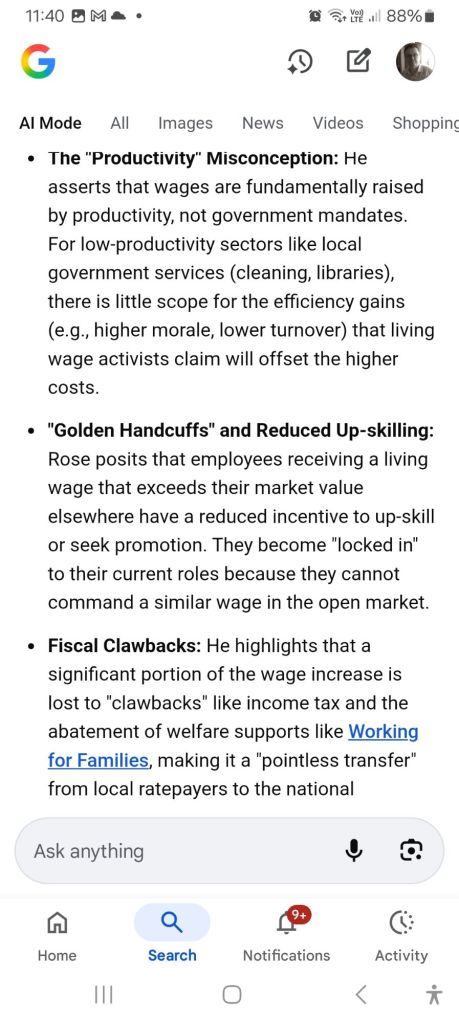
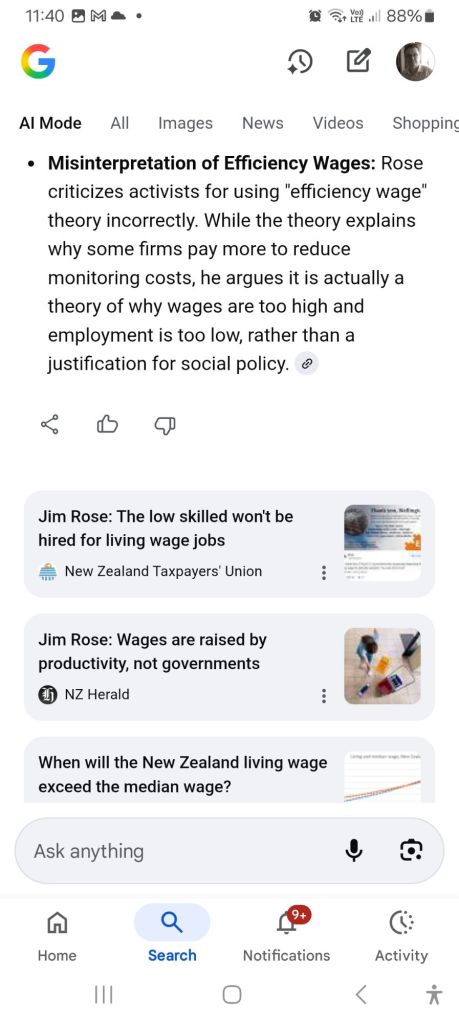
AI summary of my living wage paper
24 Dec 2025 Leave a comment
in applied price theory, history of economic thought, income redistribution, job search and matching, labour economics, labour supply, macroeconomics, minimum wage, politics - New Zealand, poverty and inequality, Public Choice, rentseeking Tags: living wage

 Utopia, you are standing in it!
Recent Comments