
https://www.facebook.com/share/p/5xeXG5jK2eEyuxzv/?mibextid=xfxF2i
Celebrating humanity's flourishing through the spread of capitalism and the rule of law
01 Sep 2024 Leave a comment
in applied price theory, Austrian economics, entrepreneurship, history of economic thought, human capital, income redistribution, labour economics, labour supply, law and economics, liberalism, Marxist economics, occupational choice, poverty and inequality, property rights, Public Choice
31 Aug 2024 Leave a comment
in applied welfare economics, Austrian economics, comparative institutional analysis, constitutional political economy, development economics, economic growth, economic history, entrepreneurship, growth miracles, history of economic thought, human capital, income redistribution, industrial organisation, labour economics, labour supply, law and economics, liberalism, macroeconomics, Marxist economics, politics - New Zealand, poverty and inequality, property rights, Public Choice, rentseeking, technological progress Tags: child poverty, family poverty, The Great Enrichment
31 Aug 2024 Leave a comment
in applied price theory, applied welfare economics, Austrian economics, comparative institutional analysis, constitutional political economy, economic growth, economic history, economics of bureaucracy, entrepreneurship, human capital, income redistribution, labour economics, labour supply, liberalism, macroeconomics, Marxist economics, politics - USA, poverty and inequality, Public Choice, public economics, rentseeking, welfare reform Tags: Europe, social insurance
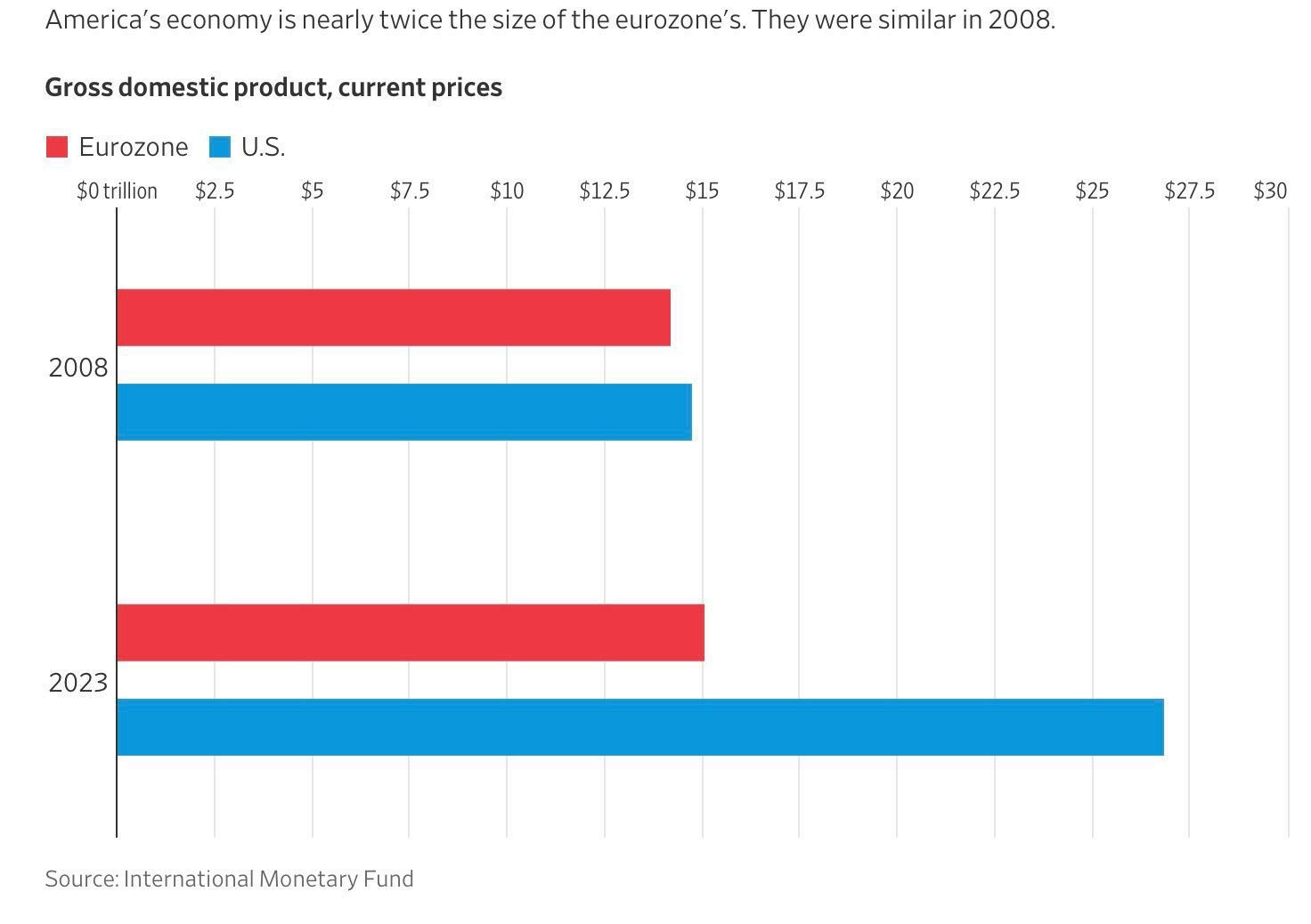
I’ve written many times about how Americans are much richer than Europeans. And I’ve also written many times that the U.S. economy has been growing faster (which shouldn’t happen according to convergence theory). There’s a simple reason for America’s superior performance. The U.S. is burdened by a medium-sized welfare state and a bad tax system […]
European Policies = European Stagnation
30 Aug 2024 Leave a comment
in income redistribution, kittens, labour economics, politics - New Zealand, poverty and inequality, Public Choice, welfare reform Tags: child poverty, family poverty

Lindsay Mitchell writes – The Child Poverty Report 2024 has just been published. It’s an overview and selected findings, as opposed to a full report which is due in 2025. Poverty can be measured in various ways.
The child poverty conundrum
22 Aug 2024 Leave a comment
in applied price theory, economic history, economics of education, entrepreneurship, human capital, industrial organisation, labour economics, labour supply, liberalism, managerial economics, market efficiency, occupational choice, organisational economics, personnel economics, politics - USA, poverty and inequality, survivor principle Tags: CEO pay, superstar wages

CEO compensation at large firms is high, especially in comparison to average worker wages, sparking debates over income inequality. Critics argue that such pay packages are unfair and disproportionate to actual company performance. Proponents contend that high pay reflects productivity and is necessary to attract scarce top talent to large firms. Let’s go to the […]
Why Top CEOs Earn Big Paychecks
16 Aug 2024 Leave a comment
in development economics, economic growth, economic history, economics of regulation, entrepreneurship, growth disasters, growth miracles, history of economic thought, income redistribution, labour economics, law and economics, liberalism, macroeconomics, Marxist economics, Milton Friedman, politics - USA, poverty and inequality, property rights, Public Choice, public economics, rentseeking Tags: Chile, free speech, political correctness, regressive left, The Great Enrichment, Venezuela
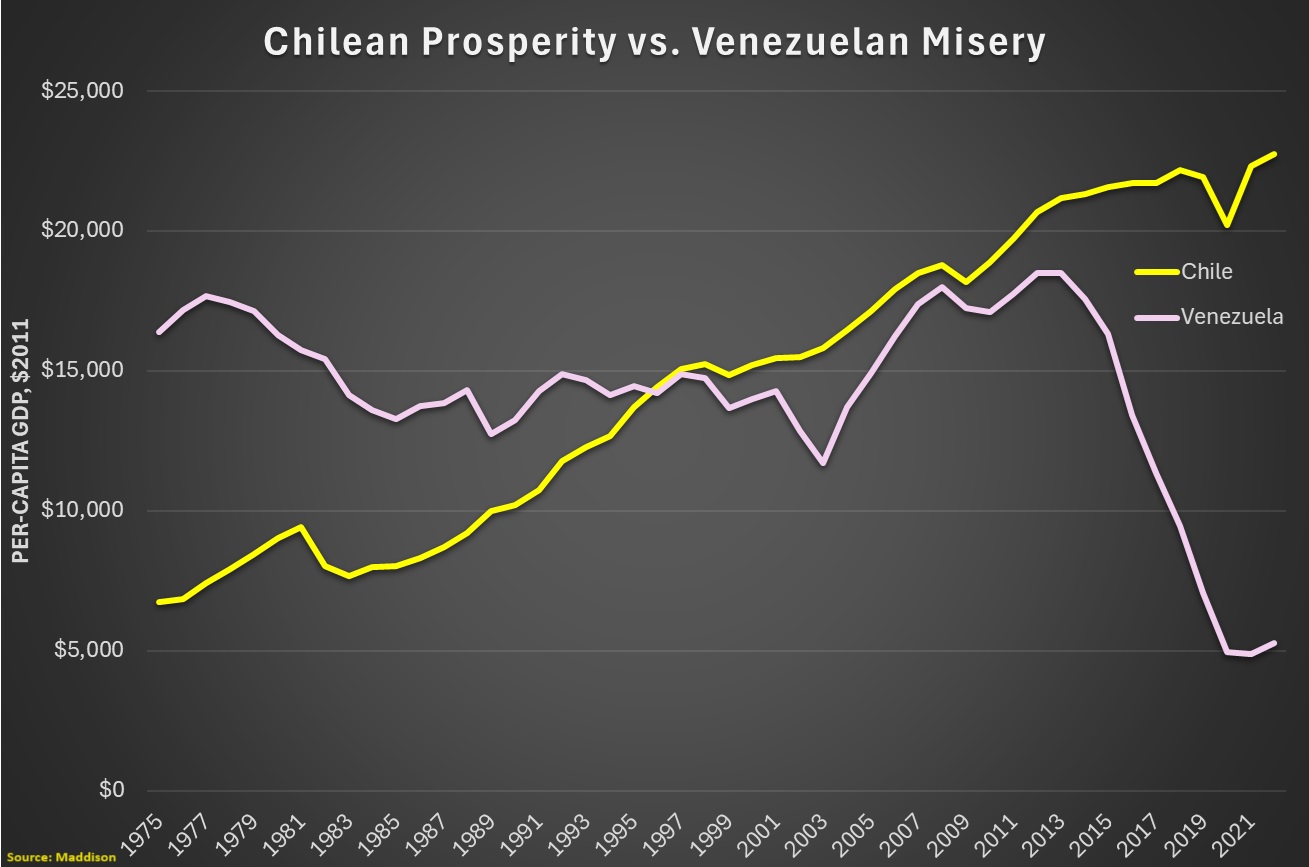
I’ve repeatedly praised Chile’s pro-market reforms (see here, here, and here) and I’ve repeatedly condemned Venezuela’s shift to socialism (see here, here, and here). But if you don’t have time to read all those columns, this chart from the Maddison database tells you everything you need to know. Simply stated, Chile’s reforms have delivered huge […]
Friedman vs Stiglitz, Chile vs Venezuela
09 Aug 2024 Leave a comment
in applied price theory, econometerics, labour economics, labour supply, poverty and inequality, unemployment, welfare reform Tags: universal basic income
This week’s column for the Stuff papers covered the excellent new US work testing the effects of a UBI. From November 2020, 3000 low-income people were randomly assigned into two groups for three years. One thousand people each received $1000 per month in unconditional funds for three years. Two thousand people each received $50 per month.Both…
Basic income, again
28 Jul 2024 Leave a comment
in applied price theory, discrimination, economic history, economics of education, gender, human capital, labour economics, labour supply, occupational choice, poverty and inequality Tags: gender wage gap, sex discrimination
23 Jul 2024 Leave a comment
in applied price theory, econometerics, human capital, labour economics, labour supply, occupational choice, poverty and inequality Tags: basic income
By Eva Vivalt, Elizabeth Rhodes, Alexander W. Bartik, David E. Broockman, Sarah Miller, Here is the link, but I am still sleeping. Here is the abstract: We study the causal impacts of income on a rich array of employment outcomes, leveraging an experiment in which 1,000 low-income individuals were randomized into receiving $1,000 per month […]
The employment effects of a guaranteed income
29 Jun 2024 Leave a comment
in discrimination, economic history, economics of education, gender, history of economic thought, human capital, labour economics, labour supply, occupational choice, politics - USA, poverty and inequality Tags: gender wage gap, sex discrimination

Claudia Goldin’s Nobel prize lecture, “An Evolving Economic Force,” has now been published in the June 2024 issue of the American Economic Review. Or if you prefer, you can watch the watch the lecture (with more numerous slides!) from the link at the Nobel website. She writes: Women are now at the center of the…
The Evolving Economic Role of Women: Goldin’s Nobel Lecture
18 Jun 2024 Leave a comment
in economics of education, human capital, labour economics, labour supply, occupational choice, poverty and inequality, unemployment Tags: graduate premium
04 Jun 2024 Leave a comment
in applied price theory, applied welfare economics, economic history, economics of education, entrepreneurship, human capital, labour economics, labour supply, occupational choice, politics - USA, poverty and inequality
02 Jun 2024 Leave a comment
in applied price theory, econometerics, economic history, human capital, labour economics, labour supply, poverty and inequality

You will be astonished, gentle reader, to learn that the question of whether worker pay has kept up with productivity growth turns out to depend on 1) how you measure worker pay; and 2) how you measure productivity growth. Scott Winship considers the alternatives and issues in “Understanding Trends in Worker Pay over the Past…
Has Worker Pay Kept Up with Productivity Growth?
31 May 2024 Leave a comment
in economic history, economics of crime, economics of education, income redistribution, labour economics, law and economics, liberalism, Marxist economics, politics - New Zealand, poverty and inequality, property rights, Public Choice, public economics Tags: child abuse, child poverty, crime and punishment, family poverty, law and order

Article is by Chris Lynch and I have pinched this one from The BFD Blog. `ĀCT MP Karen Chhour has responded to the Maori Party’s “divisive outbursts.” Co-leader Rawiri Waititi said yesterday, ‘It’s now time for us to step comfortably into our rangatiratanga and to not give too much to this Pakeha Government with their […]
Karen Chhour Skewers The Maori Party
26 May 2024 Leave a comment
in discrimination, economic history, economics of education, economics of information, gender, health and safety, human capital, labour economics, labour supply, occupational choice, poverty and inequality Tags: gender wage gap, sex discrimination

And it looks like it’s well on the way to being so, given these interesting stats out of the USA. I’d love to know how New Zealand compares in many of these categories One more generation should see large numbers of these well-educated female graduates rising to high levels of private and public sector power. […]
The Patriarchy Must Be Smashed
Celebrating humanity's flourishing through the spread of capitalism and the rule of law
Scholarly commentary on law, economics, and more
Beatrice Cherrier's blog
Celebrating humanity's flourishing through the spread of capitalism and the rule of law
Celebrating humanity's flourishing through the spread of capitalism and the rule of law
Celebrating humanity's flourishing through the spread of capitalism and the rule of law
Why Evolution is True is a blog written by Jerry Coyne, centered on evolution and biology but also dealing with diverse topics like politics, culture, and cats.
Celebrating humanity's flourishing through the spread of capitalism and the rule of law
Celebrating humanity's flourishing through the spread of capitalism and the rule of law
A rural perspective with a blue tint by Ele Ludemann
DPF's Kiwiblog - Fomenting Happy Mischief since 2003
Celebrating humanity's flourishing through the spread of capitalism and the rule of law
The world's most viewed site on global warming and climate change
Tim Harding's writings on rationality, informal logic and skepticism
A window into Doc Freiberger's library
Let's examine hard decisions!
Commentary on monetary policy in the spirit of R. G. Hawtrey
Thoughts on public policy and the media
Celebrating humanity's flourishing through the spread of capitalism and the rule of law
Politics and the economy
A blog (primarily) on Canadian and Commonwealth political history and institutions
Reading between the lines, and underneath the hype.
Economics, and such stuff as dreams are made on
"The British constitution has always been puzzling, and always will be." --Queen Elizabeth II
Celebrating humanity's flourishing through the spread of capitalism and the rule of law
Celebrating humanity's flourishing through the spread of capitalism and the rule of law
WORLD WAR II, MUSIC, HISTORY, HOLOCAUST
Undisciplined scholar, recovering academic
Celebrating humanity's flourishing through the spread of capitalism and the rule of law
Res ipsa loquitur - The thing itself speaks
Celebrating humanity's flourishing through the spread of capitalism and the rule of law
Researching the House of Commons, 1832-1868
Articles and research from the History of Parliament Trust
Reflections on books and art
Posts on the History of Law, Crime, and Justice
Celebrating humanity's flourishing through the spread of capitalism and the rule of law
Exploring the Monarchs of Europe
Cutting edge science you can dice with
Small Steps Toward A Much Better World
“We do not believe any group of men adequate enough or wise enough to operate without scrutiny or without criticism. We know that the only way to avoid error is to detect it, that the only way to detect it is to be free to inquire. We know that in secrecy error undetected will flourish and subvert”. - J Robert Oppenheimer.
The truth about the great wind power fraud - we're not here to debate the wind industry, we're here to destroy it.
Celebrating humanity's flourishing through the spread of capitalism and the rule of law
Celebrating humanity's flourishing through the spread of capitalism and the rule of law
Economics, public policy, monetary policy, financial regulation, with a New Zealand perspective
Celebrating humanity's flourishing through the spread of capitalism and the rule of law
Restraining Government in America and Around the World

 Utopia, you are standing in it!
Recent Comments