Why inequality is actually much lower in Britain than it at first seems economist.com/blogs/freeexch… http://t.co/uwjqsfan6A—
Charles Read (@EconCharlesRead) September 23, 2015
Cross-sectional versus lifetime inequality in the UK
26 Sep 2015 Leave a comment
in economic history, economics of education, human capital, labour economics, poverty and inequality Tags: British economy
Will the standard policy response to a labour market crisis reduce inequality?
24 Sep 2015 2 Comments
in applied price theory, applied welfare economics, economic history, economics of bureaucracy, economics of education, human capital, labour economics, occupational choice, poverty and inequality, Public Choice Tags: assortative mating, asymmetric marriage premium, College premium, economics of higher education, economics of schooling, economics of universities, graduate premium, marriage and divorce, power couples, university premium
Whenever there is a crisis in the labour market, the standard policy response is send them on a course. That makes you look like you care and by the time they graduate the problem will probably fixed itself. Most problems do. I found this bureaucratic response to labour market crises to repeat itself over and over again while working in the bureaucracy.
Inequality – What can be done?
Stefan Thewissen reviews Tony Atkinson’s book
bit.ly/1h0KDDF http://t.co/KiiGgFQJau—
Max Roser (@MaxCRoser) September 27, 2015
The standard policy response to a normal problem in the labour market is send them on a course. Clever geeks as yourself sitting at your desk as a policy analysis or minister did well at university. You assume others will as well including those who have neither the ability or aptitude to succeed in education. Lowering university tuition fees and easing the terms of student loans simply means that those who do well at university will not have to pay back as much to the government. People who succeed at university already have above average IQs so they already had a good head start in life.
Will more education decrease inequality? A simulation provided an answer. nyti.ms/1xw5m9W http://t.co/paQp19BEWc—
The Upshot (@UpshotNYT) March 31, 2015
The standard solution to growing inequality is to send people on a course. Trouble is that just make smart people wealthier without helping the not so smart and increases the chance of smart men and women marrying off together. This increases the inequality between power couples and the rest.
Are the rich getting richer in the USA?
24 Sep 2015 Leave a comment
in economic history, politics - USA, poverty and inequality Tags: Occupy Wall Street, top 1%
https://twitter.com/Mark_J_Perry/status/646427815693434880/photo/1
We hear a lot about rising income inequality but Census data show it's been stable for 20 yrs
aei.org/publication/th… http://t.co/Cb2u0j97fv—
Mark J. Perry (@Mark_J_Perry) September 22, 2015
Why did married couples get a pass on the great wage stagnation and the ravages of the top 1%?
20 Sep 2015 Leave a comment
in economics of love and marriage, labour economics, law and economics, poverty and inequality Tags: asymmetric marriage premium, economics of fertility, female labour force participation, male labour force participation, marriage and divorce, maternal labour force participation, single mothers, single parents
Marriage used to be a pairing of opposites: Men would work for pay and women would work at home. But in the second half of the 20th century, women flooded the labour force, raising their participation rate from 32 percent, in 1950, to nearly 60 percent in the last decade. As women closed the education gap, the very nature of marriage has changed. It has slowly become an arrangement pairing similarly rich and educated people. Ambitious workaholics used to seek partners who were happy to take care of the house. Today, they’re more likely to seek another ambitious workaholic.


The rich and educated are more likely to marry, to marry each other, and to produce rich and educated children. But this virtual cycle turns vicious for the poor.
Source: How America’s Marriage Crisis Makes Income Inequality So Much Worse – The Atlantic
@RichardvReeves Why did women get a pass on the great wage stagnation and exploitation by the top 1%?
19 Sep 2015 1 Comment
in discrimination, econometerics, economic history, gender, human capital, labour economics, labour supply, poverty and inequality Tags: female labour force participation, gender wage gap, male labour force participation, middle class stagnation, middle-class stand nation, wage stagnation
Few labour markets statistics make much sense unless broken down by gender.
Women working full-time, year-round jobs earned 78.6% of what similar men did in 2014 on.wsj.com/1KlsIC8 http://t.co/amouJSkPMr—
Real Time Economics (@WSJecon) September 19, 2015
Wages growth is no exception with female wages growth quite good for a long period of time after the 1970s – a period in which male earnings stagnated.
The beginning of male wage stagnation seemed to coincide with the closing of the gender wage gap.
U.S. wage growth doesn't look as weak when you account for benefit costs covered by employers on.wsj.com/1JJ2EmV http://t.co/s0tJutTjBy—
Nick Timiraos (@NickTimiraos) July 06, 2015
Presumably if men were previously profiting from patriarchy, that should have some implications for future wage growth and promotions for men as women catch up.
Presumably if men were previously profiting from patriarchy, that should have some implications for future wage growth for men as women catch up. Men lost the wage premium they previously earned from the sex discrimination directly in hiring, wage setting and promotions and investing in more education because they expected to be discriminated favourably at the expense of women.
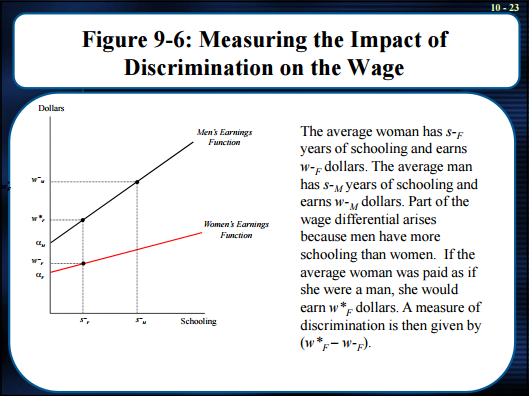
Not surprisingly the convergence in the male-female wage ratios started in the 1970s which was the decade that male wage stagnation started.

The gender wage gap started converging again also pretty much in lockstep with the top 1% starting to grab higher and higher proportions of income.
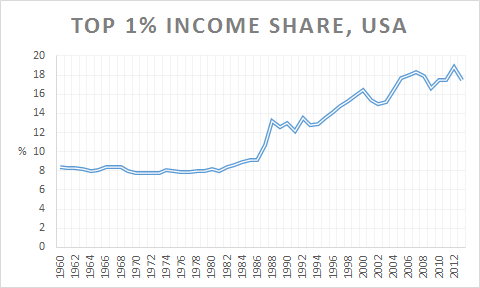
Source: Alvaredo, Facundo, Anthony B. Atkinson, Thomas Piketty and Emmanuel Saez, The World Top Incomes Database.
James Heckman on improving schools @greencatherine @dbseymour @ThomasHaig @PPTAWeb
17 Sep 2015 Leave a comment
in economics of crime, economics of education, human capital, labour supply, occupational choice, poverty and inequality Tags: behavioural genetics, crime and punishment, criminal deterrence, economics of early childhood education, economics of families, economics of fertility, economics of personality traits, marriage and divorce, single parents


@jeremycorbyn incomes of the poorest increased most under Blairism @UKLabour
13 Sep 2015 2 Comments
in economic history, labour economics, Marxist economics, poverty and inequality Tags: British economy, Leftover Left, Tony Blair, Trish Labor Party, welfare state
Under Tony Blair the incomes of the UK's poorest families increased by more than under any other Prime Minister. http://t.co/8Uh8GBqbRB—
Tom Forth (@thomasforth) September 12, 2015
@arindube Paul Krugman on the minimum/living wage in 1998
11 Sep 2015 Leave a comment
in labour economics, minimum wage, poverty and inequality Tags: family tax credits, living wage, minimum wage, social insurance


The Great Escape actually accelerated after the GFC
10 Sep 2015 Leave a comment
in development economics, economic history, global financial crisis (GFC), growth disasters, growth miracles, health economics, labour economics, macroeconomics, poverty and inequality Tags: child poverty, extreme poverty, global poverty, India, The Great Escape, The Great Fact
In 1993, >30% of India's urban population lived in extreme poverty. In 2011? Only 13%. buff.ly/1iutlQA http://t.co/238hsW2aeF—
HumanProgress.org (@humanprogress) September 09, 2015
Since 1975 average UK earnings for full-time employees have more than doubled after accounting for inflation
10 Sep 2015 Leave a comment
in applied welfare economics, economic history, labour economics, labour supply, poverty and inequality Tags: British economy, The Great Enrichment

 Utopia, you are standing in it!
Recent Comments