The average American household was poorer in 2013 than it was in 1983 – Vox

US net worth rose considerably over that period, which is what you would expect to see.

Technology has improved and productivity increased, so society has a greater capacity for wealth building. America was also quite a bit older on average in 2013 than it was in 1983, so average wealth should have gone up.

But all of these gains went to the top 20 percent of the population. It’s worse than that, actually.

Over 100 percent of the gains went to the top 20 percent, because the bottom 60 percent of the population got poorer.

What does this claim by Matthew Yglesias exactly mean? He writes frequently on economics, so his editor must think he knows something about it.

If 60% of the population got poorer as compared to 1983, they would be better off stepping into a time machine to go back to 1983. That is the only logical interpretation of this claim about 60% of the population. I owe this time machine thought experiment to Brad De Long.

Of course, going back to 1983, would involve giving up all products and services invented since then, and all product upgrades since then.

https://twitter.com/classicepics/status/561432237976322048

More importantly, for a good proportion of the population, they have become very sick or die immediately when they stepped out side of the Time Machine. This is because of shorter life expectancies in 1983 and the unavailability of a whole range of lifesaving medicines.

Am I just pedantic because I want access to crucial diabetic and other medications unavailable 30 years ago? No Internet, no cable, no international travel and no mobile phones.

In his original thought experiment, De Long asks how much you would want in additional income to agree to go back in time to a specific year. De Long was an economic historian examining the differences in living standards as compared to 1890 and 1990 and how that gap is greatly underestimated in economic statistics. De Long would have refused to go into the time machine to return to 1890 unless he could pack a very large bag to take with him:

I would want, first, health insurance: the ability to go to the doctor and be treated with late-twentieth-century medicines.

Franklin Delano Roosevelt was crippled by polio. Without antibiotic and adrenaline shots I would now be dead of childhood pneumonia.

The second thing I would want would be utility hookups–electricity and gas, central heating, and consumer appliances.

The third thing I want to buy is access to information–audio and video broadcasts, recorded music, computing power, and access to databases.

None of these were available at any price back in 1890.
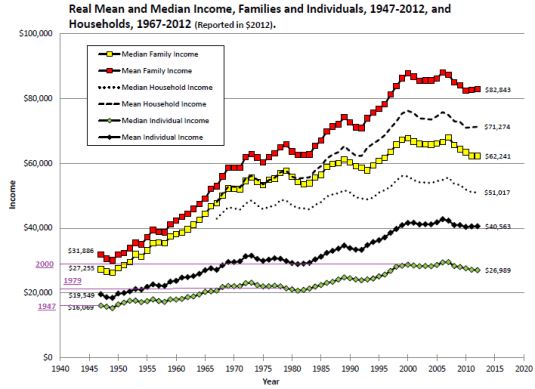
HT: http://www.vox.com/2015/1/28/7929939/net-worth-decline

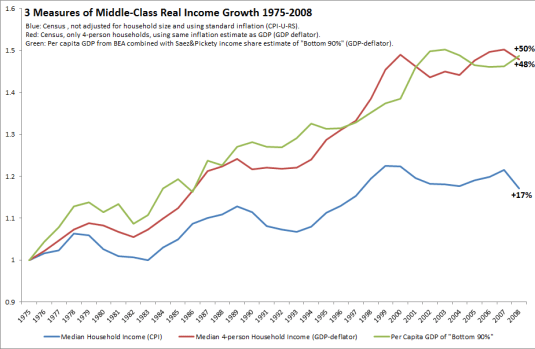
Postwar vs. New Gilded Age: How did the middle class do?

Noahpinion: Postwar vs. New Gilded Age: How did the middle class do?.

Greece should default and abandon the euro – Jeff Miron

via BBC News – Viewpoint: Greece should default and abandon the euro.

New Zealand – Chartbook of Economic Inequality

Has the dispersion of earnings been increasing in recent decades? Yes, the top decile has risen from 143 per cent of median in 1986 to 186 per cent in 2012.
Has overall inequality increased in recent years? No, the Gini coefficient has been relatively stable around 32 percent since 1996. However, it rose by 7 percentage points between 1988 and 1996.
Have there been periods when overall inequality fell for a sustained period? Yes, from mid-1950s to mid-1970s.
Has poverty been falling or rising in recent decades? Poverty has substantially increased from 1996 to 2004 before decreasing mildly till 2009.
Has there been a U-pattern for top income shares over time? Yes, top gross income shares fell from mid-1950s to mid-1980s, then rose from mid-1980s to mid-1990s.
Has the distribution of wealth followed the same pattern as income? Insufficient evidence.
Additional noteworthy features U-shape over post-war period. Top income shares estimates for the years 1998, 1999 and 2000 are affected by changes in the income tax laws. Top shares series have a break in 1951 (change in tax units).


You are welcome to share but please refer to A. B. Atkinson and S. Morelli (2014) – ‘The Chartbook of Economic Inequality’ at http://www.ChartbookOfEconomicInequality.com

This visualisation is licensed under a Creative Commons BY-NC-SA license Data visualisation by: Max Roser

New Zealand has the highest minimum wage in the world in 2014

Child poverty and single parent households in the USA


Super-Economy: The rich in Europe are poor.

via Super-Economy: The rich in Europe are poor..

The missing productivity puzzle and middle-class stagnation

via Super-Economy: The missing productivity puzzle.

Blacks Must Confront Reality About Racial Discrimination

via Blacks Must Confront Reality About Racial Discrimination – Capitalism Magazine.

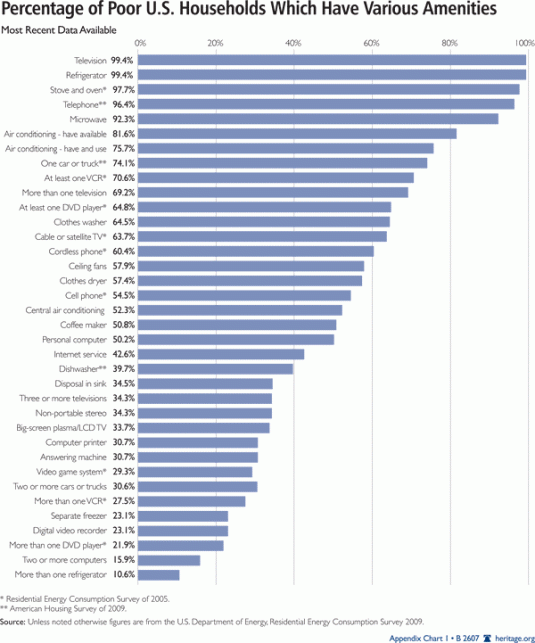
Today’s poor grow up with many amenities I didn’t have

Image

Dear Dr Sharples, please help us raise the game for ALL kids

The claim made in the letter to the Co-leader of the Maori party before the charter schools bill was passed by the New Zealand Parliament was that charter schools is “An unproven experiment is not the answer.”

Experiments are pointless if you already know the answer.

The answer is charter schools – An experiment that has proven to be immensely popular among minority parents in the USA.

Charter schools are growing fastest in New Orleans, Washington DC and Detroit – all predominately black cities with terrible public school systems.

The predominately black electorates want to experiment with something that might be better than the existing system that has failed them.

Save Our Schools NZ's avatarSave Our Schools NZ

Dear Dr  Sharples,

Increasing achievement for Maori and Pasifika students is of great importance.  The issue is at the forefront of many educators’ and parents’ minds, thanks to the charter schools debate, and for that and that alone I am grateful charters were set before us as an option.
But they are not the answer.  Charters have been shown even in the best of countries, such as Sweden, to increase inequality.  It is telling that even normally right-leaning bodies such as the Maxim Institute and SNS have spoken out against charters being the answer.  SNS are a business think tank and said charters “had increased segregation and may not have improved educational standards at all” in Sweden.  In England it is even worse, and worse still in the USA.
It is far more important that we as a country look to improving schools for all children and that we focus very…

View original post 55 more words

Digital poverty is lower than household poverty

image

Image

Milton Friedman – Rights of Workers

Video

The rise of the working rich among the top 0.1% in the USA


Source: “Income Inequality in the United States, 1913-1998” with Thomas Piketty, Quarterly Journal of Economics, 118(1), 2003, 1-39 
(Tables and Figures Updated to 2012 in Excel format, September 2013)  via Chad Jones

Before 1940, most of the income of the top 0.1% of income earners in the USA was income from investments.

By the end of the 20th century, the top 0.1% were earning their incomes as wages and salaries, business incomes and capital gains. Very little of that income of the top 0.1% was in the form of passive income from capital. The top 0.1% of the USA are now working rich – entrepreneurs.

Was Moynihan, right? The role of prospective success in assortative mating in family poverty

Image

Previous Older Entries Next Newer Entries

Bassett, Brash & Hide

Celebrating humanity's flourishing through the spread of capitalism and the rule of law

Truth on the Market

Scholarly commentary on law, economics, and more

The Undercover Historian

Beatrice Cherrier's blog

Matua Kahurangi

Celebrating humanity's flourishing through the spread of capitalism and the rule of law

Temple of Sociology

Celebrating humanity's flourishing through the spread of capitalism and the rule of law

Velvet Glove, Iron Fist

Celebrating humanity's flourishing through the spread of capitalism and the rule of law

Why Evolution Is True

Why Evolution is True is a blog written by Jerry Coyne, centered on evolution and biology but also dealing with diverse topics like politics, culture, and cats.

Down to Earth Kiwi

Celebrating humanity's flourishing through the spread of capitalism and the rule of law

NoTricksZone

Celebrating humanity's flourishing through the spread of capitalism and the rule of law

Homepaddock

A rural perspective with a blue tint by Ele Ludemann

Kiwiblog

DPF's Kiwiblog - Fomenting Happy Mischief since 2003

The Dangerous Economist

Celebrating humanity's flourishing through the spread of capitalism and the rule of law

Watts Up With That?

The world's most viewed site on global warming and climate change

The Logical Place

Tim Harding's writings on rationality, informal logic and skepticism

Doc's Books

A window into Doc Freiberger's library

The Risk-Monger

Let's examine hard decisions!

Uneasy Money

Commentary on monetary policy in the spirit of R. G. Hawtrey

Barrie Saunders

Thoughts on public policy and the media

Liberty Scott

Celebrating humanity's flourishing through the spread of capitalism and the rule of law

Point of Order

Politics and the economy

James Bowden's Blog

A blog (primarily) on Canadian and Commonwealth political history and institutions

Science Matters

Reading between the lines, and underneath the hype.

Peter Winsley

Economics, and such stuff as dreams are made on

A Venerable Puzzle

"The British constitution has always been puzzling, and always will be." --Queen Elizabeth II

The Antiplanner

Celebrating humanity's flourishing through the spread of capitalism and the rule of law

Bet On It

Celebrating humanity's flourishing through the spread of capitalism and the rule of law

History of Sorts

WORLD WAR II, MUSIC, HISTORY, HOLOCAUST

Roger Pielke Jr.

Undisciplined scholar, recovering academic

Offsetting Behaviour

Celebrating humanity's flourishing through the spread of capitalism and the rule of law

JONATHAN TURLEY

Res ipsa loquitur - The thing itself speaks

Conversable Economist

Celebrating humanity's flourishing through the spread of capitalism and the rule of law

The Victorian Commons

Researching the House of Commons, 1832-1868

The History of Parliament

Articles and research from the History of Parliament Trust

Books & Boots

Reflections on books and art

Legal History Miscellany

Posts on the History of Law, Crime, and Justice

Sex, Drugs and Economics

Celebrating humanity's flourishing through the spread of capitalism and the rule of law

European Royal History

Exploring the Monarchs of Europe

Tallbloke's Talkshop

Cutting edge science you can dice with

Marginal REVOLUTION

Small Steps Toward A Much Better World

NOT A LOT OF PEOPLE KNOW THAT

“We do not believe any group of men adequate enough or wise enough to operate without scrutiny or without criticism. We know that the only way to avoid error is to detect it, that the only way to detect it is to be free to inquire. We know that in secrecy error undetected will flourish and subvert”. - J Robert Oppenheimer.

STOP THESE THINGS

The truth about the great wind power fraud - we're not here to debate the wind industry, we're here to destroy it.

Lindsay Mitchell

Celebrating humanity's flourishing through the spread of capitalism and the rule of law

Alt-M

Celebrating humanity's flourishing through the spread of capitalism and the rule of law

croaking cassandra

Economics, public policy, monetary policy, financial regulation, with a New Zealand perspective

The Grumpy Economist

Celebrating humanity's flourishing through the spread of capitalism and the rule of law

International Liberty

Restraining Government in America and Around the World