Celebrating humanity's flourishing through the spread of capitalism and the rule of law
13 Sep 2026 Leave a comment
in applied price theory, business cycles, economics of information, history of economic thought, labour economics, labour supply, macroeconomics, Milton Friedman, monetarism, monetary economics, Robert E. Lucas, unemployment
07 Sep 2026 Leave a comment
in applied price theory, entrepreneurship, industrial organisation, labour economics, labour supply, poverty and inequality, unemployment Tags: creative destruction
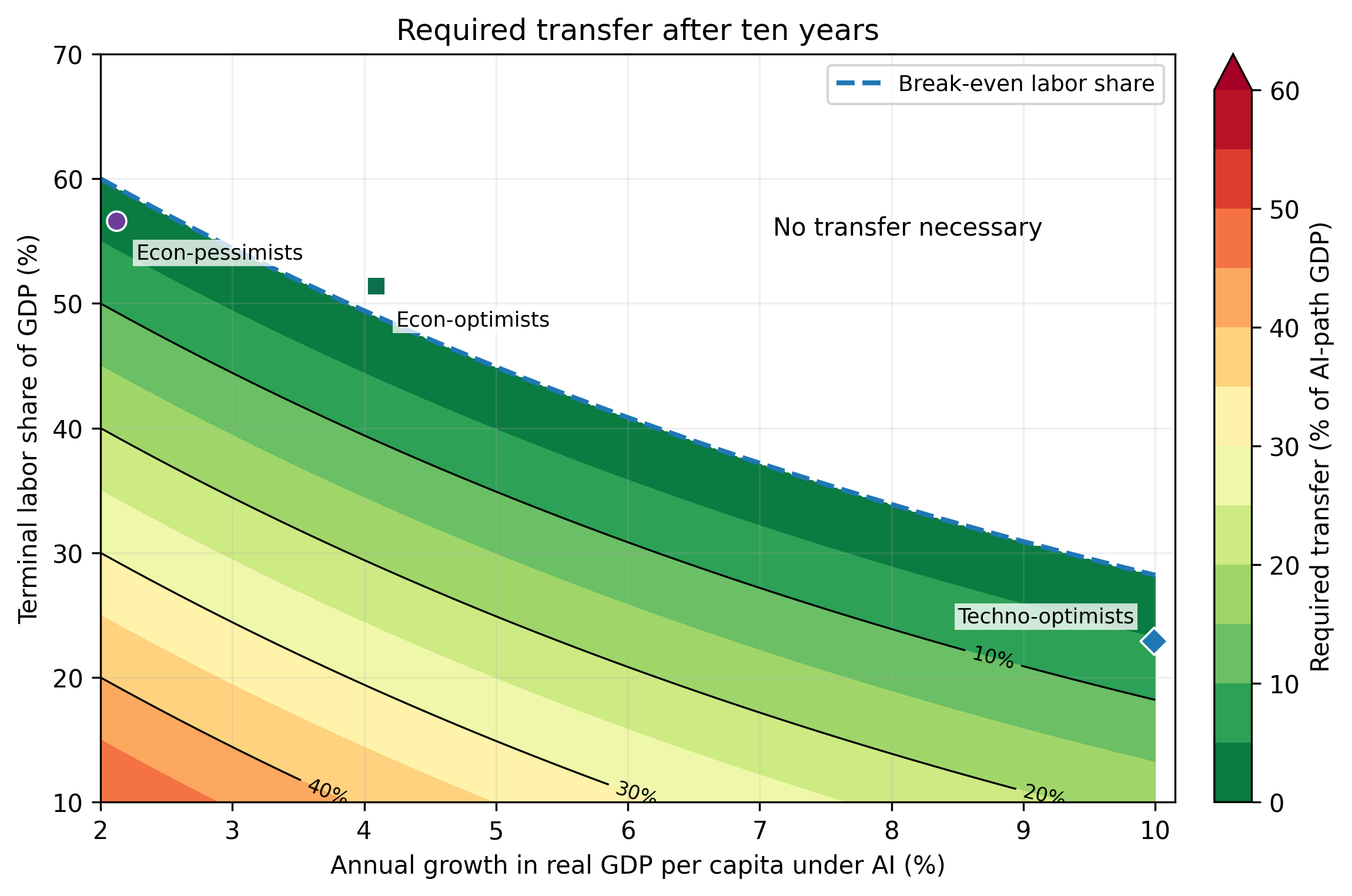
How much redistribution will AI require? A common scenario is that AI raises output enormously, but labor’s share of income collapses. GDP per capita goes up but workers get poorer, and making workers whole requires massive redistribution. In my latest paper, I run the numbers and conclude that this is probably incorrect. The idea is…
How Much Redistribution Will AI Require?
31 Aug 2026 Leave a comment
in budget deficits, business cycles, econometerics, economic growth, economic history, global financial crisis (GFC), great recession, history of economic thought, labour economics, macroeconomics, public economics, unemployment
28 Jul 2026 Leave a comment
in development economics, economic growth, economic history, fiscal policy, labour economics, macroeconomics, unemployment
This is one of the best Op-Eds you will read this year, though it deliberately deemphasizes the personal (no one is attacked) in a manner that will result in less attention. Better to write the truth! Excerpt: Why has this [voter discontent} happened? Some of it is economic. Expensive housing, stagnant incomes and widening inequality have fueled public…
The common sense of Fareed Zakaria
28 May 2026 Leave a comment
in business cycles, history of economic thought, labour economics, macroeconomics, monetary economics, unemployment
Economics has recently lost another of the greats, Nobel Prize-winning economist Edmund Phelps, who passed away last week. Phelps was a macroeconomist, and among his many contributions he helped to formalise the concept of the natural rate of unemployment. Phelps won the Nobel Prize in 2006 for “his analysis of intertemporal tradeoffs in macroeconomic policy”.Surprisingly,…
Edmund Phelps, 1933-2026
08 May 2026 Leave a comment
in applied price theory, development economics, econometerics, economic growth, economic history, history of economic thought, labour economics, macroeconomics, unemployment
Do market-oriented reforms cause economic growth? This paper revisits this question using a cross-country panel of reform episodes identified from various changes in well-known economic freedom and structural reform indices. We exploit the timing of reforms using distributed-lag and event-study frameworks that trace the dynamic response of per-capita GDP. We find little evidence of immediate…
Do Market Reforms Cause Growth?
10 Apr 2026 Leave a comment
in applied price theory, defence economics, economic history, economics of bureaucracy, energy economics, financial economics, history of economic thought, labour economics, macroeconomics, monetary economics, politics - New Zealand, Public Choice, unemployment, war and peace Tags: 1973 oil crisis, monetary policy, oil shocks

I didn’t have too much problem with either the Reserve Bank Governor’s speech a couple of weeks ago on a framework for how monetary policy might deal with the oil shock, or with this week’s OCR review release from the Monetary Policy Committee. It was really all very orthodox stuff, much as any of the […]
Oil and monetary policy
06 Apr 2026 1 Comment
in applied price theory, econometerics, economics of regulation, income redistribution, labour economics, labour supply, politics - USA, Public Choice, unemployment
Two recent joint-papers Did California’s Fast Food Minimum Wage Reduce Employment? by Clemens, Edwards and Meer and The Effects of California’s $20 Fast Food Minimum Wage on Prices by Clemens, Edwards, Meer and Nguyen give what I think is a plausible and consistent account of California’s $20 fast food minimum wage. California’s $20 fast food…
The CA Minimum Wage Increase: Summing Up
02 Apr 2026 Leave a comment
in Austrian economics, budget deficits, business cycles, economic growth, fiscal policy, global financial crisis (GFC), great depression, great recession, history of economic thought, labour economics, macroeconomics, monetarism, unemployment
TweetPrager University’s new short video on the Great Recession was inspired by Chapter 5 of Phil Gramm’s and my 2025 book, The Triumph of Economic Freedom. The post On the Great Recession appeared first on Cafe Hayek.
On the Great Recession
08 Mar 2026 Leave a comment
in applied price theory, economics of bureaucracy, economics of regulation, entrepreneurship, labour economics, law and economics, managerial economics, organisational economics, personnel economics, property rights, Public Choice, theory of the firm, unemployment Tags: creative destruction, employment law, European Union, Germany
In our textbook, Modern Principles, Tyler and I write: Imagine how difficult it would be to get a date if every date required marriage? In the same way, it’s more difficult to find a job when every job requires a long-term commitment from the employer. In two new excellent pieces, Brian Albrecht and Pieter Garicano…
The Hidden Cost of Hard-to-Fire Labor Laws: Why European Firms Don’t Take Risks
27 Dec 2025 Leave a comment
in applied price theory, Austrian economics, budget deficits, comparative institutional analysis, constitutional political economy, development economics, economic growth, economics of bureaucracy, economics of regulation, fiscal policy, growth disasters, history of economic thought, income redistribution, industrial organisation, labour economics, liberalism, libertarianism, macroeconomics, Public Choice, rentseeking, unemployment Tags: Argentina
As explained in my four-part series (here, here, here, and here) and in this clip from a recent interview, Javier Milei’s first two years have been amazingly successful. There are two points in the interview that deserve emphasis. First, Javier Milei’s libertarian policies already have been extremely beneficial for the Argentine economy. Inflation has dramatically […]
Celebrating Two Years of Libertarian Success in Argentina
05 Dec 2025 Leave a comment
in applied price theory, history of economic thought, human capital, labour economics, labour supply, Milton Friedman, occupational choice, poverty and inequality, unemployment, welfare reform
Nine years ago, I critically analyzed the Cohen-Friedman debate on means-testing Social Security. Only recently, though, did I find the original footage from 1971. As far as I know, this is the first time that any prominent social scientist made the “A program only for the poor will always be a poor program” argument that…
The Great Means-Testing Debate
25 Nov 2025 Leave a comment
in applied price theory, comparative institutional analysis, development economics, economic growth, economics of regulation, fiscal policy, growth disasters, labour economics, labour supply, liberalism, libertarianism, macroeconomics, Marxist economics, unemployment Tags: Argentina

I’m still riding high after Javier Milei’s political party won a landslide in last month’s mid-term elections in Argentina. And I’m very much hoping and expecting that gives him enough legislative support to enact big reforms next year to further liberate the Argentinian economy (tax reform, free trade, and labor market liberalization). But let’s take […]
The Milei Miracle, Part III
28 Aug 2025 Leave a comment
in applied price theory, Austrian economics, development economics, economic growth, economics of regulation, fiscal policy, growth disasters, labour economics, labour supply, law and economics, liberalism, libertarianism, macroeconomics, monetary economics, Public Choice, unemployment Tags: Argentina

Javier Milei has generated amazingly good results in just 20 months. But more reform is needed to undo the damage of 80 years of Peronism, which is why I explain that Argentina’s mid-term elections will be very important. Milei wants to turn Argentina into the world’s freest economy. That won’t be possible so long as […]
The Most Important Election(s) of 2025
Celebrating humanity's flourishing through the spread of capitalism and the rule of law
Celebrating humanity's flourishing through the spread of capitalism and the rule of law
Celebrating humanity's flourishing through the spread of capitalism and the rule of law
Celebrating humanity's flourishing through the spread of capitalism and the rule of law
Celebrating humanity's flourishing through the spread of capitalism and the rule of law
Celebrating humanity's flourishing through the spread of capitalism and the rule of law
Celebrating humanity's flourishing through the spread of capitalism and the rule of law
Celebrating humanity's flourishing through the spread of capitalism and the rule of law
Celebrating humanity's flourishing through the spread of capitalism and the rule of law
A History of the Alt-Right
Econ Prof at George Mason University, Economic Historian, Québécois
Celebrating humanity's flourishing through the spread of capitalism and the rule of law
Scholarly commentary on law, economics, and more
Beatrice Cherrier's blog
Celebrating humanity's flourishing through the spread of capitalism and the rule of law
Celebrating humanity's flourishing through the spread of capitalism and the rule of law
Celebrating humanity's flourishing through the spread of capitalism and the rule of law
Why Evolution is True is a blog written by Jerry Coyne, centered on evolution and biology but also dealing with diverse topics like politics, culture, and cats.
Celebrating humanity's flourishing through the spread of capitalism and the rule of law
A rural perspective with a blue tint by Ele Ludemann
DPF's Kiwiblog - Fomenting Happy Mischief since 2003
Celebrating humanity's flourishing through the spread of capitalism and the rule of law
The world's most viewed site on global warming and climate change
Tim Harding's writings on rationality, informal logic and skepticism
A window into Doc Freiberger's library
Let's examine hard decisions!
Commentary on monetary policy in the spirit of R. G. Hawtrey
Thoughts on public policy and the media
Celebrating humanity's flourishing through the spread of capitalism and the rule of law
Politics and the economy
A blog (primarily) on Canadian and Commonwealth political history and institutions
Reading between the lines, and underneath the hype.
Economics, and such stuff as dreams are made on
"The British constitution has always been puzzling, and always will be." --Queen Elizabeth II
Celebrating humanity's flourishing through the spread of capitalism and the rule of law
Celebrating humanity's flourishing through the spread of capitalism and the rule of law
WORLD WAR II, MUSIC, HISTORY, HOLOCAUST
Undisciplined scholar, recovering academic
Celebrating humanity's flourishing through the spread of capitalism and the rule of law
Res ipsa loquitur - The thing itself speaks
In Hume’s spirit, I will attempt to serve as an ambassador from my world of economics, and help in “finding topics of conversation fit for the entertainment of rational creatures.”
Researching the House of Commons, 1832-1868
Reflections on books and art
Posts on the History of Law, Crime, and Justice
Celebrating humanity's flourishing through the spread of capitalism and the rule of law
Exploring the Monarchs of Europe


Recent Comments