
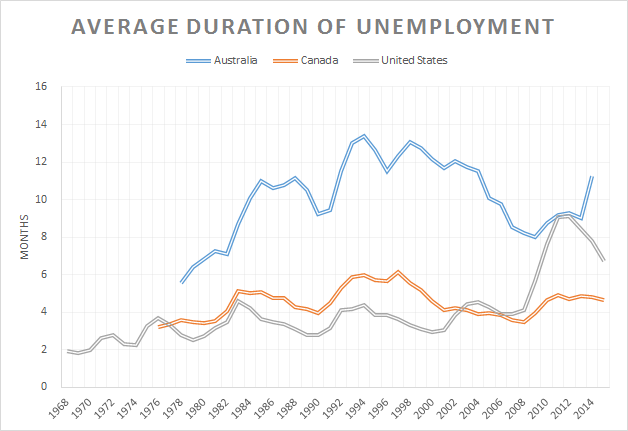
Average duration of US, Canadian and Australian unemployment since 1968
12 Oct 2016 Leave a comment
in business cycles, job search and matching, labour economics, macroeconomics, unemployment Tags: Australia, Canada, long-term unemployment, social insurance, unemployment duration
Robert Lucas on the voluntary and involuntary unemployment distinction
05 Oct 2016 Leave a comment
in job search and matching, labour economics, labour supply, macroeconomics, Robert E. Lucas, unemployment Tags: involuntary unemployment, job search, search and matching
Robert Lucas in a famous 1978 paper argued that all unemployment was voluntary because involuntary unemployment was a meaningless concept:
“The worker who loses a good job in prosperous time does not volunteer to be in this situation: he has suffered a capital loss. Similarly, the firm which loses an experienced employee in depressed times suffers an undesirable capital loss.
Nevertheless the unemployed worker at any time can always find some job at once, and a firm can always fill a vacancy instantaneously. That neither typically does so by choice is not difficult to understand given the quality of the jobs and the employees which are easiest to find.
Thus there is an involuntary element in all unemployment, in the sense that no one chooses bad luck over good; there is also a voluntary element in all unemployment, in the sense that however miserable one’s current work options, one can always choose to accept them.”
I agree that we all make choices subject to constraints. To say that a choice is involuntary because it is constrained by a scarcity of job-opportunities information is to say that choices are involuntary because there is scarcity. Alchian said there are always plenty of jobs because to suppose the contrary suggests that scarcity has been abolished.
Lucas elaborated further in 1987 in Models of Business Cycles:
A theory that does deal successfully with unemployment needs to address two quite distinct problems. One is the fact that job separations tend to take the form of unilateral decisions – a worker quits, or is laid off or fired – in which negotiations over wage rates play no explicit role.
The second is that workers who lose jobs, for whatever reason, typically pass through a period of unemployment instead of taking temporary work on the ‘spot’ labour market jobs that are readily available in any economy.
Of these, the second seems to me much the more important: it does not ‘explain’ why someone is unemployed to explain why he does not have a job with company X. After all, most employed people do not have jobs with company X either. To explain why people allocate time to a particular activity – like unemployment – we need to know why they prefer it to all other available activities: to say that I am allergic to strawberries does not ‘explain’ why I drink coffee.
Neither of these puzzles is easy to understand within a Walrasian framework, and it would be good to understand both of them better, but I suggest we begin by focusing on the second of the two.
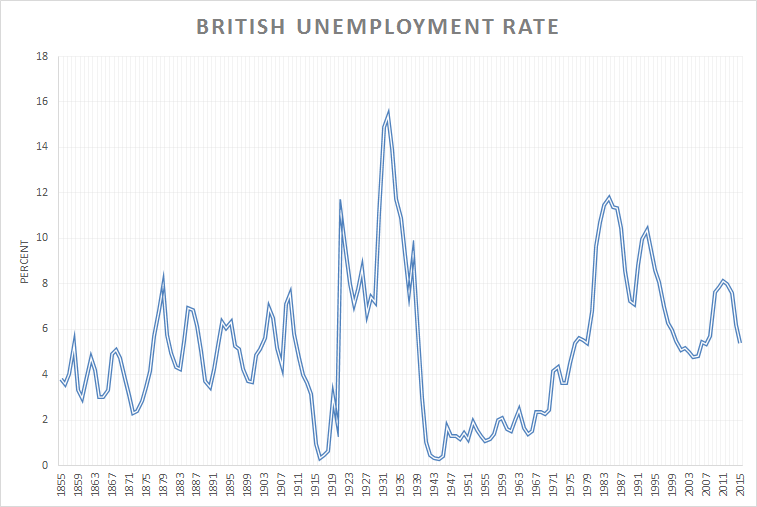
British unemployment rate since 1855
20 Aug 2016 Leave a comment
in economic history, labour economics, unemployment Tags: British economy, British history, search and matching
Average duration of Australian, Canadian and American male unemployment, aged 25 to 54
20 Jun 2016 Leave a comment
in economic history, labour economics, labour supply, unemployment Tags: social insurance, unemployment benefit

Equilibrium unemployment rate: USA, UK, France, Germany, Canada & Australia, 1985-2017
02 Jun 2016 Leave a comment
in business cycles, economic growth, economic history, global financial crisis (GFC), great recession, labour economics, labour supply, unemployment Tags: British economy, Canada, equilibrium unemployment rate, France, Germany, natural unemployment rate
I do admire the way in which the USA has been able to have a steadily falling equilibrium unemployment rate since 1984 through thick and thin. The Great Recession had no impact on the US equilibrium unemployment rate. Not only has the largest member been able to do this, the OECD host country (red squares) has had a pretty steady natural unemployment rate too all things considered.
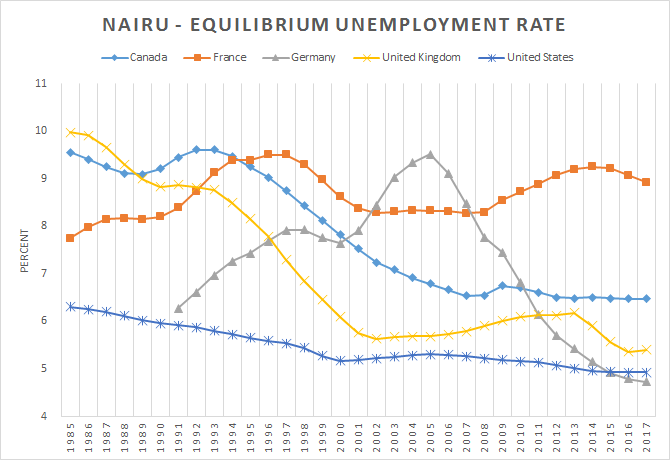
Source: OECD Economic Outlook June 2016 Data extracted on 01 Jun 2016 12:40 UTC (GMT) from OECD.Stat
Do Immigrants Steal Our Jobs?
23 May 2016 Leave a comment
in applied price theory, economic history, industrial organisation, labour economics, labour supply, unemployment Tags: economics of immigration
#FightFor15 why not double everybody’s wage if it works for the minimum wage?
21 May 2016 Leave a comment
in applied price theory, labour economics, minimum wage, politics - USA, unemployment Tags: expressive loading, rational irrationality
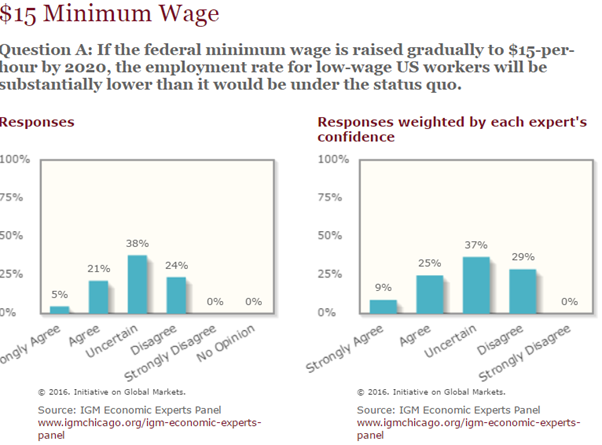
Source: Poll Results | IGM Forum.
The two-handed economist lives on in the $15 Minimum Wage debate at the IMG forum
21 May 2016 Leave a comment
in labour economics, minimum wage, politics - USA, unemployment Tags: academic bias, expressive voting, rational irrationality

Source: Poll Results | IGM Forum.
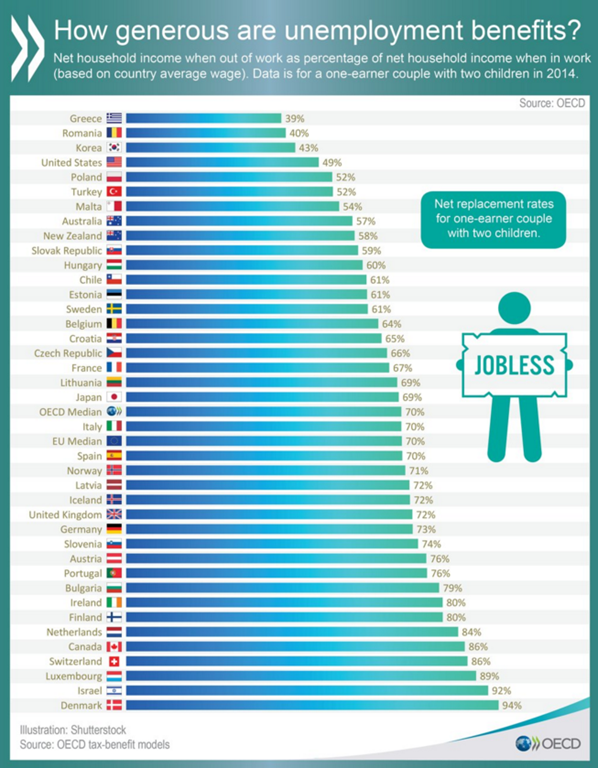
@BernieSanders @GrantRobertson1 why does anyone bother to work in #Denmark?
06 Apr 2016 Leave a comment
Unemployment rates across the OECD in 2015
26 Mar 2016 Leave a comment
in business cycles, economic growth, Euro crisis, global financial crisis (GFC), great recession, job search and matching, labour economics, macroeconomics, unemployment
The 1st @PaulKrugman on @GrantRobertson1’s #futureofwork?
21 Mar 2016 Leave a comment
in economics of regulation, labour economics, minimum wage, politics - USA, poverty and inequality, unemployment Tags: employment law, employment protection laws, France, labour market regulation, New Zealand Labour Party, rent control, social insurance, The fatal conceit, unintended consequences
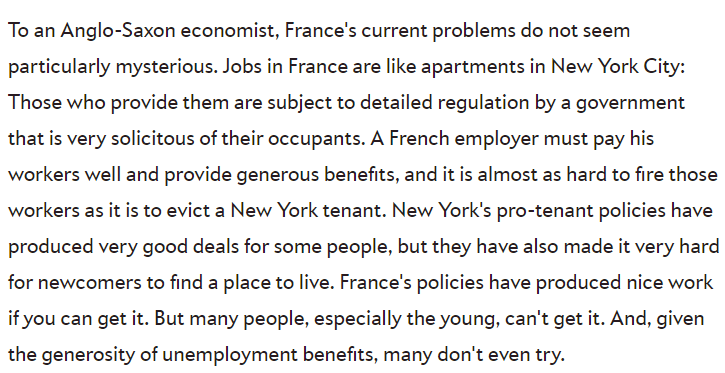
Source: Paul Krugman (1997) Unmitigated Gauls.
@James_ARobins yet another @MaxRashbrooke #inequality fact check
17 Mar 2016 Leave a comment
in applied welfare economics, economic growth, economic history, labour economics, poverty and inequality, unemployment Tags: antimarket bias, pessimism bias, rational irrationality, The Great Enrichment, top 1%

Source: Do inequality and poverty matter? | Pundit – Brian Easton (2016) .
I will outsource to Brian Easton, the CTU, the CTU’s Bill Rosenberg and Closer Together Whakatata Mai – reducing inequalities because the continual correction of Max Rashbrooke on poverty and inequality is becoming tiring.
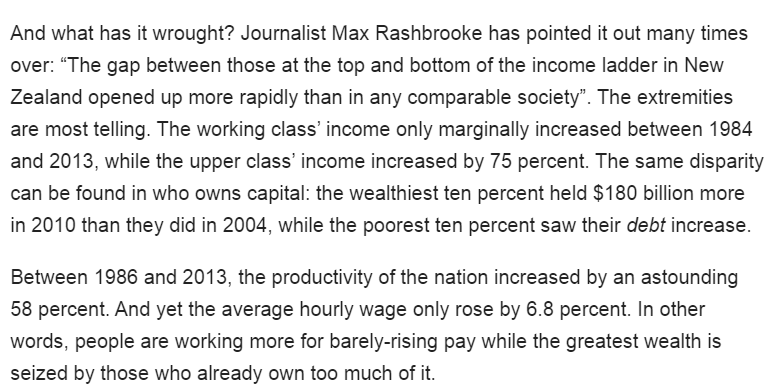
Source: Love in the time of crisis, James Robins, Wednesday, 16 March 2016, Newstalk NZ.
A brief history of inequality-from Treasury paper Fig4. Note Employment Contracts Act,GST,income tax,benefit cuts,WFF http://t.co/y4w3cUsgjD—
Bill Rosenberg (@WJRosenbergCTU) June 27, 2015
Inequality has not risen for at least 20 years as Bill Rosenberg tweeted. The rise in inequality in the late 1980s and early 1990s was followed by an employment boom that lasted to 2009.
Unemployment was as low as 3 1/2% for several years despite a large increase in labour force participation. Furthermore, the gender wage gap in New Zealand fell rapidly to now be the smallest in any industrialised country.
As the Facebook photos show, there has been strong income and wage growth despite the grizzling of the left. The return of income growth and wages growth after 20 years of real wage stagnation followed the economic reforms of the 1980s and the passage of the Employment Contracts Act in 1991.
As the CTU shows below, the economic reforms in the 1980s put an end to a sharp decline in the relative economic performance of the New Zealand economy.
Tom Sargent on how jobs are always available
10 Mar 2016 Leave a comment
in economic history, job search and matching, labour economics, labour supply, macroeconomics, unemployment

Source: How Sweden’s Unemployment Became More Like Europe’s, Lars Ljungqvist, Thomas J. Sargent 2010.
 Utopia, you are standing in it!
Recent Comments