Celebrating humanity's flourishing through the spread of capitalism and the rule of law
12 Feb 2016 Leave a comment
in applied price theory, Austrian economics, business cycles, economic growth, F.A. Hayek, fiscal policy, job search and matching, labour economics, labour supply, macroeconomics, unemployment, unions Tags: job search, mismatch unemployment, search unemployment, union power, union wage premium, waiting unemployment
12 Feb 2016 Leave a comment
in labour economics, law and economics, property rights, unemployment Tags: employment law, employment protection laws, employment regulation, mandatory notice, severance pay
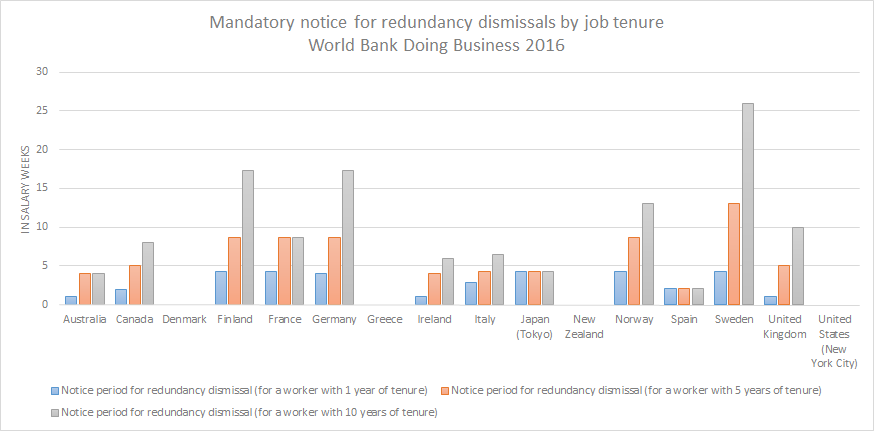
Mandatory notice periods for layoffs put the very survival of troubled the business at risk. By having to give long periods of notice, a firm experiencing a downturn is less able to adjust quickly and more likely simply to go out of business because it cannot meet its larger payroll.
Source: Labor Market Regulation – Doing Business – World Bank Group.
11 Feb 2016 Leave a comment
in human capital, job search and matching, labour economics, labour supply, law and economics, managerial economics, organisational economics, personnel economics, property rights, unemployment Tags: employment law, employment protection laws, employment regulation, firm-specific human capital, job search, labour market regulation, severance pay
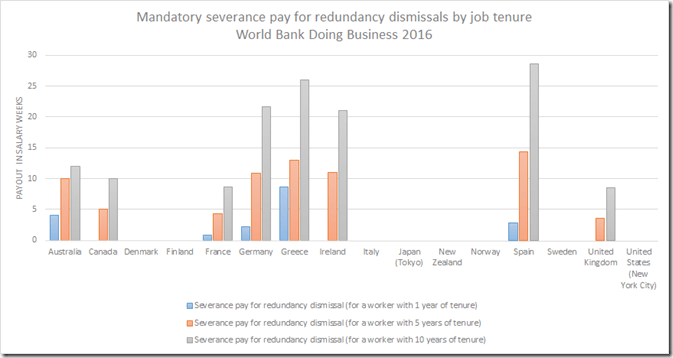
There are a wide differences across the OECD in mandatory severance pay in the event of a layoff.
Source: Labor Market Regulation – Doing Business – World Bank Group.
Severance pay makes it more expensive to fire and therefore more expensive to hire. This means fewer job vacancies will be created but they will last longer.
The presence of mandatory severance pay could increase or reduce the unemployment rate but unemployment durations will increase because it takes longer to find a suitable job match among the fewer available vacancies.
Mandating severance pay does not make the job match inherently more profitable. It just redistributes some of the surplus from the job match to the end when it is terminated.
Employers and jobseekers may agree to severance pay where investments in firm specific and job specific human capital for the job is profitable.
Severance pay in these circumstances gives the employer and more reasons to invest in specific human capital. The promise to pay severance pay will make the employer hesitate to lay them off. The employer will instead retain them over a slack period or redeploy them within the company rather than pay them out. This pre-commitment encourages investment in firm specific and job specific human capital by both sides more secure, which makes the job match more profitable overall for both sides.
Of course, if it was possible to negotiate completely around severance pay mandated by law, there would be no effects on hiring, firing and unemployment durations. All it would mean is take-home pay would be less but in the event of a layoff, these employees would get that this wage reduction back as a lump sum.
04 Feb 2016 Leave a comment
in labour economics, labour supply, minimum wage, unemployment Tags: living wage, rational irrationality, teenage unemployment, The fatal conceit
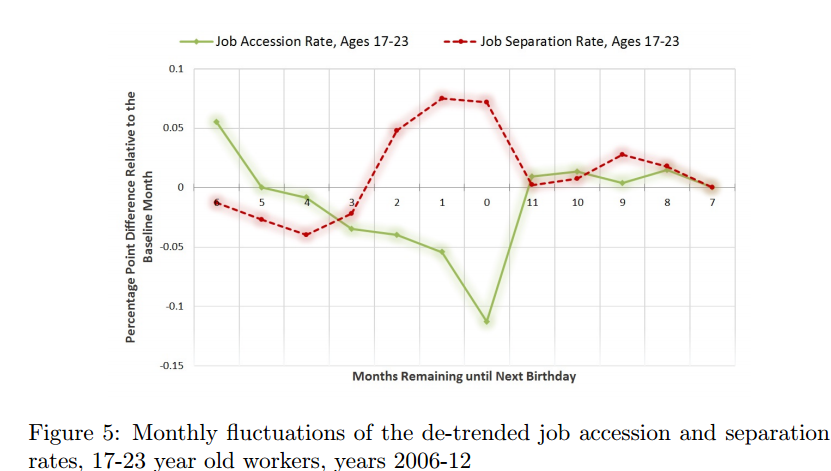
The Dutch minimum wage increases with every birthday until the age of 23. Not surprisingly, there is a surge in job losses and a recession in hiring around birthdays. What is even worse is employment opportunities are redistributed from a group with a high rate of unemployment, teenagers and young people, towards prime age adults who have a much lower rate of unemployment.
24 Jan 2016 1 Comment
in applied price theory, business cycles, macroeconomics, unemployment
Elsby, Shin and Solon (2016) have published a paper throwing a spanner in the works for business cycle theories premised on downward wage rigidity:
We devote particular attention to the hypothesis that downward nominal wage rigidity plays an important role in cyclical employment and unemployment fluctuations. We conclude that downward wage rigidity may be less binding and have lesser allocative consequences than is often supposed.
Keynesian macroeconomics is premised on downward wage rigidity. There is mass unemployment during recessions because employers are unwilling or unable to cut wages.
Elsby, Shin and Solon (2016) found that a non-trivial fraction of workers report nominal wage reductions: at least 10% of hourly workers and 20% of non-hourly workers. This fraction of workers whose nominal wage has been cut has been increasing since 1980 as shown in the chart below. The remaining workers either experienced a nominal wage freeze or a nominal wage increase in that year.
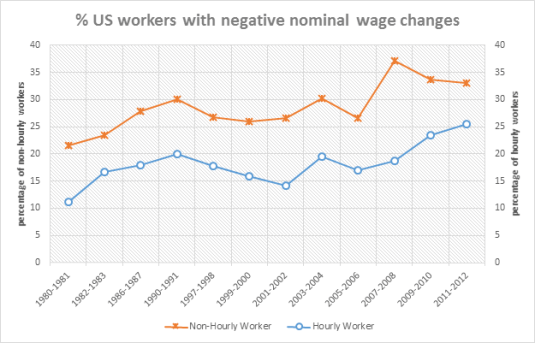
“What can wages and employment tell us about the UK’s productivity puzzle?” by Richard Blundell, Claire Crawford and Wenchao Jin found that in the recent British recession, 12% of employees in the same job as 12 months ago experienced wage freezes and 21% of workers in the same job as 12 months ago experienced wage cuts.
These results from the USA and UK come as no surprise to me because I have been on a collective employment agreement where after a restructuring, my pay was cut. The alternative was to leave and not receive a redundancy payment.
Chris Pissarides(2009), The Unemployment Volatility Puzzle: Is Wage Stickiness the Answer?, Econometrica argued the wage stickiness is not the answer to explaining unemployment since wages in new job matches are highly flexible:
1. wages of job changers are always substantially more procyclical than the wages of job stayers.
2. the wages of job stayers, and even of those who remain in the same job with the same employer are still mildly procyclical.
3. there is more procyclicality in the wages of stayers in Europe than in the United States.
4. The procyclicality of job stayers’ wages is sometimes due to bonuses, and overtime pay but it still reflects a rise in the hourly cost of labor
to the firm in cyclical peaks
I have been on several individual and collective agreements that grandfathered pay and conditions for existing workers and paid recruits less. I have lost count of the number of retirement pension scheme closed to new employees since I first encountered this cost saving practice at my first lecture at University.
My commercial law lecturer was explaining that he was lecturing part-time. His main job dealing with the litigation that might arise out of closing of the University retirement pension scheme. Some top-class academics had to retire earlier than they planned because of this closure to avoid a reduction in their pensions.
Most of my friends in the private sector are on bonus schemes were the great majority of the bonus is based on company profitability. Indeed, I know one company where everyone from the CEO down loses their bonus if there is a fatal workplace accident.
How can downward wage rigidity be a scientific hypothesis if the extensive international evidence of widespread nominal wage cuts wage cuts since the 1980s and 40%+ of the workforce on performance bonuses is not enough to refute it?
The same edition of the Journal of Labour Economics had a paper by Edward Lazear about how workplace effort varies with the business cycle and employment conditions:
…it seems that employers push their employees harder during recessions as they cut back the work force and ask each of the remaining workers to cover the tasks previously performed by the now-laid-off workers.
A number of models of long-term contracting in the labour market suggest that the level of employee effort expected varies with peak loads and general labour market conditions. That is understood from the start and is not is regarded as some form of opportunism by the employer after the contract is signed.
Likewise, employers do not lay off workers as soon as they become unprofitable in a downturn. If they did so, they would write off valuable firm specific human capital that might become profitable soon once the market recovers.
It is much easier to explain mass unemployment during a recessionas a a burst of layoffs at the beginning of the recession followed by the time it takes the unemployed to find suitable new vacancies and for employers to find it profitable to create such vacancies.
Some of these unemployed will simply wait for conditions to improve their existing industrial occupation so as to preserve their specialised human capital. These unemployed can be characterised as waiting unemployment or rest unemployment.
Other jobseekers will search further afield in new industries and occupations. These unemployed either have human capital that more general and mobile across many industries or have decided to scrap their industry specific and occupation specific human capital and try something else. The downturn in their current industry or occupation may be of sufficient duration that they regard waiting is a poor investment.
The economic concept of unemployment was rather primitive until Hutt write his hard to read theory of idle resources in 1939, Stigler’s paper in 1962 and the Phelps book in 1970.
I found Lucas and Prescott’s islands model to be an excellent explanation of unemployment. Lucas and Prescott’s economy is composed of a large number of scattered islands. Each of these islands is a one local labour market.
Workers in each of these islands have no precise knowledge of what wages will prevail in the economy outside of their own local labour market. Workers either remain on their island or leave it for what they expect to be a more alluring job further afield. Some workers are unemployed crossing between the islands, but they are nevertheless engaging in optimizing behaviour because they are looking for a better job than they have now.
Alchian (1969) lists three ways to adjust to unanticipated demand fluctuations:
• output adjustments;
• wage and price adjustments; and
• Inventories and queues (including reservations).
Alchian (1969) suggests that there is no reason for wage and price changes to be used regardless of the relative cost of these other options:
• The cost of output adjustment stems from the fact that marginal costs rise with output;
• The cost of price adjustment arises because uncertain prices and wages induce costly search by buyers and sellers seeking the best offer; and
• The third method of adjustment has holding and queuing costs.
There is a tendency for unpredicted price and wage changes to induce costly additional search. Long-term contracts including implicit contracts arise to share risks and curb opportunism over sunken investments in relationship-specific capital. These factors lead to queues, unemployment, spare capacity, layoffs, shortages, inventories and non-price rationing in conjunction with wage stability.
19 Jan 2016 Leave a comment
in Euro crisis, great recession, job search and matching, labour economics, macroeconomics, politics - New Zealand, politics - USA, unemployment Tags: Denmark, employment law, employment protection, flexicurity, labour market regulation, social insurance, welfare state
https://twitter.com/KiwiLiveNews/status/688503382181449728
My search for an example of how Danish flexicurity might have an advantage over the status quo in the New Zealand labour market is still to yield results. Danish flexicurity is no better than New Zealand and often worse in keeping long-term male unemployment rates down as the charts below show. The flexicurity model combines flexible hiring and firing with a generous social safety net and an extensive system of activation policies for the unemployed.
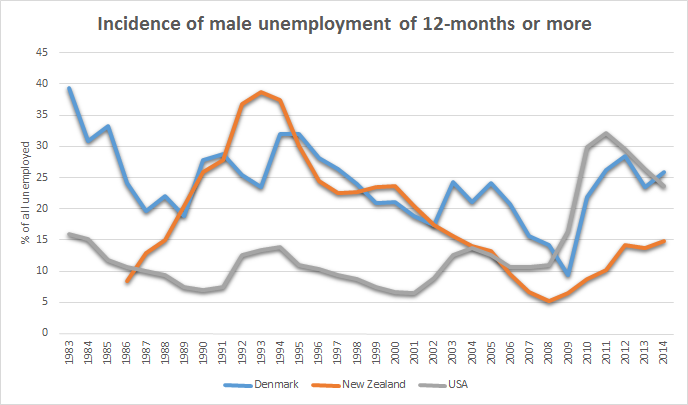
Data extracted on 18 Jan 2016 21:55 UTC (GMT) from OECD.Stat.
The charts above and below do show is that a more generous social safety net for the unemployed introduced with the onset of the Great Recession in the USA was followed by a sharp increase in the incidence of long-term unemployment.
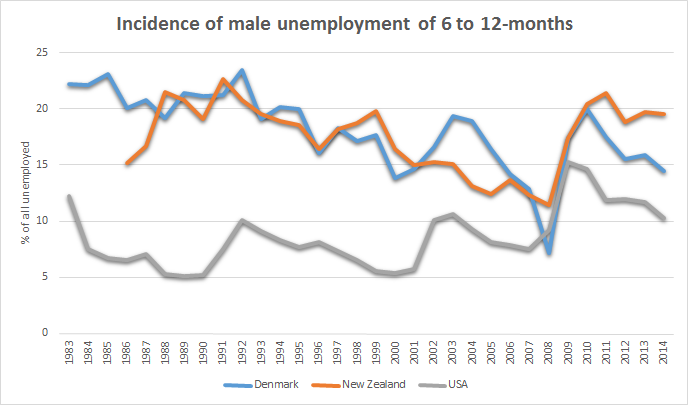
Data extracted on 18 Jan 2016 21:55 UTC (GMT) from OECD.Stat.
17 Jan 2016 Leave a comment
in economic history, labour economics, labour supply, politics - New Zealand, unemployment Tags: Denmark, employment law, labour market deregulation
The Labor Party thinks the Danish labour market is something of a model for New Zealand despite its inferior performance on unemployment.
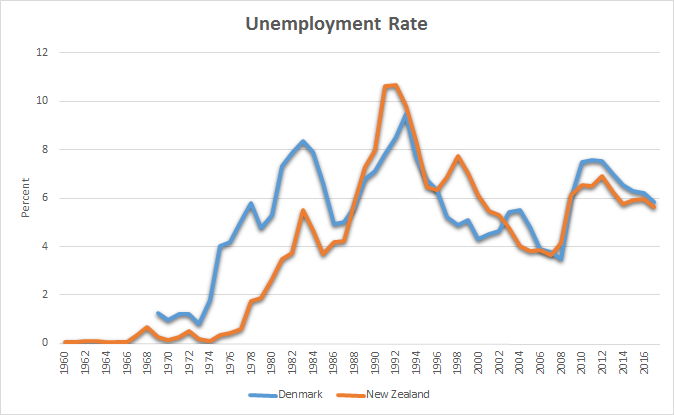
Data extracted on 17 Jan 2016 03:44 UTC (GMT) from OECD.Stat.
17 Jan 2016 Leave a comment
in labour economics, labour supply, minimum wage, politics - New Zealand, unemployment Tags: Denmark, employment law, equilibrium unemployment rate, labour market deregulation
https://twitter.com/KiwiLiveNews/status/688503382181449728
The Labour Party wants the New Zealand labour market to be more like that in Denmark. The early 1990s recession New Zealand aside, New Zealand has always had a lower equilibrium unemployment rate than Denmark.
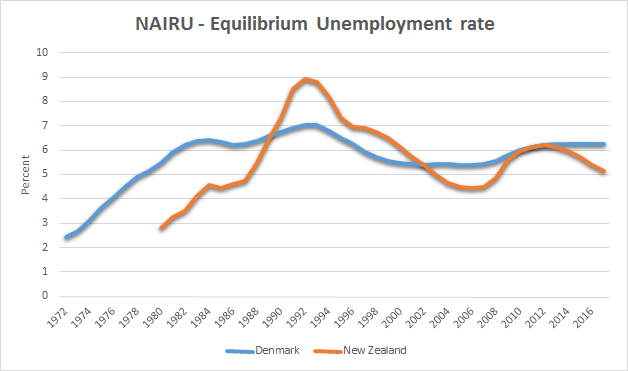
Data extracted on 17 Jan 2016 03:29 UTC (GMT) from OECD.Stat.
11 Jan 2016 Leave a comment
in business cycles, labour economics, labour supply, macroeconomics, unemployment Tags: long-term unemployment
10 Jan 2016 Leave a comment
in labour economics, labour supply, minimum wage, poverty and inequality, unemployment Tags: living wage, rational irrationality
08 Jan 2016 Leave a comment
in economics of education, politics - USA, unemployment
Fight for 15 want to argue that long-term unemployment and unemployment in general is a common problem for the skilled and unskilled. Unemployment and long-term unemployment are principally a problem of the low skilled – get over it.
Unemployment of 1-2% is not a problem, just turnover and job search.
June jobless rate for people 25+ with
B.A. or more 2.5%
High school diploma 5.4%
No H.S. 8.2%
on.wsj.com/1LG1B6z http://t.co/luUUuw9h1V—
Sudeep Reddy (@Reddy) July 02, 2015
16 Dec 2015 Leave a comment
in applied price theory, labour economics, labour supply, politics - New Zealand, poverty and inequality, unemployment
Jacinda Adern does have a point that the Prime Minister overplayed the role of drug dependency in child poverty, but he is not completely off the mark. A whole bunch of self-destructive behaviours play a role in family poverty.

Source: Minister of Social Development Cabinet Paper on Pre-employment Drug Testing Requirements.
Too many children have irresponsible parents. Caplan along with Charles Murray point out that a number of pathologies are particularly prevalent among poor:
Caplan is disputing that healthy adults who are poor are victims. That is central to the poverty is not a choice movement: the poor are victims.
The New Zealand experience with work testing of beneficiaries for drugs is most of them quickly stopped using dope. Many jobs have tests for drug-taking.
27 Nov 2015 Leave a comment
in economic history, job search and matching, labour economics, unemployment
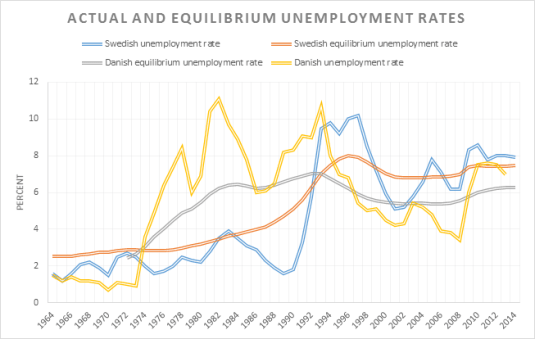
The Danish equilibrium unemployment rate has been surprisingly stable since 1982 despite rather volatile actual unemployment. The Swedish unemployment rate was allowed to increase in line with the economic crisis in the early 1990s and that was it. How nice it must be for the Danes and Swedes to have such stable labour market institutions.
Source: OECD Economic Outlook November 2015.
The Danes have a highly deregulated labour market. There were major economic and welfare state reforms in Sweden in the early 1990s in response to high unemployment. These institutional developments barely showed up in their equilibrium unemployment rates.
27 Nov 2015 Leave a comment
in economic history, job search and matching, labour economics, unemployment
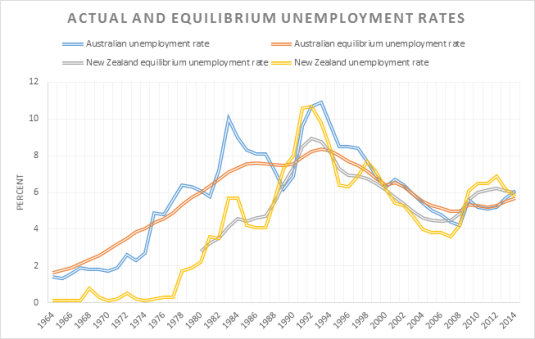
The Australian and New Zealand equilibrium unemployment rates are much more obedient. They neatly track actual unemployment with few exceptions for recessions. So much so is this close tracking of the actual unemployment rate by the equilibrium unemployment rate that you wonder what extra the latter concept adds.
Source: OECD Stat and OECD Economic Outlook November 2015.
26 Nov 2015 1 Comment
in economic history, job search and matching, unemployment
Unlike the USA, the OECD’s host country’s actual and equilibrium unemployment rates track each other rather too closely for comfort. In contrast, Italian unemployment hardly ever catches up with the Italian equilibrium unemployment rate. In common with the US equilibrium unemployment rate, the Italian equilibrium unemployment rate was rather stable for quite some time.

Source: OECD Stat and OECD Economic Outlook November 2015
Celebrating humanity's flourishing through the spread of capitalism and the rule of law
Scholarly commentary on law, economics, and more
Beatrice Cherrier's blog
Celebrating humanity's flourishing through the spread of capitalism and the rule of law
Celebrating humanity's flourishing through the spread of capitalism and the rule of law
Celebrating humanity's flourishing through the spread of capitalism and the rule of law
Why Evolution is True is a blog written by Jerry Coyne, centered on evolution and biology but also dealing with diverse topics like politics, culture, and cats.
Celebrating humanity's flourishing through the spread of capitalism and the rule of law
Celebrating humanity's flourishing through the spread of capitalism and the rule of law
A rural perspective with a blue tint by Ele Ludemann
DPF's Kiwiblog - Fomenting Happy Mischief since 2003
Celebrating humanity's flourishing through the spread of capitalism and the rule of law
The world's most viewed site on global warming and climate change
Tim Harding's writings on rationality, informal logic and skepticism
A window into Doc Freiberger's library
Let's examine hard decisions!
Commentary on monetary policy in the spirit of R. G. Hawtrey
Thoughts on public policy and the media
Celebrating humanity's flourishing through the spread of capitalism and the rule of law
Politics and the economy
A blog (primarily) on Canadian and Commonwealth political history and institutions
Reading between the lines, and underneath the hype.
Economics, and such stuff as dreams are made on
"The British constitution has always been puzzling, and always will be." --Queen Elizabeth II
Celebrating humanity's flourishing through the spread of capitalism and the rule of law
Celebrating humanity's flourishing through the spread of capitalism and the rule of law
WORLD WAR II, MUSIC, HISTORY, HOLOCAUST
Undisciplined scholar, recovering academic
Celebrating humanity's flourishing through the spread of capitalism and the rule of law
Res ipsa loquitur - The thing itself speaks
Celebrating humanity's flourishing through the spread of capitalism and the rule of law
Researching the House of Commons, 1832-1868
Articles and research from the History of Parliament Trust
Reflections on books and art
Posts on the History of Law, Crime, and Justice
Celebrating humanity's flourishing through the spread of capitalism and the rule of law
Exploring the Monarchs of Europe
Cutting edge science you can dice with
Small Steps Toward A Much Better World
“We do not believe any group of men adequate enough or wise enough to operate without scrutiny or without criticism. We know that the only way to avoid error is to detect it, that the only way to detect it is to be free to inquire. We know that in secrecy error undetected will flourish and subvert”. - J Robert Oppenheimer.
The truth about the great wind power fraud - we're not here to debate the wind industry, we're here to destroy it.
Celebrating humanity's flourishing through the spread of capitalism and the rule of law
Celebrating humanity's flourishing through the spread of capitalism and the rule of law
Economics, public policy, monetary policy, financial regulation, with a New Zealand perspective
Celebrating humanity's flourishing through the spread of capitalism and the rule of law
Restraining Government in America and Around the World
 Utopia, you are standing in it!
Recent Comments