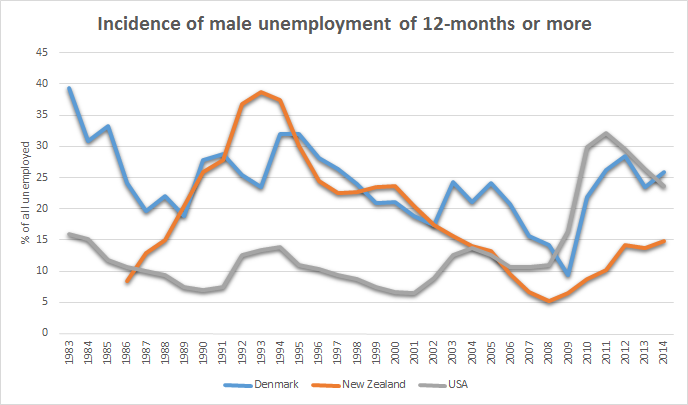
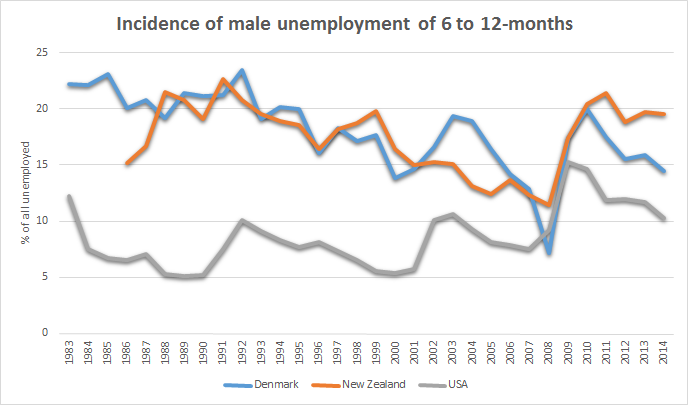
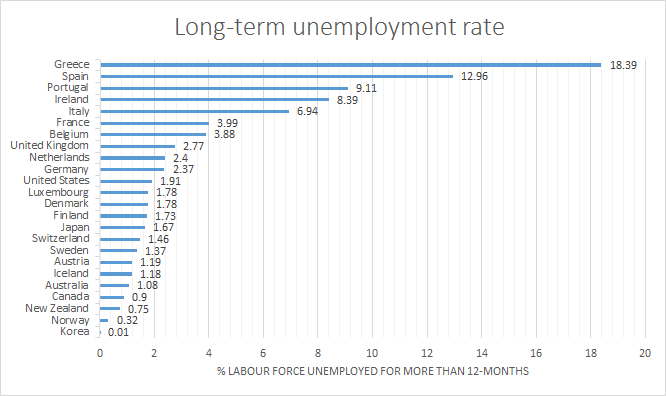
My search for an example of how Danish flexicurity might have an advantage over the status quo in the New Zealand labour market is still to yield results. Danish flexicurity is no better than New Zealand and often worse in keeping long-term male unemployment rates down as the charts below show. The flexicurity model combines flexible hiring and firing with a generous social safety net and an extensive system of activation policies for the unemployed.
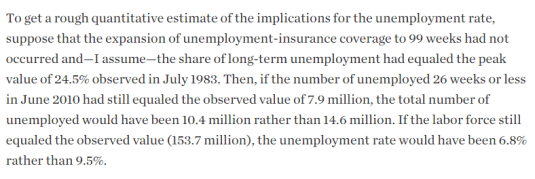
The charts above and below do show is that a more generous social safety net for the unemployed introduced with the onset of the Great Recession in the USA was followed by a sharp increase in the incidence of long-term unemployment.
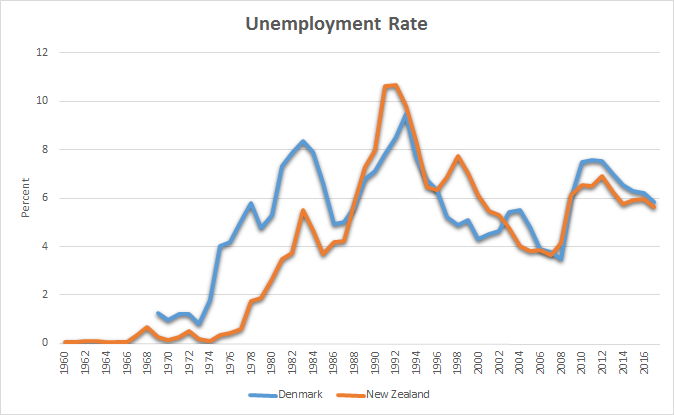
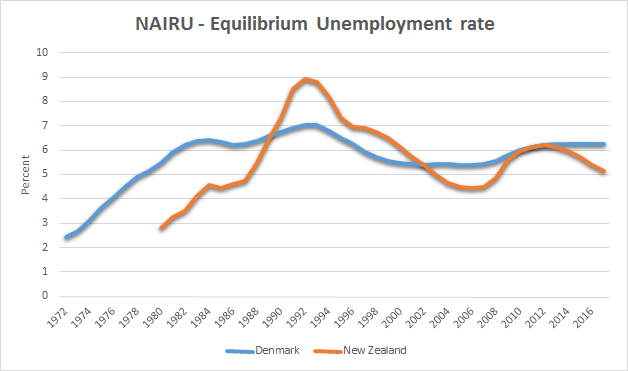
The Labour Party wants the New Zealand labour market to be more like that in Denmark. The early 1990s recession New Zealand aside, New Zealand has always had a lower equilibrium unemployment rate than Denmark.
Fight for 15 want to argue that long-term unemployment and unemployment in general is a common problem for the skilled and unskilled. Unemployment and long-term unemployment are principally a problem of the low skilled – get over it.
Unemployment of 1-2% is not a problem, just turnover and job search.
Jacinda Adern does have a point that the Prime Minister overplayed the role of drug dependency in child poverty, but he is not completely off the mark. A whole bunch of self-destructive behaviours play a role in family poverty.
Too many children have irresponsible parents. Caplan along with Charles Murray point out that a number of pathologies are particularly prevalent among poor:
alcoholism: Alcohol costs money, interferes with your ability to work, and leads to expensive reckless behaviour.
drug addiction: Like alcohol, but more expensive, and likely to eventually lead to legal troubles you’re too poor to buy your way out of.
single parenthood: Raising a child takes a lot of effort and a lot of money. One poor person rarely has enough resources to comfortably provide this combination of effort and money.
unprotected sex: Unprotected sex quickly leads to single parenthood. See above.
dropping out of high school: High school drop-outs earn much lower wages than graduates. Kids from rich families may be able to afford this sacrifice, but kids from poor families can’t.
being single: Getting married lets couples avoid a lot of wasteful duplication of household expenses. These savings may not mean much to the rich, but they make a huge difference for the poor.
non-remunerative crime: Drunk driving and bar fights don’t pay. In fact, they have high expected medical and legal expenses. The rich might be able to afford these costs. The poor can’t.
Caplan is disputing that healthy adults who are poor are victims. That is central to the poverty is not a choice movement: the poor are victims.
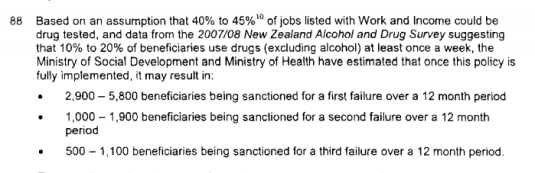
The New Zealand experience with work testing of beneficiaries for drugs is most of them quickly stopped using dope. Many jobs have tests for drug-taking.
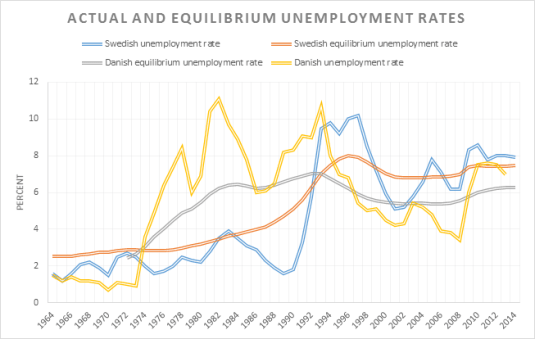
The Danish equilibrium unemployment rate has been surprisingly stable since 1982 despite rather volatile actual unemployment. The Swedish unemployment rate was allowed to increase in line with the economic crisis in the early 1990s and that was it. How nice it must be for the Danes and Swedes to have such stable labour market institutions.
Source: OECD Economic Outlook November 2015.
The Danes have a highly deregulated labour market. There were major economic and welfare state reforms in Sweden in the early 1990s in response to high unemployment. These institutional developments barely showed up in their equilibrium unemployment rates.
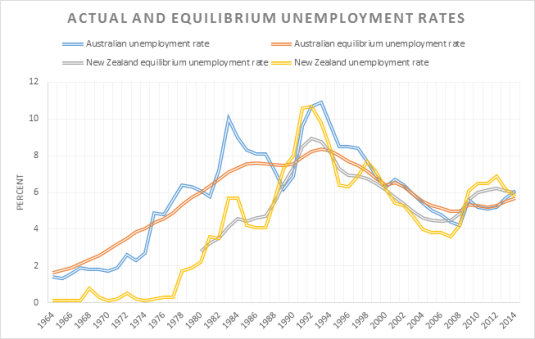
The Australian and New Zealand equilibrium unemployment rates are much more obedient. They neatly track actual unemployment with few exceptions for recessions. So much so is this close tracking of the actual unemployment rate by the equilibrium unemployment rate that you wonder what extra the latter concept adds.
Source: OECD Stat and OECD Economic Outlook November 2015.
Unlike the USA, the OECD’s host country’s actual and equilibrium unemployment rates track each other rather too closely for comfort. In contrast, Italian unemployment hardly ever catches up with the Italian equilibrium unemployment rate. In common with the US equilibrium unemployment rate, the Italian equilibrium unemployment rate was rather stable for quite some time.
Source: OECD Stat and OECD Economic Outlook November 2015
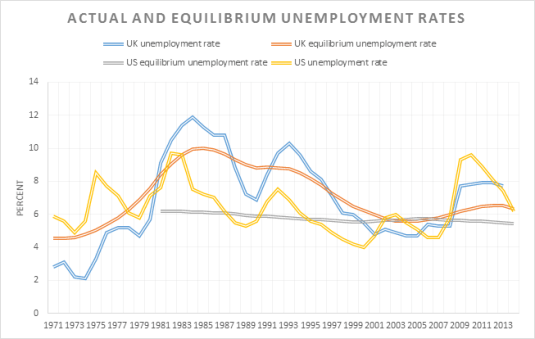
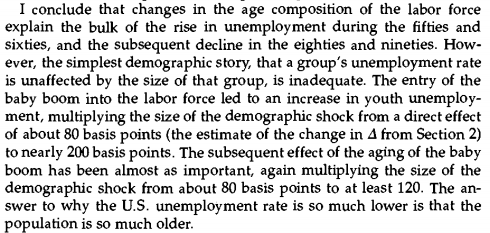
I can’t think of a charitable explanation of why the equilibrium unemployment rate is so stable in the USA and yet tracks actual unemployment with a bit of a lag in the UK. There is a large literature showing that the equilibrium unemployment rate in the USA has gone up and down quite significantly if only for demographic reasons related to the baby boomers passing through the workforce in large numbers in the 70s.
Source: OECD Stat and OECD Economic Outlook November 2015.
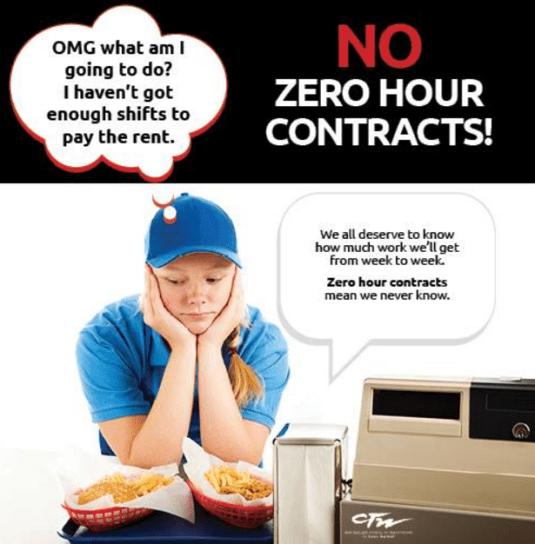
I stayed on after my Parliamentary testimony this morning to listen to others. A dozen or more made submissions arguing for more regulation – usually asking that zero hours contracts be outlawed.
I was the only submitter so far who argued against any regulation of zero hours contracts. I was thanked for putting a different perspective at the end of my submission. All members of the committee were very polite and listen to what I had to say.
Inadvertently, of course, Iain Lees-Galloway and Sue Moroney of the Labour Party and several members of the Public Service Association unearthed telling points against the case for regulation of zero hours contracts in the course of the morning in both the submissions and through the Q&A.
The first member of the Public Service Association to present information against zero hours contracts was a home support worker who was a union organiser.
This Public Service Association union organiser said, among many points in a kitchen sink submission, that zero hour contracts would deter people from entering her industry. That’s my point about zero hours contracts:
Zero hours contracts are a risk to employers when recruiting unless they are packaged within an attractive job offer; and
Offering a zero hours contracts will deter applicants from accepting a job offer unless there is some compensating factor in that offer.
A second member of the Public Service Association talked about her daughter who was on a zero hours contract in her first job. After a seven-month spell of unemployment, her daughter worked as many shifts as possible to show she was a valued member of her team. Good for her. In low skilled jobs, what employers look for is someone who is friendly and reliable.
Part of that story was about the difficulties of her daughter with the correct payment of her unemployment benefit. Every Friday she has to telephone WINZ to forecast how many hours she expected to work in the following week so her unemployment benefit is correctly calculated for the following paid day.
From time to time, the submitter’s daughter was called in at the last minute for a shift on her zero hours contract at the weekend so that estimate of the previous day is incorrect and she is overpaid on her benefit.
This retention of unemployment benefit eligibility is a key point against the arguments raised by Iain Lee-Galloway about how workers and, in particular, the unemployed have no option but to accept zero hours contracts. Galloway was correct in making this the crux of the matter.
He can he kept stressing the inequality of bargaining power and a lack of options of job applicants when questioning me at the hearings this morning.
It was Iain Lees-Galloway who set up this bargaining power inequality as a crucial argument against zero hours contracts, not me. Zero hours contracts are said by the Labour Party and the unions to be a bad deal. It’s an offer job seekers cannot refuse, especially if they’re unemployed.
If beneficiaries do have options and they can refuse an offer of a zero hours contract, as 50% of British unemployment beneficiaries do, most arguments for the regulation or prohibition of zero hours contracts fall of the first hurdle.
The submitter’s daughter was still on an unemployment benefit despite taking a zero hours contract. She had options. She had a basic income, the unemployment benefit, so she was never left in the lurch if there was no shift that week. She never earned less than the unemployment benefit weekend and week out and often earned more.
No one who already has a job would take a zero hours contracts unless they were confident of matching the hours and income they earn now; and
An unemployment beneficiary keeps the unemployment benefit as a cushion when they accept a zero hours contract unless they earn more than $200 a week.
The unemployment benefit allows beneficiaries to earn up to $200 a week after which benefit is withdrawn at 50 cents per dollar. As the beneficiary is still on the benefit, they have access to those all-important 2nd tier benefits ranging from accommodation allowances to special grants for unexpected urgent expenses.
Zero hours contracts allow the unemployed to make the benefit pay. Simon Chapple pointed out to me a few years ago that part-time work and benefit receipt can be an attractive long-term option for low skilled workers such as single mothers. The unemployment or single-parent beneficiary who works part-time has the certainty of the unemployment benefit plus a couple hundred dollars extra-week from their part-time job while retaining the second tier benefits that guard against unexpected expenses.
Sue Moroney then finished off the case against regulating zero hours contracts when questioning a submitter from the construction industry. The submitter was discussing the generosity of parental leave as well as zero hours contracts.
Sue Moroney pointed out that because of childcare responsibilities, the ability of that industry to attract women is greatly diminished if they offer zero hours contracts. She was pointing out a major cost of zero hours contracts to employers who offer them.
Sue Moroney highlighted the risk to employers of cutting themselves off from a major part of the job applicant pool – mothers of young children. That is a big cost unless employers offering zero hours contracts either pay a wage premium to keep access to that talent or offer these contracts to teenagers and adults, men and women, who circumstances dispose to working variable hours, sometimes working long hours and sometimes not working at all that week.
Zero hours contracts is an issue about job search and job matching. These contracts will benefit some employers and some employees. Other jobseekers will not sign such contracts. Still others will find that after signing a zero hours contract, that was not the best choice for them in retrospect. That form of on-the-job learning about competing job opportunities is common. Young people spend their first 10 to 15 years in the workforce job shopping. They move through half a dozen or more different jobs, employers and even industries before they find a good fit for them and stay on.
All in all, zero hours contracts empower the unemployed. Zero-hours contracts allow the unemployed to try out jobs while keeping their unemployment or single parent benefit. They don’t have to go completely off the benefit then risk a stand-down period of 6 to 12 weeks if they leave a regular job that is unsatisfactory.
Furthermore, the zero hours contracts give them an opportunity sometimes to earn a lot of money in a short period of time was still retaining their benefit eligibility. As another member of the Public Service Association mentioned when your wages balloon because of long hours one week, your benefit is wound back, but they are still on their benefit. They don’t have to reapply and risk of stand-down period
Zero hours contracts expand the options of jobseekers, especially the unemployed. Taking a zero hours contract gives the unemployed the option to test out a job without having to give up their unemployment benefit. They are empowering, not put upon as the Labour Party and the union members argued today.
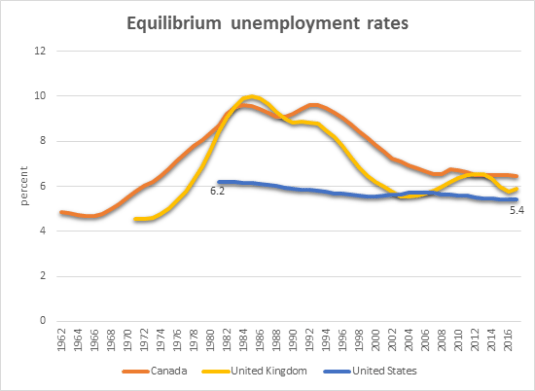
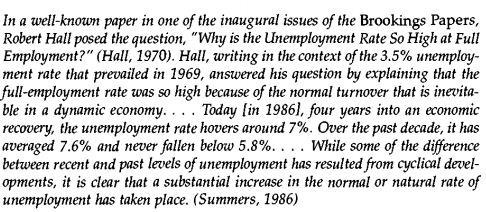
The equilibrium unemployment rate in the USA has been dead flat at a little under 6% as far back as the OECD Economic Outlook November 2015 can estimate. The Canadian and British equilibrium unemployment rates have gone up and down to the point of near doubling at times. Institutions cannot be so stable in the USA and so unstable Canada and Britain in terms of the incentives to post vacancies, for search for work in the same in different industries and occupations and revise asking wages. We’re talking about a 35 year stretch macroeconomic and labour market policy in the USA.
More correctly, for the early 1970s literature, the equilibrium unemployment rate had risen to 4% after being at an equilibrium rate of about 3%. Something doesn’t add up.
This estimate of an unchanging US equilibrium unemployment rate doesn’t add up even more when you consider the discussions after the Great Recession about how the extensions to unemployment insurance from a time limit of 26 weeks to 99 weeks would increase the equilibrium unemployment rate. Something really doesn’t add up for the US equilibrium unemployment rate to be so stable and the British and Canadian equilibrium unemployment rates to be so volatile.
Why Evolution is True is a blog written by Jerry Coyne, centered on evolution and biology but also dealing with diverse topics like politics, culture, and cats.
In Hume’s spirit, I will attempt to serve as an ambassador from my world of economics, and help in “finding topics of conversation fit for the entertainment of rational creatures.”
“We do not believe any group of men adequate enough or wise enough to operate without scrutiny or without criticism. We know that the only way to avoid error is to detect it, that the only way to detect it is to be free to inquire. We know that in secrecy error undetected will flourish and subvert”. - J Robert Oppenheimer.


 Utopia, you are standing in it!
Recent Comments