I do not know enough about Canadian politics and unemployment insurance arrangements to understand why its percentage of long-term unemployed did not change much after the global financial crisis while it skyrocketed in the USA. European unemployment duration is already been long. There was a significant improvement in the number of long-term unemployed as percentage of all unemployed men under the horrors of Thatcherism.
The unemployment rate was zero in New Zealand in 1956, 1957 and 1961. Apparently no one was jobless even for a day in New Zealand when changing jobs or entering or re-entering the workforce from outside employment, from school or other educational callings or as a migrant, if the OECD data is to be believed.
Unemployment was 1% for the rest of the 1960s in New Zealand before skyrocketing to 2.5% in 1975. By 1983, under the best of the good old days before the scourge of neoliberalism, unemployment rate had reached 5.5% after a steady increase from more than a decade.
The less than 1% unemployment was mostly under National Party rule but this era is looked upon with great fondness by the left-wing in New Zealand. Same in Australia where the good old days are known as the Menzies era: 23 years of Conservative party rule but beloved now by the left-wing as the ideal mixed economy.
Australian unemployment rates in the late 1960s was also pretty low given the requirements of labour market churn and entry on re-entry into the labour force.
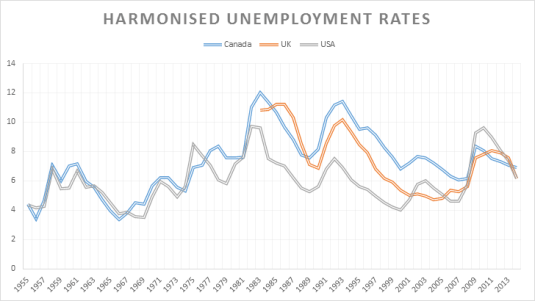
Canada has had much worse unemployment rates than the USA since the late 1970s. British unemployment rates have been doing okay since the late 1990s until the global financial crisis.
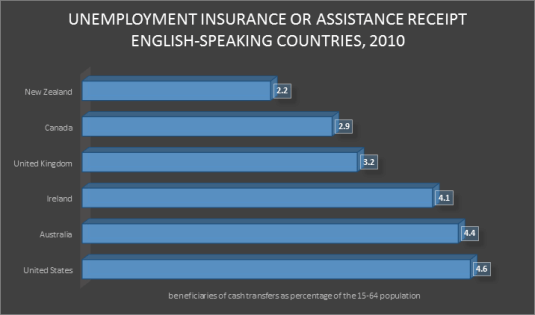
Ireland has a secondary out of work benefit for the unemployed that adds another 8.7% to their welfare rolls in 2010 but it is not in the OECD data table for the above graph.
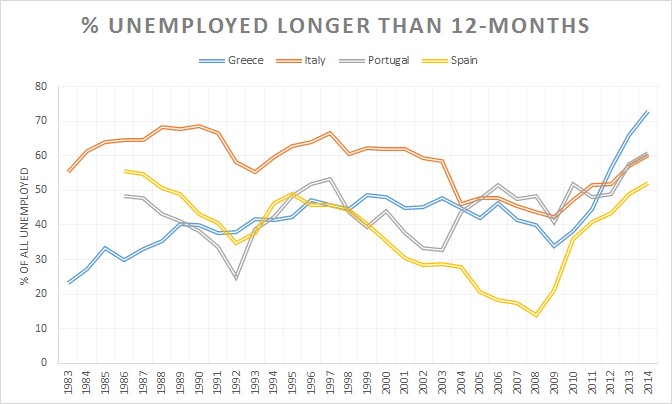
The boom that preceded the bust in the Greek economy did nothing for the rate of long-term unemployment among Greeks. Long-term unemployment had been pretty stable prior to the economic boom after joining the euro currency union.
Source: OECD StatExtract.
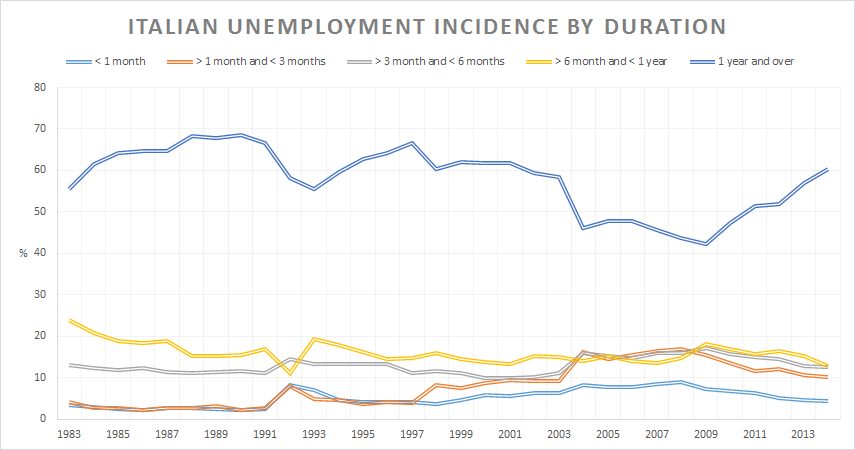
Nothing much happened to long-term unemployment in Italy or Portugal in recent decades. Spanish long-term unemployment fell in line with the economic boom in Spain over the 1980s and 1990s up until the global financial crisis.
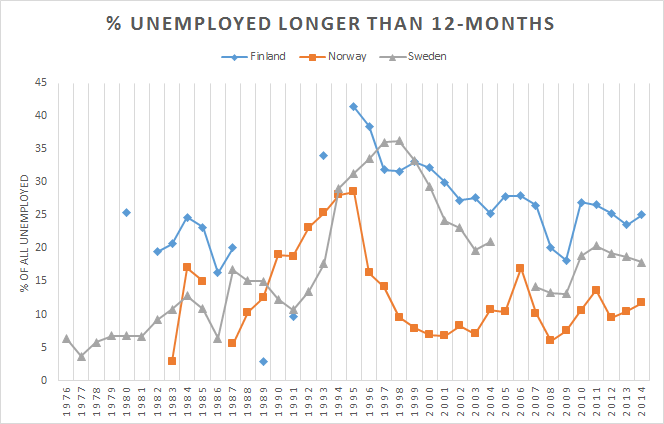
As I recall, most unemployed have been unemployed longer than 12 months in Sweden have to go on a labour market program. When they returned to unemployment after the program, the clock starts again. They are deemed to be freshly unemployed rather than adding to the previous spell with an interlude on a make work program. This makes Swedish long-term unemployment data rather unintelligible.
Source: OECD StatExtract.
Finland was recovering from its worst depression since the 1930s and the early 1990s when its data on long-term unemployment started to be continuous. This makes Finnish unemployment data rather difficult to interpret. Norway’s data for the long-term unemployed goes up and down a bit too much to be trustworthy without a background policy narrative.
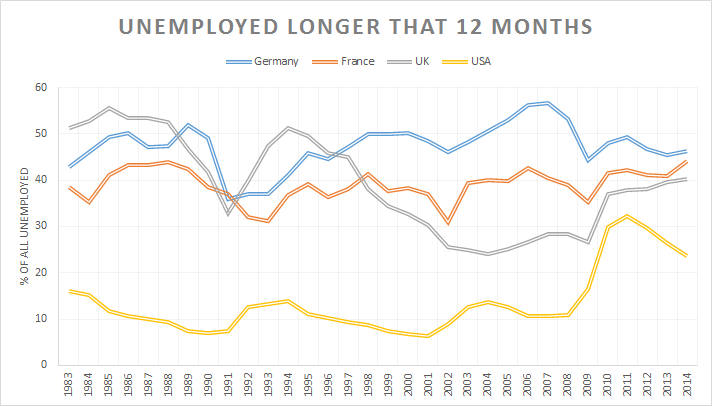
As the British labour market and long-term unemployment was starting to get something like that in the USA, the USA started to have unemployment it was more like the European labour markets in terms of the number of long-term unemployed. Nothing much happened in Germany and France.
German long term unemployment has been pretty stable albeit with an up-and-down after German unification. There is also a fall in long-term unemployment after some labour market reforms around 2005.
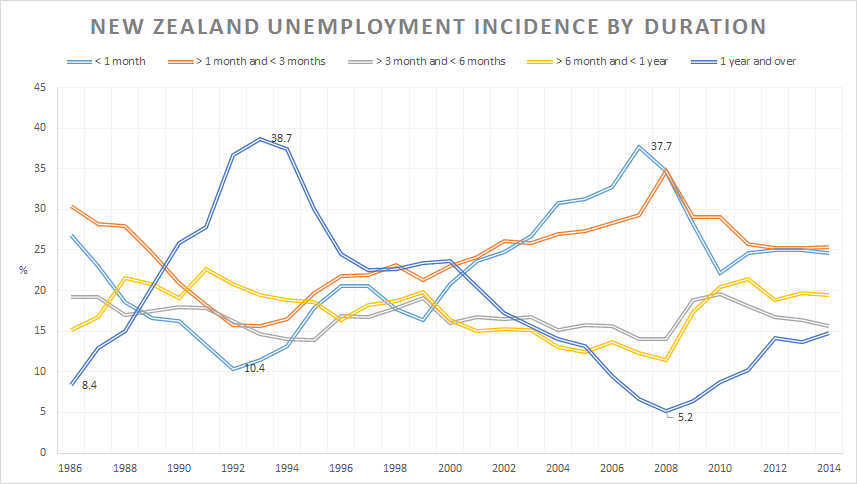
There has been bit of a wild ride in long-term unemployment in New Zealand. Long-term unemployment – longer than one year – ranging from just over 8% of unemployment in 1986 to nearly 40% in 1992 then down to 5% in 2008. Clearly the duration of unemployment in New Zealand is highly sensitive to the business cycle unlike the case in the USA or UK.
Source: OECD StatExtract.
This sensitivity of long-term unemployment to the business cycle does not bode well for the hypothesis of hysteresis where human capital depreciates the longer a jobseeker is out of employment. For this hypothesis to hold, there must be some enduring aspect of long-term unemployment rather than just going up and down with the business cycle rather noticeably.
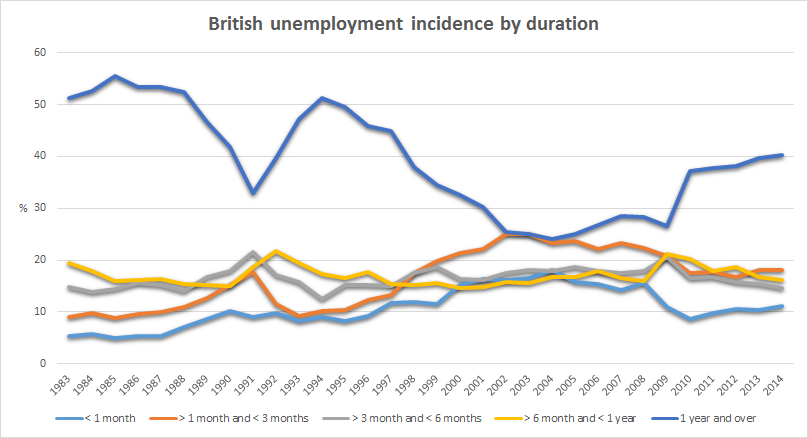
In contrast to the USA, there is been a long-term decline in long-term unemployment, that is unemployment of more than a year, in the British economy over the 1990s. The situation then stabilised and then increased after the global financial crisis. There is also a rather rapid fall in long-term unemployment in the mid-1980s as the British economy recovered under Thatchernomics
Why Evolution is True is a blog written by Jerry Coyne, centered on evolution and biology but also dealing with diverse topics like politics, culture, and cats.
In Hume’s spirit, I will attempt to serve as an ambassador from my world of economics, and help in “finding topics of conversation fit for the entertainment of rational creatures.”
“We do not believe any group of men adequate enough or wise enough to operate without scrutiny or without criticism. We know that the only way to avoid error is to detect it, that the only way to detect it is to be free to inquire. We know that in secrecy error undetected will flourish and subvert”. - J Robert Oppenheimer.




 Utopia, you are standing in it!
Recent Comments