
HT: Matt Bruenig
Celebrating humanity's flourishing through the spread of capitalism and the rule of law
19 Mar 2016 Leave a comment
in labour economics, labour supply, occupational choice, poverty and inequality, welfare reform Tags: asymmetric marriage premium, child poverty, family poverty
HT: Matt Bruenig
08 Mar 2016 Leave a comment
in economics of education, politics - New Zealand, population economics, poverty and inequality, welfare reform

Source: The Economics of Human Development and Social Mobility, James J. Heckman, Stefano Mosso, NBER Working Paper No. 19925, February 2014.
08 Mar 2016 Leave a comment
in applied welfare economics, economic history, economics of bureaucracy, labour economics, politics - USA, poverty and inequality, Public Choice, welfare reform Tags: 1996 US welfare reforms, pessimism bias, social insurance, welfare state
From @EugeneSteuerle: Combined tax rates and creating a 21st century social welfare budget tpc.io/1GCdrYF http://t.co/aNRPqz5gAc—
Tax Policy Center (@TaxPolicyCenter) June 28, 2015

The only alternative offered by the Centre for American Progress is send them on a course. This response, which is the standard policy response to any labour market crisis, will not solve poverty, mush less inequality.
Will more education decrease inequality? A simulation provided an answer. nyti.ms/1xw5m9W http://t.co/paQp19BEWc—
The Upshot (@UpshotNYT) March 31, 2015
28 Feb 2016 Leave a comment
in applied price theory, fiscal policy, labour economics, labour supply, politics - Australia, politics - New Zealand, politics - USA, poverty and inequality, public economics, welfare reform Tags: poverty traps, single mothers, single parents, social insurance, taxation and labour supply, welfare state
27 Feb 2016 Leave a comment
in economic history, labour economics, labour supply, politics - New Zealand, welfare reform Tags: domestic purposes benefit, single mothers, single parents, social insurance, unemployment benefit, welfare state
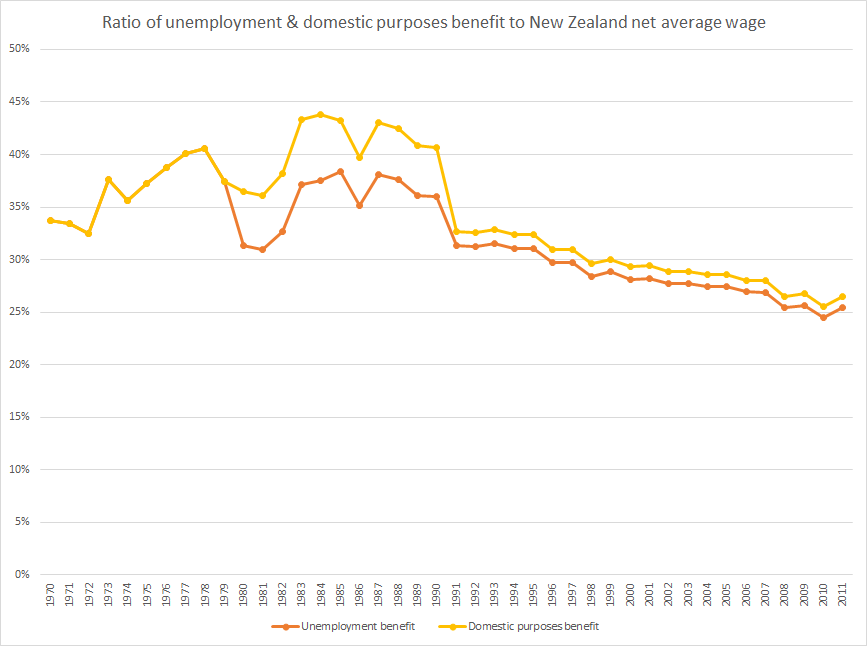
Source: OECD Economic Survey New Zealand 2015.
20 Feb 2016 Leave a comment
in economic history, fiscal policy, labour economics, macroeconomics, politics - USA, welfare reform Tags: social insurance, welfare state
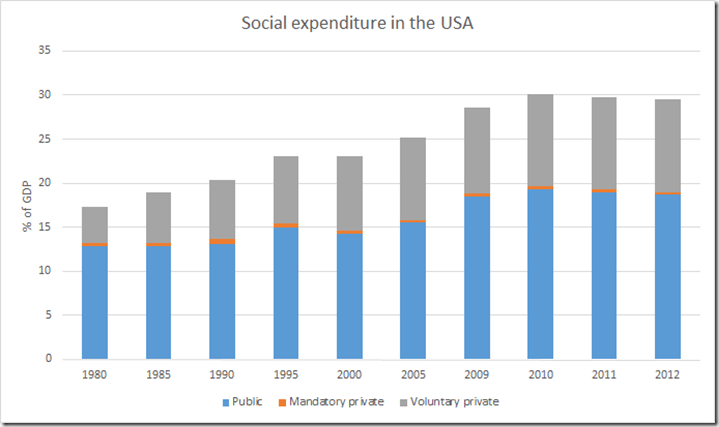
Source: OECD Income Distribution database.
20 Feb 2016 Leave a comment
in applied welfare economics, economics of regulation, fiscal policy, labour economics, politics - Australia, politics - New Zealand, politics - USA, welfare reform Tags: British economy, Canada, Denmark, Finland, France, Germany, Italy, Japan, Norway, social insurance, Sweden, welfare state
Mandatory and voluntary private social expenditure makes a big difference to the degree of social insurance in some countries but not others. The calculation of these numbers in purchasing power parity would be much more interesting.
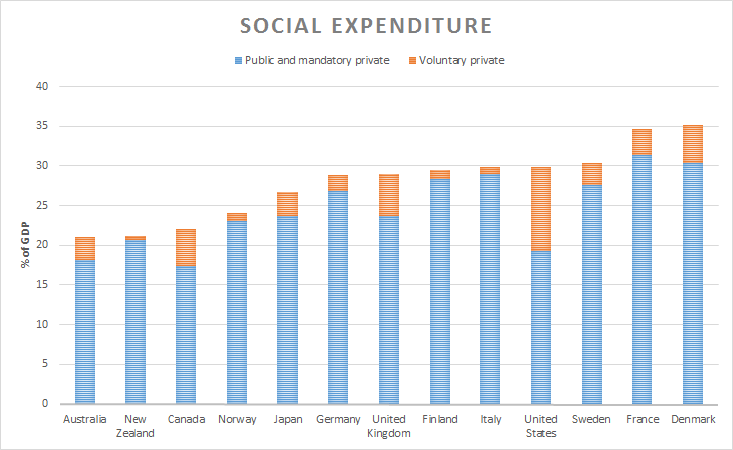
Source: OECD Income Distribution database.
20 Feb 2016 Leave a comment
in fiscal policy, income redistribution, labour economics, politics - Australia, politics - New Zealand, politics - USA, Public Choice, welfare reform Tags: British economy, Denmark, Finland, France, Germany, Italy, Japan, Norway, social insurance, Sweden, welfare state
Some welfare states are much more targeted. Australia has the most targeted welfare state in terms of public social benefits paid in cash to the bottom quintile (Q1) of income earners.

Source: OECD Income Distribution database.
16 Feb 2016 Leave a comment
in applied welfare economics, economics of bureaucracy, labour supply, politics - USA, welfare reform
In common with New Zealand, Maine found that a number could not complete work requirements because they could not get time off work from their off the books job.
Lindsay Mitchell found through Official Information Act requests that one in 10 beneficiaries are working full-time and one in 5 have no intention of looking for a job in the next year despite a requirement to actively look for work as a condition of receipt of their benefit.
15 Feb 2016 Leave a comment
in applied welfare economics, politics - USA, welfare reform
The 1996 federal welfare reforms were supposed to condemn the poor to homelessness and no money to buy food. Deep poverty did not get worse as a result of those reforms. That alone refutes its critics.

Source: Take 2: Another Look at Bernie Sanders, Welfare Reform, and Deep Poverty | Mother Jones.
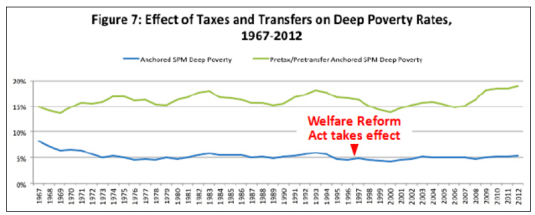
Source: New Study Says Poverty Rate Hasn’t Budged For 40 Years | Mother Jones.

Source: Weekend Follow-Up #1: Welfare Reform and Deep Poverty | Mother Jones.
12 Feb 2016 Leave a comment
in applied welfare economics, economic history, labour economics, labour supply, politics - USA, welfare reform
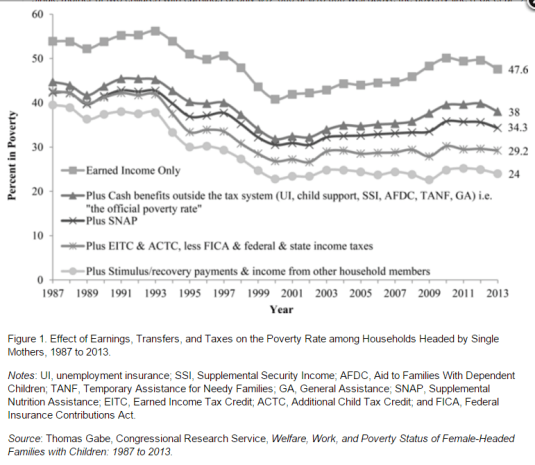
Despite the dire predictions, there has been a permanent reduction in child poverty of 25%, a 35% increase in the employment rates of never married mothers and a 16% increase in the employment rates of single mothers.
Minorities benefited the most from the 1996 US federal welfare reforms in terms of higher employment rates and lower child poverty rates.
As part of the 1996 reforms, Medicaid eligibility was not lost when going off welfare and single parents by getting a job qualified for the Earned Income Tax Credit.
01 Feb 2016 Leave a comment
in labour economics, labour supply, politics - New Zealand, poverty and inequality, welfare reform Tags: Maori economic development, single mothers, single parents, welfare state
17 Jan 2016 Leave a comment
in economic history, gender, labour economics, labour supply, politics - USA, welfare reform Tags: child poverty, family poverty, single mothers, single parents, US welfare reforms
Celebrating humanity's flourishing through the spread of capitalism and the rule of law
Celebrating humanity's flourishing through the spread of capitalism and the rule of law
Celebrating humanity's flourishing through the spread of capitalism and the rule of law
Celebrating humanity's flourishing through the spread of capitalism and the rule of law
Celebrating humanity's flourishing through the spread of capitalism and the rule of law
Celebrating humanity's flourishing through the spread of capitalism and the rule of law
Celebrating humanity's flourishing through the spread of capitalism and the rule of law
A History of the Alt-Right
Econ Prof at George Mason University, Economic Historian, Québécois
Celebrating humanity's flourishing through the spread of capitalism and the rule of law
Scholarly commentary on law, economics, and more
Beatrice Cherrier's blog
Celebrating humanity's flourishing through the spread of capitalism and the rule of law
Celebrating humanity's flourishing through the spread of capitalism and the rule of law
Celebrating humanity's flourishing through the spread of capitalism and the rule of law
Why Evolution is True is a blog written by Jerry Coyne, centered on evolution and biology but also dealing with diverse topics like politics, culture, and cats.
Celebrating humanity's flourishing through the spread of capitalism and the rule of law
A rural perspective with a blue tint by Ele Ludemann
DPF's Kiwiblog - Fomenting Happy Mischief since 2003
Celebrating humanity's flourishing through the spread of capitalism and the rule of law
The world's most viewed site on global warming and climate change
Tim Harding's writings on rationality, informal logic and skepticism
A window into Doc Freiberger's library
Let's examine hard decisions!
Commentary on monetary policy in the spirit of R. G. Hawtrey
Thoughts on public policy and the media
Celebrating humanity's flourishing through the spread of capitalism and the rule of law
Politics and the economy
A blog (primarily) on Canadian and Commonwealth political history and institutions
Reading between the lines, and underneath the hype.
Economics, and such stuff as dreams are made on
"The British constitution has always been puzzling, and always will be." --Queen Elizabeth II
Celebrating humanity's flourishing through the spread of capitalism and the rule of law
Celebrating humanity's flourishing through the spread of capitalism and the rule of law
WORLD WAR II, MUSIC, HISTORY, HOLOCAUST
Undisciplined scholar, recovering academic
Celebrating humanity's flourishing through the spread of capitalism and the rule of law
Res ipsa loquitur - The thing itself speaks
In Hume’s spirit, I will attempt to serve as an ambassador from my world of economics, and help in “finding topics of conversation fit for the entertainment of rational creatures.”
Researching the House of Commons, 1832-1868
Articles and research from the History of Parliament Trust
Reflections on books and art
Posts on the History of Law, Crime, and Justice
Celebrating humanity's flourishing through the spread of capitalism and the rule of law
Exploring the Monarchs of Europe
Cutting edge science you can dice with


Recent Comments