
doctors spotted Knight – pictured with wife, Helen – eating, wiping his face and writing while he was in hospital for observations
Celebrating humanity's flourishing through the spread of capitalism and the rule of law
08 Nov 2014 Leave a comment
in economics of crime, welfare reform Tags: crime and punishment
doctors spotted Knight – pictured with wife, Helen – eating, wiping his face and writing while he was in hospital for observations
08 Nov 2014 Leave a comment
in poverty and inequality, welfare reform Tags: poverty and inequality, The Great Erichment, welfare reform

via Whale Oil Beef Hooked and waikato-times
08 Nov 2014 Leave a comment
in labour economics, labour supply, politics - New Zealand, public economics, taxation, welfare reform Tags: effective marginal tax rates, tax – welfare system interactions

There are 3.38 million individual taxpayers. Of these, about 120,000 (3.4 percent) face EMTRs over 60%, 120,000 (3.4 percent) face EMTRs between 50% and 60%, and 160,000 (4.5 percent) face EMTRs between 40% and 50%. Slightly more than 88 percent of taxpayers face EMTRs below 40%.
HT: New-Zealand-tax-system-and-how-it-compares-internationally
06 Nov 2014 Leave a comment
in labour economics, poverty and inequality, welfare reform Tags: bottom 1%, economics of personality traits, Occupy Wall Street, poverty and inequality, top 1%

The Occupy Wall Street protesters had free food provided by kitchens staffed by volunteers.

These self appointed representatives of the bottom 99% didn’t appreciate brushing shoulders with the bottom 1 percent of the social stratum:
The Occupy Wall Street volunteer kitchen staff launched a “counter” revolution yesterday — because they’re angry about working 18-hour days to provide food for “professional homeless” people and ex-cons masquerading as protesters.
For three days beginning tomorrow, the cooks will serve only brown rice and other spartan grub instead of the usual menu of organic chicken and vegetables, spaghetti bolognese, and roasted beet and sheep’s-milk-cheese salad.
They will also provide directions to local soup kitchens for the vagrants, criminals and other freeloaders who have been descending on Zuccotti Park in increasing numbers every day.
To show they mean business, the kitchen staff refused to serve any food for two hours yesterday in order to meet with organizers to air their grievances, sources said…
Overall security at the park had deteriorated to the point where many frightened female protesters had abandoned the increasingly out-of-control occupation, security- team members said.

05 Nov 2014 Leave a comment
in labour economics, poverty and inequality, welfare reform Tags: Bryan Caplan, do gooders, Occupy Wall Street, poverty and inequality, top 1%

Bryan Caplan drew up a nice list of factors that contribute to poverty
Caplan argues that there is an undeserving poor if they fail to follow the following reasonable steps to avoid poverty and hardship:
05 Nov 2014 Leave a comment
in applied price theory, economics of education, politics - New Zealand, poverty and inequality, welfare reform Tags: Heartless Left, Leftover Left, school breakfast programmes
The Feed the Kids Bill that has been reintroduced into the new New Zealand Parliament still contains no provision to feed the parents who are too poor to make their children breakfast.

Why are these hungry parents not invited for breakfast as well? No parent would have breakfast if their children was to go hungry. Both the parent and child must have gone hungry that morning, perhaps morning after morning. There is no other charitable explanation.
The Bill aims to set up government funded breakfast and lunch programmes in all decile 1-2 schools. The cost is $100 million a year – including food, staffing, administration, monitoring and evaluation.
Lindsay Mitchell was on the money when she wrote:
Even parents reliant on a benefit are paid enough to provide some fruit and modest sandwiches daily.
An inability to do so is a symptom of a greater problem requiring scrutiny – for the sake of their child.
“The ‘income management’ regime provides a response to genuinely hungry children.
It may interest you that even Labour advocated for extended income management in its election manifesto.
Their 2014 ‘Social Development’ policy paper proposed, “…allow[ing] income management to be used as a tool by social agencies where there are known child protection issues and it is considered in the best interests of the child, especially where there are gambling, drug and alcohol issues involved.”
Hungry children is a child protection issue. Parents who fail to feed their children should come to the attention of the child protection authorities. Those on the benefit should be subject to income management because they clearly are spending their money elsewhere.
On the Left, there is a refusal to discuss the role of addiction and incompetent parenting in child poverty. The 2014 election manifesto of the Labour Party is a welcome departure from that tradition of denial.
02 Nov 2014 Leave a comment
in economics of religion, labour economics, politics - New Zealand, urban economics, welfare reform Tags: child poverty, Duncan Garner, expressive voting, green rent seeking, land use zoning, regulation of land supply, Resource Management Act
Duncan Garner wrote a passionate column yesterday in the local paper calling for gutsy action on child poverty.
His analysis of the causes of child poverty in New Zealand was good. Garner’s solutions had nothing to do with what he had identified as the causes of child poverty. As Garner himself wrote:
… in order to tackle poverty it’s important to attempt to define what it means today.
Poverty is children living in crowded, damp homes who don’t get three square meals a day.
They may not have their own bed, they won’t see a doctor when they’re sick and many of them will be admitted to hospital with serious poverty-related illnesses such as respiratory problems and skin infections.
They may live in households where paying the rent accounts for 60 per cent of the family’s income every week.
Garner then discussed the plight of one particular family in Auckland:
The parents are nice people, with seven children.
They shared a tiny home with three other adults and another child.
Dad works full-time at a meat factory and they had been waiting 10 months for a state house. They had beds in the dining room and lounge.
They couldn’t afford the cost of a private rental home. One son, aged 11, had a serious lung problem. I saw poverty in action that day and it was deeply disturbing. I highlighted their plight on my radio show and within weeks a shamed Housing NZ had found them a home.
The family Garner discussed is in a tiny house because they lacked the income to rent a better one. They must rely on social housing provided by government with income related rents.
Recurring through his problem definition is the impact that rising housing costs is having on the poor.
Nonetheless, Garner then advocates cash payments to low income families, a tax credit system seen as more generous and inclusive, and a back to school bonus without addressing the supply of housing.
The evidence is overwhelming in New Zealand that the main driver of the increases in the child poverty since the 1980s is rising housing costs.
In the longer run after housing costs child poverty rates in 2013 were close to double what they were in the late 1980s mainly because housing costs in 2013 were much higher relative to income than they were in the late 1980s.
– Bryan Perry, 2014 Household Incomes Report – Key Findings. Ministry of Social Development (July 2014).
Any policy to reduce child poverty must increase the supply of houses by reducing regulatory restrictions on the supply of land.
The Metropolitan Limit confines the expansion of Auckland beyond the existing built-up area. This regulatory constraint explains the exceptionally high housing price-income ratio of Auckland.

The limit imposed on the horizontal expansion of the city in green fields encourages increases in residential prices. As demand for new housing increases, no new land supply can enter the market and stem price rises in response to this increased demand.

If you serious about child poverty, you have to criticise government regulation: the dead hand of the Resource Management Act (RMA) on the poor and the vulnerable.
11 Oct 2014 Leave a comment
in applied welfare economics, labour economics, politics - New Zealand, welfare reform Tags: welfare reform
19 Sep 2014 1 Comment
in applied price theory, labour economics, labour supply, welfare reform Tags: British economy, wage flexibility, welfare reform
The simplest explanation is that supply is increasing: as supply increases output increases real prices fall and output increases.
The Financial Times shows the data and puts forward several explanations:
(1) welfare reforms are pushing people off the dole and into the labor force;
(2) older workers are choosing to retire at a later age.
Both explanations would imply an increase in supply.
via Managerial Econ: Why are wages decreasing and employment increasing in Great Britain?.
03 Aug 2014 6 Comments
in business cycles, job search and matching, labour economics, labour supply, macroeconomics, welfare reform Tags: Active labour market programs, Jeff Borland, mandatory work requirements, search and matching, welfare reform, work for the dole
Jeff Borland is a critic of work for the dole. He points out that they do not improve the job finding rates of participants and in fact reduce the amount of job search because work for the Dole participants are busy undertaking work for the dole requirements:
The main reason is that participation in the program diverts participants from job seeking activity towards Work for the Dole activity. Research on similar programs internationally has come up with comparable findings.
This made me wonder. If unemployment is caused by deficient aggregate demand, and otherwise is involuntary, how can work for the dole increase unemployment or reduce the rate at which people exit unemployment?
‘Involuntary’ unemployment occurs when all those willing and able to work at the given real wage but no job is available, i.e. the economy is below full employment. A worker is ‘involuntary’ unemployment if he or she would accept a job at the given real wage. Keynesians believe money wages are slow to adjust (e.g. due to money illusion, fixed contracts or because employers and employees want long run money wage stability), and so the real wage may no adjust to clear the labour market: there can be ‘involuntary’ unemployment.

Under the deficient aggregate demand theory of unemployment, people have no control over why they are unemployed – that’s why their unemployment is involuntary.
Sticky wages are no less sticky when work for the dole is introduced and people search more intensively for jobs. Deficient demand unemployment is no less deficient when there is an increase in job search intensity.

Work for the dole must be carefully defined, of course, to differentiate it from the failed active labour market programs of the past that attempted to improve the employability of the unemployed. By work for the dole, I simply mean mandatory work requirements simply make it more of an ordeal to be on unemployment and thereby encourage people to find a job.
Mandatory work requirements simply tax leisure. By taxing leisure, mandatory work requirements change the work leisure trade-off between unemployment and seeking a job with greater zeal and a lower asking wage more attractive option. More applicants asking for lower wages will mean employers can fill jobs faster and at lower wages, which means our create more jobs in the first place.
The probability of finding a job for an unemployed worker depends on how hard this individual searches and how many jobs are available: Chance of Finding Job = Search Effort x Job Availability
Both the search effort of the unemployed and job creation decisions by employers are potentially affected by unemployment benefit generosity and mandatory work for welfare benefits requirements.
Modern theory of the labour market, based on Mortensen and Pissarides provides that more generous unemployment benefits put upward pressure on wages the unemployed seek. If wages go up, holding worker productivity constant, the amount left to cover the cost of job creation by firms declines, leading to a decline in job creation.
Everything else equal under the labour macroeconomics workhorse search and matching model of the labour market, reducing the rewards of being unemployed exerts downward pressure on the equilibrium wage. This fall in asking wages increases the profits employers receive from filled jobs, leading to more vacancy creation. More vacancies imply a higher finding rate for workers, which leads to less unemployment. The vacancy creation decision is based on comparing the cost of creating a job to the profits the firm expects to obtain from hiring the worker.
When unemployment benefits are less generous or more onerous work requirements are attached, some of the unemployed will become less choosey about the jobs they seek in the wages they will accept. a number of people at the margin between working or not. An example is commuting distance to jobs. A number of people turn down a job because is just that little too far to commute. A small change in the cost of accepting that job would have resulted in them moving from being unemployed to fully employed.
Unemployment is easy to explain in modern labour macroeconomics: it takes time for a job seeker to find a suitable job with a firm that wishes to hire him or her; it takes time for a firm to fill a vacancy. Search is required on both sides of the labour market – there are always would-be workers searching for jobs, and firms searching for workers to fill vacancies.
In a recession, a large number of jobs are destroyed at the same time. It takes time for these unemployed workers to be reallocated new jobs. It takes time for firms to find where it is profitable to create new jobs and find workers suitable to fill these new jobs.
Recessions are reorganisations. Unemployed workers look for jobs, and firms open vacancies to maximize their profits. Matching unemployed workers with new firms firms is a time-consuming and costly process.
31 Jul 2014 Leave a comment
in applied price theory, fiscal policy, job search and matching, labour economics, labour supply, macroeconomics, welfare reform Tags: Active labour market programs, Lars Calmfors, welfare reform, work for the dole, workfare

Lars Calmfors is a Swedish economist whose main interest is labour makets.
His iron law of Active Labour Market Policy (ALMP) refers to a characteristic of make work schemes, like the WPA that operated in the United States in the 1930s.
The characteristic or problem with these schemes is that if people are attracted to these schemes by generous pay or conditions, their motive to search for regular work is necessarily reduced.
Assuming unemployment is anywhere near NAIRU, the effect of this reduced aggregate labour supply will be inflationary, which means that demand will have to be reduced, which in turn means that the jobs created by the make work scheme will be, at least to some extent, at the expense of regular jobs.
Alternatively, if people are coerced into joining make work schemes because of what might be called a “workfare” sanction, their job search efforts are not reduced, thus the jobs created by the make work scheme have a better chance of not being at the expense of normal jobs.
via RALPHONOMICS: Calmfor’s Iron Law of Active Labour Market Policy..
31 Jul 2014 1 Comment
in economics of regulation, labour economics, politics - New Zealand, unemployment, welfare reform Tags: 90 day trials, employment law, employment probation periods, employment protection, labour market regulation
The first chart below shows that NZ is the 4th most deregulated labour market for individual dismissals.
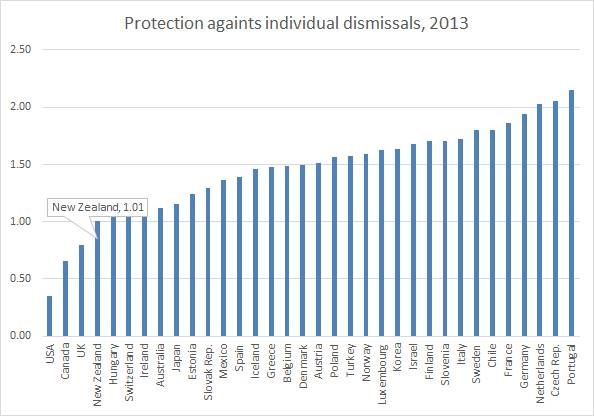
Source: OECD employment protection index
The next figure below shows that NZ is top of the world for deregulation of lay-offs and redundancies.
![clip_image002[7]](https://utopiayouarestandinginit.com/wp-content/uploads/2014/07/clip_image0027.jpg "clip_image002[7]")
Source: OECD employment protection index
The chart below shows that New Zealand is far more flexible than in Western Europe and is pretty near the USA in terms of people moving in and out of the unemployment pool every month with great ease.
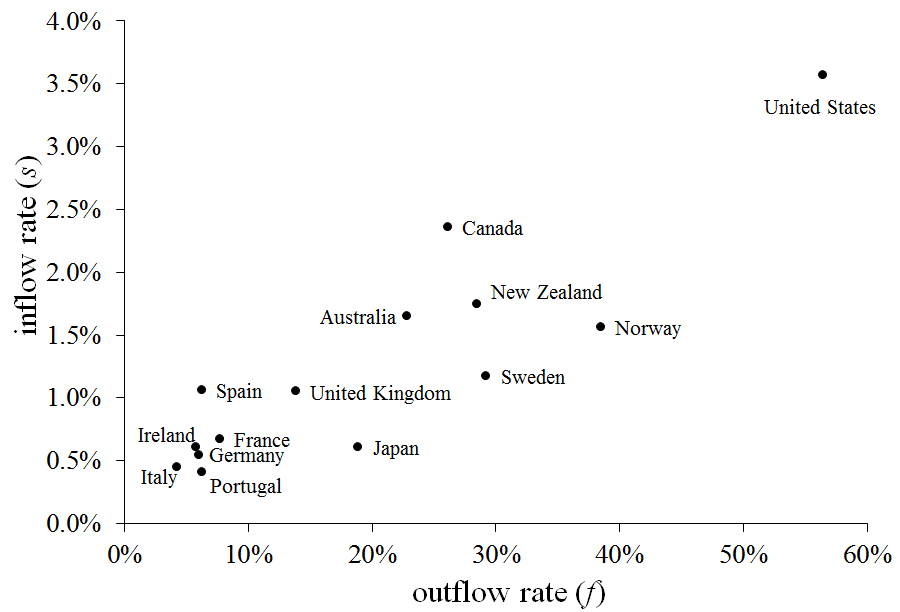
Source: Elsby, Hobijn and Şahin (2013).
There are very high outflow rates from unemployment among the Anglo-Saxon and Nordic economies. The economies of Continental Europe stand in stark contrast. Unemployment outflow rates in these economies lie below 10% at a monthly frequency.
A major labour market reform in recent years in New Zealand was introduction of the option of a 90 day trial for new employees, initially in small businesses and then in all businesses.
The UK recently extended its trial period from one-year to two-years. Trial periods are common in OECD member countries.
There is plenty of evidence to back-up the notion that increased job security leads to less employee effort and more absenteeism. Some examples are:
· Sick leave spiking straight after probation periods ended;
· Teacher absenteeism increasing after getting tenure after 5-years; and
· Academic productivity declining after winning tenure.
The MBIE research into the actual operation of 90-day trials was highly favourable in terms of increased employment, the hiring of riskier applicants and lower costs of ending bad job matches (about 15-20% of trials did not work out). These outcomes are the usual importance of a test drive argument for employment trial periods.
Interestingly, the MBIE research also found that some employers hired new employees on 90-day trials for positions about which these employers were uncertain might be profitable. But for the option of the trial period, these jobs never would have existed.
This suggests that in some firms, 90-day trials are a decisively cheaper alternative to hiring an employee and perhaps making them redundant later if the new position does not pay for itself. No one’s fault: the market just did not sustain the expansion in staff as expected.
The MBIE research shows that winners from 90-day trials are new labour force entrants, the unemployed and beneficiaries, migrants and labour force re-entrants such as mothers.
I kept note of an interesting press report adding to this where Hospitality New Zealand Wellington president Jeremy Smith said he had hired dozens of staff he would not otherwise have considered. Because of the transient nature of the hospitality industry, it was often difficult to check references so a trial period “levelled the playing field”.
Celebrating humanity's flourishing through the spread of capitalism and the rule of law
Scholarly commentary on law, economics, and more
Beatrice Cherrier's blog
Celebrating humanity's flourishing through the spread of capitalism and the rule of law
Celebrating humanity's flourishing through the spread of capitalism and the rule of law
Celebrating humanity's flourishing through the spread of capitalism and the rule of law
Why Evolution is True is a blog written by Jerry Coyne, centered on evolution and biology but also dealing with diverse topics like politics, culture, and cats.
Celebrating humanity's flourishing through the spread of capitalism and the rule of law
Celebrating humanity's flourishing through the spread of capitalism and the rule of law
A rural perspective with a blue tint by Ele Ludemann
DPF's Kiwiblog - Fomenting Happy Mischief since 2003
Celebrating humanity's flourishing through the spread of capitalism and the rule of law
The world's most viewed site on global warming and climate change
Tim Harding's writings on rationality, informal logic and skepticism
A window into Doc Freiberger's library
Let's examine hard decisions!
Commentary on monetary policy in the spirit of R. G. Hawtrey
Thoughts on public policy and the media
Celebrating humanity's flourishing through the spread of capitalism and the rule of law
Politics and the economy
A blog (primarily) on Canadian and Commonwealth political history and institutions
Reading between the lines, and underneath the hype.
Economics, and such stuff as dreams are made on
"The British constitution has always been puzzling, and always will be." --Queen Elizabeth II
Celebrating humanity's flourishing through the spread of capitalism and the rule of law
Celebrating humanity's flourishing through the spread of capitalism and the rule of law
WORLD WAR II, MUSIC, HISTORY, HOLOCAUST
Undisciplined scholar, recovering academic
Celebrating humanity's flourishing through the spread of capitalism and the rule of law
Res ipsa loquitur - The thing itself speaks
Celebrating humanity's flourishing through the spread of capitalism and the rule of law
Researching the House of Commons, 1832-1868
Articles and research from the History of Parliament Trust
Reflections on books and art
Posts on the History of Law, Crime, and Justice
Celebrating humanity's flourishing through the spread of capitalism and the rule of law
Exploring the Monarchs of Europe
Cutting edge science you can dice with
Small Steps Toward A Much Better World
“We do not believe any group of men adequate enough or wise enough to operate without scrutiny or without criticism. We know that the only way to avoid error is to detect it, that the only way to detect it is to be free to inquire. We know that in secrecy error undetected will flourish and subvert”. - J Robert Oppenheimer.
The truth about the great wind power fraud - we're not here to debate the wind industry, we're here to destroy it.
Celebrating humanity's flourishing through the spread of capitalism and the rule of law
Celebrating humanity's flourishing through the spread of capitalism and the rule of law
Economics, public policy, monetary policy, financial regulation, with a New Zealand perspective
Celebrating humanity's flourishing through the spread of capitalism and the rule of law
Restraining Government in America and Around the World



 Utopia, you are standing in it!
Recent Comments