The Effect of Police Body-Worn Cameras on Use of Force and Citizens’ Complaints Against the Police

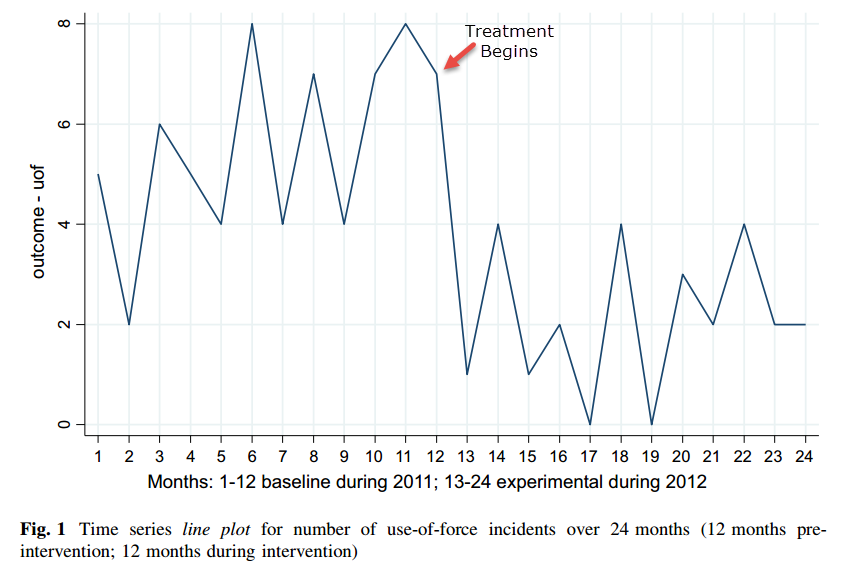
The results are no surprise. There is a 50% drop in the use of force by police when they are required to wear body cameras.

We conducted a randomized controlled trial, where nearly 1,000 officer shifts were randomized over a 12-month period to treatment and control conditions.

During ‘‘treatment shifts’’ officers were required to wear and use body-worn-cameras when interacting with members of the public, while during ‘‘control shifts’’ officers were instructed not to carry or use the devices in any way.

We observed the number of complaints, incidents of use-of-force, and the number of contacts between police officers and the public, in the years and months preceding the trial (in order to establish a baseline) and during the 12 months of the
experiment.

police body cameras and use of force

Police use of force reports halved on shifts when police wore cameras. It is not known whether this reduction in the use of force is because members of the public were now aware that any misbehaviour by them to be caught on camera  and used as evidence against them or police were aware that any excessive force by them would be caught on camera as well.

How a Death with Dignity Bill will pass in New Zealand

The right to die with dignity has long had substantial public support in New Zealand. Opinion polls show that about 60% of the population support it and these opinion polls date back 20 years.

Members of Parliament won’t touch it. Late last year, a backbench Labour MP withdrew from plans to put a Death with Dignity Bill in the ballot for private members’ bills. This was done because of pressure from Labour Party colleagues not wishing euthanasia to be a distraction in the forthcoming general election.

The two previous attempts at passing a Death with Dignity Bill failed despite widespread public support:

In each of these cases, the MP concerned had a compelling personal narrative about the loss of family member or friend after a long fight with cancer as their motive.

Any future attempt to introduce such a bill will also require the MP concerned to have such a personal narrative. It is also not unimportant that both MPs that introduced the previous bills were little-known and their particular activities had nothing to do with whether they got re-elected or not.

Peter Brown was a list MP whose presence in Parliament solely depended on the popularity of Winston Peters. New Zealand First is a one-man party. Michael Laws had quit the National Party and was sitting as an independent.

The law has long acted to prevent, by force if necessary, suicide – including suicide by refusing to take appropriate measures necessary to preserve one’s life after the point at which life become unbearable. Justice Scalia argued that:

I believe in liberal democracy, which is a democracy that worries about the tyranny of the majority, but it is the majority itself that must draw the lines.

Whether the patient’s wishes to be honoured in this area is left to elected representatives to legislate. Justice Scalia asks

Are there, then, no reasonable and humane limits that ought not to be exceeded in requiring an individual to preserve his own life? There obviously are, but they are not set forth in the Due Process Clause.

What assures us that those limits will not be exceeded is the same constitutional guarantee that is the source of most of our protection – what protects us, for example, from being assessed a tax of 100% of our income above the subsistence level, from being forbidden to drive cars, or from being required to send our children to school for 10 hours a day, none of which horribles is categorically prohibited by the Constitution.

Our salvation is the Equal Protection Clause, which requires the democratic majority to accept for themselves and their loved ones what they impose on you and me.

Many who support euthanasia in principle have serious reservations about the ability to craft a Bill that prevents abuses. Parliaments have an interest in protecting vulnerable groups–including the poor, the elderly, and disabled persons–from abuse, neglect, and mistakes.

The democratic process must strike a proper balance between the interests of terminally ill, mentally competent individuals who would seek to end their suffering and the State’s interests in protecting those who might seek to end life mistakenly or under pressure.

The pros and cons of euthanasia as a practical matter is ably summarised by Richard Posner:

 Countries and states that authorize physician-assisted suicide impose strict requirements that minimize the danger of involuntary euthanasia—too strict, some believe (such as the requirement in Dutch law that the patient’s suffering be “unbearable” before he can invoke physician assistance to end his life).

These requirements (which further reduce the stigma of physician-assisted suicide by confining the practice to cases of genuine desperation) are not airtight, or uniformly observed. Any system will be abused. The question is whether the incidence of abuses, combined with the other costs of the system, outweigh the benefits.

Gary Becker has written frequently on the issue of euthanasia and suicide. Indeed, he wrote the Economic Theory of Suicide, not long after his wife took her own life in the early 1970s. He argues well about people’s ability to weigh the considerations:

Rational forward–looking persons with good information about their future circumstances would commit suicide only when convinced that they would be worse off by continuing to live.

David Hume said (in his Essays on Suicide and the Immortality of the Soul) “That suicide may often be consistent with interest and with our duty to ourselves no one can question, who allows that age, sickness, or misfortune may render life a burden, and make it worse than annihilation.”

Schopenhauer was also confident about the rationality of suicide, “It will generally be found that, as soon as the terrors of life outweigh the terrors of death, a man will put an end to his life” (Parerga and Paralipomena).

Becker also wrote insightfully of the terrors of death:

Hume adds “I believe no man ever threw away life, while it was worth keeping. For such is our natural horror of death”, and Schopenhauer makes the same observation “But the terrors of death offer considerable resistance…”

The reason why Death with Dignity Bills fail in Parliament is those in the community who are against it are passionately against that it and will change their vote if it passed. Those that are for it are not swinging or single issue voters.

Whoever moves the Bill will be a less well known MP with a personal narrative as to why they did it. What will be in that Bill? Scalia again:

Leaving this matter to the political process is not only legally correct, it is pragmatically so. That alone… can produce compromises satisfying a sufficient mass of the electorate that this deeply felt issue will cease distorting the remainder of our democratic process.
 

The top 10 con games explained

Video

Steven N S Cheung on corruption and economic development

Image

Morning People Are Less Ethical at Night – HBR

image

https://hbr.org/2014/06/morning-people-are-less-ethical-at-night/?utm_campaign=Socialflow&utm_source=Socialflow&utm_medium=Tweet

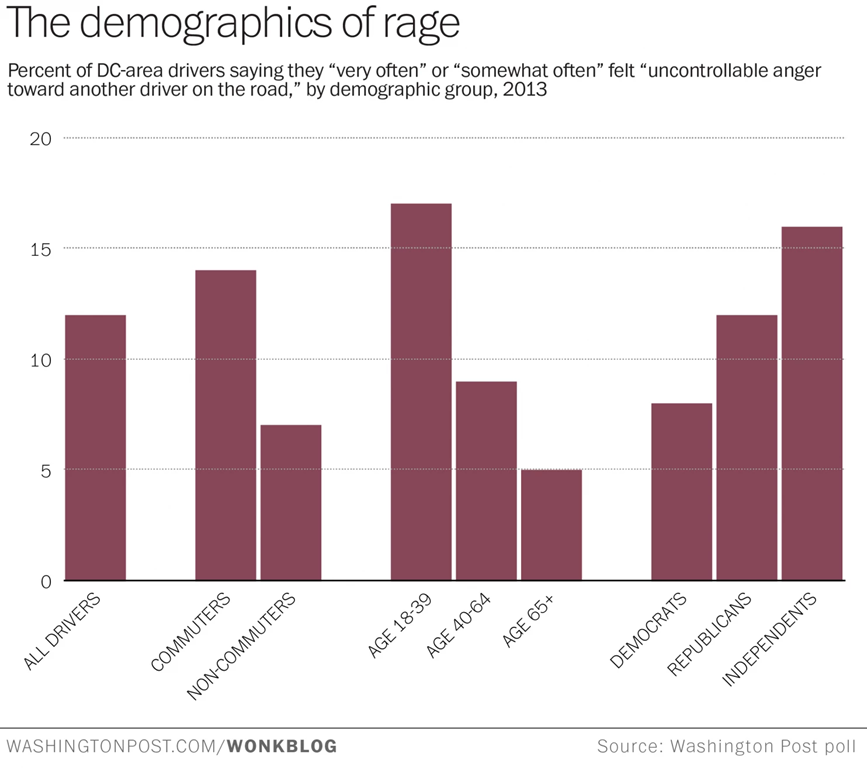
Voter demographics alert: the politics of road rage

the politics of road rage

.

Cigarette smuggling in the United States on a state-by-state basis

via EconomicPolicyJournal.com: Cigarette Smuggling in the United States.

Court-siding as The Sting reborn?

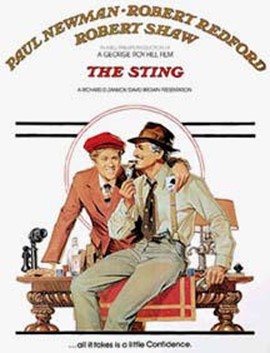
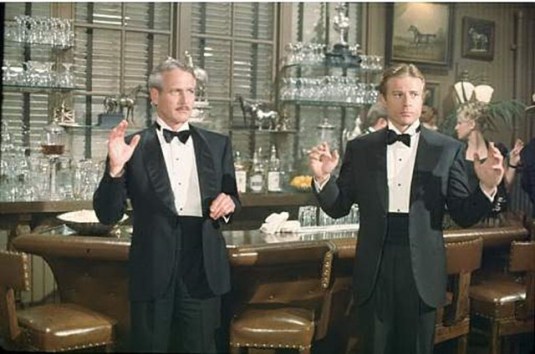
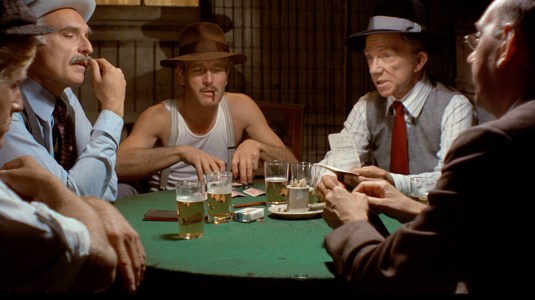
Court-siding in the Cricket World Cup yesterday reminded me of the 1973 classic movie The Sting with Paul Newman and Robert Redford. This movie is still worth watching today – a great Robert Redford, Paul Newman movie told with great wit.

Both court-siding and The Sting were both sharp practices by gamblers based on the delay in broadcasting sports results.

In court siding, the six or seven second delay in cricket broadcasts allow spectators with mobile phones to tip off gambling confederates in other parts of the world to place last second bets.

Court siding carries a 10 year prison term in the Australian State of Victoria. It is not illegal elsewhere and some have suggested that gambling syndicates turned to court siding because it’s easier to accomplish than match fixing.

Dozens of people are ejected from cricket games every year for court siding. They are easy to spot. They take no interest in the game, don’t cheer or clap and spend all their time on a mobile phone or laptop.

In The Sting, a bunch of grifters conned a gangster by pretending they could manipulate the distribution of horseracing results by the local telegraph office in the 1920s. The confederate delays the distribution of the racing results for several minutes, so the race is run and the result known before the bets are placed with the unsuspecting betting shop, relying on Telegraph racing results.

Central to the con, which is called the Wire is setting up a betting shop filled with grifters in on the con placing false bets. The only gambler who places a real bet is the mark.

The wire was most popular in the early 20th century, when horse and dog race results were sent to betting parlours via the telegraph. As with court-siding, the con is time and personnel intensive requiring a large gang to be involved.

As with most cons, the Wire is based on manipulating the greed and deep pockets of the mark, including a willingness to act illegally to profit from gambling or other business ventures.

In the case of The Wire, there is corruption involved because a confederate of the telegraph office is supposed to be on the take. The confederate in the Telegraph office delays distribution of the race results, while the tips of his co-conspirators giving them enough time to place a bet.

In the case of court siding, this practice seems to me to be simply entrepreneurial alertness or arbitrage.

Betting in sport is often on spreads such as when a no ball is bowled, who is the first change bowler, who bowled a no ball or got out before a milestone such as 50 or 100 runs.

Court siding cannot be stopped by closing the betting shop 10 seconds early because they are not events that happen to a timetable such as closing the betting before the race starts.

It is up to bookmakers to solve this problem because it is an ordinary business problem. There is no corruption, bribery or any form of conspiracy between the employees of the bookmaker and the gamblers or between the gamblers and the players of the particular sport. The police should not be wasting their time with court siding.

Bookmakers could stop the practice of court-siding dead if they introduced a 10 second delay between lodging a bet online and when the bet is accepted. This 10 second delay is longer than the broadcasting delay that makes court siding possible and profitable.

Buzz Aldrin punches Moon landing conspiracy theorist stalker after being harassed by him

HT: Liar_tuck

What is the next best explanation for this dramatic fall in crime rates in Chicago?

Image

William Blackstone’s maximum

All presumptive evidence of felony should be admitted cautiously; for the law holds, that it is better that ten guilty persons escape, than that one innocent suffer.  - William Blackstone

Image

the number of terrorist incidents driven by religion has increased dramatically since 2000

HT: wonkblog

Spot the jihadist translated from French

A decriminalisation rally with attitude

https://twitter.com/oldpicsarchive/status/560770364100579328

Image

Spurious correlations alert: executions and murder rates – updated

– Updated

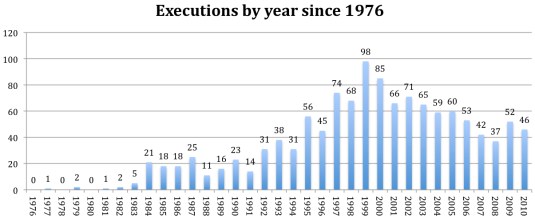
Many a data shyster will make hay with the above chart on the simple correlation between executions and the drop in the US murder rate.

The reality is there are so few executions and they are so infrequent with the exception of Texas that any purported correlation between the death penalty and murder rates requires careful study.

f2tcnowyz0wa9sdjikdrhg

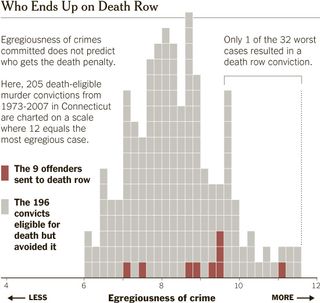
Indeed, for some condemned prisoners, gang bangers are an example, their life expectancy may be increased by the long time they spend on death row versus been murdered by a business associated or a business rival on the streets. As Levitt noted:

no rational criminal should be deterred by the death penalty, since the punishment is too distant and too unlikely to merit much attention.

As such, economists who argue that the death penalty works are put in the uncomfortable position of having to argue that criminals are irrationally overreacting when they are deterred by it.

08editorial-grx-popup

The occupational hazard of been murdered by business rival for gang bangers is higher than the chance of them been arrested, tried , convicted, and condemned to death and then executed after a long appeals process. Not surprisingly, Levitt argued that:

…the quality of life in prison is likely to have a greater impact on criminal behaviour than the death penalty.

Using state-level panel data covering the period 1950–90, we demonstrate that the death rate among prisoners (the best available proxy for prison conditions) is negatively correlated with crime rates, consistent with deterrence. This finding is shown to be quite robust.

In contrast, there is little systematic evidence that the execution rate influences crime rates in this time period.

Previous Older Entries Next Newer Entries

David Andolfatto

Celebrating humanity's flourishing through the spread of capitalism and the rule of law

Monetary Non-Neutrality

Celebrating humanity's flourishing through the spread of capitalism and the rule of law

Reason Magazine

Celebrating humanity's flourishing through the spread of capitalism and the rule of law

Coyote Blog

Celebrating humanity's flourishing through the spread of capitalism and the rule of law

Thoughts from the North

Celebrating humanity's flourishing through the spread of capitalism and the rule of law

Fardels Bear

A History of the Alt-Right

Vincent Geloso

Econ Prof at George Mason University, Economic Historian, Québécois

Bassett, Brash & Hide

Celebrating humanity's flourishing through the spread of capitalism and the rule of law

Truth on the Market

Scholarly commentary on law, economics, and more

The Undercover Historian

Beatrice Cherrier's blog

Matua Kahurangi

Celebrating humanity's flourishing through the spread of capitalism and the rule of law

Temple of Sociology

Celebrating humanity's flourishing through the spread of capitalism and the rule of law

Velvet Glove, Iron Fist

Celebrating humanity's flourishing through the spread of capitalism and the rule of law

Why Evolution Is True

Why Evolution is True is a blog written by Jerry Coyne, centered on evolution and biology but also dealing with diverse topics like politics, culture, and cats.

NoTricksZone

Celebrating humanity's flourishing through the spread of capitalism and the rule of law

Homepaddock

A rural perspective with a blue tint by Ele Ludemann

Kiwiblog

DPF's Kiwiblog - Fomenting Happy Mischief since 2003

The Dangerous Economist

Celebrating humanity's flourishing through the spread of capitalism and the rule of law

Watts Up With That?

The world's most viewed site on global warming and climate change

The Logical Place

Tim Harding's writings on rationality, informal logic and skepticism

Doc's Books

A window into Doc Freiberger's library

The Risk-Monger

Let's examine hard decisions!

Uneasy Money

Commentary on monetary policy in the spirit of R. G. Hawtrey

Barrie Saunders

Thoughts on public policy and the media

Liberty Scott

Celebrating humanity's flourishing through the spread of capitalism and the rule of law

Point of Order

Politics and the economy

James Bowden's Blog

A blog (primarily) on Canadian and Commonwealth political history and institutions

Science Matters

Reading between the lines, and underneath the hype.

Peter Winsley

Economics, and such stuff as dreams are made on

A Venerable Puzzle

"The British constitution has always been puzzling, and always will be." --Queen Elizabeth II

The Antiplanner

Celebrating humanity's flourishing through the spread of capitalism and the rule of law

Bet On It

Celebrating humanity's flourishing through the spread of capitalism and the rule of law

History of Sorts

WORLD WAR II, MUSIC, HISTORY, HOLOCAUST

Roger Pielke Jr.

Undisciplined scholar, recovering academic

Offsetting Behaviour

Celebrating humanity's flourishing through the spread of capitalism and the rule of law

JONATHAN TURLEY

Res ipsa loquitur - The thing itself speaks

Conversable Economist

In Hume’s spirit, I will attempt to serve as an ambassador from my world of economics, and help in “finding topics of conversation fit for the entertainment of rational creatures.”

The Victorian Commons

Researching the House of Commons, 1832-1868

The History of Parliament

Articles and research from the History of Parliament Trust

Books & Boots

Reflections on books and art

Legal History Miscellany

Posts on the History of Law, Crime, and Justice

Sex, Drugs and Economics

Celebrating humanity's flourishing through the spread of capitalism and the rule of law

European Royal History

Exploring the Monarchs of Europe

Tallbloke's Talkshop

Cutting edge science you can dice with

Marginal REVOLUTION

Small Steps Toward A Much Better World

NOT A LOT OF PEOPLE KNOW THAT

“We do not believe any group of men adequate enough or wise enough to operate without scrutiny or without criticism. We know that the only way to avoid error is to detect it, that the only way to detect it is to be free to inquire. We know that in secrecy error undetected will flourish and subvert”. - J Robert Oppenheimer.