Becoming a mother and going part time is seriously bad for women's incomes https://t.co/lSUtgHWvZF pic.twitter.com/2bFfELztnX
— Chris Giles (@ChrisGiles_) August 23, 2016

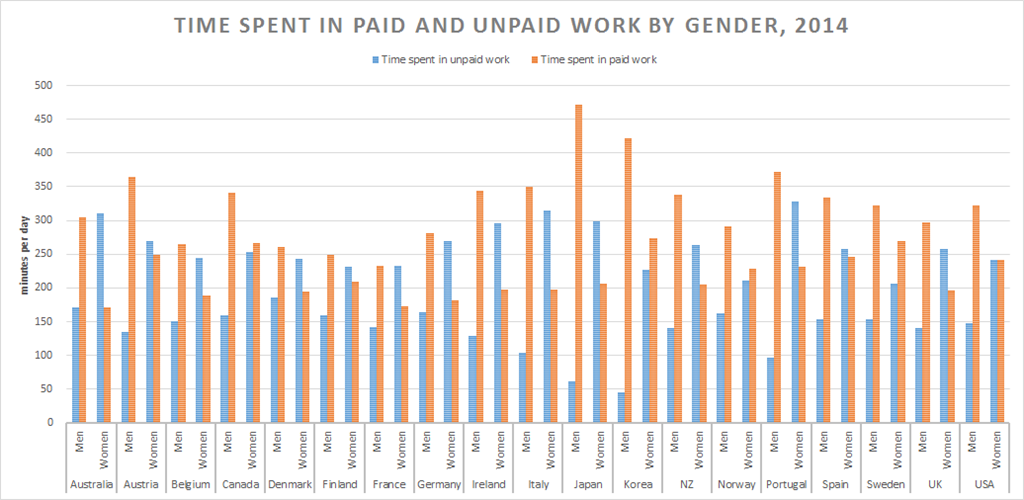
Time spent in paid and unpaid work across the OECD by gender
30 Jul 2016 1 Comment
in economics of love and marriage, gender, labour economics, labour supply Tags: asymmetric marriage premium, female labour force participation, household production, marital division of labour
Trailer for ‘Loving’ — true story of an interracial marriage that caused them to be sentenced to prison in Virginia in 1958
13 Jul 2016 Leave a comment
in economics, economics of love and marriage, law and economics, movies Tags: racial discrimination
Child poverty in single parent and two-parent households in New Zealand
06 Jul 2016 Leave a comment
in economics of love and marriage, labour economics, labour supply, poverty and inequality, welfare reform Tags: child poverty, family poverty, single mothers, single parents
Looks like the greed of the top 1% was targeted exclusively as single parents since the 1980s. Child poverty in two-parent families has not risen much at all. These households often have jobs and will presumably be under the jackboot of neoliberalism stripping away their bargaining power through the decimation of unions and the introduction of the Employment Contracts Act. Despite these horrors, family poverty did not increase much if there are two parents in the house.
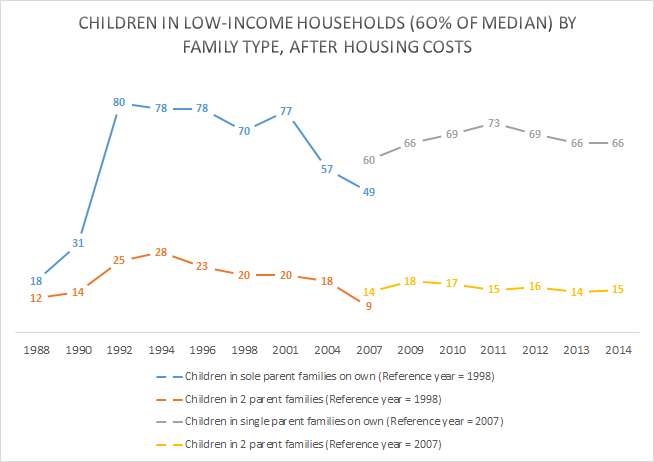
Source: Bryan Perry, Household Incomes in New Zealand: trends in indicators of inequality and hardship 1982 to 2014 – Ministry of Social Development, Wellington (August 2015), Table H.4.
Bryan Caplan argues that there is an undeserving poor if they fail to follow the following reasonable steps to avoid poverty and hardship:
- Work full-time, even if the best job you can find isn’t fun;
- Spend your money on food and shelter before cigarettes and cable TV; and
- Use contraception if you can’t afford a child.
The rise and rise of power couples in the USA
30 Jun 2016 Leave a comment
in economic history, economics of love and marriage, labour economics
.@nzteu is right, student loans entrench inequality
29 Jun 2016 Leave a comment
in economics of education, economics of love and marriage, human capital, labour economics, occupational choice, poverty and inequality Tags: power couples, student loans
Those of European ethnicity had a median net worth of $114,000, compared with $23,000 for Māori , $12,000 for Pasifika and $33,000 for Asians according to the latest Statistics New Zealand data just released.
The Tertiary Education Union made great play about how much of the low net worth of young people and others is due to student loans
Young people (aged 15–24) had the lowest individual median net worth of any age group – just $1,000. The most common debt for young people is education loans.
The union then goes on to say that
Median education loan liabilities are only one-tenth of Pākehā people’s median assets, but they are a quarter of Māori people’s assets and over a third of Pacific people’s assets (table 7.01).
The data shows that the households with the smallest median net worth have the largest median education loans (table 2.02). These loans make up nearly a quarter of their total debt (table 2.03).
Over a third of households within the poorest quintile of net worth have education loans, whereas less than a tenth of households in the wealthiest quintile have education debt (table 2.04).
In a nutshell, not enough people are going to university because of the prospect of repaying student loans and more would go if it were cheaper and that would reducing inequality. The explosion in tertiary educational attendance over the last generation, an increase of about 150% for the adult population aged 25 to 64 was not good enough to reduce inequality.
Free tuition at University is a hand-out to those already had a good start in life. It will be paid for by those who will never go because they do not have an above average IQ.
How much more will you earn by going to university? It depends hugely on which country you're from http://t.co/7RMnUTM8nj—
paulkirby (@paul1kirby) September 11, 2015
Low-cost student loans were supposed to be away to reduce inequality. Instead, they give a flying start to those of already above-average talents. If social justice is to mean anything, it does not involve giving freebies to those who already have a head start in life.
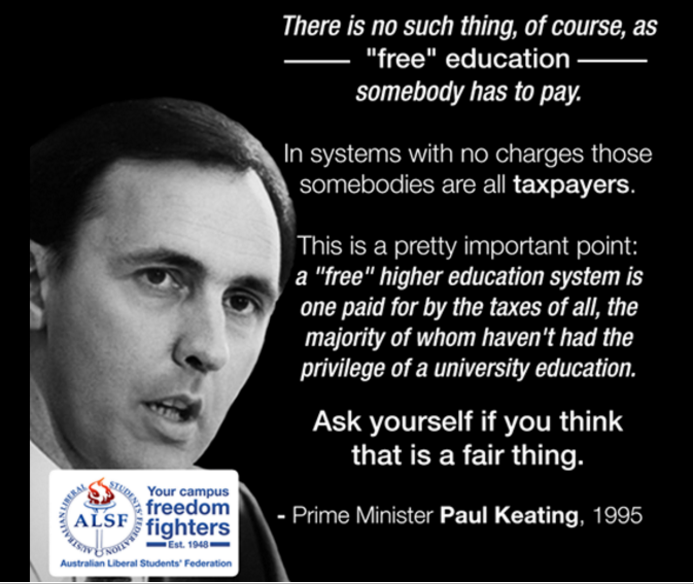
The average student loan debt is about $14,000 while the lifetime earnings premium from university education is about $1/2 million in New Zealand.
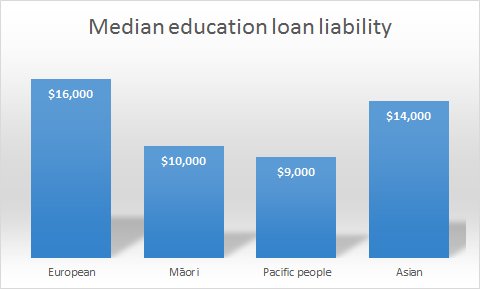
Source: Statistics New Zealand, Household net worth statistics: Year ended 30 June 2015.
Lowering university tuition fees and easing the terms of student loans simply means that those who do well at university will not have to pay back as much to the government. People who succeed at university already have above average IQs so they already had a good head start in life.
Charles Murray points out that succeeded at college requires an IQ of at least 115 but 84% of the population don’t have this:
Historically, an IQ of 115 or higher was deemed to make someone “prime college material.” That range comprises about 16 per cent of the population. Since 28 per cent of all adults have BAs, the IQ required to get a degree these days is obviously a lot lower than 115.
Cheaper higher education does not help the not so smart secure a qualification they lack the innate talent to earn with decent marks and increases the chance of smart men and women marrying. This increases the inequality between power couples and the rest.
Generation Unbound – The drift into parenthood without marriage
26 Jun 2016 Leave a comment
in economics of love and marriage, gender Tags: economics of fertility, marriage and divorce, single parents
Over half of all births to young adults in the United States now occur outside of marriage, and many are unplanned. The result is increased poverty and inequality for children. The left argues for more social support for unmarried parents; the right argues for a return to traditional marriage. In Generation Unbound, Isabel V. Sawhill offers a third approach: change “drifters” into “planners.”
Dara Ó Briain – A Catholic & Protestant Mixed Marriage
20 Jun 2016 Leave a comment
in economics, economics of love and marriage, economics of religion, property rights Tags: Ireland
HT: Donal McChaffery
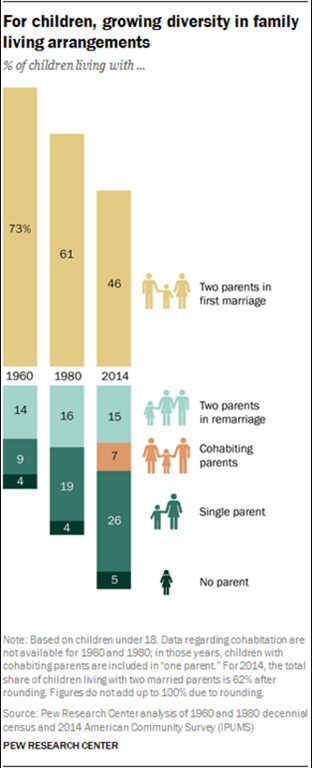
There is no longer one dominant family form
19 May 2016 Leave a comment
in economic history, economics of love and marriage Tags: blended families, dating market, marriage and divorce, single mothers, single parents
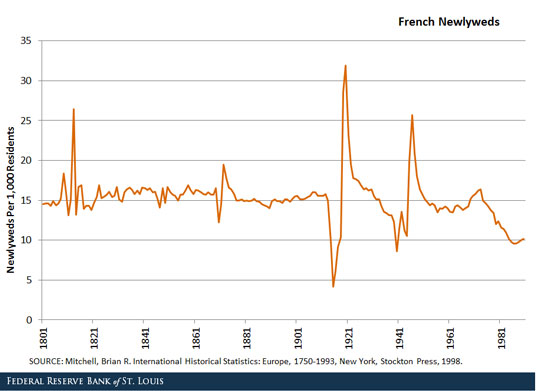
How World War I changed French marriage patterns
18 May 2016 Leave a comment
in economic history, economics of love and marriage Tags: dating market, economics of fertility, France, marriage and divorce, World War I
Ikea Debuts Mänland, a Daycare for Men While Women Shop
09 May 2016 Leave a comment
in economics of love and marriage, economics of media and culture, law and economics Tags: battle of the sexes
Men hate to shop. It’s a truism that Bud Light ads have hammered into us for decades. Ikea has absorbed it, too, and come up with a novel solution in its Australian stores.
Source: Ikea Debuts Mänland, a Daycare for Men While Women Shop | Adweek
 Utopia, you are standing in it!
Recent Comments