America's moms: pewrsr.ch/1uJD07V by @pewresearch #MothersDay http://t.co/o8TIH9xWSH—
Neil Shah (@NeilShahWSJ) May 10, 2015
America’ s mums
20 May 2015 Leave a comment
in discrimination, economics of love and marriage, gender, labour economics, labour supply, law and economics, occupational choice Tags: economics of marriage, female labour falls participation, marriage and divorce, single mothers
Families with single mothers face the greatest risk of falling into deep poverty
20 May 2015 1 Comment
American families with single mothers face the greatest risk of falling into deep poverty: brook.gs/1IVXiTo http://t.co/dwLcQzvHkh—
Brookings (@BrookingsInst) May 13, 2015
The main drivers of child poverty
15 May 2015 Leave a comment
in applied welfare economics, economics of love and marriage, gender, labour economics, labour supply, occupational choice, politics - Australia, politics - New Zealand, politics - USA, population economics, welfare reform Tags: child poverty, economics of the family, family poverty, marriage and divorce, single mothers, single parents
CHART: Black Illegitimacy Rate Went from < 20% in 1950 to 75.2% in 2010. Has Obama ever mentioned that? http://t.co/1UBUQ5aLRi—
Mark J. Perry (@Mark_J_Perry) May 12, 2015
Quotation of the Day from Charles Murray http://t.co/Y8W6xGjRPO—
Mark J. Perry (@Mark_J_Perry) May 12, 2015
Why is the gender gap so large and the glass ceiling so thick in Sweden?
14 May 2015 1 Comment
in discrimination, economics of love and marriage, gender, human capital, labour economics, occupational choice, politics - USA Tags: asymmetric marriage premium, do gooders, economics of families, gender wage gap, maternity leave, Sweden, The fatal conceit, unintended consequences
The gender wage gap is no better than the OECD average, despite generous maternity and paternity leave. What gives?
America: one day a year celebrating mothers, fathers.
Sweden: 480 days paid leave per child. vox.com/2014/5/12/5708… http://t.co/weFDrTj7Jb—
Ezra Klein (@ezraklein) May 11, 2015
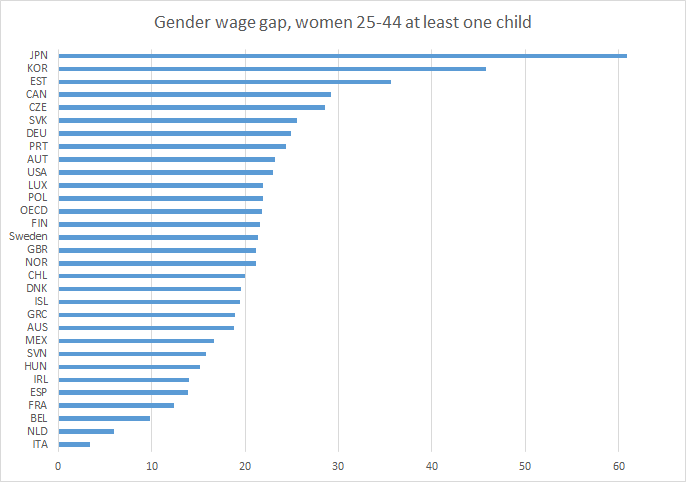
Source: Closing the gender gap: Act now – http://dx.doi.org/10.1787/9789264179370-en
How big is the wage gap in your country? bit.ly/18o8icV #IWD2015 http://t.co/XTdntCRfDQ—
(@OECD) March 08, 2015
One important question is whether government policies are effective in reducing the gap. One such policy is family leave legislation designed to subsidize parents to stay home with new-born or newly adopted children.
One of the RLE articles shows that for high earners in Sweden there is a large difference between the wages earned by men and women (the so-called “glass ceiling”), which is present even before the first child is born. It increases after having children, even more so if parental leave taking is spread out.
These findings suggest that the availability of very long parental leave in Sweden may be responsible for the glass ceiling because of lower levels of human capital investment among women and employers’ responses by placing relatively few women in fast-track career positions. Thus, while this policy makes holding a job easier and more family-friendly, it may not be as effective as some might think in eradicating the gender gap.
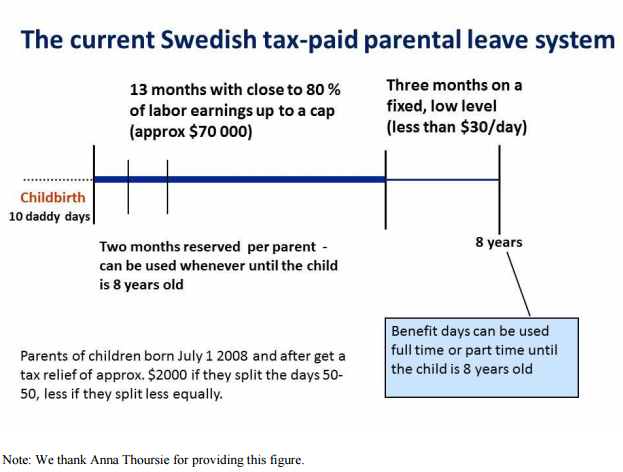
via New volume on gender convergence in the labour market | IZA Newsroom.
Child poverty and single parenthood
13 May 2015 Leave a comment
in economics of love and marriage, gender, labour economics, labour supply, occupational choice, poverty and inequality, welfare reform Tags: child poverty, economics of marriage, family poverty, marriage and divorce, single mothers, single parents, welfare reform
Over half of all births to young adults in the U.S. now occur outside of marriage. bit.ly/1qONO10 http://t.co/KXl4sFd122—
Isabel Sawhill (@isawhill) September 17, 2014
Despite forgoing #marriage, young Americans are not forgoing parenthood. bit.ly/1sMG2bJ http://t.co/1aSELaJlfg—
Isabel Sawhill (@isawhill) October 31, 2014
Despite forgoing #marriage, young Americans are not forgoing #parenthood. bit.ly/1xLa1AJ http://t.co/fetnPAiCPG—
Isabel Sawhill (@isawhill) October 13, 2014
Almost 60% of births to women with only a high school degree occur out of wedlock. bit.ly/1sMG2bJ http://t.co/zomTFjZwA2—
Isabel Sawhill (@isawhill) October 14, 2014
Study: Men are lazy to their core
08 May 2015 Leave a comment
in economics of love and marriage, gender, labour supply Tags: child rearing, childcare, gender gap, household production, marital division of labour

Adding it all up — both paid work and unpaid housework, including childcare — the average man’s work week was three hours longer than his partner’s before birth, but after parenthood he worked 8.5 hours less than his partner.
This is particularly interesting, given that this is a socio-economic cohort — wealthy and educated — that generally says equality of household labour is important in a relationship.
via Study: Men are lazy to their core – The Washington Post.
The rise and rise of mothers as breadwinners
05 May 2015 Leave a comment
in economics of love and marriage, gender, labour economics, labour supply, occupational choice Tags: female labour supply, gender wage gap, household division of labour, maternal labour supply
What is assortative mating?
02 May 2015 Leave a comment
in discrimination, economics of education, economics of love and marriage, gender, human capital, labour economics, labour supply, law and economics, occupational choice Tags: assortative mating
#Dailychart: Sex and money: How women's equality increases wealth inequality. econ.st/1kCYG1R http://t.co/dfrYJs4vBs—
The Economist (@ECONdailycharts) February 13, 2014
Social change is rapid – opinion on same-sex marriage version
01 May 2015 2 Comments
in economics of love and marriage, law and economics, politics - USA Tags: same-sex divorce, same-sex marriage
#Dailychart: Same-sex marriage is legal in 36 states. Here's how opinion has changed econ.st/1dpjNnI http://t.co/8fdhl8KJC2—
The Economist (@ECONdailycharts) April 28, 2015
The marriage squeeze in India and China
27 Apr 2015 Leave a comment
The marriage squeeze in India and China is taking a third of humanity into uncharted territory econ.st/1IN2wyw http://t.co/GbjVDDqJ5h—
The Economist (@EconBizFin) April 26, 2015
The changing American family
24 Apr 2015 3 Comments
in economics of love and marriage, gender, labour economics, labour supply, poverty and inequality, welfare reform Tags: family demographics, single parents


via Was Moynihan Right? What happens to the children of unmarried mothers : Education Next

Peak relationship breakup times mapped
21 Apr 2015 Leave a comment
in economics of love and marriage Tags: dating market, family demographics, marriage and divorce, search and matching
Fathers’ time use, 1965 and now
19 Apr 2015 Leave a comment
in economics of love and marriage, labour economics, labour supply, occupational choice Tags: child rearing, family demographics, household division of labour, household production, marriage and divorce

 Utopia, you are standing in it!
Recent Comments